


Search results
Search for "surface roughness" in Full Text gives 274 result(s) in Beilstein Journal of Nanotechnology. Showing first 200.
A differential Hall effect measurement method with sub-nanometre resolution for active dopant concentration profiling in ultrathin doped Si1−xGex and Si layers
Beilstein J. Nanotechnol. 2018, 9, 1926–1939, doi:10.3762/bjnano.9.184
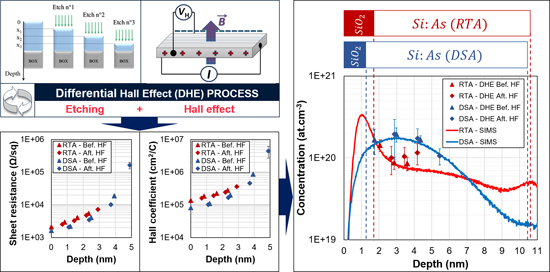
- good agreement with previous results obtained by our research group [26]. Concerning the surface roughness, tapping mode AFM analysis provided arithmetic averages Ra of about 1.2 Å (Figure S2, Supporting Information File 1). However, in view of its application for DHE experiments, it is necessary to
- surface roughness, we used ethanol instead of ultrapure water as rinsing solvent [28]. We performed multiple cycles of etching processes on in situ boron-doped Si layers (grown on top of Si substrates) with continuous monitoring of the removed thickness (by ellipsometry measurements) and the surface
- /cm2, the observed structure is identical to that found in the as-implanted sample with the SiGe layer being almost fully crystalline (and having a surface roughness of about 1 nm). This suggests that the laser energy density used in these cases is always lower than the threshold value necessary to


Uniform cobalt nanoparticles embedded in hexagonal mesoporous nanoplates as a magnetically separable, recyclable adsorbent
Beilstein J. Nanotechnol. 2018, 9, 1770–1781, doi:10.3762/bjnano.9.168
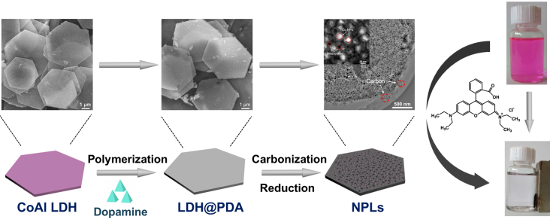
- increasing concentration of DA (Figure S2A–D, Supporting Information File 1). After the heat treatment at 800 °C, Co nanoparticles embedded in the rough and porous carbon layer are observed (Figure S2E–H, Supporting Information File 1). The surface roughness is observed to reduce with decreasing


Light extraction efficiency enhancement of flip-chip blue light-emitting diodes by anodic aluminum oxide
Beilstein J. Nanotechnol. 2018, 9, 1602–1612, doi:10.3762/bjnano.9.152
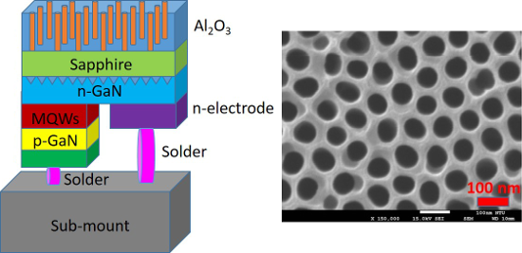
- are shown in Figure 2. The results show the surface roughness and surface height distribution of the three samples. Figure 2a, Figure 2d, and Figure 2g show the three-dimensional AFM images of AAO60, AAO70, and AAO80, respectively. Figure 2d shows the overall structure and structural integrity of the
- reflected by the surface roughness of LEDs. RCWA analysis indicated that surface plasmon waves are not involved in LEE enhancement. Experimental To produce a typical LED chip with a single-sided PSS, InGaN/GaN MQW LEDs were grown on c-plane (0001)-oriented PSSs using a metal–organic chemical vapor


Optical near-field mapping of plasmonic nanostructures prepared by nanosphere lithography
Beilstein J. Nanotechnol. 2018, 9, 1536–1543, doi:10.3762/bjnano.9.144
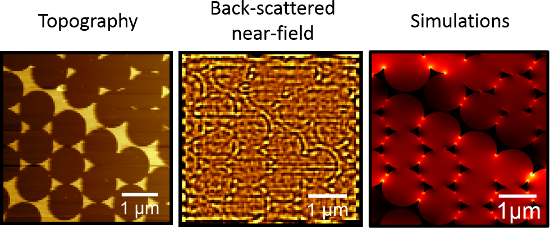
- laser onto a gold tip. A schematic of the experimental setup can be found elsewhere [37]. The elastically backscattered signal detected by a PMT was studied here. To obtain a tip with a radius down to 10 nm and low surface roughness, the gold tips were fabricated by electrochemical etching. A 100 µm




Scanning speed phenomenon in contact-resonance atomic force microscopy
Beilstein J. Nanotechnol. 2018, 9, 945–952, doi:10.3762/bjnano.9.87
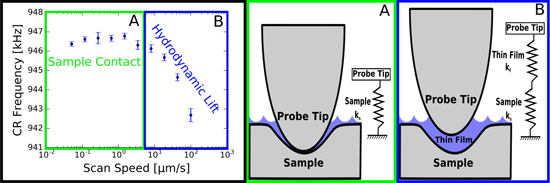
- large normal stiffness to the AFM tip. Here we have neglected surface roughness, which will provide an upper bound to the fluid stiffness that is experimentally achievable. To estimate the vertical lift force and subsequent film stiffness generated by the surface water layer, we utilize a simple slider


Bioinspired self-healing materials: lessons from nature
Beilstein J. Nanotechnol. 2018, 9, 907–935, doi:10.3762/bjnano.9.85
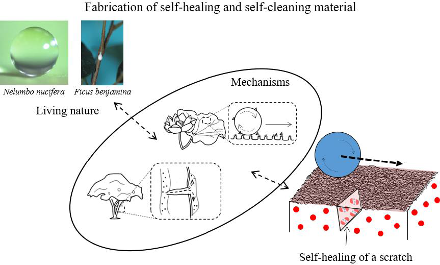
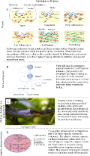
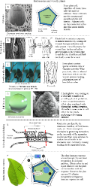
- superhydrophobic functionality of the surface. In doing so, the rolling drops pick up or absorb particulates and dirt, cleaning the leaf. The superhydrophobic behavior is caused by a combination of hierarchical surface roughness at the nanometer and microscale combined with an epicuticular wax coating [32]. The








Effect of annealing treatments on CeO2 grown on TiN and Si substrates by atomic layer deposition
Beilstein J. Nanotechnol. 2018, 9, 890–899, doi:10.3762/bjnano.9.83
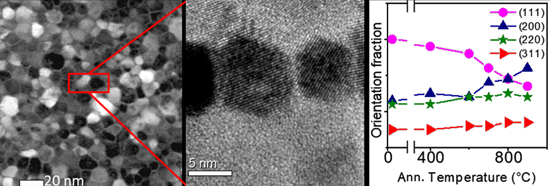
- atmosphere by using a graphite dome. Thickness, interface and surface roughness, and electronic density have been determined by data fitting using the MAUD software program [24]. MAUD has also been used for Rietveld refinement of GIXRD patterns, allowing to determine CeO2 cell parameter and crystallite size
- the Ce(thd)4 molecules do not effectively diffuse onto the substrate surface and the surface coverage on the TiN or Si substrates remains strictly connected to the surface roughness, which is higher on the TiN surface (compared to Si). We should keep in mind that the sticking coefficient of Ce(thd)4


Towards the third dimension in direct electron beam writing of silver
Beilstein J. Nanotechnol. 2018, 9, 842–849, doi:10.3762/bjnano.9.78
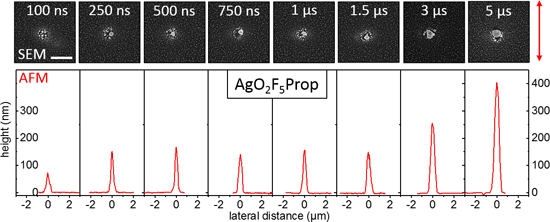
- precursor flux is slightly lower. The square deposits show the earlier observed surface roughness for both of the precursors. The corresponding EDX quantification points to an even higher silver content in case of the AgO2F5Prop precursor, while the small amount of oxygen is comparable. The determined


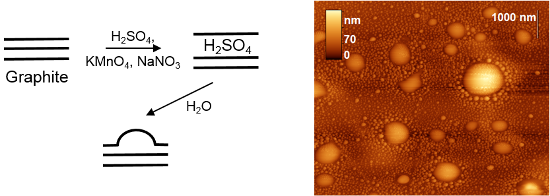
Blister formation during graphite surface oxidation by Hummers’ method
Beilstein J. Nanotechnol. 2018, 9, 407–414, doi:10.3762/bjnano.9.40
- and hydrogen peroxide solution, the surface became gray and matte, which indicated a significant change in the surface roughness. Raman spectroscopy of the HAPG surface before and after the treatment Raman spectra, recorded from the ordered regions on the HAPG surface before and after the treatment


The nanofluidic confinement apparatus: studying confinement-dependent nanoparticle behavior and diffusion
Beilstein J. Nanotechnol. 2018, 9, 301–310, doi:10.3762/bjnano.9.30
- of the confining surfaces can be determined. By tilting the sample, the phase difference was minimized using the cross-correlation of the corner to the center signals. The optical path difference between glass and substrate varies because of the inherent surface roughness of the contributing
- measured surface roughness values. During the measurements described in the subsequent sections, thermal drift and pressure changes may lead to a deflection of the relatively compliant cover glass. These deflections are compensated by implementing a closed-loop system, that registers changes in the
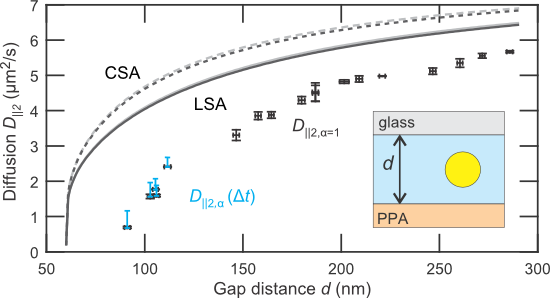
- = 0.61d (black) and in the middle of the slit h = 0.5d (gray). The asymmetric height leads to merely 1.5% lower diffusion coefficients and cannot explain the 20–50% lower diffusivity measured. We also exclude that the localization due to surface roughness is the predominant factor for this reduction



Review: Electrostatically actuated nanobeam-based nanoelectromechanical switches – materials solutions and operational conditions
Beilstein J. Nanotechnol. 2018, 9, 271–300, doi:10.3762/bjnano.9.29
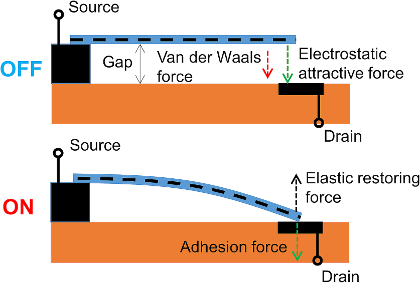
- difficult to fabricate due to their high intrinsic stress, large surface roughness and grain size, inherent porosity, and low strength. To date, there are rather few reports on metallic NEM switches [17][18][114][115]. Molybdenum is attractive as a NEM switch material due to its high melting temperature


Liquid-crystalline nanoarchitectures for tissue engineering
Beilstein J. Nanotechnol. 2018, 9, 205–215, doi:10.3762/bjnano.9.22
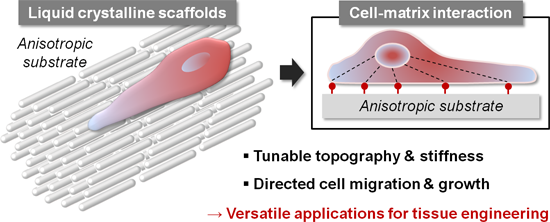
- modulus, porosity, surface roughness, and local anisotropy [102]. LC hydrogels and implants in nematic and smectic-A phases LC-ordered anisotropic gels have great potential to be directly applied to regenerative medicine therapeutics, due to their intrinsic tissue compatibility. Thermally or


Dopant-stimulated growth of GaN nanotube-like nanostructures on Si(111) by molecular beam epitaxy
Beilstein J. Nanotechnol. 2018, 9, 146–154, doi:10.3762/bjnano.9.17
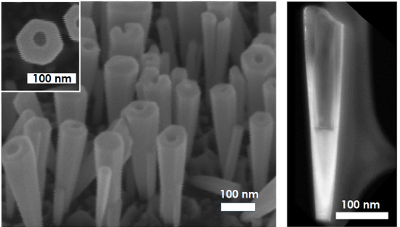
- the field of photovoltaics. In case of silicon-based solar cells (SCs), reflection can be reduced from 30% (pure Si) down to 3% without deposition of multilayer antireflection coatings or involvement of complicated postgrowth techniques generally used for modification of the SC surface roughness [9


Growth model and structure evolution of Ag layers deposited on Ge films
Beilstein J. Nanotechnol. 2018, 9, 66–76, doi:10.3762/bjnano.9.9
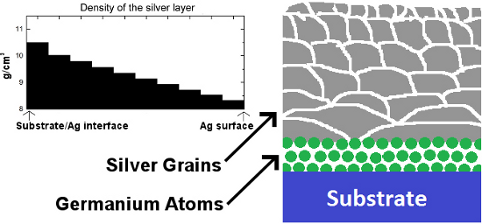
- [13][14]. The SPP wave propagation length depends on the permittivity of the metal film, but also on its surface roughness, which is responsible for scattering losses. Thin silver layers deposited on glass substrates usually exhibit an island growth [15]. One way of fabricating smooth and thermally
- (AFM) scans show that the grain size indeed decreases when the Ag layer is deposited on a Ge wetting film (Figure 2b) with respect to the non wetted film (Figure 2a), which is in consistency with the previous findings [4][19][20][22][24]. Table 1 shows the AFM- and XRR-derived surface roughness root
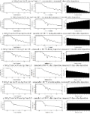
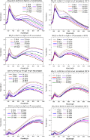
- measurements performed 3 days after deposition, which indicates that with time, the surface roughness of the silver films has increased. This is likely because of the slight movement of the silver grains due to the migration of the Ge atoms to the subsurface grain boundaries. The XRR data for the samples






Exploring wear at the nanoscale with circular mode atomic force microscopy
Beilstein J. Nanotechnol. 2017, 8, 2662–2668, doi:10.3762/bjnano.8.266
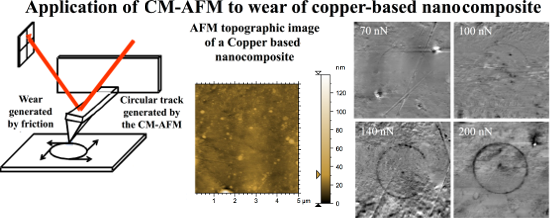
- less than 100 nm) [26]. The surface roughness, Ra, of the samples, determined from AFM topographic images of 5 × 5 µm, is 2.9 ± 0.6 nm. Wear experiments were performed with the CM-AFM mode implemented on a DI-3100 Nanoscope V controller Bruker AFM, in air, at ambient temperature and at a relative


Interface conditions of roughness-induced superoleophilic and superoleophobic surfaces immersed in hexadecane and ethylene glycol
Beilstein J. Nanotechnol. 2017, 8, 2504–2514, doi:10.3762/bjnano.8.250
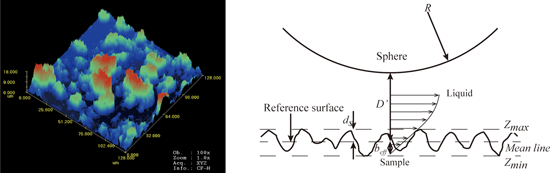
- affect the effective value of slip length in measurements. Moreover, there are no studies on the effect of roughness on slip at interfaces between oil and superoleophilic/superoleophobic surfaces. A theoretical description of the real surface roughness is yet to be found. Results show that the effective
- slip length is negative and decreases with an increasing root mean squared (RMS) roughness of surfaces, as the increasing roughness enhances the area with discontinuous slip at the solid–liquid interface. The underlying mechanisms are analyzed. The amplitude parameters of surface roughness could
- degrees of roughness, and demonstrated that surface roughness at different length scales seems to influence the additional slippage. Kunert and Harting [20] investigated the problem of roughness-induced slip by means of lattice Boltzmann (LB) simulations and measured the slip length on a randomly generated





Comparing postdeposition reactions of electrons and radicals with Pt nanostructures created by focused electron beam induced deposition
Beilstein J. Nanotechnol. 2017, 8, 2410–2424, doi:10.3762/bjnano.8.240
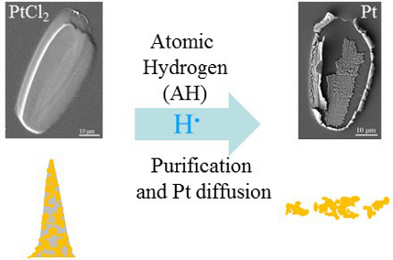
- -line leveling, surface roughness, profile extraction and 3D rendering was carried out with Pico Image Basic 5.0.2 software. Deposition, characterization and treatment of FEBID structures in the FIB Nova 200 system In these experiments, FEBID was performed on a FIB Nova 200 dual beam microscope (FEI
- %) with no deposit damage or void formation. In a Cu example, Miyazoe et al. [27] investigated H2–Ar microplasma effects on FEBID deposits created from Cu(hfac)2. Postgrowth purification resulted in an increase in Cu content from ≈12% to 27%, coupled with a volume decrease and an increase in surface
- roughness. Wnuk et al. [28] subjected deposits created from Me2Au(acac) to AH and/or atomic oxygen (AO). AH removed all of the O atoms and the majority of C atoms from the deposit while AO removed all of the C atoms far more efficiently than AH, but with some accompanying Au oxidation. However, exposure to




Increasing the stability of DNA nanostructure templates by atomic layer deposition of Al2O3 and its application in imprinting lithography
Beilstein J. Nanotechnol. 2017, 8, 2363–2375, doi:10.3762/bjnano.8.236
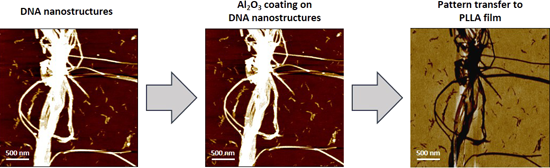
- film (Figure 5). We note that the polymer residue was not observed on the surface of the DNA nanotube master template with the ca. 5 nm thick Al2O3 film even after the 5th replication. The surface roughness of Al2O3 film grown using ALD slowly increases as the number of cycles goes up [49]. Therefore

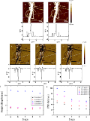


Surfactant-induced enhancement of droplet adhesion in superhydrophobic soybean (Glycine max L.) leaves
Beilstein J. Nanotechnol. 2017, 8, 2345–2356, doi:10.3762/bjnano.8.234
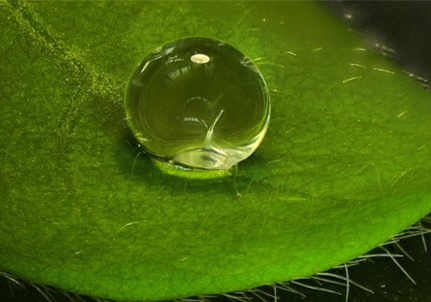
- of wax platelets composed of n-hexatriacontane [43]. Smaller sizes of wax crystals reduce the surface roughness and the contact angle and also increase the adherence of the droplets to the surfaces, as indicated by the hysteresis or given tilt angles [42][43]. Surfactants with a high HLB value (XP ED


Tailoring the nanoscale morphology of HKUST-1 thin films via codeposition and seeded growth
Beilstein J. Nanotechnol. 2017, 8, 2307–2314, doi:10.3762/bjnano.8.230
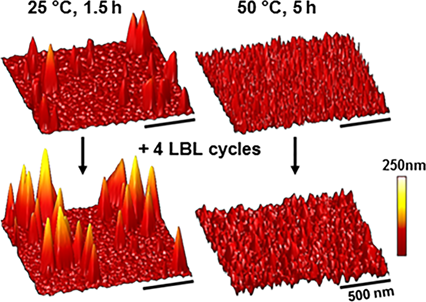
- characterize samples, investigating surface morphology, surface roughness, and film thickness. Results and Discussion For this study of codeposition and seeded surMOF film growth, the MOF was anchored to the substrate by a SAM of 16-mercaptohexadecanoic acid (MHDA), which was formed on a thermally deposited
- Nanoscope Analysis software (Bruker, Santa Barbara, CA, USA). This program was used to appropriately flatten and scale the image. The geometric average surface roughness, Rq, was calculated for each image. The reported roughness values and standard deviations herein (Table 1) reflect the average Rq from a


The interplay between spin densities and magnetic superexchange interactions: case studies of mono- and trinuclear bis(oxamato)-type complexes
Beilstein J. Nanotechnol. 2017, 8, 2245–2256, doi:10.3762/bjnano.8.224
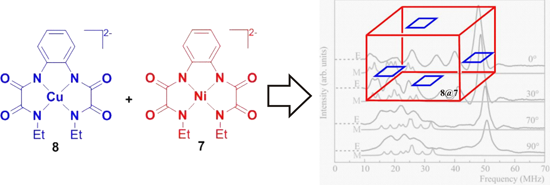
- of spintronic devices in detail, we focused on the synthesis of type-III complexes as models of SMMs with the aim to deposit them as thin films on surfaces. Already in 2006, we reported on the deposition of thin films of a type-III complex by spin coating [27], although the surface roughness of the


![[Graphic 15]](/bjnano/content/inline/2190-4286-8-224-i20.svg?max-width=637&scale=1.18182) molecular plan...
molecular plan...


Angstrom-scale flatness using selective nanoscale etching
Beilstein J. Nanotechnol. 2017, 8, 2181–2185, doi:10.3762/bjnano.8.217
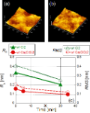
- obtained 0 min, 5 min, and 35 min after wet etching. In the AFM images, the surface roughness (Ra) was found to be 0.161, 0.134, and 0.100 nm, respectively (solid circles in Figure 3d). In addition, we checked the Ra where light was not irradiated with the Ca(ClO)2 solution and found that its value was
- unchanged (0.139 nm for before and 0.138 nm for after etching; solid squares in Figure 3d). These results indicate that near-field wet etching decreased the surface roughness. We also plotted the root mean square (RMS) roughness values in Figure 3d. Although the value is not the same, they have a similar
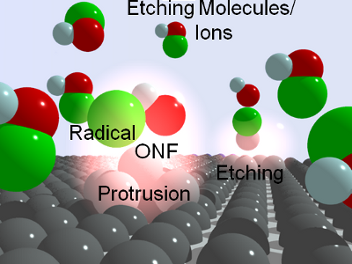
- , further control of the selective etching at smaller scales should be achievable by controlling mean free path (i.e. the partial pressure of the gas). Schematic of the near-field etching process. Experimental setup for the near-field wet etching technique. Time dependence of surface roughness using a



A comparative study of the nanoscale and macroscale tribological attributes of alumina and stainless steel surfaces immersed in aqueous suspensions of positively or negatively charged nanodiamonds
Beilstein J. Nanotechnol. 2017, 8, 2045–2059, doi:10.3762/bjnano.8.205
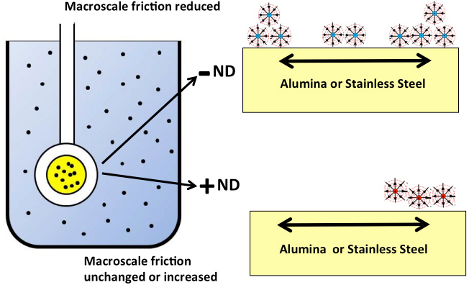
- consistent with strong attachment of NDs and/or chemical changes to the surfaces. AFM images of the surfaces indicated slight increases in the surface roughness upon an exposure to both +ND and −ND suspensions. A suggested mechanism for these observations is that carboxylated −NDs from aqueous suspensions
- saturates towards a value of σs and no longer exhibits fractal scaling. The surface roughness parameters (D, ξ and σs) reported herein were obtained from the log(σ) vs log(scan size) plot method as described by Krim and co-workers [32]. Previously, a detailed comparison of the results obtained by this
- experimental shifts are attributable to the surface roughness of the electrodes. Changes in f and R for the samples exposed to ND suspensions were found to be dependent on the ND surface charge. Both the alumina and SS304 samples exhibit a slow, yet a small increase in f upon an exposure to +ND suspension


Growth and characterization of textured well-faceted ZnO on planar Si(100), planar Si(111), and textured Si(100) substrates for solar cell applications
Beilstein J. Nanotechnol. 2017, 8, 1939–1945, doi:10.3762/bjnano.8.194
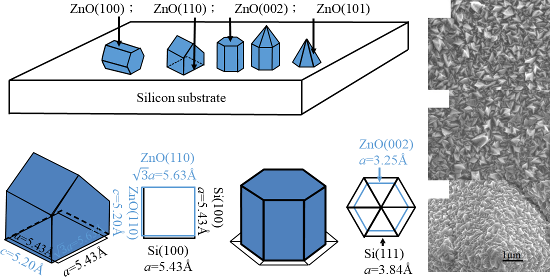
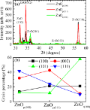
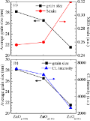
- -sized texture of the Si substrate has a limited contribution. Discussion The main grain orientation, surface morphology, AFM surface roughness (Rq) from AFM, average grain size (D), strain (ε), and CL intensity of samples ZnOp(100), ZnOp(111), and ZnOt(100) are shown in Table 1. The results clearly
- wafer surface. The surface roughness of these pyramidal structures was measured as 0.226 µm using AFM. Therefore, the average size of the pyramidal structures was taken to be approximately this value. The pyramidal structures will expose their (111) facets to the wafer surface. However, their physical
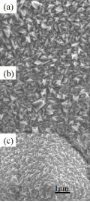
- : 48.488 nm), (b) ZnOp(111) (Rq: 48.284 nm), and (c) ZnOt(100). Surface roughness of each sample, Rq, is given in parentheses when available. (a) The lattice mismatch between a ZnO(110) unit cell of 5.63 Å (× lattice constant a) by 5.20 Å (lattice constant c) and a Si(100) cubic unit cell of 5.43 Å by 5.43



![[Graphic 2]](/bjnano/content/inline/2190-4286-8-194-i4.png?max-width=637&scale=1.18182) × lattice constant a) by 5.20 Å (l...
× lattice constant a) by 5.20 Å (l...


Stick–slip boundary friction mode as a second-order phase transition with an inhomogeneous distribution of elastic stress in the contact area
Beilstein J. Nanotechnol. 2017, 8, 1889–1896, doi:10.3762/bjnano.8.189
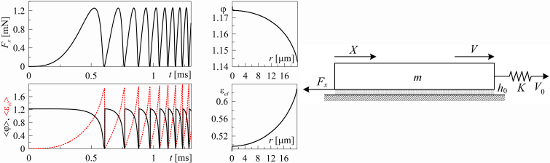
- mode occurs in tribological systems when the thickness of the lubricant layer separating two contacting surfaces is significantly smaller than the typical size of the surface roughness. At such a system configuration, the lateral motion of the friction surface is followed by a contact interaction


![[Graphic 15]](/bjnano/content/inline/2190-4286-8-189-i33.png?max-width=637&scale=1.18182) = 1.0, ...
= 1.0, ...





