Search results
Search for "surface topography" in Full Text gives 138 result(s) in Beilstein Journal of Nanotechnology.
Electron-beam patterned self-assembled monolayers as templates for Cu electrodeposition and lift-off
Beilstein J. Nanotechnol. 2012, 3, 101–113, doi:10.3762/bjnano.3.11
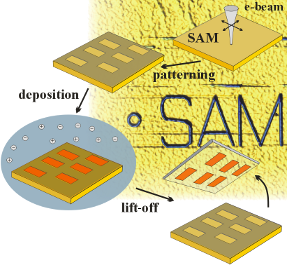
- -off (Figure 7b). We ascribe this to nonvertical growth of the trench walls due to transport-limited deposition, similar to subconformal Cu deposition in microelectronics [55][56]. Besides the definition of the lateral dimensions, another point of interest is the surface topography. Reminding ourselves





Fabrication of multi-parametric platforms based on nanocone arrays for determination of cellular response
Beilstein J. Nanotechnol. 2011, 2, 545–551, doi:10.3762/bjnano.2.58
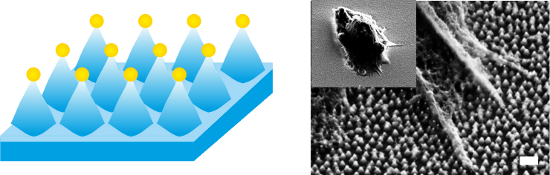
- Lindarti Purwaningsih Tobias Schoen Tobias Wolfram Claudia Pacholski Joachim P. Spatz Department of New Materials and Biosystems, Max Planck Institute for Intelligent Systems, Heisenbergstraße 3, 70569 Stuttgart, Germany 10.3762/bjnano.2.58 Abstract Cellular response to both surface topography
- finding for research dealing with the reactions of neuron-like tissue in the immediate moments after direct contact with an implanted surface. Keywords: block copolymer nanolithography; cell adhesion; nanostructures; surface chemistry; surface topography; Introduction Nanostructured materials for
- medical applications are intended to be in contact with human tissue and therefore to influence cell function by their surface topography as well as by their surface chemistry. Countless studies on cellular response to nanoscale topographies [1][2][3][4], chemical gradients [5][6], and combinations of


The effect of surface anisotropy in the slippery zone of Nepenthes alata pitchers on beetle attachment
Beilstein J. Nanotechnol. 2011, 2, 302–310, doi:10.3762/bjnano.2.35
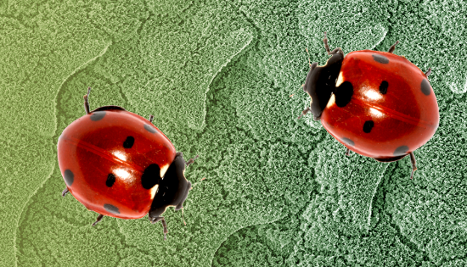
- effects on insect attachment and examine the contribution of surface topography, we prepared replicas of the de-waxed pitchers and tested them together with de-waxed plant samples in the second type of traction experiments. Replicas were obtained by applying the two-component dental wax (Coltène President



The role of the cantilever in Kelvin probe force microscopy measurements
Beilstein J. Nanotechnol. 2011, 2, 252–260, doi:10.3762/bjnano.2.29
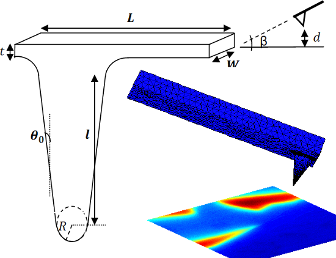
- measure the surface topography, while the oscillations due to the electrostatic force (in amplitude modulated AM-KPFM at the second resonance or in frequency modulated FM-KPFM at several hundred Hz [16]) are nullified by adjusting Vdc(r). The first resonance oscillations have a strong effect on the
- discussed below. The effect of the first resonance In either the single or dual pass KPFM methods the cantilever oscillates at the frequency of its first resonance in order to measure the surface topography in the non-contact mode. In the previous sections the cantilever was considered rigid, meaning that


Moisture harvesting and water transport through specialized micro-structures on the integument of lizards
Beilstein J. Nanotechnol. 2011, 2, 204–214, doi:10.3762/bjnano.2.24
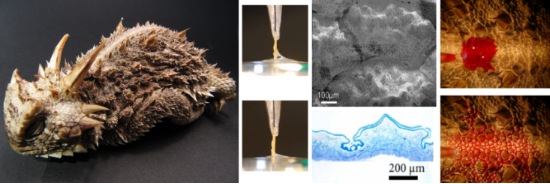
- . We further tried to mimic the properties and effects of the natural integument by manufacturing replicas of the surface topography. We found that in fact this micro ornamentation yields a super-wettable (superhydrophilic) surface, and the semi-tubular capillaries allow for an efficient – and in the


Superhydrophobicity in perfection: the outstanding properties of the lotus leaf
Beilstein J. Nanotechnol. 2011, 2, 152–161, doi:10.3762/bjnano.2.19
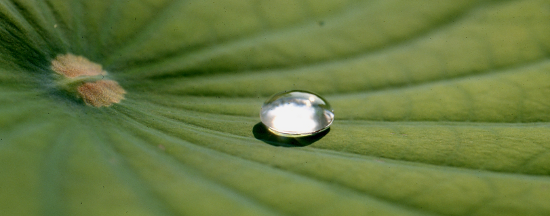
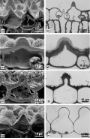
- as the surface topography, robustness and the unique properties of the epicuticular wax. The aim of this article is to integrate the relevant features of the lotus leaf, and to compare them with superhydrophobic leaves of other plant species in order to illustrate their significance. Results and







Capillary origami: superhydrophobic ribbon surfaces and liquid marbles
Beilstein J. Nanotechnol. 2011, 2, 145–151, doi:10.3762/bjnano.2.18
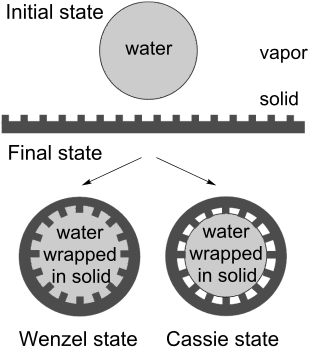
- flexible solid possessing no curvature (or stretching) energy and, hence, a vanishing elastocapillary length. In the study of liquid marbles, the simplest assumption is that each grain is spherical in shape and has no particular surface topography. As a consequence all grains, irrespective of their surface



Manipulation of gold colloidal nanoparticles with atomic force microscopy in dynamic mode: influence of particle–substrate chemistry and morphology, and of operating conditions
Beilstein J. Nanotechnol. 2011, 2, 85–98, doi:10.3762/bjnano.2.10
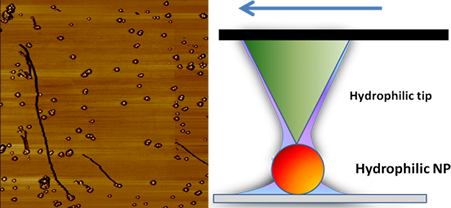
- the effect of functional (hydrophilic vs hydrophobic) molecules grafted on the Au nanoparticles on their mobility. In addition, we will address the important issue of environmental conditions (T, RH%), surface topography and tip scan velocities on the manipulation performance of gold nanoparticles


Single-pass Kelvin force microscopy and dC/dZ measurements in the intermittent contact: applications to polymer materials
Beilstein J. Nanotechnol. 2011, 2, 15–27, doi:10.3762/bjnano.2.2
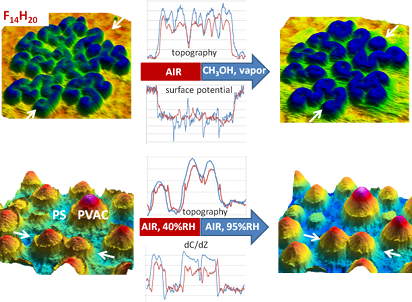
- contact regime. In other words, imaging at the set-point amplitude (Asp) below its transition value will insure a profiling of surface topography, and at higher Asp the imaging will proceed in the non-contact mode when the probe experiences long-range forces such as electrostatic forces. This is





Defects in oxide surfaces studied by atomic force and scanning tunneling microscopy
Beilstein J. Nanotechnol. 2011, 2, 1–14, doi:10.3762/bjnano.2.1
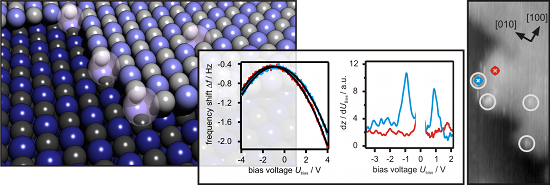
- makes atomic resolution on conductors [7] as well as on insulators [8] possible. In addition to investigations on the surface topography, site specific spectroscopy measurements can be performed [8]. The whole setup is placed in a sound absorber cabin and is carried on a wooden frame, which, in turn, is


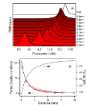
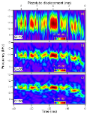
Tip-sample interactions on graphite studied using the wavelet transform
Beilstein J. Nanotechnol. 2010, 1, 172–181, doi:10.3762/bjnano.1.21
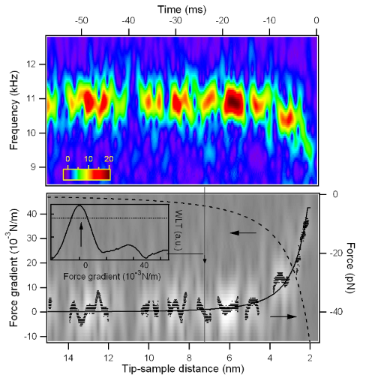
- microscopy (NC-AFM) is a powerful tool to study not only the surface topography, but also the mechanical and chemical characteristics of the sample at the nanoscale [1][2][3]. The tip of an excited cantilever is sensitive to both forces and force gradients, when approaching the sample surface. The response




Precursor concentration and temperature controlled formation of polyvinyl alcohol-capped CdSe-quantum dots
Beilstein J. Nanotechnol. 2010, 1, 119–127, doi:10.3762/bjnano.1.14
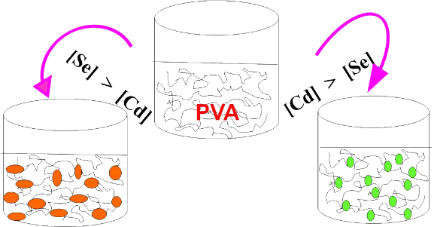
- -section of Cd and Se, indicate the stoichiometry of the cadmium selenide quantum dots formed as 1:1, i.e., Cd1Se1. TEM and AFM studies Transmission electron microscopy and atomic force microscopy are very important techniques for providing information about particle size, shape, surface topography, etc




Sensing surface PEGylation with microcantilevers
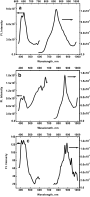
Beilstein J. Nanotechnol. 2010, 1, 3–13, doi:10.3762/bjnano.1.2
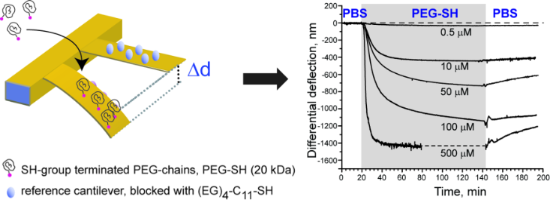
- polymer brush are less likely obtained by the “grafting to” approach [42]. AFM images of the PEGylated Au surface taken under different solvent conditions reinforce the interpretation that a brush-like layer has formed. In PBS buffer (good solvent), we find that the surface topography is strongly
- surface structure (Figure 6). In contrast, the Au surface topography does not change regardless of the scanning force used in 20% 2-propanol (poor solvent). This is due to the collapsed conformation of tethered PEG chains that offers minimal resistance against the AFM tip. The influence of solvent quality