Search results
Search for "titanium dioxide" in Full Text gives 139 result(s) in Beilstein Journal of Nanotechnology.
Growth and characterization of CNT–TiO2 heterostructures
Beilstein J. Nanotechnol. 2014, 5, 946–955, doi:10.3762/bjnano.5.108
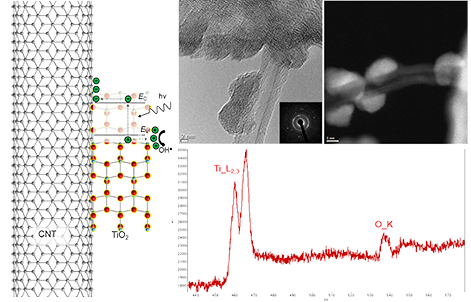
- /metal oxide material systems. Keywords: atomic layer deposition (ALD); carbon nanotubes; electron energy loss spectroscopy (EELS); interface; titanium dioxide (TiO2); transmission electron microscopy (TEM); Introduction Since the discovery by Iijima in 1991, carbon nanotubes (CNTs) have always been on


Nanostructure sensitization of transition metal oxides for visible-light photocatalysis
Beilstein J. Nanotechnol. 2014, 5, 696–710, doi:10.3762/bjnano.5.82
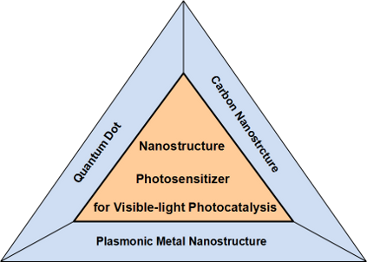
- photosensitization of nanoporous titanium dioxide, zinc oxide, tin dioxide, niobium oxide, and tantalum oxide by quantum-sized cadmium sulfide, lead sulfide, silver sulfide, antimony sulfide, and bismuth sulfide. They found that the photocurrent quantum yields of these photosensitized transition metal oxides can be


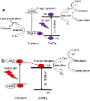


A visible-light-driven composite photocatalyst of TiO2 nanotube arrays and graphene quantum dots
Beilstein J. Nanotechnol. 2014, 5, 689–695, doi:10.3762/bjnano.5.81
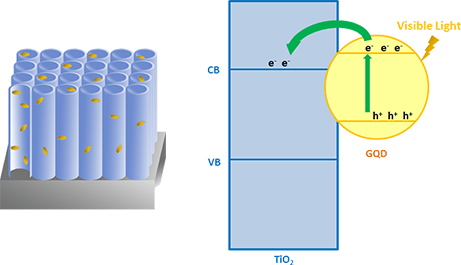
- ][2]. Among various photocatalysts, nanostructured titanium dioxide (TiO2) is the most widely used because of its high activity, long-term stability and low production cost [3][4]. However, pure TiO2 is not efficient for solar-driven applications because it requires UV excitation [5]. Belonging to one


Injection of ligand-free gold and silver nanoparticles into murine embryos does not impact pre-implantation development
Beilstein J. Nanotechnol. 2014, 5, 677–688, doi:10.3762/bjnano.5.80
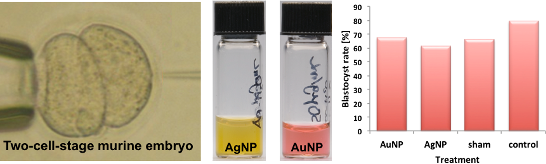
- , nanoparticles were found to be stopped by the placental barrier [4][5][6]. The majority of authors, however, observed placental crossing. This encompasses studies of nanoparticles composed of gold [7][8], titanium dioxide [9][10], CdTe/CdS quantum dots [11], and polystyrene [12]. Thus, transplacental crossing
- ][17][18][19][20], nickel (NiNP) [21], zinc oxide (ZnONP) [22][23], titanium dioxide (TiO2NP) [23][24][25], aluminium trioxide (Al2O3NP) [23] and copper (CuNP) [22][25]. Toxic effects were observed after exposure to AgNP, CuNP, ZnONP and NiNP. AuNP, TiO2NP and Al2O3NP, on the other hand, seemed to be
- all studies regarding embryotoxicity of nanoparticles were performed in mouse pups after exposing their mothers to titanium dioxide. While no information was given concerning the impact on early embryo development, it seems noteworthy that, regardless of the exposure route, in several studies pups of




Applicability and costs of nanofiltration in combination with photocatalysis for the treatment of dye house effluents
Beilstein J. Nanotechnol. 2014, 5, 476–484, doi:10.3762/bjnano.5.55
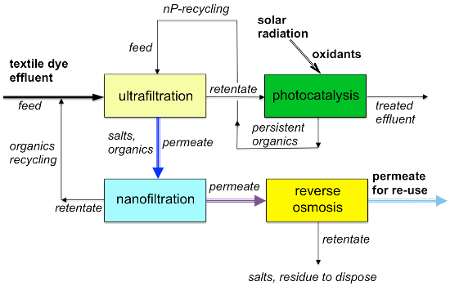
- generated by UV irradiation of photocatalysts in the reaction system. Commonly applied photocatalysts include TiO2, ZnO, Fe2O3, CdS, GaP and ZnS. Among these, titanium dioxide (TiO2) has attracted great interest in research and development because of its mechanical properties, chemical and thermal stability


Modeling and optimization of atomic layer deposition processes on vertically aligned carbon nanotubes
Beilstein J. Nanotechnol. 2014, 5, 234–244, doi:10.3762/bjnano.5.25
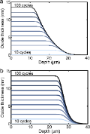
- , is estimated to be 1/VAB22/3, where VAB2 is the volume of a deposited oxide unit, here determined by the dimensions of the titanium dioxide unit cell. By using the parameters defined in Table 1, the concentration of the precursor as a function of the depth within the VACNT array is plotted at various
- typical ALD deposition rates for titanium dioxide. In principle, one can modify the precursor surface adsorption density to achieve more reasonable deposition rates. The two extreme limits for the maximum growth per cycle would be the limits, at which the density is either determined by the oxide volume
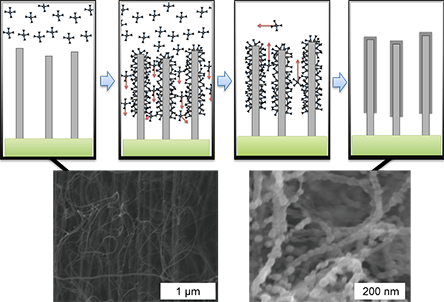
- multiwalled CNTs, 50–90 µm in height. By using scanning electron microscopy (SEM), the distribution of CNT diameters is measured, and the bare CNT radii are found to be 6.3 ± 0.2 nm. Titanium dioxide is deposited on the CNTs by using a custom-built ALD system. The depositions are performed at 225 °C with a



Quantum size effects in TiO2 thin films grown by atomic layer deposition
Beilstein J. Nanotechnol. 2014, 5, 77–82, doi:10.3762/bjnano.5.7
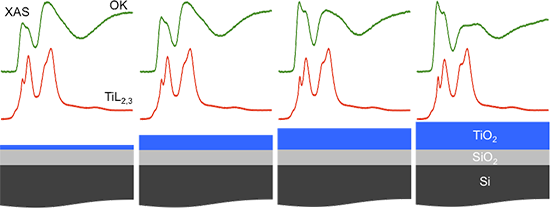
- size effects; titanium dioxide (TiO2); water splitting; X-ray absorption spectroscopy (XAS); Introduction Titanium dioxide (TiO2) is an important material for the photoelectrolysis of water [1] and for many other photocatalytic reactions [2]. Its effective conversion of solar light, although limited


Study of mesoporous CdS-quantum-dot-sensitized TiO2 films by using X-ray photoelectron spectroscopy and AFM
Beilstein J. Nanotechnol. 2014, 5, 68–76, doi:10.3762/bjnano.5.6
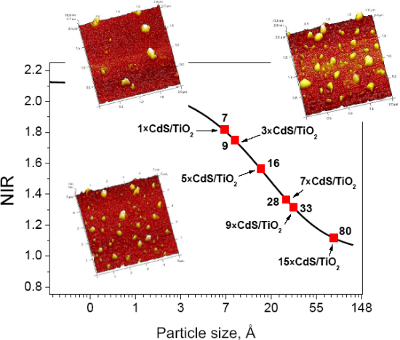
- at the surface of the titanium dioxide films. This result contradicts that obtained by using XPS surface analysis performed on the films, which confirmed the presence of CdS nanoparticles (Table 1, see below). The formation of CdS inside the films pores could explain the discrepancy. Consequently
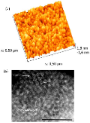
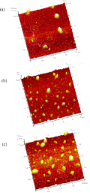
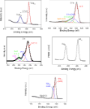
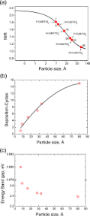
- /TiO2 sample. Absorption spectra of the CdS-sensitized titanium dioxide films after different numbers of deposition cycles. XPS analysis. Spectra of Ti 2p, O 1s, C 1s, Cd 3d and S 2p, and core peaks for 15×CdS/TiO2 sample. (a) CdS particle size calculated by Davis model vs NIR (normalized intensity


Characterization of electroforming-free titanium dioxide memristors
Beilstein J. Nanotechnol. 2013, 4, 467–473, doi:10.3762/bjnano.4.55
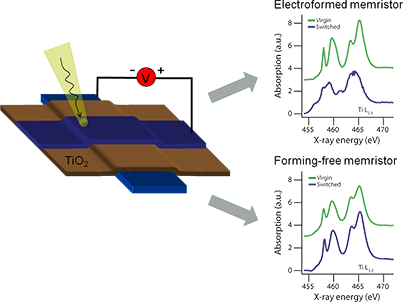
- -970, Brazil Universidade Federal de Minas Gerais, 31270-901, Belo Horizonte, MG, Brazil Advanced Light Source, Lawrence Berkeley National Laboratory, Berkeley, CA 94720, USA 10.3762/bjnano.4.55 Abstract Metal–insulator–metal (MIM) structures based on titanium dioxide have demonstrated reversible and




Kelvin probe force microscopy of nanocrystalline TiO2 photoelectrodes
Beilstein J. Nanotechnol. 2013, 4, 418–428, doi:10.3762/bjnano.4.49
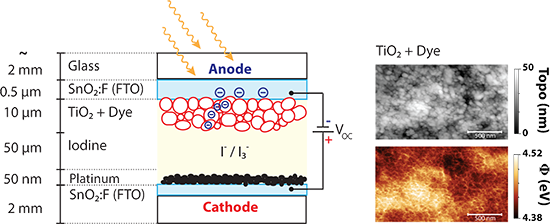
- ); surface photovoltage (SPV); titanium dioxide (TiO2); Introduction Dye-sensitized solar cells (DSCs) provide a promising low-cost, high-efficiency third-generation photovoltaic concept based on the spectral sensitization of a nanoporous wide bandgap semiconductor [1][2]. In the past two decades DSCs have


Photocatalytic antibacterial performance of TiO2 and Ag-doped TiO2 against S. aureus. P. aeruginosa and E. coli
Beilstein J. Nanotechnol. 2013, 4, 345–351, doi:10.3762/bjnano.4.40
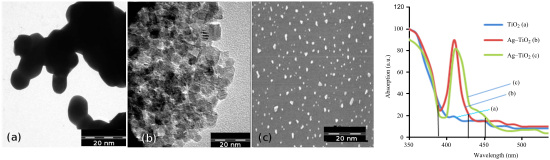
- is decreased. The photocatalytic activity of TiO2 nanoparticles depends not only on the properties of the TiO2 material itself, but also on the modification of TiO2 with metal or metal oxide. Previous studies reported that the addition of noble metal (silver and gold) in titanium dioxide enhances its
- comparison to those of the TiO2 nanoparticles because the metallic silver ions cause some changes in the electronic structure of the Ag-containing titanium dioxide nanoparticles [20]. Moreover, the PL intensity of Ag-doped TiO2 (7%) is lower in comparison to the case of 3% doping of Ag, and this can be
- cultures were grown in Luria broth and maintained on Luria agar plates. Cultures were grown with 2% inoculums at 25 °C until 0.2 optical density (O.D.) at 660 nm was achieved and used for antibacterial activity. Preparation of TiO2 nanoparticles Titanium dioxide nanoparticles were synthesized by an acid


Paper modified with ZnO nanorods – antimicrobial studies
Beilstein J. Nanotechnol. 2012, 3, 684–691, doi:10.3762/bjnano.3.78
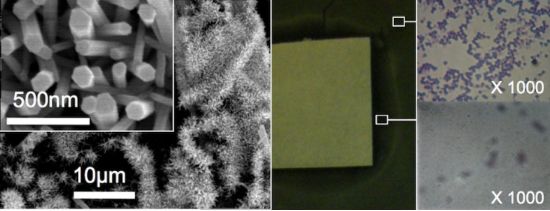
- -oxide semiconductors, such as ZnO, titanium dioxide (TiO2), etc. The photogenerated free carriers allow efficient mineralization of toxic organic compounds [16] and hazardous inorganic materials [17], and microbial disinfection [18] through the creation of a hydroxyl radical (OH·), which acts as a


Self-assembled monolayers and titanium dioxide: From surface patterning to potential applications
Beilstein J. Nanotechnol. 2011, 2, 845–861, doi:10.3762/bjnano.2.94
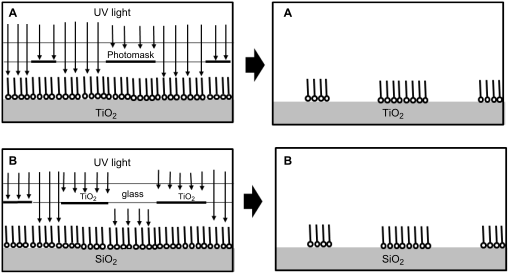
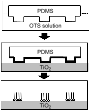
- and the rare photocatalytic properties of titanium dioxide provide a rationale for the study of systems comprising both. Such systems can be realized in the form of SAMs grown on TiO2 or, in a complementary manner, as TiO2 grown on SAMs. Accordingly, the current status of knowledge regarding SAMs on
- titanium dioxide based devices. Accordingly, particular attention is given to the description of a variety of methods and techniques aimed at utilizing the photocatalytic properties of titanium dioxide for patterning. Reports on a variety of applications are discussed. These examples, representing the
- areas of photovoltaics, microelectronics, microelectromechanics, photocatalysis, corrosion prevention and even biomedicine should be regarded as appetizers paving the way for further studies to be performed. Keywords: photocatalysis; remote degradation; self-assembled monolayers; titanium dioxide



Schottky junction/ohmic contact behavior of a nanoporous TiO2 thin film photoanode in contact with redox electrolyte solutions
Beilstein J. Nanotechnol. 2011, 2, 127–134, doi:10.3762/bjnano.2.15
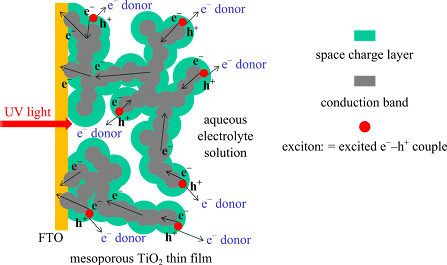
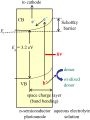
- [Fe(CN)6]4− around the redox potential of the iron complex. It was suggested that the iron complex forms a second Schottky junction for which the flat band potential (Efb) lies near the redox potential of the iron complex. Keywords: cyclic voltammogram of titanium dioxide photoanode; flat band