


Search results
Search for "electronic structure" in Full Text gives 249 result(s) in Beilstein Journal of Nanotechnology. Showing first 200.
Ferromagnetic behaviour of ZnO: the role of grain boundaries
Beilstein J. Nanotechnol. 2016, 7, 1936–1947, doi:10.3762/bjnano.7.185
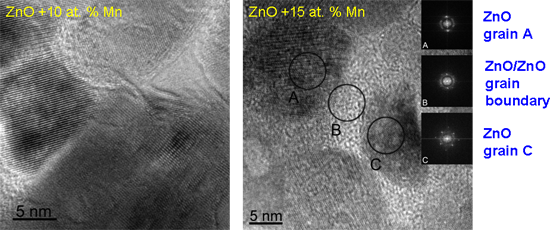
- functional theory calculations. For the cluster with about 200 atoms in an effective electrostatic field formed by the rest of the simulated system the electronic structure was determined. The calculation show that for single-crystalline ZnO the energy difference between highest occupied molecular orbital


Nanostructured TiO2-based gas sensors with enhanced sensitivity to reducing gases
Beilstein J. Nanotechnol. 2016, 7, 1718–1726, doi:10.3762/bjnano.7.164
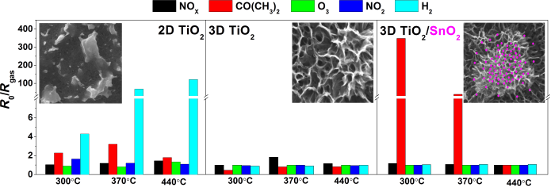
- electronic structure by improving electron migration from titanium dioxide to tin dioxide and promotes oxygen molecule adsorption at the surface [34]. The as-formed heterojunction (n–n type) affects the response due to the formation of the accumulation/depletion layer and increases the potential barrier at


Scanning probe microscopy studies on the adsorption of selected molecular dyes on titania
Beilstein J. Nanotechnol. 2016, 7, 1642–1653, doi:10.3762/bjnano.7.156
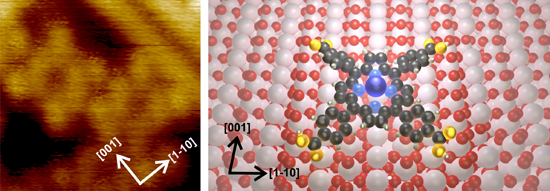
- [27]. More detailed analyses of the electronic structure, molecular orientations, energy level alignment and charge transfer dynamics have been provided by Cao et al. [29][30]. The authors showed that strong coupling between the PTCDA molecules and the TiO2 substrate results in charge transfer time
- [45]. These authors, in addition to investigating the growth mode of the FePc overlayers, also analysed their electronic structure in detail. The molecular films grow in a layer-plus-island mode, and in the observed layers, the molecular plane is parallel to the surface [45]. The molecules in the
- first layer, resulting in the alteration of the electronic structure and charge transfer from the molecules, is a significant disadvantage [45]. The results obtained for metal-free phthalocyanines are in line with those mentioned above. Molecules in the first layer adsorb in a flat-lying geometry and


Filled and empty states of Zn-TPP films deposited on Fe(001)-p(1×1)O
Beilstein J. Nanotechnol. 2016, 7, 1527–1531, doi:10.3762/bjnano.7.146
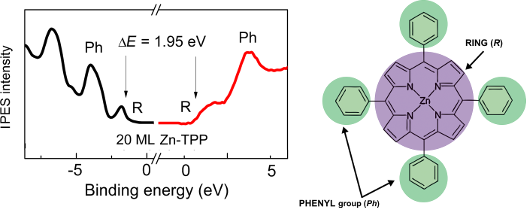
- analysis proves that Zn-TPP molecules are deposited flat on the surface and the molecular skeleton is not significantly distorted, as observed when Zn-TPP is grown on other substrates for comparison. In this paper, we investigate the electronic structure of a Zn-TPP film, studying both normally occupied

Preparation of alginate–chitosan–cyclodextrin micro- and nanoparticles loaded with anti-tuberculosis compounds
Beilstein J. Nanotechnol. 2016, 7, 1208–1218, doi:10.3762/bjnano.7.112
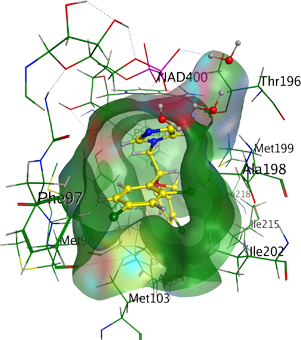
- ) in molecular systems. The electron density distribution in the frontier orbitals of the enzyme–ligand complexes under study provides information about the donor–acceptor character of the interactions inside the complexes. The electronic structure calculations were carried out with Gaussian 09 using




Photocurrent generation in carbon nanotube/cubic-phase HfO2 nanoparticle hybrid nanocomposites
Beilstein J. Nanotechnol. 2016, 7, 1075–1085, doi:10.3762/bjnano.7.101
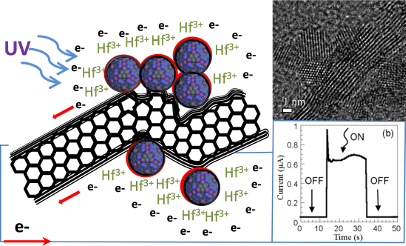
- electronic structure of the C K-edge in the nanocomposites was probed by electron energy loss spectroscopy, highlighting the key role of the MWCNT growth defects in anchoring HfO2 NPs. A combined optical emission and absorption spectroscopy approach illustrated that, in contrast to HfO2 NPs, the metallic
- MWCNTs do not emit light but instead expose their discrete electronic structure in the absorption spectra. The hybrid material manifests characteristic absorption features with a gradual merger of the MWCNT π-plasmon resonance band with the intrinsic defect band and fundamental edge of HfO2. The
- of symmetry. This implies a local change of the electronic structure [36] along with an increase in π mismatch. This in turn accentuates the reactivity of these MWCNTs and converts these defects into receptors for functional groups on the surface of the nanoparticles. Buckling and kinking of the


Modelling of ‘sub-atomic’ contrast resulting from back-bonding on Si(111)-7×7
Beilstein J. Nanotechnol. 2016, 7, 937–945, doi:10.3762/bjnano.7.85
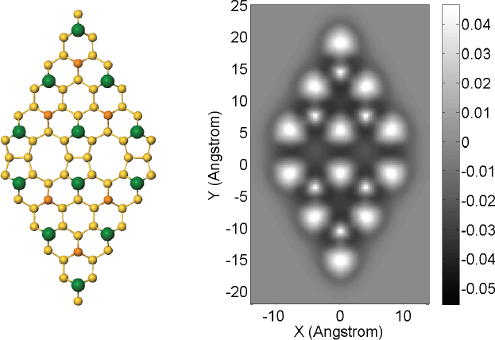
- experimentally arise naturally from the exploration of an asymmetric potential by a flexible tip and do not require consideration of the detailed electronic structure of the surface. By constructing artificial surface slabs utilising different elements of the full Si(111)-7×7 unit cell, we are able to examine

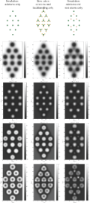


First-principles study of the structure of water layers on flat and stepped Pb electrodes
Beilstein J. Nanotechnol. 2016, 7, 533–543, doi:10.3762/bjnano.7.47
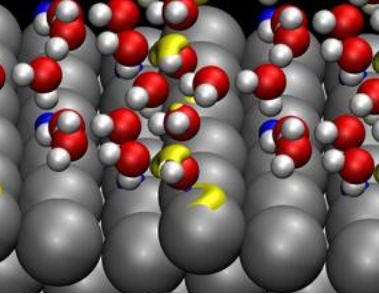
- electrode/electrolyte interfaces based on first-principles electronic structure calculations. As Pb has been used as one of the metallic electrode materials, we have already studied the Pb self-diffusion on flat and stepped Pb surfaces [13] as this controls the growth mechanism of the contacts. The results


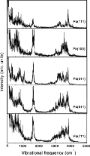
Rigid multipodal platforms for metal surfaces
Beilstein J. Nanotechnol. 2016, 7, 374–405, doi:10.3762/bjnano.7.34






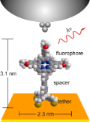








Large area scanning probe microscope in ultra-high vacuum demonstrated for electrostatic force measurements on high-voltage devices
Beilstein J. Nanotechnol. 2015, 6, 2485–2497, doi:10.3762/bjnano.6.258

- and interfaces is given by T. Seyller [52]. The electronic structure of SiC surfaces suffers from a strong electron correlation induced by a Mott–Hubbard metal–insulator transition [53] due to a half-filled and hence metallic band arising from dangling bonds. More refined studies employed a 2D Hubbard
- also affecting the electronic structure at surfaces [56]. Especially carbon clusters are responsible for donor states in the lower part of the bandgap as well as a continuum of donor- and acceptor-type states in the central part of the band gap. Thus, the measurements presented here fit perfectly in
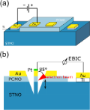
- of NN,eff = 1.3 × 1016 cm−3. SiC JBS device structure Finally, we applied the technique to analyse the electronic structure of a complex SiC power semiconductor device. SiC material properties enable devices compatible with higher voltages and operating temperatures compared to traditional Si-based


High electronic couplings of single mesitylene molecular junctions
Beilstein J. Nanotechnol. 2015, 6, 2431–2437, doi:10.3762/bjnano.6.251
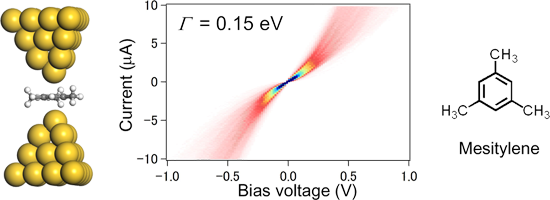
- -binding to the electrodes. However, there are little direct experimental results revealing strong metal–molecule couplings. The electronic structure of molecular junctions including metal–molecule couplings can be characterized by current-voltage (I–V) characteristics of molecular junctions. Transition
- from Equation 1 and Equation 2: Here, Γ = ΓL + ΓR, and α = ΓL/Γ. The parameters of electronic structure, Γ and ε0, of each states of the mesitylene junction are determined by fitting of the statistically averaged I–V curves with Equation 3. The fitting results are Γ_H = 0.15 eV, ε0_H = 0.31 eV for the




Vibration-mediated Kondo transport in molecular junctions: conductance evolution during mechanical stretching
Beilstein J. Nanotechnol. 2015, 6, 2417–2422, doi:10.3762/bjnano.6.249
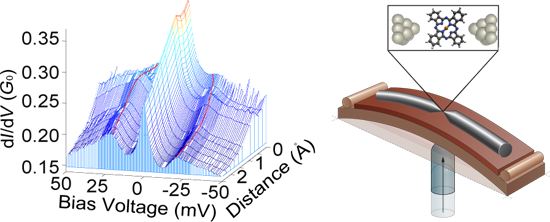
- conductance in a similar way, possibly as a response to variations in the electronic structure of the stretched junction [27][36][37][38]. The examined evolution of the side peaks due to junction elongation reflects a simple linear response of inelastic conductance due to electron–vibration interaction as


Plasma fluorination of vertically aligned carbon nanotubes: functionalization and thermal stability
Beilstein J. Nanotechnol. 2015, 6, 2263–2271, doi:10.3762/bjnano.6.232
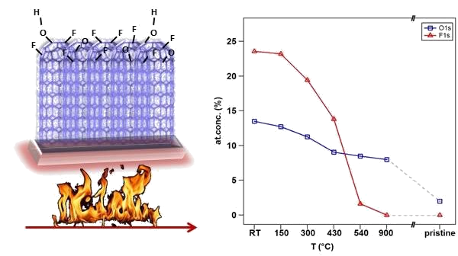
- , generating an inductive effect on the overall electronic structure. While during the heating process, fluorine desorbs from the surface, oxygen atoms, which were participating in the plasma-generated C–O, stay bound. The oxygen-related states are no longer affected by the presence of fluorine and they are


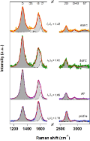
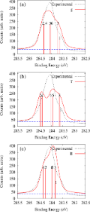
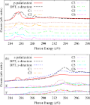
Core-level spectra and molecular deformation in adsorption: V-shaped pentacene on Al(001)
Beilstein J. Nanotechnol. 2015, 6, 2242–2251, doi:10.3762/bjnano.6.230
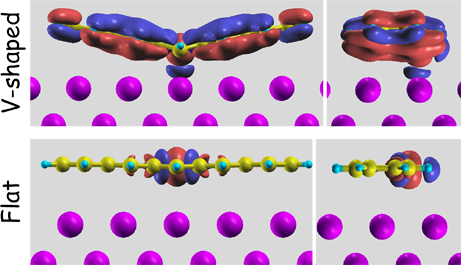
- contributions by the core excitations from C1 whereas the y-direction one mainly by those from the carbon atoms C2, C4 and C6. Conclusion The pentacene/Al(001) system was studied by means of DFT methods in order to understand how the electronic structure of the V-shaped adsorbed molecule affects the XPS and the




Nonconservative current-driven dynamics: beyond the nanoscale
Beilstein J. Nanotechnol. 2015, 6, 2140–2147, doi:10.3762/bjnano.6.219
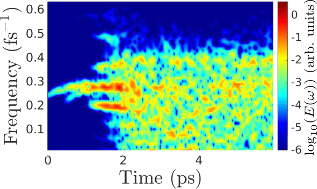
- = 0.36361. Noninteracting electrons are considered throughout. As in [13], we compress the chain to a lattice spacing of R = 2.373 Å to suppress a Peierls distortion and resultant band gap that form after geometry relaxation. Landauer steady state In the adiabatic steady-state method for the electronic
- structure, we employ the Landauer picture of conduction. Here the electrodes are infinite, and electrons populate sets of stationary Lippmann–Schwinger scattering states, arriving from either side. The respective population functions, fL(E) and fR(E), correspond to the electrochemical potentials of the left




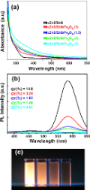
A facile method for the preparation of bifunctional Mn:ZnS/ZnS/Fe3O4 magnetic and fluorescent nanocrystals
Beilstein J. Nanotechnol. 2015, 6, 1743–1751, doi:10.3762/bjnano.6.178
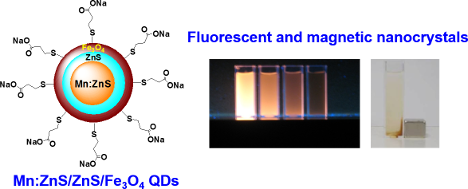
- their large surface-to-volume ratio and from confinement phenomena resulting in an atomic-like electronic structure with discrete energy levels. Thus, QDs have been widely studied for their fundamental properties and applications, mostly employed as emitters for biolabelling [3][5], light emitting




Atomic scale interface design and characterisation
Beilstein J. Nanotechnol. 2015, 6, 1708–1711, doi:10.3762/bjnano.6.174

- atomic force microscopy (AFM) images, the microscopy knowledge about the local electronic structure of the system is extremely important. Full understanding of the electronic structure and properties of a large number of solids can be credited to first principles simulations, and more specifically
- surface adsorbates [28], and nanosystems structured from misfit layer compounds [29]. Planar and bended misfit structures, such as tubes, scrolls or nanoparticles, with intriguing electronic and magnetic characteristics have been synthesized, while calculations explained their electronic structure and
Possibilities and limitations of advanced transmission electron microscopy for carbon-based nanomaterials
Beilstein J. Nanotechnol. 2015, 6, 1541–1557, doi:10.3762/bjnano.6.158
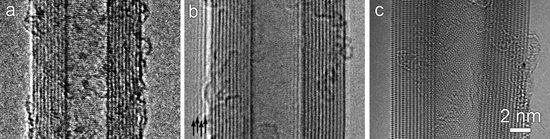
- which attributes the deformation to lattice mismatch [79]. Whichever the driving force is, the geometric distortions in the graphitic lattice have been clearly evidenced by 3D TEM, indicating a significant difference in the electronic structure at the metal–CNT contact. The consequent resistance change
- moving it from the nanometer scale [85] toward the atomic scale. 3.2 Advanced spectroscopy of carbon-based materials In contrast to structural imaging which uses elastically scattered electrons, chemical and electronic structure information can be obtained simultaneously using inelastically scattered



Current–voltage characteristics of manganite–titanite perovskite junctions
Beilstein J. Nanotechnol. 2015, 6, 1467–1484, doi:10.3762/bjnano.6.152
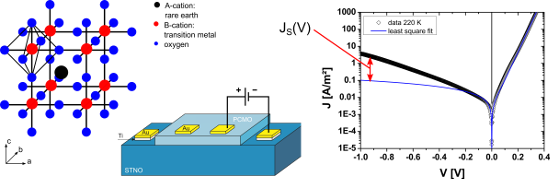
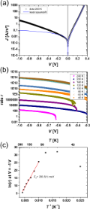
- semiconductor 1 and 2, named Vbi,1 and Vbi,2 A model for the electronic structure of the interface has been developed by Anderson et al., assuming a sharp junction with band discontinuities [30]. For the derivation of the J–V curve, it is assumed that the transport mechanism is governed by injection over the
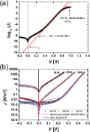
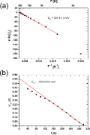
- dependence of these parameters gives additional information about the electronic structure of the p–n interface and the transport mechanism across the interface. In inorganic junctions, the temperature dependence of the open circuit voltage is given by for JS << JSC. For a heterojunction, the low temperature
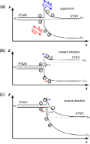
- current. This can be discussed according to Figure 10, where the expected simplified band diagram of the manganite–titanate junction is shown for electro-chemical equilibrium and with applied voltage in both forward and reverse directions. We disregard here all changes of the electronic structure of the





Electron and heat transport in porphyrin-based single-molecule transistors with electro-burnt graphene electrodes
Beilstein J. Nanotechnol. 2015, 6, 1413–1420, doi:10.3762/bjnano.6.146
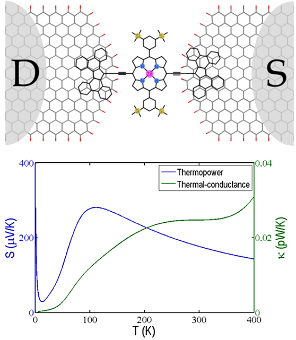
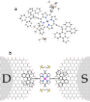
- electronic structure of the prophyrin molecule. Then we study the electro-burnt graphene electrodes and finally the two-terminal device in which the anchor groups of the porphyrin molecule bind to the graphene electrodes by p-orbital overlap. We then discuss the contribution of each part of the molecule to
- interactions. The central porphyrin is also connected to two side groups, which stabilize the molecule within the junction. We first use density functional theory (DFT) to study the electronic structure of the PM. To characterize the gas phase molecule, the isolated PM shown in Figure 1a is relaxed to reach
- , the edges of the EBG are likely terminated by oxygen, especially close to the junction. Therefore, before studying the transport properties of the PM, we focus on the transport properties of the EBG electrodes with oxygen-terminated edges. Figure 3 shows the molecular and electronic structure of the


Can molecular projected density of states (PDOS) be systematically used in electronic conductance analysis?
Beilstein J. Nanotechnol. 2015, 6, 1247–1259, doi:10.3762/bjnano.6.128
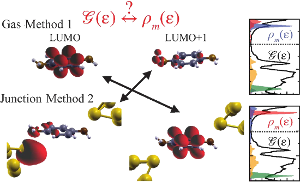
- quantum transport is needed in order to fully understand the behavior of the molecular junction as an electronic device. Thus, it is important to establish a relationship between the conductance and the electronic structure, for example, by determining the main constituents influencing the absolute value
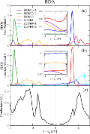
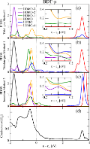
- . ΓL/R(ε) is the left/right-lead injection rate. is the retarded/advanced Green function for the central region. The quantities and ΓL/R(ε) can be obtained from the DFT electronic structure (i.e., the energies εn and wavefunctions ) of the central region containing an “extended molecule” and of the
- reason, it is believed that the molecule itself and its electronic structure has a deep influence on the conductance. The interpretation of the conductance profile, , or of the zero-bias conductance, , is often carried out by referring to the projected density of states onto molecular orbitals (see next





Charge carrier mobility and electronic properties of Al(Op)3: impact of excimer formation
Beilstein J. Nanotechnol. 2015, 6, 1107–1115, doi:10.3762/bjnano.6.112
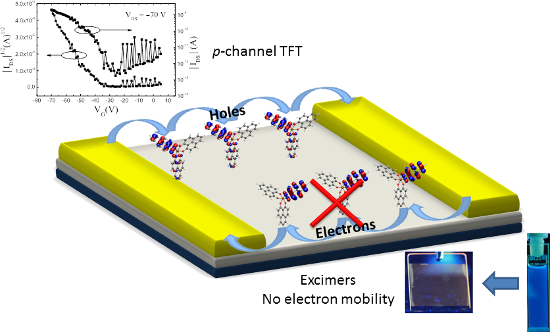
- electronic structure and microscopic properties between these two materials. The simulation of the charge mobility requires coupling of macroscopic system properties, such as the intrinsic bulk mobility, temperature, applied bias voltage, etc., with the microscopic (often local) properties, such as energy


Electrocatalysis on the nm scale
Beilstein J. Nanotechnol. 2015, 6, 1008–1009, doi:10.3762/bjnano.6.103
- developed to a stage where a reliable description of complex surface structures and surface processes (at the solid–gas interface) is possible based on first-principles electronic structure theory (in particular, (periodic) density functional theory (DFT)), but it is also increasingly developing new
Graphene on SiC(0001) inspected by dynamic atomic force microscopy at room temperature
Beilstein J. Nanotechnol. 2015, 6, 901–906, doi:10.3762/bjnano.6.93
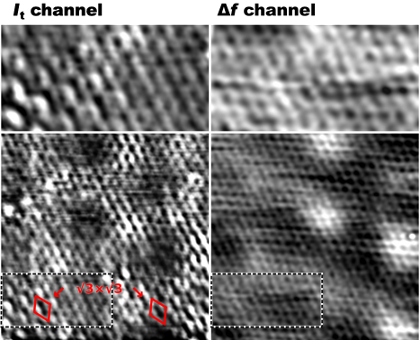
- systems. Alternatively, graphene on SiC(0001) is a more promising candidate for applications [4][5]. But its electronic behaviour is still strongly affected by intrinsic properties of the substrate and the morphology of the interface [6]. Understanding the interplay between atomic and electronic structure
- . For the first time we bring experimental data, that can distinguish the topographic landscape from the local electronic structure of SLG on a 6H-SiC(0001) substrate. At room temperature we employed a combined STM and dynamic atomic force microscopy (dAFM) based on the Q-plus sensor working under UHV



![[Graphic 1]](/bjnano/content/inline/2190-4286-6-93-i1.png?max-width=637&scale=1.18182) × 6
× 6Statistics of work and orthogonality catastrophe in discrete level systems: an application to fullerene molecules and ultra-cold trapped Fermi gases
Beilstein J. Nanotechnol. 2015, 6, 755–766, doi:10.3762/bjnano.6.78
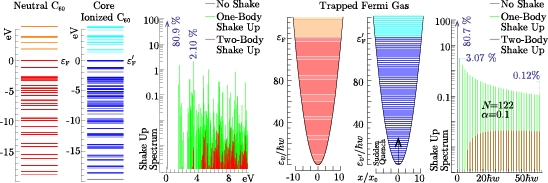
- some work on the cluster by core-ionizing one of its atoms to form a molecular cation. The valence electrons are then thrown out of equilibrium, tending to dynamically relax and compensate for the presence of a positive charge. To depict the rearrangement of the valence electronic structure, we use a
- causes for this discrepancy are discussed in [18]. The valence states are of the form and , where and are the valence-eigenvectors of coefficients for C60 and , respectively. As shown in Figure 1, the valence electronic structure of the neutral and ionized clusters is made of discrete energy levels
- Hamiltonians We have seen that the key ingredients of the work distribution (Equation 2) are the many-body states of the unperturbed and perturbed Fermi systems. In the following we will take the different physical situations set forth above. Specifically, we will first investigate the valence electronic

![[Graphic 22]](/bjnano/content/inline/2190-4286-6-78-i30.png?max-width=637&scale=1.18182) ) fullerene molecules, as com...
) fullerene molecules, as com...





