


Search results
Search for "luminescence" in Full Text gives 170 result(s) in Beilstein Journal of Nanotechnology.
Nanostructure sensitization of transition metal oxides for visible-light photocatalysis
Beilstein J. Nanotechnol. 2014, 5, 696–710, doi:10.3762/bjnano.5.82
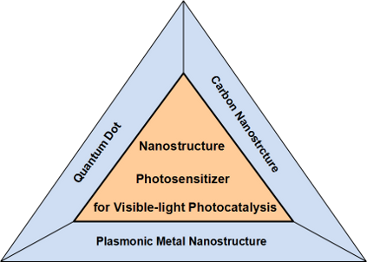
- carriers, quantum dots have a unique photoluminescence (PL). In comparison with organic dyes, quantum dots are characterized by unique optical and electronic properties such as a higher PL quantum efficiency, a wide continuous absorption, a narrower PL band, tunable luminescence depending only on their
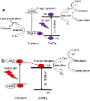
- semiconductor can change into a direct bandgap. Correspondingly, the monolayer of MoS2 exhibits 104 times enhancement of luminescence quantum efficiency than that of bulk material. This new finding has also been verified by other research groups [149][150]. Based on this new finding, one may easily imagine that




Encapsulation of nanoparticles into single-crystal ZnO nanorods and microrods
Beilstein J. Nanotechnol. 2014, 5, 485–493, doi:10.3762/bjnano.5.56
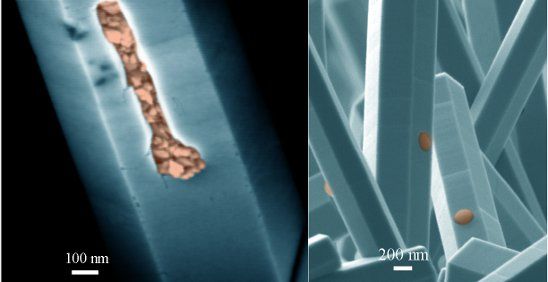
- –matter interaction within those crystals, the luminescence of the cavity material has been conventionally used as a light source. Under excitation, ZnO emits UV light at about 380 nm ascribed to its wide band gap (Eg ≈ 3.4 eV). With crystal defects such as oxygen vacancies, ZnO show visible
- photoluminescence under UV light excitation. Though ZnO micro/nanorods can be both light emitters and optical cavities, the drawback is that their luminescence is not tunable in terms of wavelength and efficiency. For laser applications, the visible emission of ZnO micro/nanocavities has a broad range which can be
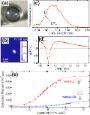
- , ruling out the influence of ZnO luminescence in causing the shift of NDs emission. In Figure 6b, the PL spectrum of NDs in a thick ZnO microrod shows a different shape compared to that of naked NDs. The inset in Figure 6b is an optical microscope image, in which the relatively thick rod marked by a cross


Preparation of poly(N-vinylpyrrolidone)-stabilized ZnO colloid nanoparticles
Beilstein J. Nanotechnol. 2014, 5, 402–406, doi:10.3762/bjnano.5.47
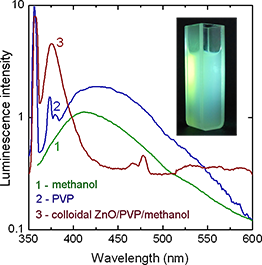
- colloidal solutions with good luminescence properties are obtained by using PVP as stabilizer in the synthesis of ZnO nanoparticles by a sol–gel method assisted by ultrasound. Nanoparticles with sizes of 30–40 nm in a PVP matrix are produced as a solid product. The colloidal ZnO/PVP/methanol solution, apart
- (PL) spectra of the ZnO nanoparticles in methanol were measured at room temperature with an MDR-23 spectrometer. The samples were excited by a nitrogen laser with wavelength of 337.1 nm. Results and Discussion The image of a cell with ZnO colloidal solution is shown in Figure 1. A bright luminescence
- -bandgap luminescence with a maximum at 376 nm, which coincides with that observed in high-quality ZnO bulk crystals and is related to the recombination of free excitons. The observation of efficient free exciton emission at room temperature, as well as the weak visible emission observed at 550 nm is


One pot synthesis of silver nanoparticles using a cyclodextrin containing polymer as reductant and stabilizer
Beilstein J. Nanotechnol. 2014, 5, 380–385, doi:10.3762/bjnano.5.44
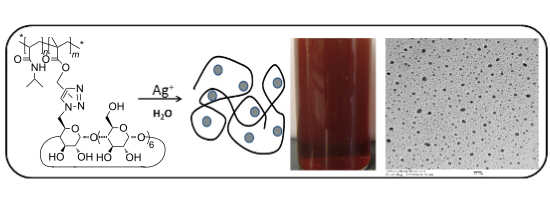
- –visible spectrophotometer equipped with a Thermo Scientific CD10 Heating Circulator bath. Fluorescence spectra were recorded on a Perkin Elmer LS55 luminescence spectrometer. Zeta Potential and dynamic light scattering (DLS) experiments were carried out with a Malvern Zetasizer Nano; ZS ZEN 3600 at a


Photoactivation of luminescence in CdS nanocrystals
Beilstein J. Nanotechnol. 2014, 5, 355–359, doi:10.3762/bjnano.5.40
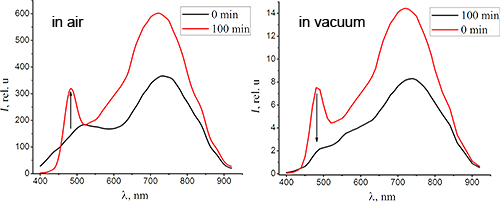
- Valentyn Smyntyna Bogdan Semenenko Valentyna Skobeeva Nikolay Malushin Experimental Physics Department Odessa; I.I. Mechnikov National University; 2, Dvoryanska St., Odessa, UA-65026, Ukraine 10.3762/bjnano.5.40 Abstract This paper presents the results of the research on the luminescence of
- the surface of NC. The observed effect is explained by the recombination mechanism that is responsible for the short-wavelength emission band. Keywords: cadmium sulfide (CdS); luminescence; nanoparticles; short-wavelength emission band; surface modification; Introduction Semiconductor nanocrystals
- spectrum. For that reason these materials are commonly used as luminophores in light emitting devices. A variety of luminescence colors can be produced from the same material by controlling the size of the nanocrystals. An important property of crystals that have a size in the nanometer-range and are


Energy transfer in complexes of water-soluble quantum dots and chlorin e6 molecules in different environments
Beilstein J. Nanotechnol. 2013, 4, 895–902, doi:10.3762/bjnano.4.101
- of Ce6 is located and the QD absorption is relatively small, was used. Time resolved luminescence measurements were performed with a laser scanning luminescent microscope, Micro Time 100 (Pico Quant), that allows registration of the luminescence decay in the 430–850 nm spectral range with 100 ps time
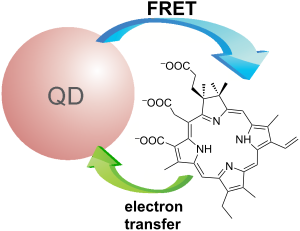
- , normalized to the Ce6 optical density at excitation wavelength, is ≈1.5 times higher for 475 nm excitation than for the 640 nm one that indicates a presence of sensibilized Ce6 luminescence. These facts show intracomplex FRET from QD to Ce6. For this system, the energy transfer efficiency of 8%, calculated
- and their tendency to dissociation, they are supposed to be good model objects to explore the dependencies of FRET efficiency and Ce6 QY on n in the complexes by spectral luminescence methods. The samples for studies were prepared by stepwise increasing the Ce6 concentration in solution of QD and Ce6


Modulation of defect-mediated energy transfer from ZnO nanoparticles for the photocatalytic degradation of bilirubin
Beilstein J. Nanotechnol. 2013, 4, 714–725, doi:10.3762/bjnano.4.81
- ]. It has been reported that the native defects in the ZnO lattice, mostly the oxygen vacancy sites, play an important role in the photocatalytic activity of the nanostructures [11]. Oxygen vacancies have been reported as the cause of the characteristic green luminescence of ZnO [12][13][14]. These
- deep-level trap state (VO++) as the origin of the green luminescence. Whereas Vanheusden et al. [29] reported that the recombination of an electron from a VO+ state to a valence band hole lead to the green luminescence peak. In contrast, J. D. Ye et al. [27] has reported that both the above assumptions
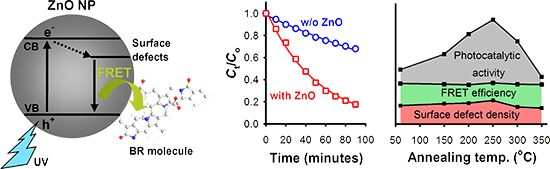
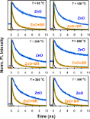
- are correct and demonstrated that the broad green–yellow luminescence from ZnO is mainly composed of two individual emission bands centered at approx. 520 and approx. 590 nm respectively, as shown in Figure 3b. It was observed that with increasing annealing temperature the green–yellow emission from
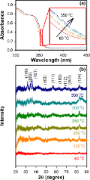
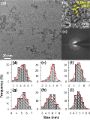
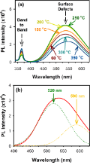


Evolution of microstructure and related optical properties of ZnO grown by atomic layer deposition
Beilstein J. Nanotechnol. 2013, 4, 690–698, doi:10.3762/bjnano.4.78
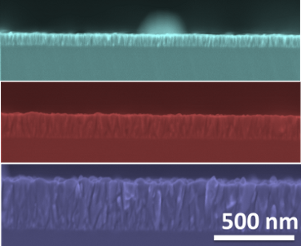
- 1 nm steps over the 300–1100 nm range, and photoluminescence in the 370–800 nm range. A solid state LCS-DTL-374QT Nd:YAG 355 nm laser source (Russia) at the intensity of 19 mW/cm2 was used to excite the luminescence. Emission spectra were registered by the experimental setup described by Viter et al


Near-field effects and energy transfer in hybrid metal-oxide nanostructures
Beilstein J. Nanotechnol. 2013, 4, 306–317, doi:10.3762/bjnano.4.34
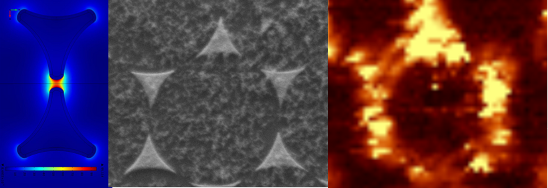
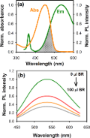
- Eu fluorescence can be suppressed by covering the nanoantennas with a 10 nm thick SiOx layer. Keywords: confocal microscopy; energy transfer; field enhancement; light harvesting; luminescence; nano-antennas; nanosphere lithography; nanostructures; plasmonics; simulation; TiO2 nanoparticles








Selective surface modification of lithographic silicon oxide nanostructures by organofunctional silanes
Beilstein J. Nanotechnol. 2013, 4, 218–226, doi:10.3762/bjnano.4.22
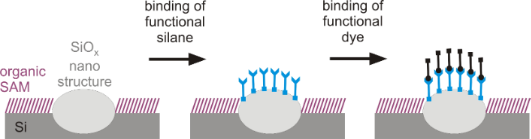
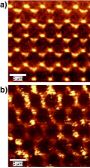
- the successful binding. Figure 6 shows a typical fluorescence spectrum from the FITC-terminated structure depicted in Figure 5. A confocal microscope image of the whole structure is displayed in the inset. There is a clear luminescence signal, which originates from the nanostructure only. The spectral


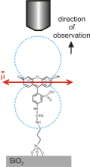
![[Graphic 2]](/bjnano/content/inline/2190-4286-4-22-i2.png?max-width=637&scale=1.18182) (red arrow) of FITC bound to a SiO2 surface.
(red arrow) of FITC bound to a SiO2 surface.
Nanoparticles of novel organotin(IV) complexes bearing phosphoric triamide ligands
Beilstein J. Nanotechnol. 2013, 4, 94–102, doi:10.3762/bjnano.4.11
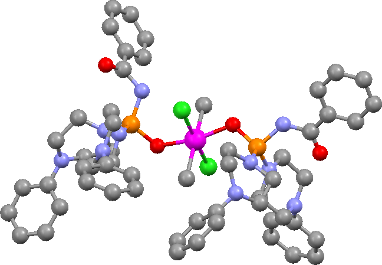
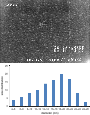
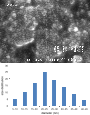
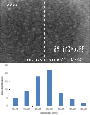
- complexation. Keywords: luminescence; nanoparticles; organotin(IV) complexes; phosphoric triamide; ultrasonic; Introduction In recent years, the increasing progress in the preparation of nanomaterials has led to characterization of a great number of nanostructures [1]. Nanoscale materials are of significance




Plasmonic oligomers in cylindrical vector light beams
Beilstein J. Nanotechnol. 2013, 4, 57–65, doi:10.3762/bjnano.4.6
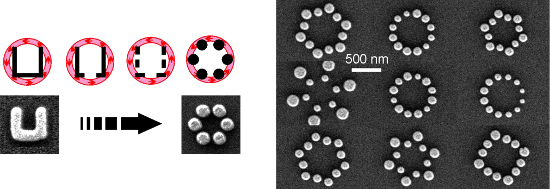
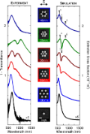
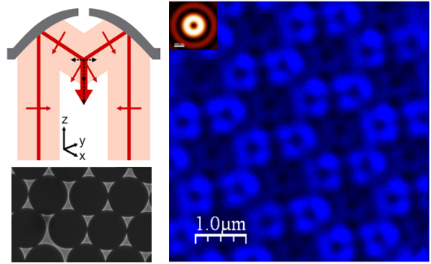
- the plasmonic structures. Experiments and simulation of near-field imaging of plasmonic oligomer rings using gold luminescence We excited the plasmonic oligomer rings with radially and azimuthally polarized light at 632.8 nm. The excitation was performed by utilizing a parabolic mirror with an NA
- , resembling a “magnetic focusing”, featuring a central spot of enhanced intensity with a diameter of ca. 340 nm. The reason for this behavior is as follows: The luminescence signal is generated by the individual gold dots, which in turn have been excited by the external light filed. Thus, the signal strength
- optical microscopes. Oligomer rings composed of gold nanodots, SEM images on the left, confocal luminescence images under azimuthally polarized illumination on the right. Lower row: Simulations based on a planar convolution of the exciting light field with the structure geometry. The left image depicts




Diamond nanophotonics
Beilstein J. Nanotechnol. 2012, 3, 895–908, doi:10.3762/bjnano.3.100
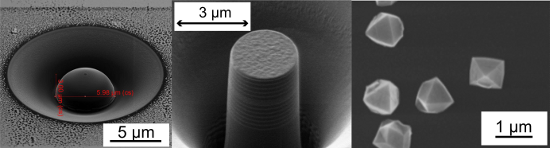
- already conducted to produce this center [21][22]. However, the yield of nickel–nitrogen-related centers seems to be rather low. Tungsten is known to produce a family of so-called W5-centers with several luminescence lines near 714 nm [23]. Up to now these centers were only produced by chance in
- polycrystalline diamond samples grown by the hot-filament technique. Accordingly, not much is known about their luminescence properties. Our aim was to produce the W-centers in a well-defined way, in order to enable further studies on these color centers. The goal of our work is the fabrication of stable single
- (1.4035 eV) and 885.12 nm (1.4008 eV), which is in accordance with values known for the 1.4 eV center [16]. CL measurements on the same nickel-doped sample revealed further nickel-related lines. As shown in Figure 13b a luminescence line at a wavelength of 794 nm was detected accompanied by two phonon





Assessing the plasmonics of gold nano-triangles with higher order laser modes
Beilstein J. Nanotechnol. 2012, 3, 674–683, doi:10.3762/bjnano.3.77
- (optical axis of the optical microscope) electric field. We collected and evaluated the emitted luminescence and thereby investigated the respectively excited plasmonic modes. These varied considerably: firstly with the light polarisation in the focus, secondly with the aspect ratio of the triangles and
- position of the triangles with the confocally observed luminescence patterns. Ultimately, we also achieved surface-enhanced Raman spectroscopic studies of adenine molecules adsorbed on such gold nano-triangles. Experimental Our custom-built parabolic mirror based near-field optical microscope has been
- the scattered luminescence coming from the sample. This scattered light is separated from the incoming laser beam by a beam splitter. Subsequently, two consecutive notch filters block the laser wavelength in order to select only the inelastically Stokes scattered light. This signal is finally directed


Combining nanoscale manipulation with macroscale relocation of single quantum dots
Beilstein J. Nanotechnol. 2012, 3, 324–328, doi:10.3762/bjnano.3.36
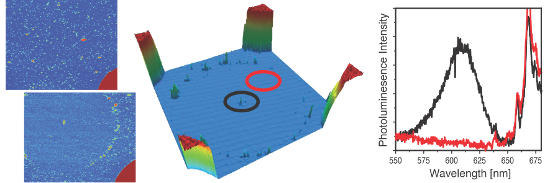
- manipulated QD is centred at 608 nm, and luminescence at this wavelength is completely absent elsewhere in the cell. The full-width at half-maximum (FWHM) of the QD spectra is 108 meV, which corresponds well to the previously studied emission from single colloidal quantum dots, for which PL blinking was


Highly efficient ZnO/Au Schottky barrier dye-sensitized solar cells: Role of gold nanoparticles on the charge-transfer process
Beilstein J. Nanotechnol. 2011, 2, 681–690, doi:10.3762/bjnano.2.73
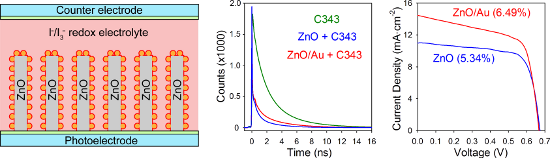
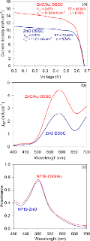
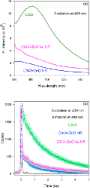
- characteristics of bare ZnO-nanorod and ZnO/Au-nanocomposite DSSCs measured at 1 sun, AM 1.5 G illumination (100 mW/cm2).a Dynamics of picosecond-resolved luminescence transients of C343 dye in the presence and absence of bare ZnO nanorods and ZnO/Au nanocomposites.a J–V characteristics of bare ZnO-nanorod and



Distance dependence of near-field fluorescence enhancement and quenching of single quantum dots
Beilstein J. Nanotechnol. 2011, 2, 645–652, doi:10.3762/bjnano.2.68
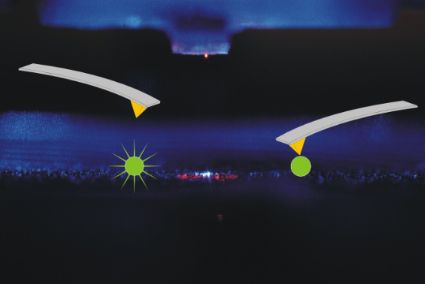
- impact of this relative fluorescence quenching is negligible. Conclusion We presented experimental data and simulations for the fluorescence emission control of single quantum dots by the external intervention of a gold-coated AFM tip. The acquired luminescence data exhibited a nontrivial dependence on
- , respectively. Generally, the shift of the quantum yield can be described in terms of the radiative and nonradiative decay rates (γr, γnr) as follows: The coupling between a dipole emitter and a sharp metallic tip results in an increase of γr [32][35]. Yet, the degree of luminescence enhancement is inherently
- limited by the fluorophore’s intrinsic quantum yield q0, i.e., strong luminescence enhancement can only be observed for low q0 (γnr >> γr). In order to quantify Q, namely the impact of dipolar coupling between the gold tip apex and the fluorophore in the absence of any secondary fields, the detectable


Room temperature excitation spectroscopy of single quantum dots
Beilstein J. Nanotechnol. 2011, 2, 516–524, doi:10.3762/bjnano.2.56

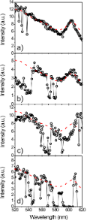
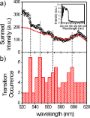
- molecule detection sensitivity to demonstrate excitation spectra of isolated semiconductor nanocrystals. These fluorophores, often referred to as quantum dots, have unique optical properties [30][31][32][33][34][35], including a narrow and tailored luminescence emission spectrum and significantly enhanced
- than the very photostable quantum dots analyzed in this study. The recorded data further enables the detailed analysis of the influence of the excitation wavelength on the blinking of single quantum dots. Numerous studies on single quantum dots have shown complicated luminescence intermittency, or

Nanophotonics, nano-optics and nanospectroscopy
Beilstein J. Nanotechnol. 2011, 2, 499–500, doi:10.3762/bjnano.2.53

- dimensions much smaller than the wavelength of electromagnetic radiation [7][8][9]. Well-known examples are the negative refractive index created by metamaterials [10][11], the quantum confinement observed in the absorption and luminescence spectra of semiconductor nanoparticles [12], and the plasmon
Fabrication and spectroscopic studies on highly luminescent CdSe/CdS nanorod polymer composites
Beilstein J. Nanotechnol. 2010, 1, 94–100, doi:10.3762/bjnano.1.11
- . Keywords: CdSe; luminescence lifetime; nanocomposites; nanorods; quantum yield; Introduction Semiconductor nanoparticles have attracted great interest in recent years because of their fascinating optical properties. Their emission wavelength can be tuned directly by changing their size and shape as a
- , aggregation of nanoparticles, loss of transparency and luminescence quenching due to exciton energy transfer [2][7]. Several methods have been described to overcome these problems for quantum dot polymer composites. For example, Bawendi and coworkers incorporated trioctylphosphine oxide covered CdSe/ZnS QDs
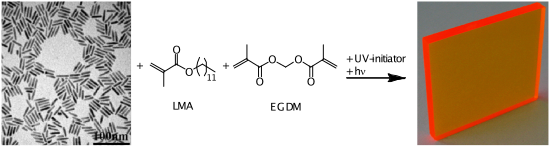
- thermal polymerization process leads to luminescence quenching and as a result nanocomposites with photoluminescence (PL) quantum efficiency (QE) of less than 40% were obtained [6][7][8]. Here we present two different methods to fabricate nanorod polymer composites: (a) UV-polymerization and (b) a radical





