Search results
Search for "photovoltaic" in Full Text gives 161 result(s) in Beilstein Journal of Nanotechnology.
Horizontal versus vertical charge and energy transfer in hybrid assemblies of semiconductor nanoparticles
Beilstein J. Nanotechnol. 2012, 3, 629–636, doi:10.3762/bjnano.3.72
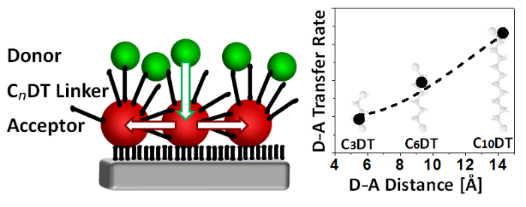
- . Keywords: charge transfer; energy transfer; nanoparticles; organic linker; quantum dots; Introduction Self-assembled structures of semiconductor nanoparticles (NPs) are viewed as a possible avenue for producing photovoltaic devices with efficient collection of light and charge separation processes [1


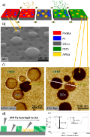
Polymer blend lithography: A versatile method to fabricate nanopatterned self-assembled monolayers
Beilstein J. Nanotechnol. 2012, 3, 620–628, doi:10.3762/bjnano.3.71
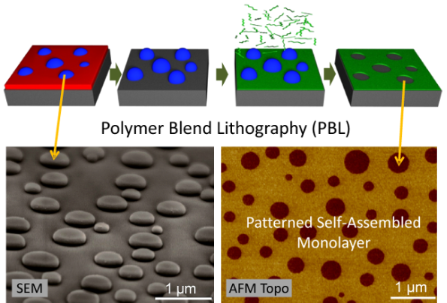
- intensively studied over the past two decades and allows the formation of complex layered or lateral micro- or nanoscale structures [31][32][33][34][35][36][37][38]. These structures can be used for many applications, such as antireflection coatings [39], photovoltaic devices [40][41], organic light-emitting


Reduced electron recombination of dye-sensitized solar cells based on TiO2 spheres consisting of ultrathin nanosheets with [001] facet exposed
Beilstein J. Nanotechnol. 2012, 3, 378–387, doi:10.3762/bjnano.3.44
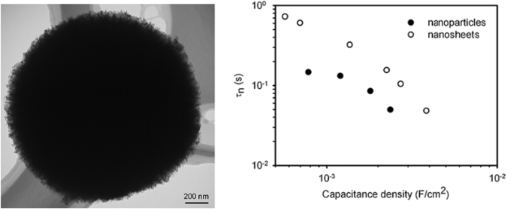
- ; ultrathin nanosheets; Introduction In the past two decades, dye-sensitized solar cells (DSCs) have received substantial attention from both academic and industrial communities as one of the most promising low-cost, high-efficiency third-generation photovoltaic devices [1][2]. A typical DSC consists of a
- structure consisting of ultrathin nanosheets with 100% of the [001] facet exposed were synthesized and applied in dye-sensitized solar cells (DSCs). The photovoltaic performance of the DSCs with different concentrations of the hierarchically structured TiO2 spheres was evaluated. The kinetics of electron
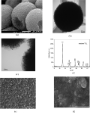


Structural, electronic and photovoltaic characterization of multiwalled carbon nanotubes grown directly on stainless steel
Beilstein J. Nanotechnol. 2012, 3, 360–367, doi:10.3762/bjnano.3.42
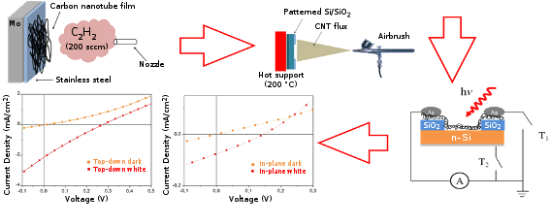
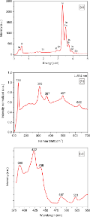
- silicon substrate plays an important role in the production of electron–hole pairs. Keywords: carbon nanotubes; electronic properties; heterojunction; photovoltaic; stainless steel; Introduction Carbon nanotubes (CNTs) possess unique electronic, mechanical and optical properties that make them
- of graphite. In particular, a broadening of the π-plasmon of CNTs is found, which can be ascribed to the presence of several structures that are completely absent in HOPG and probably due to transitions among Van Hove singularities. Here we also show that MWCNTs exhibit an interesting photovoltaic
- activity when they are deposited on a crystalline silicon substrate by the airbrush method. We recall that, while several efforts have been devoted to the build-up of photovoltaic devices based on a SWCNT–Si heterojunction, achieving a surprising efficiency of up to 11% [8], just a few works reported the



Junction formation of Cu3BiS3 investigated by Kelvin probe force microscopy and surface photovoltage measurements
Beilstein J. Nanotechnol. 2012, 3, 277–284, doi:10.3762/bjnano.3.31
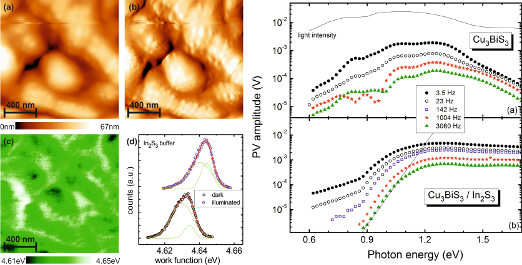
- 10.3762/bjnano.3.31 Abstract Recently, the compound semiconductor Cu3BiS3 has been demonstrated to have a band gap of ~1.4 eV, well suited for photovoltaic energy harvesting. The preparation of polycrystalline thin films was successfully realized and now the junction formation to the n-type window needs
- the influence of defect states below the band gap on charge separation and a surface-defect passivation by the In2S3 buffer layer. Our findings indicate that Cu3BiS3 may become an interesting absorber material for thin-film solar cells; however, for photovoltaic application the band bending at the
- photovoltaic active interface with a SPV of ~130 mV [7]. It is well known from the Cu(In,Ga)Se2 solar cells that a buffer layer is required between the n-ZnO window and the p-type absorber layer to reach high efficiency values [8]. Traditionally, CdS deposited by chemical bath deposition (CBD) has been used as


Surface functionalization of aluminosilicate nanotubes with organic molecules
Beilstein J. Nanotechnol. 2012, 3, 82–100, doi:10.3762/bjnano.3.10

- . Therefore, it is crucial to develop a facile synthetic method capable of making uniform and template-free imogolite/P3HT nanofiber hybrids in bulk quantities. Such a synthetic method would be useful for tuning the properties of sensors and photovoltaic or light-emitting devices, which are dependent on well


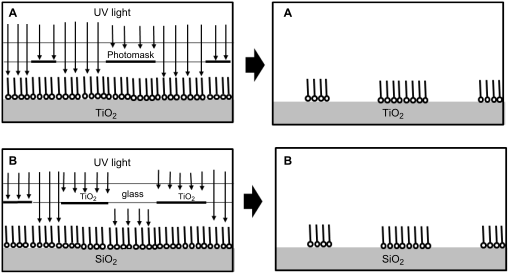
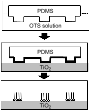
Self-assembled monolayers and titanium dioxide: From surface patterning to potential applications
Beilstein J. Nanotechnol. 2011, 2, 845–861, doi:10.3762/bjnano.2.94



Highly efficient ZnO/Au Schottky barrier dye-sensitized solar cells: Role of gold nanoparticles on the charge-transfer process
Beilstein J. Nanotechnol. 2011, 2, 681–690, doi:10.3762/bjnano.2.73
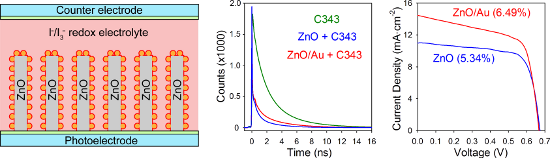
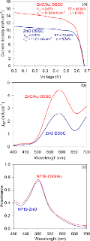
- shown in Figure 2b. The solar cells with ZnO-nanorod and ZnO/Au-nanocomposite photoelectrodes in the absence of dye N719 were initially prepared in order to study the photovoltaic behavior of the ZnO/Au-nanocomposite system. The J–V characteristics of these solar cells are shown in Table 1. Upon




Nanophotonics, nano-optics and nanospectroscopy
Beilstein J. Nanotechnol. 2011, 2, 499–500, doi:10.3762/bjnano.2.53

- applications can be imagined, e.g., in materials sciences in the pursuit of efficient photovoltaic energy conversion; in the engineering sciences as quantum devices functioning as switches that truly operate at the quantum limit with single photons; or in the life sciences as local optical sensors to observe
Formation of precise 2D Au particle arrays via thermally induced dewetting on pre-patterned substrates
Beilstein J. Nanotechnol. 2011, 2, 318–326, doi:10.3762/bjnano.2.37
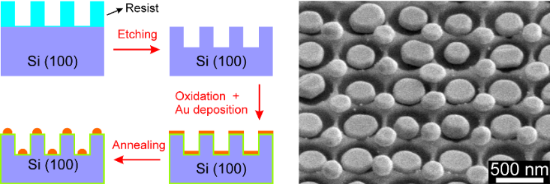
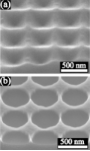
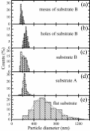
- applicability of this method in fabricating large areas of particle arrays for the plasmonic devices or in improving the efficiency of the photovoltaic devices and light-emitting diodes (LED) by modification of the surface optical properties. Experimental The surface of (100) Si wafers was pre-patterned into a





Room temperature synthesis of indium tin oxide nanotubes with high precision wall thickness by electroless deposition
Beilstein J. Nanotechnol. 2011, 2, 119–126, doi:10.3762/bjnano.2.14
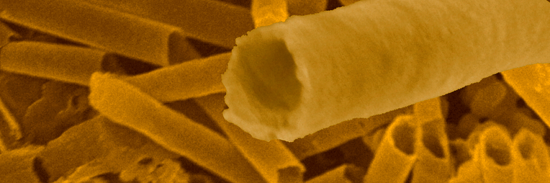
- of the polycarbonate template having a tube density from 1 to 109 tubes/cm². These arrays can be used directly for sensor, photovoltaic or electronic applications. Experimental Sample preparation Polycarbonate foils with thicknesses of 6 to 30 µm were used as templates. Commercial polycarbonate (PC