Search results
Search for "size distribution" in Full Text gives 598 result(s) in Beilstein Journal of Nanotechnology. Showing first 200.
Revealing the formation mechanism and band gap tuning of Sb2S3 nanoparticles
Beilstein J. Nanotechnol. 2021, 12, 1021–1033, doi:10.3762/bjnano.12.76
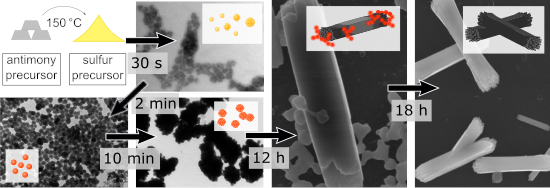
- distribution of the spherical, amorphous particles in the samples obtained after 12 and 16 h, respectively. A decreasing diameter with progressing reaction time is visible and likely due to Ostwald ripening. The size distribution curves were calculated assuming a Gaussian distribution. Nanoparticles obtained
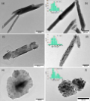
- nanoparticles after different reaction times: (a) TEM, 2 min, (b) TEM, 5 min, (c) TEM, 30 min, (d) SEM, 12 h, (e) SEM, 16 h, and (f) SEM, 30 h. X-ray diffractograms of a sample after a reaction time of (a) 30 min and (b) 18 h (the red lines correspond to stibnite, COD 9003460). Histograms showing the size


The role of deep eutectic solvents and carrageenan in synthesizing biocompatible anisotropic metal nanoparticles
Beilstein J. Nanotechnol. 2021, 12, 924–938, doi:10.3762/bjnano.12.69
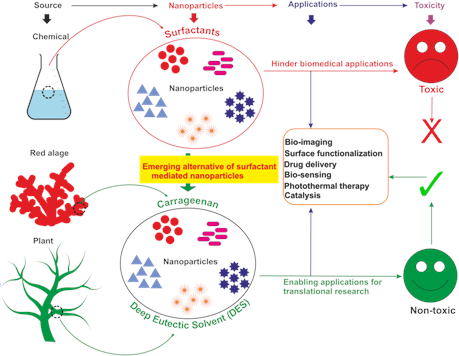
- Relationships in Electrocatalysis”, Angew. Chem. Int. Ed., with permission from John Wiley and Sons. Copyright © 2008 Wiley-VCH Verlag GmbH & Co. KGaA, Weinheim. This content is not subject to CC BY 4.0. Carrageenan as capping and reducing agent for gold nanoparticle synthesis. (A) Histogram for the size
- distribution of nanoparticles. (B), (C) and (D) show TEM micrographs of the nanoparticles at different magnifications. (E) and (F) show the antitumor activity against MDA-MB-231 and HCT-116. Adapted from [32], © 2018 X. Chen et al., distributed under the terms of the Creative Commons Attribution 4.0


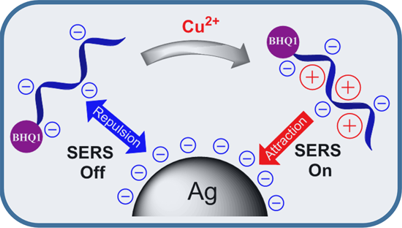
Modification of a SERS-active Ag surface to promote adsorption of charged analytes: effect of Cu2+ ions
Beilstein J. Nanotechnol. 2021, 12, 902–912, doi:10.3762/bjnano.12.67
- an SEM image of the NPs as well as the corresponding size distribution histogram. A similar TEM image (Figure S1, Supporting Information File 1) shows fewer nanoparticles and is therefore less reliable. Both methods give NP diameters in the interval of 30–35 nm. According to the SEM image, the NPs
- are mostly spherical with an average diameter of 33 nm. SEM and TEM images demonstrate a similar size distribution. Hence, we conclude that no NP size selection occurs during their adsorptive immobilization. The absorption spectrum of the Ag NPs (Figure S2, Supporting Information File 1) is in good
- surface was rather uniform, that is, the deviation between different point was less than 10% for each sample. An average representative graph has been chosen for demonstration in Figures 5, 7, and 8). SEM image of Ag NPs and the corresponding size distribution histogram. For SEM imaging Ag NPs were


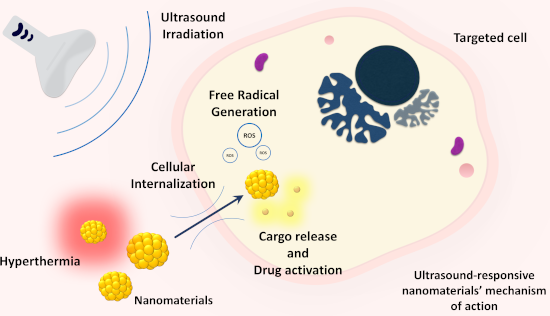
Comprehensive review on ultrasound-responsive theranostic nanomaterials: mechanisms, structures and medical applications
Beilstein J. Nanotechnol. 2021, 12, 808–862, doi:10.3762/bjnano.12.64


Silver nanoparticles nucleated in NaOH-treated halloysite: a potential antimicrobial material
Beilstein J. Nanotechnol. 2021, 12, 798–807, doi:10.3762/bjnano.12.63
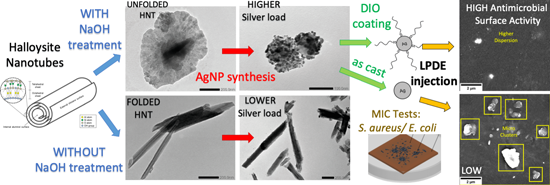
- size distribution is more disperse for Ag/HNT-8 compared to Ag/HNT-0 and Ag/HNT-4. Expectedly, the main size difference among the samples is not so large, because the three samples were synthesized under the same conditions, which results in similar nucleation parameters. The small size difference is




Silver nanoparticles induce the cardiomyogenic differentiation of bone marrow derived mesenchymal stem cells via telomere length extension
Beilstein J. Nanotechnol. 2021, 12, 786–797, doi:10.3762/bjnano.12.62
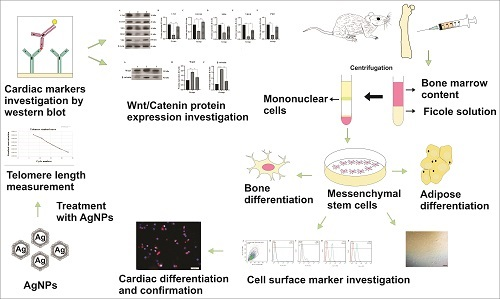
- laboratory unit, which is approved by the Iranian Nanotechnology Initiative Council (Figure 9A). Also, the size distribution and zeta potential distribution was provided by the commercial supplier as (Figure 9B,C). BM-MSCs isolation BM-MSCs were isolated for a previous study by Fathi and co-workers [41
- real-time PCR (D and E); (*P < 0.05, **P < 0.01, and ***P < 0.001), respectively. Ag-NPs structure. (A) SEM image of Ag-NPs, (B) size distribution by intensity, and (C) zeta potential distribution. Ag-NPs characterization. Primer sequences used for the aTL measurement. Primer sequences used for the


Fate and transformation of silver nanoparticles in different biological conditions
Beilstein J. Nanotechnol. 2021, 12, 665–679, doi:10.3762/bjnano.12.53
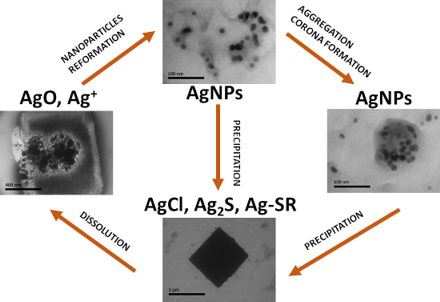
- was studied in the presence of the most relevant biothiols: cysteine (CYS) and glutathione (GSH). Data on the size distribution of different AgNPs in the tested media are given in Figure 5 and in Supporting Information File 1, Table S1, while observed ζ potentials are presented in Figure 6 and in
- , Perkin Elmer, Shelton, USA). The silver standard solution (1000 mg/L in 5% HNO3) from Merck (Darmstadt, Germany) was used for calibration. All prepared AgNPs were characterized by means of shape, primary size, size distribution, and surface charge in UPW. The particle visualization was performed by TEM
- ) equipped with a green laser (532 nm) at an angle of 173°. The values of dH were obtained as the value of the maximum peak of the size distribution by volume and reported as an average of ten measurements. The ζ potential values were determined by ELS using the same Zetasizer Nano ZS instrument. The values




Stability and activity of platinum nanoparticles in the oxygen electroreduction reaction: is size or uniformity of primary importance?
Beilstein J. Nanotechnol. 2021, 12, 593–606, doi:10.3762/bjnano.12.49
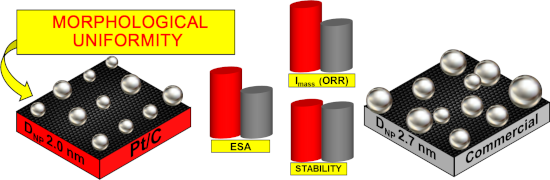
- . Keywords: durability; electrocatalysts; morphology control; oxygen reduction reaction; platinum nanoparticles; size distribution; spatial distribution; Introduction Nowadays, low-temperature proton-exchange membrane fuel cells (PEMFC) are gaining a wider application. This is due to their environmental
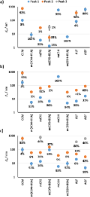
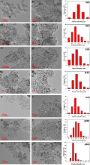
- min. A drop of the resulting suspension was applied to a standard copper mesh with a diameter of 3.05 mm, covered with a 5–6 nm thick layer of amorphous carbon. Next, the sample was dried in air at room temperature for 60 min. The histograms of platinum nanoparticle size distribution in the catalysts
- micrographs. The composition of the commercial catalysts JM20 and JM40 is similar to that of G20 and G40: the average crystallite size is 2.5 and 3.7 nm, and the average NP size is 2.7 and 3.7 nm, respectively. The comparison of the NP size distribution histograms indicates that in the synthesized Pt/C


On the stability of microwave-fabricated SERS substrates – chemical and morphological considerations
Beilstein J. Nanotechnol. 2021, 12, 541–551, doi:10.3762/bjnano.12.44
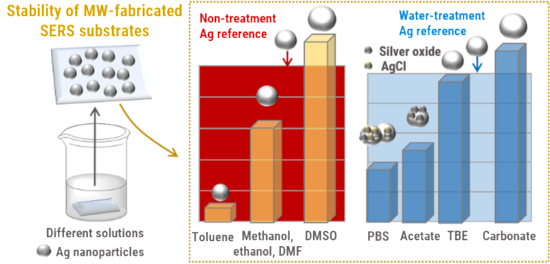
- capabilities of the SERS substrates due to size and nanolensing effects [26][27]. However, this complicates the quantitative analysis of the nanoparticle sizes. In this study, we analyzed the averaged particle size distribution by evaluating the projected area of the particles to determine the particle


Surface-enhanced Raman scattering of water in aqueous dispersions of silver nanoparticles
Beilstein J. Nanotechnol. 2021, 12, 497–506, doi:10.3762/bjnano.12.40
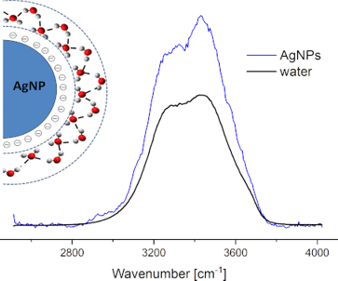
- in the Supporting Information section of [35]). The calculated EF is equal to (4.8 ± 0.8) × 106, taking into account the size distribution of the nanoparticles in the AgNPs blue sample. This result assumes that all water molecules located on the Ag surface participate in the resonance effect. Of
- account the size distribution of nanoparticles in the AgNPs blue sample. The temperature analysis showed that the observed enhancement increases with the increase of the temperature. The calculated activation energy for a AgNPs sample is larger than that for pure water, which is an effect of water


Boosting of photocatalytic hydrogen evolution via chlorine doping of polymeric carbon nitride
Beilstein J. Nanotechnol. 2021, 12, 473–484, doi:10.3762/bjnano.12.38
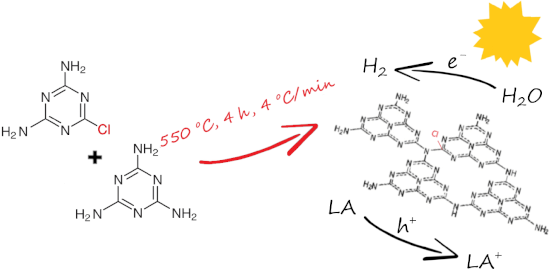
- samples, which is typical of mesoporous materials (Figure 6). The hysteresis loops, pore–size distribution curves, and average pore diameter for both samples are similar. The proportion of micropores is small and the samples contain mainly mesopores. The sample modified by chlorine presents a slightly


Rapid controlled synthesis of gold–platinum nanorods with excellent photothermal properties under 808 nm excitation
Beilstein J. Nanotechnol. 2021, 12, 462–472, doi:10.3762/bjnano.12.37
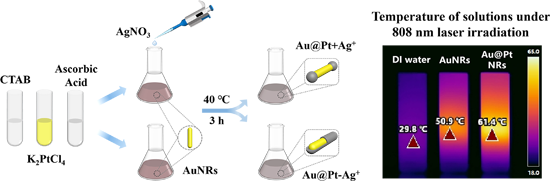
- integrity after four laser irradiations, showing almost no change in morphology and size distribution. Conclusion We report a simple method for preparing dumbbell-like Au@Pt NRs under mild conditions. By controlling the concentration of Ag+ and K2PtCl4 in the reaction solution, Au@Pt NRs were synthesized


A review on nanostructured silver as a basic ingredient in medicine: physicochemical parameters and characterization
Beilstein J. Nanotechnol. 2021, 12, 440–461, doi:10.3762/bjnano.12.36
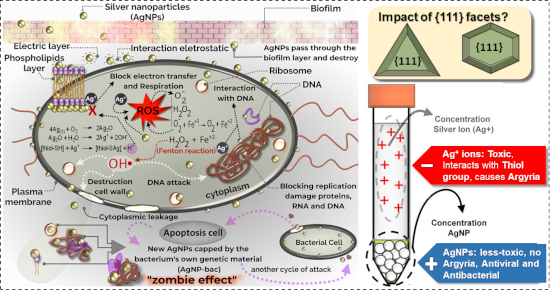
- solutions (i.e., the polydispersion index, PDI) which is basically a representation of the size distribution of the population in a given sample. The numerical value of the PDI ranges from 0 (for a perfectly uniform sample in terms of particle sizes) to 1.0 (for a highly polydispersed sample with a
- complementary way, the size, distribution, shape heterogeneity, morphology, dispersion, and aggregation can be directly evaluated via TEM in which the high spatial resolution facilitates the investigation of the electronic structure and chemical composition [156]. However, the disadvantages other than the


Solution combustion synthesis of a nanometer-scale Co3O4 anode material for Li-ion batteries
Beilstein J. Nanotechnol. 2021, 12, 424–431, doi:10.3762/bjnano.12.34
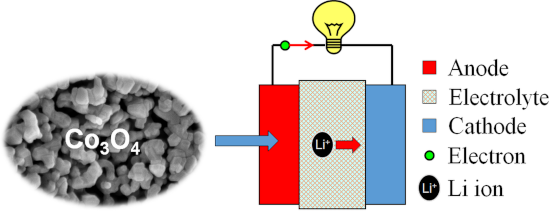
- been established that the electrochemical performance of Co3O4 materials is improved when they possess either small size or appropriate pore size distribution and morphologies, such as porous or hierarchical structures, or the combination of both these features [3][4]. So far, different syntheses have
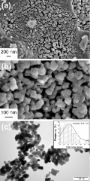
- powder magnified (a) 25,000 times and (b) 100,000 times. (c) TEM image of the Co3O4 powder (inset: a particle size distribution diagram). Electrochemical properties of the Co3O4 electrodes. (a) The first to fifth cycle profiles measured at current density of 100 mA·g−1. (b) Cycling performance measured


Spontaneous shape transition of MnxGe1−x islands to long nanowires
Beilstein J. Nanotechnol. 2021, 12, 366–374, doi:10.3762/bjnano.12.30
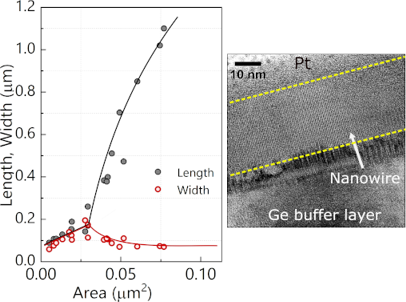
- using these techniques, NWs are grown away from the substrate, usually in a tilted direction, and size distribution and geometry strongly depend on the growth dynamics [32][33]. Furthermore, it is known that the catalyst introduces uncontrolled and unwanted contamination inside the crystal lattice of
- Ge on Si substrates, or the endotaxial growth of transitional metal silicides (e.g., CoSi2) [34][36]. In these studies, the NWs exhibit a narrow diameter distribution, in contrast to those obtained by VLS, which commonly have wider range due to the droplet size distribution. In the present work, we
- (NPs). Further increase of the Mn layer thickness to 9 ML results in a closely packed film of agglomerated islands with a relatively uniform size distribution (≃100 nm) completely filling the surface (see Figure 1c). XRD in Bragg–Brentano geometry has been carried out on these islands on the annealed 9


Nickel nanoparticle-decorated reduced graphene oxide/WO3 nanocomposite – a promising candidate for gas sensing
Beilstein J. Nanotechnol. 2021, 12, 343–353, doi:10.3762/bjnano.12.28
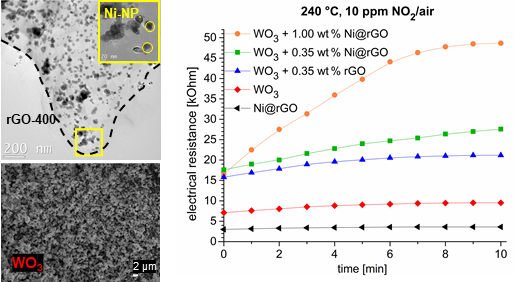
- . TEM samples were prepared by drop casting the with acetonitrile diluted material on 200 µm carbon-coated copper grids, followed by washing the grid several times with acetonitrile to remove the excess ionic liquid. The size distribution was determined manually or with the aid of the Gatan Digital


Characterization, bio-uptake and toxicity of polymer-coated silver nanoparticles and their interaction with human peripheral blood mononuclear cells
Beilstein J. Nanotechnol. 2021, 12, 282–294, doi:10.3762/bjnano.12.23
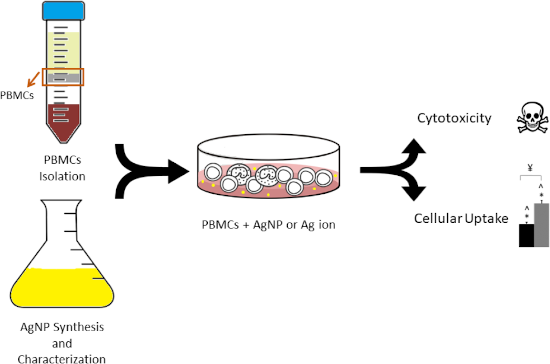
- 9.4). STEM images of 1000 µg·L−1 PVP-AgNPs and particle size distribution obtained from ImageJ. PVP-AgNPs in RPMI medium (without cells) at (a, b) t = 0, size distribution = 29 ± 0.49 nm and at (c, d) t = 24 h, size distribution = 17 ± 11 nm, under the same conditions as during exposure to cells



Differences in surface chemistry of iron oxide nanoparticles result in different routes of internalization
Beilstein J. Nanotechnol. 2021, 12, 270–281, doi:10.3762/bjnano.12.22
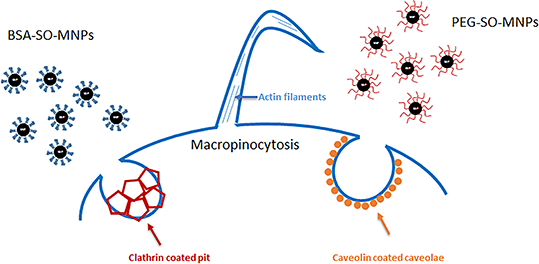
- characteristics of these nanoparticles in the solvent and culture medium are shown in Table 1. Dynamic light scattering (DLS) Particle size distribution and zeta potential of the surface-modified MNPs in stock solution and culture medium were determined by DLS using a Zetasizer Nano-ZS (Malvern Instruments, UK



A review on the green and sustainable synthesis of silver nanoparticles and one-dimensional silver nanostructures
Beilstein J. Nanotechnol. 2021, 12, 102–136, doi:10.3762/bjnano.12.9
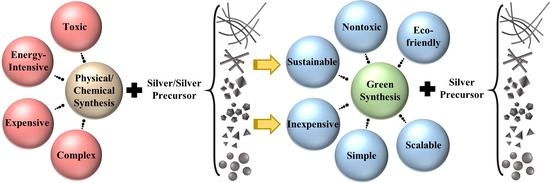
- but not limited to renewable energy, electronics, biosensors, wastewater treatment, medicine, and clinical equipment. The properties of silver nanostructures, such as size, size distribution, and morphology, are strongly dependent on synthesis process conditions such as the process type, equipment
- ], lithography [120][121], spray pyrolysis [122][123][124], radiolysis [125][126][127][128], arc discharge [129][130][131][132][133], and photoirradiation [134][135][136] have been utilized to synthesize various morphologies of silver nanostructures with varied size and size distribution. The physical synthesis
- demonstrated great advances in the last decade, yet there are still issues regarding stability, size distribution, morphology, unknown biological functions [140], and the consideration that some biological processes cannot become industrially feasible due to strict and time-consuming aseptic procedures [185


The role of gold atom concentration in the formation of Cu–Au nanoparticles from the gas phase
Beilstein J. Nanotechnol. 2021, 12, 72–81, doi:10.3762/bjnano.12.6
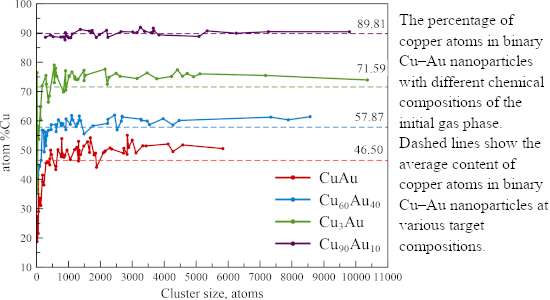
- study was to determine the possible effect of the initial chemical composition of the gas phase, in the synthesis chamber, on the size distribution of the final particles and on the chemical composition of gold and copper atoms. To analyze the processes occurring during condensation, four different
- simulation and the data on the size distribution of Cu3Au clusters obtained by laser deposition [3]. An analysis of the shape and distribution of the Cu3Au clusters on the substrate indicates that the agglomeration processes were suppressed in this case [3]. The reason for that may be the wide spatial
- with the data from the performed MD simulation for the Cu90Au10 case. A size distribution very similar to that of the simulation results of Cu nanoparticles is seen for binary Cu–Au particles obtained from this chemical composition of the initial gas medium. The main group containing clusters with a


Bio-imaging with the helium-ion microscope: A review
Beilstein J. Nanotechnol. 2021, 12, 1–23, doi:10.3762/bjnano.12.1


Free and partially encapsulated manganese ferrite nanoparticles in multiwall carbon nanotubes
Beilstein J. Nanotechnol. 2020, 11, 1891–1904, doi:10.3762/bjnano.11.170
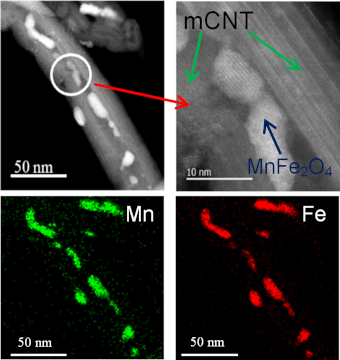
- nanoparticles have sizes ranging from 5 to 24 nm, with an estimated average size of 10–19 nm (Figure 1b). The particle size distribution is shown in Supporting Information File 1, Figure S2. In addition, a HRTEM image (Figure 1c) indicates a lattice spacing of 0.26 nm for the (311) plane of the MnFe2O4
- , the hyperfine fields at the tetrahedral and octahedral sites are lower than those of the bulk [21]. The large value used for the line width is due to the large size distribution and/or to surface effects. Although free and partially encapsulated manganese ferrite nanoparticles are prepared using two




Unravelling the interfacial interaction in mesoporous SiO2@nickel phyllosilicate/TiO2 core–shell nanostructures for photocatalytic activity
Beilstein J. Nanotechnol. 2020, 11, 1834–1846, doi:10.3762/bjnano.11.165
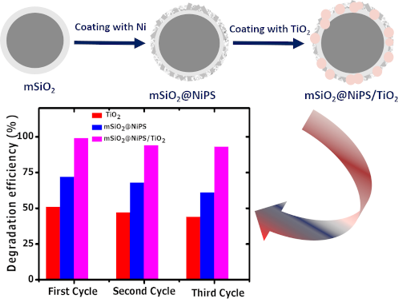
- agglomerated pores [49]. TiO2, on the other hand, displayed a type-II isotherm characteristic of a nonporous material (Supporting Information File 1, Figure S2b). The pore size distribution in the SiO2 was narrow (2–5 nm) and in the mesoporous range with an average pore size of 3.2 nm (Figure 2b). After
- /ammonia) [45][46][49]. In addition, the pore size distribution of the mSiO2@NiPS core–shell nanocomposite was broader (2–15 nm) than that of mSiO2 (Figure 2b). During the formation of the mSiO2@NiPS/TiO2 composite, the pore diameter slightly increased to 7.7 nm, indicating the presence of interparticle
- surface area was determined by the BET method from N2 adsorption data and the pore size distribution was determined by the Barret–Joyner–Halenda (BJH) method. The diffuse reflectance (DR) UV–vis spectra were obtained in the range of 200–800 nm using a Cary 500 spectrophotometer equipped with a Praying


Nanocasting synthesis of BiFeO3 nanoparticles with enhanced visible-light photocatalytic activity
Beilstein J. Nanotechnol. 2020, 11, 1822–1833, doi:10.3762/bjnano.11.164
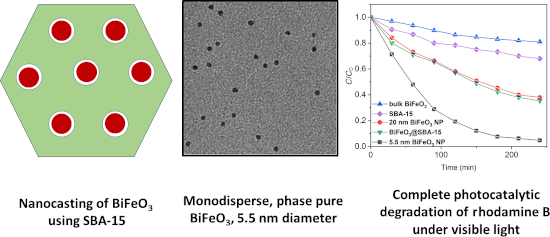
- exclusively round particles with a particle diameter of 5.5 nm with a very narrow size distribution (standard deviation of ±1.0 nm on 258 analyzed particles, see histogram in Figure 5b). The monodisperse nature of the nanoparticles as well as their size of 5.5 nm confirms the successful wet impregnation of
- very narrow particle size distribution. The results also suggest that the nanoparticles are characterized by a low concentration of surface defects and a low level of local strain, which is ideal for surface-based applications such as photocatalysis. This is confirmed by the reaction kinetics of the




Self-standing heterostructured NiCx-NiFe-NC/biochar as a highly efficient cathode for lithium–oxygen batteries
Beilstein J. Nanotechnol. 2020, 11, 1809–1821, doi:10.3762/bjnano.11.163
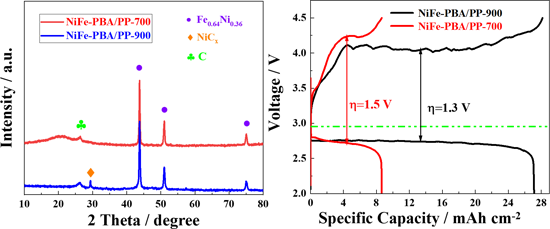
- 2a shows that the Prussian blue analogues formed on the surface of PP have a well-defined cubic shape with an uniform particle size distribution. The particle size was approx. 80 nm. These cubic particles were made out of many small particles and many cavities were observed on the surface. SEM images