Search results
Search for "transport properties" in Full Text gives 171 result(s) in Beilstein Journal of Nanotechnology.
Focused electron beam induced deposition: A perspective
Beilstein J. Nanotechnol. 2012, 3, 597–619, doi:10.3762/bjnano.3.70
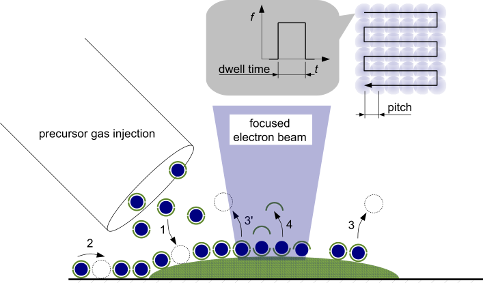
- metals are reviewed next with a focus on recent theoretical advancements in the field. As a case study the transport properties of Pt–C nanogranular FEBID structures are discussed. It is shown that by means of a post-growth electron-irradiation treatment the electronic intergrain-coupling strength can be
- continuously tuned over a wide range. This provides unique access to the transport properties of this material close to the insulator-to-metal transition. In the last part of the review, recent developments in mechanical strain-sensing and the detection of small, inhomogeneous magnetic fields by employing
- dissociation. As a matter of fact, post-growth irradiation can be advantageously used for fine-tuning the electronic transport properties of FEBID structures, and this will be discussed in the context of nanogranular structures later in this review. In any case, the energy spectrum of the electrons that can


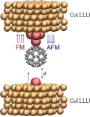
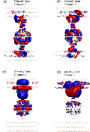
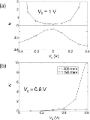
Strong spin-filtering and spin-valve effects in a molecular V–C60–V contact
Beilstein J. Nanotechnol. 2012, 3, 589–596, doi:10.3762/bjnano.3.69
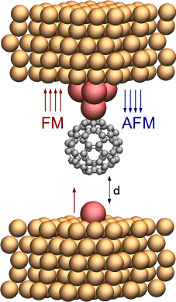
- transport properties of a C60-molecular junction in a setup relevant for STM experiments. Our results demonstrate how the FM and AFM configurations can be identified due to their markedly different conductance and shot noise. Thus, it may allow for the study of the magnetic coupling between tip and



P-wave Cooper pair splitting
Beilstein J. Nanotechnol. 2012, 3, 493–500, doi:10.3762/bjnano.3.56
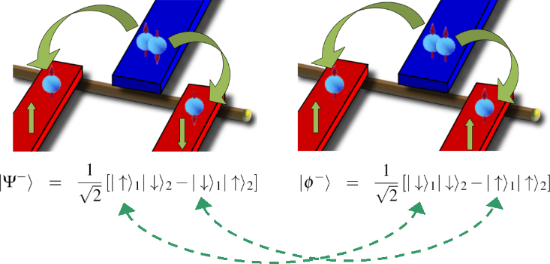
- parameters as far as spin-active scattering is concerned, namely γF1,1 = γF2,1, γF1,2 = γF2,2. In this case we define operators which allow us to rewrite the tunneling Hamiltonians in Equation 6 and Equation 7 as This minimal model still reveals all of the transport properties that we wish to discuss here


![[Graphic 23]](/bjnano/content/inline/2190-4286-3-56-i36.png?max-width=637&scale=1.18182) according to Equation 13 is cal...
according to Equation 13 is cal...
X-ray absorption spectroscopy by full-field X-ray microscopy of a thin graphite flake: Imaging and electronic structure via the carbon K-edge
Beilstein J. Nanotechnol. 2012, 3, 345–350, doi:10.3762/bjnano.3.39
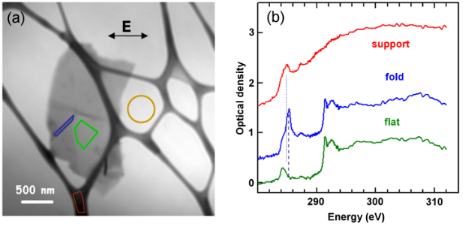
- presence of topological defects. Doping by metal impurities that were present in the original exfoliated graphite is indicated by the presence of a pre-edge signal at 284.2 eV. Keywords: carbon; graphene; nanostructure; NEXAFS; X-ray microscopy; Introduction The demonstration of the remarkable transport
- properties of graphene in 2004 by Geim and Novoselov triggered intense interest in its electronic structure [1][2][3][4][5][6][7][8][9][10][11]. A key aspect of the electronic structure, namely understanding how the graphene band structure is altered by impurity doping introduced during the synthesis



Molecular-resolution imaging of pentacene on KCl(001)
Beilstein J. Nanotechnol. 2012, 3, 186–191, doi:10.3762/bjnano.3.20
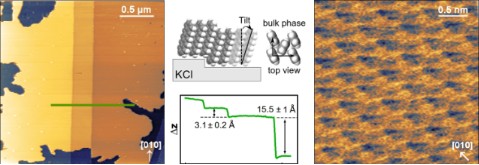
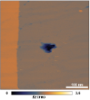
- causes a pronounced anisotropy of the electronic transport properties. Therefore, the electronic properties of pentacene are closely related to its structural order, and a precise control of the molecular packing and the crystalline orientation of thin films is of vital interest for the optimization of


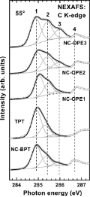
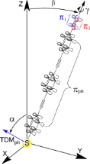
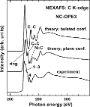
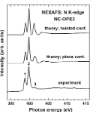
X-ray spectroscopy characterization of self-assembled monolayers of nitrile-substituted oligo(phenylene ethynylene)s with variable chain length
Beilstein J. Nanotechnol. 2012, 3, 12–24, doi:10.3762/bjnano.3.2
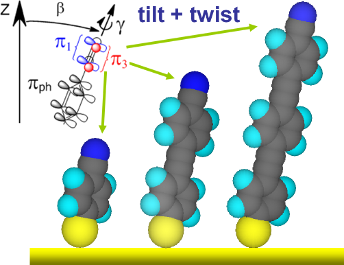
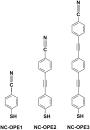
- functional molecular unit, which in the simplest case is represented by a conducting oligomeric molecular chain, often termed a “molecular wire”. The charge transport properties of this chain are an essential factor affecting the performance of the entire molecular device. In this context, transport
- properties of several potential molecular wires, including alkyl, oligophenyl, and oligo(phenylene ethynylene) (OPE) chains have been studied by a variety of different techniques including, for example, conducting-probe mercury drops [3][4][5], break junctions [6][7][8][9][10][11], scanning-microscopy tips



When “small” terms matter: Coupled interference features in the transport properties of cross-conjugated molecules
Beilstein J. Nanotechnol. 2011, 2, 862–871, doi:10.3762/bjnano.2.95
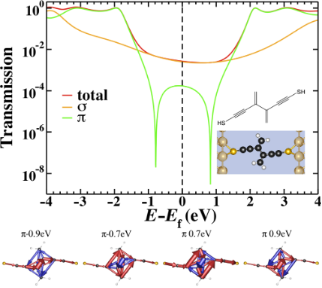
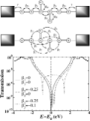
- significant qualitative changes in the transport properties. In particular, we show that coupling of multiple interference features in cross-conjugated molecules by through-space coupling will lead to splitting of the features, as can correlation effects. The degeneracy of multiple interference features in
- electronics; quantum interference; thermoelectrics; topology; Introduction Destructive interference effects, such as nodes in the transmission function, are a signature of coherence and offer a possible avenue for tuning the transport properties of single-molecule junctions. While not present in all systems
- realizing useful molecular devices. Previous work on supernodes focused on cyclic systems [16], but the transport properties of both cyclic [17][18] and acyclic [19][20] cross-conjugated molecules have also been predicted to exhibit interference features in experimentally relevant energy ranges. Here we




Current-induced dynamics in carbon atomic contacts
Beilstein J. Nanotechnol. 2011, 2, 814–823, doi:10.3762/bjnano.2.90
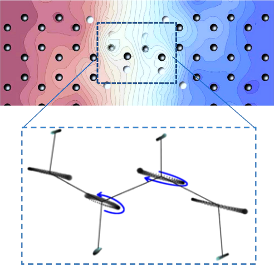
- show how the current-induced effects could be investigated in molecular contacts connecting gated graphene or nanotube electrodes. Graphene is now being explored very extensively due to its outstanding electrical and thermal transport properties [10][11][12]. Besides being highly important in their own
- ][20], their stability [21], and electron-transport properties [22][23][24]. Here we explore the current-induced forces and nanoscale Joule heating of the carbon chain system between electrically gated graphene electrodes. The paper is organized as follows. After a brief outline of the semiclassical
- obtained temperature distributions with (Figure 6c, Figure 6d) and without (Figure 6e, Figure 6f) the anharmonic interactions shows that anharmonic couplings between the vibrational modes have a significant influence on the heat-transport properties and local Joule heating of the system. The heating is



Enhancement of the critical current density in FeO-coated MgB2 thin films at high magnetic fields
Beilstein J. Nanotechnol. 2011, 2, 809–813, doi:10.3762/bjnano.2.89
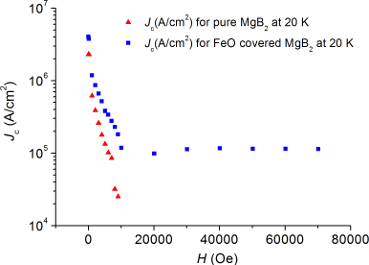
- material, with a hexagonal crystal structure and a critical temperature of Tc = 39 K, raised a lot of questions about its transport properties. This strong type-II superconductor has a fairly high critical current density in zero magnetic field, i.e., up to Jc ~ 1.6 × 10⁷ A/cm2 at 15 K [2]. This
- the effect of nanoparticles deposited onto the surface of MgB2 thin films on the transport properties of these films. In order to carry out the proposed research, MgB2 films with a thickness of about 600 nm were prepared on the MgO (100) substrates by using a “two-step” synthesis technology similar to


STM study on the self-assembly of oligothiophene-based organic semiconductors
Beilstein J. Nanotechnol. 2011, 2, 802–808, doi:10.3762/bjnano.2.88
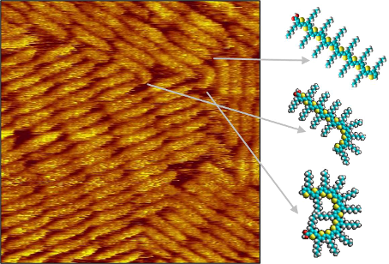
- transport properties in the solid state, which allow their application in a variety of organic-electronic devices [1]. Among others, organic semiconductors based on thiophenes are very promising materials in the field, because of their superior stability and the possibility to chemically functionalize them


Effect of the environment on the electrical conductance of the single benzene-1,4-diamine molecule junction
Beilstein J. Nanotechnol. 2011, 2, 755–759, doi:10.3762/bjnano.2.83
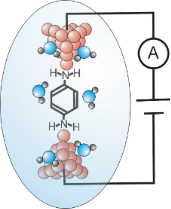
- coverage of the BDA molecule at metal electrodes and atomic and molecular motion of the single-molecule junction. Keywords: benzene-1,4-diamine; electric conductance; single-molecule junction; solvent; Introduction The electron transport properties through a single molecule bridging metal electrodes
- electrodes themselves. Wu et al. demonstrated that the aromatic π–π coupling between adjacent molecules affected the formation of the molecule junction and electron transport through the molecule junction [6]. Venkataraman’s group and our group independently evaluated the electron-transport properties of π
- benzenedithiol molecule junction depended on the length of the C–S bond; thus, the spread in the conductance value was suppressed in water compared with that in vacuum. These experimental and theoretical studies suggested that the solvent molecule could affect the electron-transport properties of the single


Towards quantitative accuracy in first-principles transport calculations: The GW method applied to alkane/gold junctions
Beilstein J. Nanotechnol. 2011, 2, 746–754, doi:10.3762/bjnano.2.82
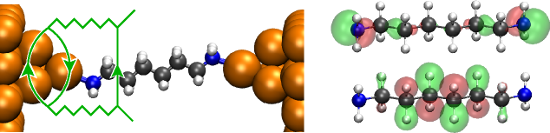
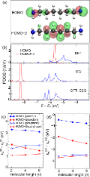
- -standing problem in the field of charge transport. Here we demonstrate excellent agreement with experiments for the transport properties of the gold/alkanediamine benchmark system when electron–electron interactions are described by the many-body GW approximation. The conductance follows an exponential
- pronounced due to the many possible contact geometries resulting from the strong Au–S interaction. Amine groups have been shown to produce more well-defined transport properties [1], which can be understood from the relatively weak Au–NH2 bond leading to larger structural selectivity [2]. Even for a given
- importance for the transport properties of molecular junctions and seems to be the dominant effect at low bias voltage. At higher bias voltages, many-body calculations on small model systems suggest that electron correlations induce additional shifting and broadening of the molecular levels, which can also



Lifetime analysis of individual-atom contacts and crossover to geometric-shell structures in unstrained silver nanowires
Beilstein J. Nanotechnol. 2011, 2, 740–745, doi:10.3762/bjnano.2.81
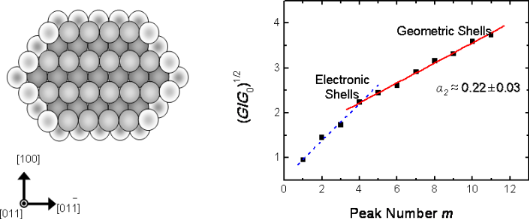
- conductance. Here, we study the transport properties and conductance-distribution statistics of electrochemically fabricated silver nanowires. We give a complete description of silver nanocontacts starting from individual atomic configurations (i.e., one or two atom contacts) proceeding to electronic-shell


Nonconservative current-induced forces: A physical interpretation
Beilstein J. Nanotechnol. 2011, 2, 727–733, doi:10.3762/bjnano.2.79
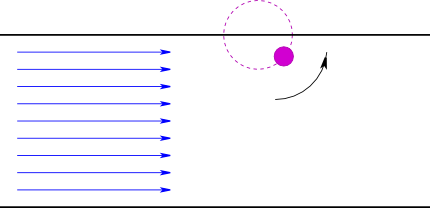
- –nuclear interactions lie at the heart of the transport properties of nanoscale conductors. Even in the limit of elastic (phonon-free) conduction, the nature and positions of nuclei in a nanojunction determine the external potential, experienced by current-carrying electrons, and, together with electron

Optical properties of fully conjugated cyclo[n]thiophenes – An experimental and theoretical approach
Beilstein J. Nanotechnol. 2011, 2, 720–726, doi:10.3762/bjnano.2.78
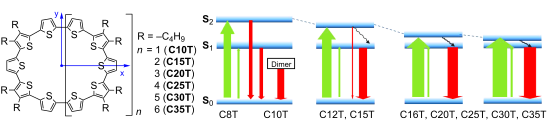
- In the last few decades organic conjugated polymers and oligomers, in particular poly- and oligothiophenes, have attracted a broad interest due to their excellent electronic and transport properties in the solid state, which allow their application in a variety of organic-electronic devices, such as


Nanostructured, mesoporous Au/TiO2 model catalysts – structure, stability and catalytic properties
Beilstein J. Nanotechnol. 2011, 2, 593–606, doi:10.3762/bjnano.2.63
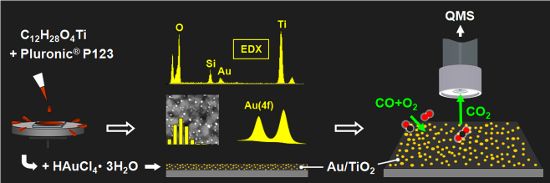
- , Germany Transmission Electron Microscopy Group, Ulm University, D-89069 Ulm, Germany Materials Chemistry, Paris-Lodron University Salzburg, Austria 10.3762/bjnano.2.63 Abstract Aiming at model systems with close-to-realistic transport properties, we have prepared and studied planar Au/TiO2 thin-film
- respect to their (internal) transport properties, as given, e.g., by the absence/presence of pore diffusion. Therefore, we recently started to develop a new type of model system, consisting of a nanoscale catalyst layer of a hundred to a few hundred nanometers thickness on a planar support. While both the
- preparation procedure and the internal surface chemistry and structure closely resemble those of realistic, dispersed catalysts, the transport properties in the nanostructured catalyst are much better controlled. Therefore, these model catalysts should be particularly suited for studies on the influence of






Self-organizing bioinspired oligothiophene–oligopeptide hybrids
Beilstein J. Nanotechnol. 2011, 2, 525–544, doi:10.3762/bjnano.2.57
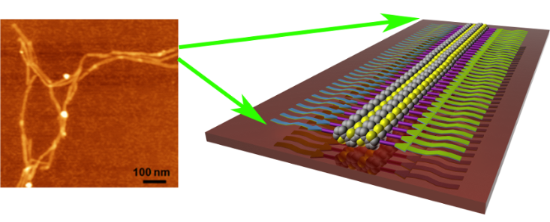
- fundamental understanding of their structural and charge transport properties. Various morphological organization examples of fibrillar aggregates that can be formed by polymer bioconjugates: (a) Wide planar tapes [18]; (b) helical superstructure [19]; (c) tapes with a dumb-bell shaped cross section [20]; (d




Charge transfer through single molecule contacts: How reliable are rate descriptions?
Beilstein J. Nanotechnol. 2011, 2, 416–426, doi:10.3762/bjnano.2.47
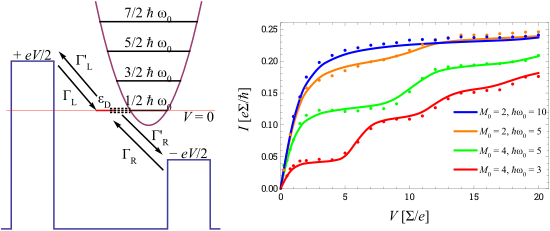
- or even superconducting metallic leads [2][3]. The objective is to exploit nonlinear transport properties of molecular junctions as the elementary units for a future molecular electronics. While the initial experiments were operated at room temperature, low temperatures down to the millikelvin range


![[Graphic 38]](/bjnano/content/inline/2190-4286-2-47-i61.png?max-width=637&scale=1.18182) ω0 and versus the electron–phonon coupling m0.
ω0 and versus the electron–phonon coupling m0.


Organic–inorganic nanosystems
Beilstein J. Nanotechnol. 2011, 2, 363–364, doi:10.3762/bjnano.2.41

- these interfaces on the transport properties of the devices, the electronic properties of various arrangements of organic molecules on top of metals must be studied. For the analysis of single molecules, the most promising technique is Scanning Tunneling Microscopy (STM) and its spectroscopic variant
Simple theoretical analysis of the photoemission from quantum confined effective mass superlattices of optoelectronic materials
Beilstein J. Nanotechnol. 2011, 2, 339–362, doi:10.3762/bjnano.2.40
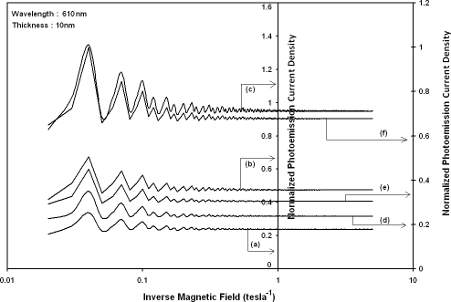
- materials was investigated on the basis of newly formulated electron energy spectra, in the presence of external light waves, which controls the transport properties of ultra-small electronic devices under intense radiation. The effect of magnetic quantization on the photoemission from the aforementioned


Review and outlook: from single nanoparticles to self-assembled monolayers and granular GMR sensors
Beilstein J. Nanotechnol. 2010, 1, 75–93, doi:10.3762/bjnano.1.10
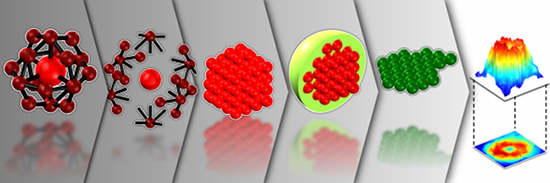
- we further analyze different properties of granular giant magnetoresistance sensors based on their spin-dependent transport properties. Review 1. Particle preparation In principle, two different strategies for the synthesis of nanoparticles may be pursued. The top-down method starts from the bulk
- results in a force onto the particles which entails the assembly close to air–liquid boundary. This allows for a controlled positioning of the particle monolayer within a specified target region (on top of magnetoresistive sensors, between contacts for measurements of electrical transport properties etc
- magnetism is dominated by external fields prior to interparticle coupling. b) In the high concentration regime, dipolar coupling plays the major role for the dynamic processes and the equilibrium configuration of magnetic particles assembled in monolayers. 3.2 Transport properties By embedding magnetic