Search results
Search for "aqueous solutions" in Full Text gives 215 result(s) in Beilstein Journal of Nanotechnology. Showing first 200.
The surface properties of nanoparticles determine the agglomeration state and the size of the particles under physiological conditions
Beilstein J. Nanotechnol. 2014, 5, 1774–1786, doi:10.3762/bjnano.5.188
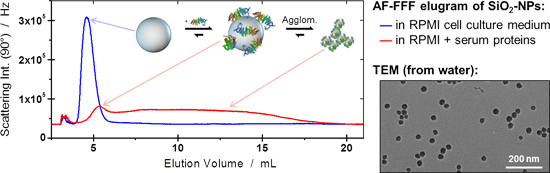
- (aqueous solutions of alkali silicates, e.g., Na2SiO3, Na4SiO4). Typically, this neutralization is performed by using ion exchange resins where particle sizes of around 5 to 500 nm in diameter can be realized [55][56][57]. 2. Pyrogenic silica (also referred to as “fumed silica”) is produced on the


Non-covalent and reversible functionalization of carbon nanotubes
Beilstein J. Nanotechnol. 2014, 5, 1675–1690, doi:10.3762/bjnano.5.178
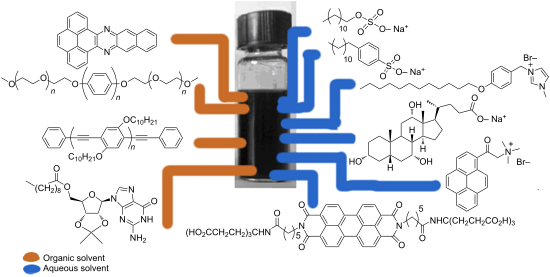
- , toluene and isooctane. Supramolecular complexes can be formed between CNTs and a biopolymer such as DNA, in order to disperse CNTs in aqueous solutions (see next section). Recently two decanoyl-functionalized guanosines (LipoGs, see Table 1) have been used [58] for the disaggregation of SWCNTs in
- to pH variations. At pH values higher than 9 the aqueous dispersions of PLL/SWCNTs complexes lose their stability due to the different affinity of PLL towards the nanotubes in their neutral or charged state. Indeed, in aqueous solutions at pH < 9 PLL interacts with the nanotubes either via
- conferring to the polymer a different dispersing power [93]. Another example of reversible dispersion/precipitation of CNTs is the folic acid (FA)/SWCNT system. The insolubility of folic acid in acidic aqueous solutions prevents it acting as a CNT dispersant. Nevertheless, once CNTs have been FA-coated, the



Ionic liquid-assisted formation of cellulose/calcium phosphate hybrid materials
Beilstein J. Nanotechnol. 2014, 5, 1553–1568, doi:10.3762/bjnano.5.167
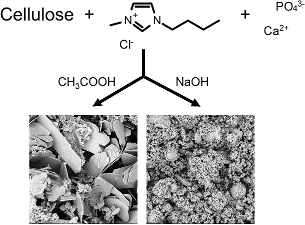
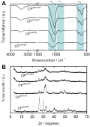
- conventional processes in aqueous solutions, XRD and FTIR spectroscopy (Figure 1) show that these precipitates are HAP and ClAP. Likely the reason for ClAP formation is the fact that the IL [Bmim][Cl] contains a high amount of chloride. The formation of Ca-deficient HAP or ClAP is further confirmed by EDXS
- the chemical composition of these materials is different from the original biomaterial [5][6][7][8][9][10][11]. Unfortunately, the synthesis of carbohydrate-based hybrid materials is not straightforward. This is due to the fact that many carbohydrates exhibit low solubilities in aqueous media. Aqueous
- solutions, however, are the most commonly used media for calcium phosphate mineralization [12][13]. As a result, mineralization of carbohydrates often yields heterogeneous materials with properties that are not suited for an application. In spite of this, a number of authors have reported the successful


Current state of laser synthesis of metal and alloy nanoparticles as ligand-free reference materials for nano-toxicological assays
Beilstein J. Nanotechnol. 2014, 5, 1523–1541, doi:10.3762/bjnano.5.165
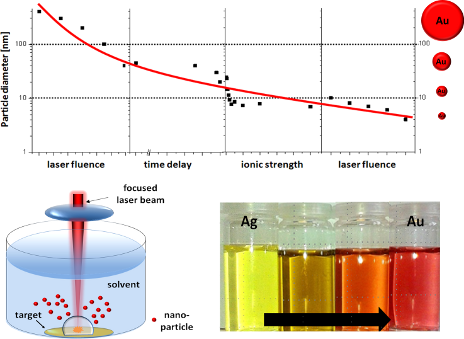
- been known that during measurements of the electrokinetic potentials in aqueous solutions the temperature dependence of conductivity, dielectric constant and viscosity are negligible up to a temperature of 343 K [106]. Based on these simplified assumptions, at room temperature (T = 293 K) a zeta


Liquid fuel cells
Beilstein J. Nanotechnol. 2014, 5, 1399–1418, doi:10.3762/bjnano.5.153
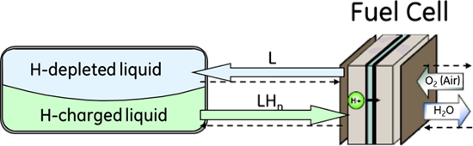
- energy density (Table 1) and solubility in water. Aqueous solutions of sugars (glucose, sucrose, and lactose) were used in implantable bio micro fuel cells [32] but their energy density is too small to be used in large scale applications. Aqueous solutions of some inorganic compounds containing

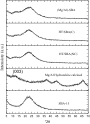
Nanoporous composites prepared by a combination of SBA-15 with Mg–Al mixed oxides. Water vapor sorption properties
Beilstein J. Nanotechnol. 2014, 5, 1226–1234, doi:10.3762/bjnano.5.136

- the sample was calcined in air at 550 °C for 6 h to eliminate the organic template. A typical Mg–Al hydrotalcite was synthesized according to the procedure reported in a previous work [21]. Two aqueous solutions, one containing Mg(NO3)2·6H2O and Al(NO3)3·7H2O (both from Aldrich, 98%), and the other



Surface processes during purification of InP quantum dots
Beilstein J. Nanotechnol. 2014, 5, 1220–1225, doi:10.3762/bjnano.5.135
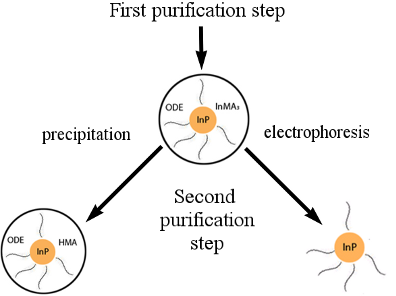
- of a “bad” one [8]. Another simple and effective method widely used in biological and biochemical research, protein chemistry and pharmacology is electrophoresis [9]. Electrophoretic techniques can separate charged objects in a uniform electric field, but this technique is usually applied to aqueous
- solutions of QDs [10]. In this paper we compare two methods of InP QDs purification: traditional precipitation and a new electrophoretic technique in an organic solvent and describe the surface processes that occur during purification. Experimental Materials and equipment For synthesis we used high-purity



The study of surface wetting, nanobubbles and boundary slip with an applied voltage: A review
Beilstein J. Nanotechnol. 2014, 5, 1042–1065, doi:10.3762/bjnano.5.117
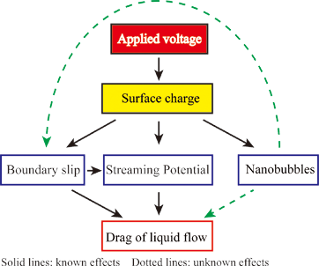
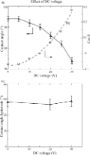
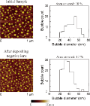
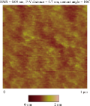
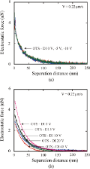
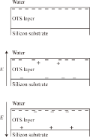
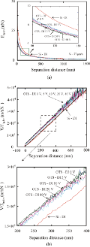
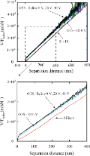
- charged due to the pressure of hydroxy ions in aqueous solutions [63]. The electric field provided by the applied voltage will affect the charged nanobubbles. Thus, the effect of the applied voltage on nanobubbles at the interface of solid and liquid should be studied experimentally. Currently, most of










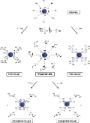
Double layer effects in a model of proton discharge on charged electrodes
Beilstein J. Nanotechnol. 2014, 5, 973–982, doi:10.3762/bjnano.5.111
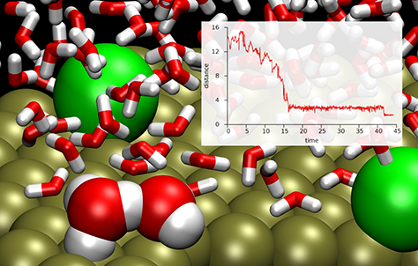
- layer effects on proton discharge reactions from aqueous solutions to charged platinum electrodes. We have extended a recently developed combined proton transfer/proton discharge model on the basis of empirical valence bond theory to include specifically adsorbed sodium cations and chloride anions. For
- compared reactive trajectory calculations of proton discharge from aqueous solutions to charged platinum electrodes for pure water, for adsorbate layers with single Na+ and Cl− ions, and for an adsorbate layer with two Cl− ions. All ions have their full positive or negative elementary charge, so that no


Nanodiamond-DGEA peptide conjugates for enhanced delivery of doxorubicin to prostate cancer
Beilstein J. Nanotechnol. 2014, 5, 937–945, doi:10.3762/bjnano.5.107
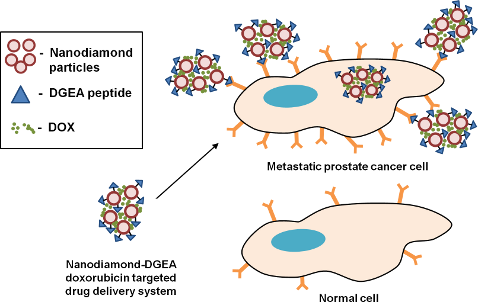
- ND-DGEA+DOX system decreased below 30 mV, both the conjugates and systems were stable at dilute concentrations in aqueous solutions for several days. ND-DGEA selective targeting The ability of DGEA to specifically interact with metastatic prostate cancer cells was observed using PC3 and hMSC cells


Optimizing the synthesis of CdS/ZnS core/shell semiconductor nanocrystals for bioimaging applications
Beilstein J. Nanotechnol. 2014, 5, 919–926, doi:10.3762/bjnano.5.105
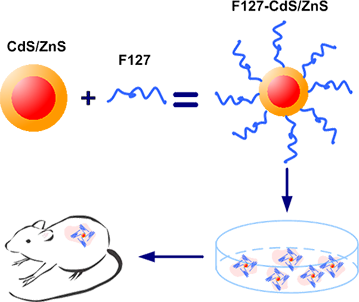
- aqueous solutions. It is critical to disperse QDs in water before their application by surface modification with biofunctional molecules for the purpose of bioimaging. However, for many biological applications, it is necessary to transfer the QDs into water through a capping ligand exchange [16][17][18


Volcano plots in hydrogen electrocatalysis – uses and abuses
Beilstein J. Nanotechnol. 2014, 5, 846–854, doi:10.3762/bjnano.5.96
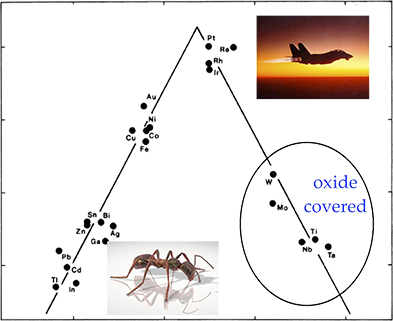
- denotes the exchange current density, and EMH the energy of hydride formation. Data taken from [5]. ’Volcano’ plots for hydrogen evolution in acid and alkaline aqueous solutions. Note that ascending and descending branch are reversed with respect to Figure 1. Square of the coupling constants between the


Nanostructure sensitization of transition metal oxides for visible-light photocatalysis
Beilstein J. Nanotechnol. 2014, 5, 696–710, doi:10.3762/bjnano.5.82
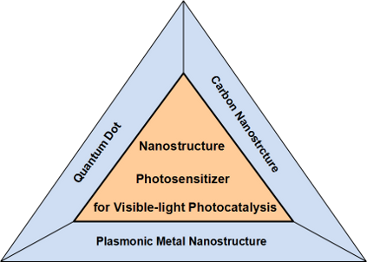
- benzene and methanol under visible light at room temperature [128]. The photocatalytic activities of ZnO/carbon nanodots are also reported to degrade aqueous solutions of rhodamine B under visible light irradiation [129]. Similarly, other carbon nanodots based wide-bandgap transition metal oxides, such as




Effects of the preparation method on the structure and the visible-light photocatalytic activity of Ag2CrO4
Beilstein J. Nanotechnol. 2014, 5, 658–666, doi:10.3762/bjnano.5.77
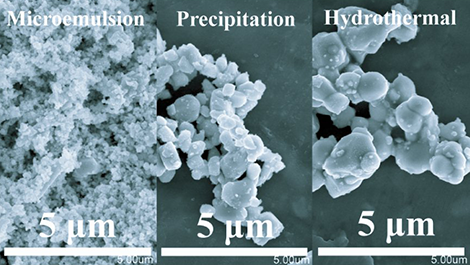
- solution (0.5 mL, 0.25 M) and kept for 1 h under stirring. The resultant suspension was aged for 24 h. Sample S-P: AgNO3 (1000 mL, 0.5 M) and K2CrO4 (1000 mL, 0.25 M) aqueous solutions were mixed together under vigorous stirring. The resultant suspension was then aged for 24 h. Sample S-H: The sample


Enhanced photocatalytic activity of Ag–ZnO hybrid plasmonic nanostructures prepared by a facile wet chemical method
Beilstein J. Nanotechnol. 2014, 5, 639–650, doi:10.3762/bjnano.5.75
- aqueous solutions of zinc nitrate and KOH involves the following reactions [37]: The concentration of KOH is an important factor in deciding the morphology of the ZnO nanostructures that are formed. The addition of aqueous KOH into Zn salt solution leads to formation of white precipitates of Zn(OH)2
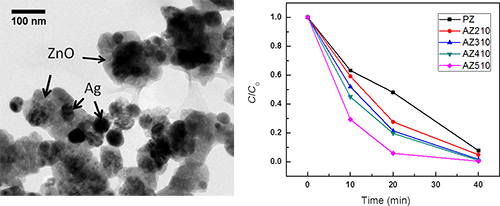
- on the effects of trisodium citrate on the shape evolution of ZnO nanostructures will be reported elsewhere. Photocatalytic studies Figure 7 shows the UV–visible absorption spectra of 10 μM MB aqueous solutions with different photocatalysts AZ210, AZ310, AZ410 and AZ510 following the irradiation with


Mesoporous cerium oxide nanospheres for the visible-light driven photocatalytic degradation of dyes
Beilstein J. Nanotechnol. 2014, 5, 517–523, doi:10.3762/bjnano.5.60
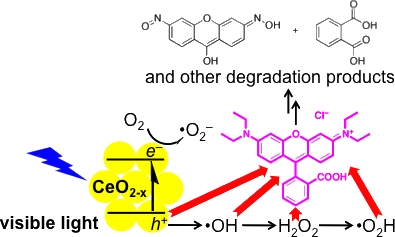
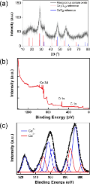
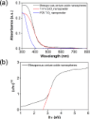
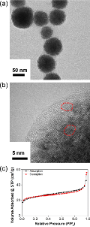
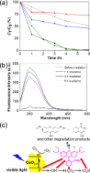
- enhanced visible light absorption has been exploited for driving the photocatalytic degradation of RhB in aqueous solutions (vide infra). The transmission electron microscopy (TEM) images of the cerium oxide sample supported the mesoporous nature and nanosphere morphology of the material (Figure 3a). The

A catechol biosensor based on electrospun carbon nanofibers
Beilstein J. Nanotechnol. 2014, 5, 346–354, doi:10.3762/bjnano.5.39
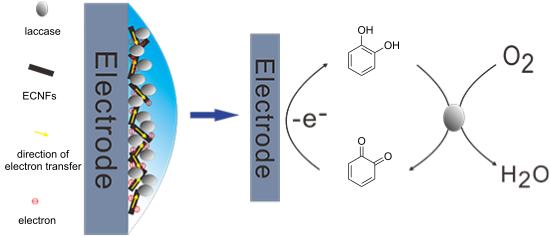
- , China). All reagents were analytical grade and used without further purification. All aqueous solutions were prepared with Milli-Q purified water (>18.0 MΩ·cm). The acetate buffer system (containing 0.2 M HAC-NaAC) was selected as buffer solution. Apparatus A Hitachi S-4800 field-emission scanning


Constant-distance mode SECM as a tool to visualize local electrocatalytic activity of oxygen reduction catalysts
Beilstein J. Nanotechnol. 2014, 5, 141–151, doi:10.3762/bjnano.5.14
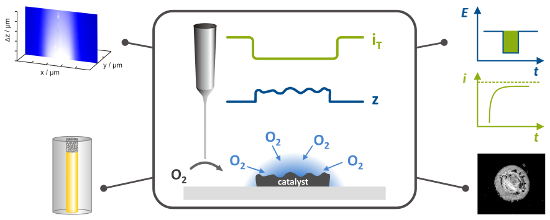
- ], future work aims towards the high-resolution detection of catalytic activity at elevated temperatures. Experimental Chemicals and materials All chemicals were used as received without further purification and all aqueous solutions were prepared using ultrapure water (Siemens Water Technologies




Some reflections on the understanding of the oxygen reduction reaction at Pt(111)
Beilstein J. Nanotechnol. 2013, 4, 956–967, doi:10.3762/bjnano.4.108
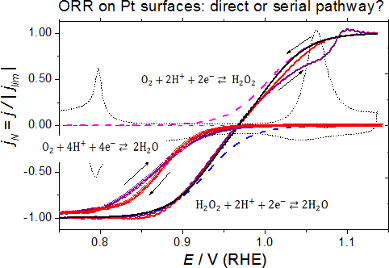
- Clavilier et al. [72]. All the experiments were carried out at room temperature, approximately 22 °C, in a two-compartment, three-electrode all-glass cell, by following a well detailed experimental protocol [73]. Suprapure perchloric acid (Merck) and H2O2 (Panreac) were used to prepare the aqueous solutions


Energy transfer in complexes of water-soluble quantum dots and chlorin e6 molecules in different environments
Beilstein J. Nanotechnol. 2013, 4, 895–902, doi:10.3762/bjnano.4.101
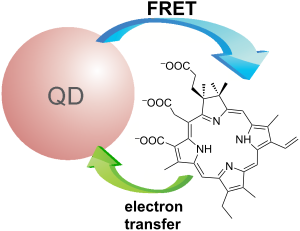
- CdSe/ZnS with different core sizes (2.5 nm, 3.5 nm, and 5 nm) were synthesized using similar methods as previously described [9]. All QD samples have a QY of about 20% in hydrophobic solvents and 5–8% in aqueous solutions. Complex formation in aqueous solutions To form water-soluble complexes of
- of the etching, carboxyl groups are produced on the interior surface and in the loosened layer nearby the pore wall. The dissociation of the carboxyl groups in aqueous solutions leads to the appearance of negative charges on the track pore surface [11]. This gives the opportunity to passivate the
- into the membranes due to electrostatic interaction with the carboxyl groups on the inner surface and in the loosened layer on the track pore wall. Membranes with embedded QDs were impregnated by aqueous solutions of Ce6 for formation of the QDs/Ce6 complexes. In order to study the dependence of the


Synthesis of boron nitride nanotubes from unprocessed colemanite
Beilstein J. Nanotechnol. 2013, 4, 843–851, doi:10.3762/bjnano.4.95
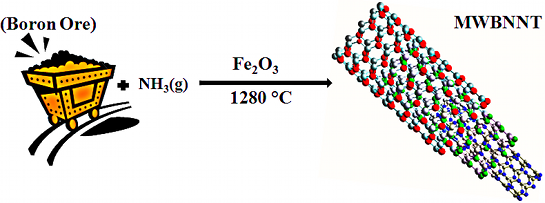
- BNNT-polymer composites can be prepared from polymeric structures containing aromatic moities to enhance their dispersibility in organic solvents [9][10]. DNA and proteins such as ferritin are used to disperse BNNTs in aqueous solutions for biological applications [11]. The BNNTs are also used to


Probing the plasmonic near-field by one- and two-photon excited surface enhanced Raman scattering
Beilstein J. Nanotechnol. 2013, 4, 834–842, doi:10.3762/bjnano.4.94
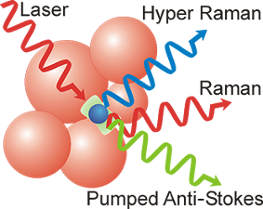
- following, we want to determine how many molecules can find a place at the hottest hot spots. Based on this information, we can infer the number of hot spots and their geometrical size. SERS signal vs concentration of the target molecule The experiments were performed in aqueous solutions of silver
- factor on the order of 1014 when 830 nm excitation is used. This level of enhancement was confirmed by checking anti-Stokes to Stokes signal ratios in SEPARS experiments. SERS samples of rhodamine 6G concentrations between 10−15 and 10−6 M were prepared by adding aqueous solutions of the dye at




Structural, optical and photocatalytic properties of flower-like ZnO nanostructures prepared by a facile wet chemical method
Beilstein J. Nanotechnol. 2013, 4, 763–770, doi:10.3762/bjnano.4.87
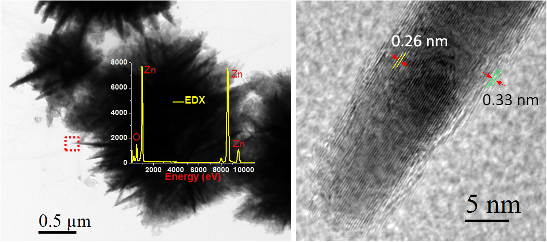
- uses zinc acetate and KOH as precursors mixed in a ratio of 1:10 under stirring at 60 °C. It is well known that the formation of ZnO nanoparticles in aqueous solutions from Zn(CH3COO)2 and KOH under alkaline conditions and heating involves the following reactions [39][40]: Firstly, the addition of KOH
- chemical route using alkali precipitation from aqueous solutions of Zn(CH3COO)2·2H2O and KOH. In a typical synthesis, calculated amounts of Zn(CH3COO)2·2H2O was added into 100 mL of doubly distilled water under stirring to prepare 0.02 M, 0.05 M and 0.1 M solutions. Different amounts of KOH were added
- measuring the degradation of MB under sunlight irradiation. Aqueous solutions of 22.4 μM MB were prepared in 100 mL doubly distilled water. For the photocatalytic studies, typically 5 mg of the as-synthesized ZnO nanostructures as photocatalysts were ultrasonically dispersed the MB solutions in 10 mL glass


Ultramicrosensors based on transition metal hexacyanoferrates for scanning electrochemical microscopy
Beilstein J. Nanotechnol. 2013, 4, 649–654, doi:10.3762/bjnano.4.72
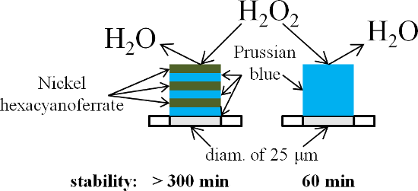
- achieved. However, the stability of PB in neutral aqueous solutions is not sufficient in respect to the long-term continuous monitoring of high levels of H2O2 [20]. Moreover, different iron complexing agents (e.g., EDTA) are known to solubilize PB. This problem is particularly severe for PB-modified UME
- (CN)63− ions tend to form insoluble precipitate in pure aqueous solutions. Therefore an excessive amount of supporting electrolyte (0.5 М KCl) was used during the deposition of Ni–HCF films. Deposition of Ni–HCF was performed by using CV as described elsewhere [20]. Every two cycles of PB deposition


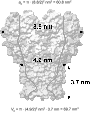
Nanoscopic surfactant behavior of the porin MspA in aqueous media
Beilstein J. Nanotechnol. 2013, 4, 278–284, doi:10.3762/bjnano.4.30
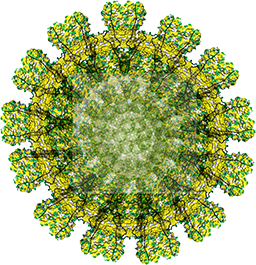
- aggregation of individual MspA in aqueous solutions ((5 × 10⁻⁵)× PBS and 1× PBS) as a function of temperature. The results are summarized in Figure 2. MspA shows a distinct tendency to aggregate independently of the ionic strength of the surrounding medium. The maxima in hydrodynamic diameter of the