Search results
Search for "capillary" in Full Text gives 260 result(s) in Beilstein Journal of Nanotechnology. Showing first 200.
Structural and tribometric characterization of biomimetically inspired synthetic "insect adhesives"
Beilstein J. Nanotechnol. 2017, 8, 45–63, doi:10.3762/bjnano.8.6
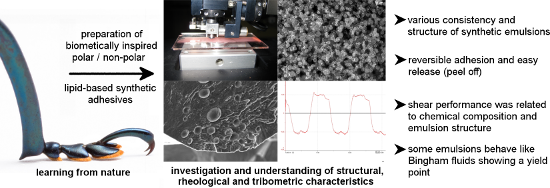
- adhesive fluids produced by glandular systems underlying the adhesive cuticular structures [2][3][4]. One major function of these liquid adhesives is to wet and maximize the contact area with the substrate by filling its surface irregularities [5][6]. In addition, viscous and capillary forces are conveyed


Streptavidin-coated gold nanoparticles: critical role of oligonucleotides on stability and fractal aggregation
Beilstein J. Nanotechnol. 2017, 8, 1–11, doi:10.3762/bjnano.8.1
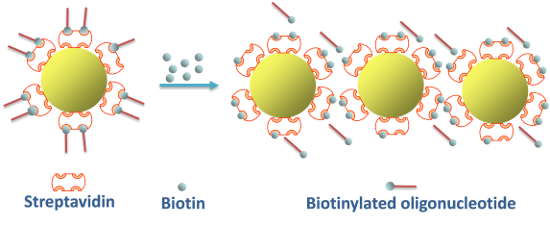
- or 0.22 µm pore size membrane. Samples (1 mL) were transferred into a disposable polystyrene cuvette for DLS measurements while a folded capillary cell was used for ζ-potential measurements. The concentration of solutions (0.1–1 nM) was adjusted to accommodate scattering properties of samples and




When the going gets rough – studying the effect of surface roughness on the adhesive abilities of tree frogs
Beilstein J. Nanotechnol. 2016, 7, 2116–2131, doi:10.3762/bjnano.7.201
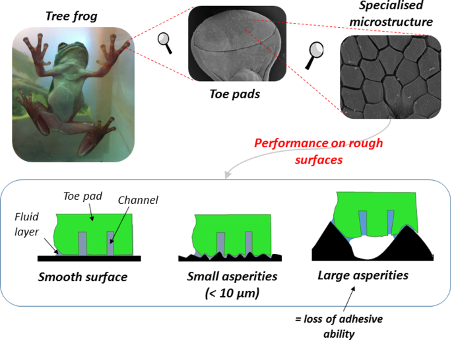
- capillary and viscosity forces between the pad and the surface [1][2][3]. The polygonal epithelial cells (approx. 10 µm in diameter) are covered with nanostructures, which are thought to create friction by direct contact with the surface [3]. The combination of the fluid filled adhesive area and the
- specialised morphology allow the tree frogs to climb smooth vertical and overhanging surfaces. The attachment ability of tree frogs is affected by both surface chemistry and surface roughness. Hydrophobic leaves (such as those on lotus leaves [4]), could affect the capillary forces produced by the pad (which
- capillary forces will be reduced due to a decline in the Laplace pressure component of capillarity [7]. Bhushan’s ‘submerged‘ regime is that of a rock/torrent frog climbing water-covered rock, where the toe pads are completely submerged, thus abolishing any meniscus [8]. In such cases, capillary forces will




Annealing-induced recovery of indents in thin Au(Fe) bilayer films
Beilstein J. Nanotechnol. 2016, 7, 2088–2099, doi:10.3762/bjnano.7.199
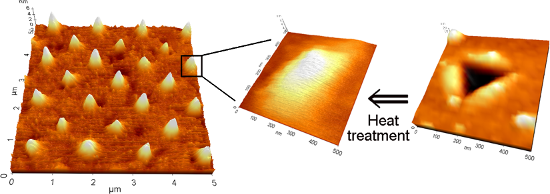
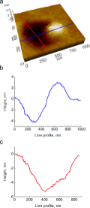
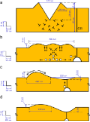
- processes in the material controlled by capillary forces [10][11] or the interaction of defects [12]. The healing capability of defects was recently demonstrated for Au [13] and Fe [14] nanoparticles. It was shown that the controlled injection of dislocations into single-crystalline faceted metal





Solvent-mediated conductance increase of dodecanethiol-stabilized gold nanoparticle monolayers
Beilstein J. Nanotechnol. 2016, 7, 2057–2064, doi:10.3762/bjnano.7.196
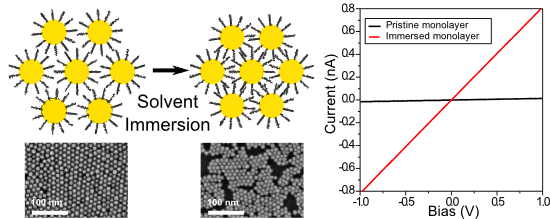
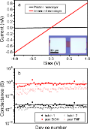
- for 10 s. From Figure 4, we can conclude that the compaction process is completed within one hour. This excludes that capillary forces originating from a drying solvent meniscus cause the compaction of the monolayer, because it would be independent of the immersion duration. The observed time



Chitosan-based nanoparticles for improved anticancer efficacy and bioavailability of mifepristone
Beilstein J. Nanotechnol. 2016, 7, 1861–1870, doi:10.3762/bjnano.7.178
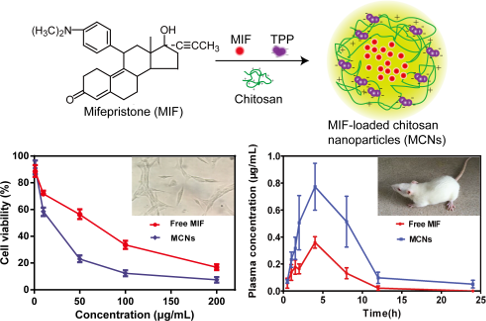
- Corporation., Milford, MA, USA) was operated in positive mode and equipped with an electrospray ionization (ESI) source. The main operating parameters were optimized as follows: desolvation gas (nitrogen) 600 L/h, cone gas (nitrogen) 50 L/h, collision gas (argon) about 0.15 MPa, cone voltage 30 V, capillary


Nano- and microstructured materials for in vitro studies of the physiology of vascular cells
Beilstein J. Nanotechnol. 2016, 7, 1620–1641, doi:10.3762/bjnano.7.155
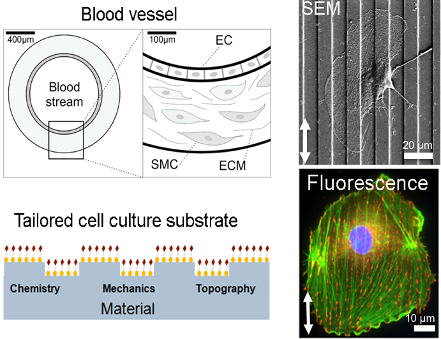
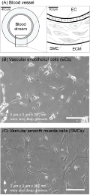
- solution with the desired polymer is ejected through a capillary towards a substrate by applying a high-voltage electric field. Long fibers with diameters in the range from 2 nm to several micrometers can be generated [69][70][71][72]. However, electrospinning has not been yet satisfactorily employed to



Surface roughness rather than surface chemistry essentially affects insect adhesion
Beilstein J. Nanotechnol. 2016, 7, 1471–1479, doi:10.3762/bjnano.7.139
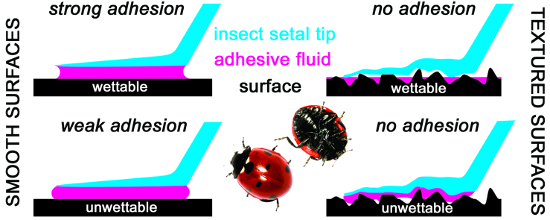
- to that observed in air. The oil-covered hairy pads on the feet of the beetle show a pinning effect, which retains air bubbles, and capillary attachment is produced by bubbles in contact with the hydrophobic substrate. Additionally, the liquid bridges of the pad between the foot and the substrate
- also produce capillary forces. Inspired by this idea, artificial silicone polymer structures with underwater adhesive properties were fabricated [34]. Thus, the relationship between surface structures and the attachment of insects, in combination with their particular chemical/physical properties, has



False positives and false negatives measure less than 0.001% in labeling ssDNA with osmium tetroxide 2,2’-bipyridine
Beilstein J. Nanotechnol. 2016, 7, 1434–1446, doi:10.3762/bjnano.7.135
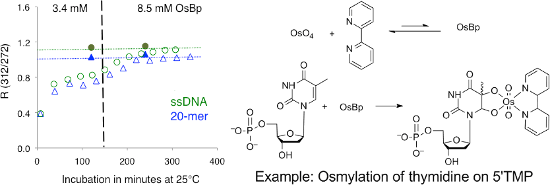
- properties of the degradation products via nanopore translocation can be evaluated to assure base calling quality in a DNA sequencing effort. Keywords: α-hemolysin; capillary electrophoresis; DNA sequencing; high-performance liquid chromatography; nanopores; osmium tetroxide bipyridine; osmylated oligos
- (HPLC) or capillary electrophoresis (CE). It turns out that both analytical tools clearly resolve DNA from the OsBp label, which appears as a single peak with the methods used in this report. For the more typical cases where the oligo/DNA has 5 or more pyrimidines, the resolution between intact and
- lower fraction of T and C in the oligo. The ratio T/Ntot = 0.30 for the 20-mer and 0.33 for M13mp18; (T + C)/Ntot equals 0.50 for the 20-mer and 0.54 for M13mp18 [31]. Upper limits for purine osmylation and DNA backbone degradation (false positives) Capillary zone electrophoresis (CZE) methods were


Three-gradient regular solution model for simple liquids wetting complex surface topologies
Beilstein J. Nanotechnol. 2016, 7, 1377–1396, doi:10.3762/bjnano.7.129

- cavities. In such structures we should anticipate the occurrence of capillary condensation or, alternatively, capillary drying. For this reason we use the regular solution model to study classical capillary condensation. To this end we consider a system that contains two surfaces. One at z = 0 and another
- oversaturation of water in the vapour phase; a phenomenon named after Kelvin. With oversaturation of the system, which necessarily occurs in our calculations due to the finite size of our droplets, one will invariably get closer to the spinodal point of the capillary condensation process. Hence, oversaturation
- may trigger the filling of confined regions by the liquid. Small droplets cause a stronger oversaturation than larger droplets and the presence of small droplets may result in a spontaneous filling of the voids by capillary condensation when this may not yet occur for larger drops. The radius


![[Graphic 10]](/bjnano/content/inline/2190-4286-7-129-i31.png?max-width=637&scale=1.18182) and standard deviation as a function of the cavity diameter d (in...
and standard deviation as a function of the cavity diameter d (in...

![[Graphic 20]](/bjnano/content/inline/2190-4286-7-129-i41.png?max-width=637&scale=1.18182) and the corresponding fluctuations (measured along the x-direction) indica...
and the corresponding fluctuations (measured along the x-direction) indica...

![[Graphic 28]](/bjnano/content/inline/2190-4286-7-129-i49.png?max-width=637&scale=1.18182) and the corresponding standard deviation as measure of variation in the ...
and the corresponding standard deviation as measure of variation in the ...

![[Graphic 39]](/bjnano/content/inline/2190-4286-7-129-i60.png?max-width=637&scale=1.18182) and standard deviation as function of cut-off fraction c for fixed ...
and standard deviation as function of cut-off fraction c for fixed ...
Viability and proliferation of endothelial cells upon exposure to GaN nanoparticles
Beilstein J. Nanotechnol. 2016, 7, 1330–1337, doi:10.3762/bjnano.7.124
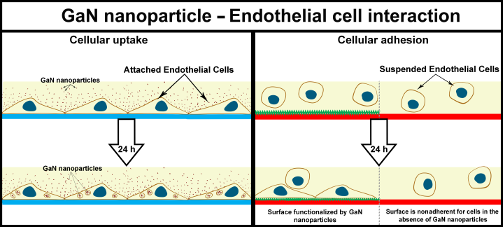
- capillary tubes and thus develop new blood vessels via ramification of the existing ones. The development of the blood vessel wall after the capillary formation discloses the efficient intercellular communication [10]. Tissue engineering and artificial organ development are also emerging fields that involve



Influence of ambient humidity on the attachment ability of ladybird beetles (Coccinella septempunctata)
Beilstein J. Nanotechnol. 2016, 7, 1322–1329, doi:10.3762/bjnano.7.123
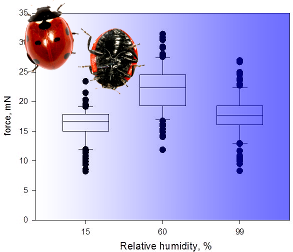
- capillary forces (wet adhesion). The fluid can increase the contact area by filling minute cavities of micro- and nano-rough surfaces, where setae otherwise cannot adapt to, and prevents slipping of the foot due to its specific rheological properties [31][32][33][34][35]. It was demonstrated that the
- adhesive pads of spiders and geckos the humidity-related effects on adhesion can be explained by three different mechanisms: (1) capillary forces due to the formation of liquid bridges; (2) changes in the effective short-range interactions due to adsorbed monolayers of water on the substrate [11][14]; (3
- against it. The tarsal secretions in hairy attachment pads of beetles were found to be mainly lipid-based [22][26][27][49][50], with only a small volatile fraction (likely water) [30]. Peisker et al. [46] speculated that these secretions may have an additional function, apart from forming capillary


Functional diversity of resilin in Arthropoda
Beilstein J. Nanotechnol. 2016, 7, 1241–1259, doi:10.3762/bjnano.7.115
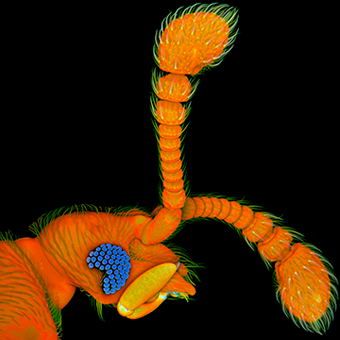
- contribute to the adhesion efficiency of adhesive pads in the form of capillary interactions and cleaning effects. With regard to the resilin-dominated setal tips, an additional function is conceivable. As described above, resilin is only soft and flexible when it is hydrated. Accordingly, to keep the


Mesoporous hollow carbon spheres for lithium–sulfur batteries: distribution of sulfur and electrochemical performance
Beilstein J. Nanotechnol. 2016, 7, 1229–1240, doi:10.3762/bjnano.7.114
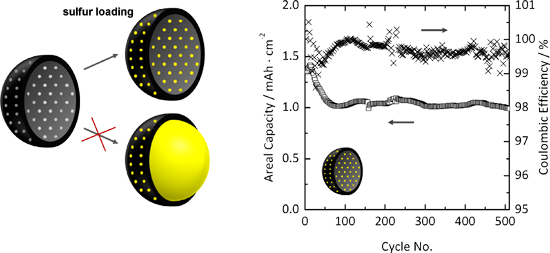
- pores are blocked by sulfur and thus, are no longer accessible for nitrogen gas during the measurements. We believe that the strong capillary forces on liquids/melts in the mesopores are responsible for the pore blocking effect. Once sulfur has filled the mesopores there is no further driving force for


Reasons and remedies for the agglomeration of multilayered graphene and carbon nanotubes in polymers
Beilstein J. Nanotechnol. 2016, 7, 1174–1196, doi:10.3762/bjnano.7.109
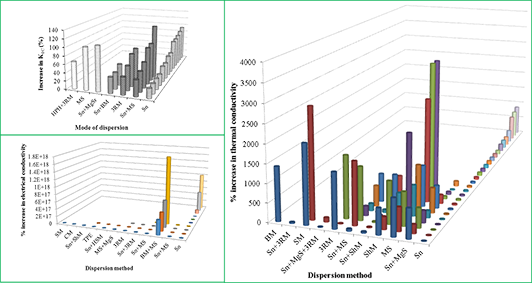
- synthesis of endohedral CNTs (Figure 12c) is a physical modification in which the foreign atoms or molecules are inserted inside of the CNT by capillary action through defect sites [40]. The influence of the different functionalization methods on K1C values is shown in Figure 13. The smallest improvement


Reorientation of single-wall carbon nanotubes in negative anisotropy liquid crystals by an electric field
Beilstein J. Nanotechnol. 2016, 7, 825–833, doi:10.3762/bjnano.7.74
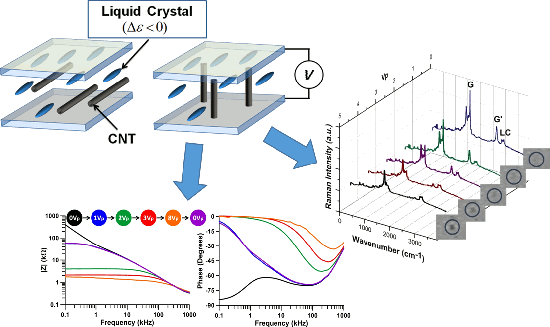
- magnetically stirred at room temperature until toluene evaporation was complete. The LC cells are capillary filled. The impedance measurements require a small signal (<0.1Vrms) to obtain a linear system response. In this study, the effect of external electric fields must be included. Usually, the alternative


Cantilever bending based on humidity-actuated mesoporous silica/silicon bilayers
Beilstein J. Nanotechnol. 2016, 7, 637–644, doi:10.3762/bjnano.7.56
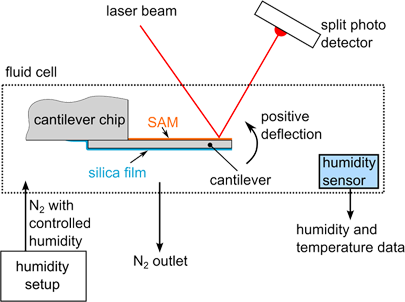
- water sorption isotherms measured for similar materials, indicating the different pressures for capillary condensation during adsorption and capillary evaporation during desorption, respectively, in pores with quite monodisperse size distributions [22]. It is well known that adsorption and desorption of
- filling/emptying (capillary condensation/evaporation) of the pores with water. Because the change of the relative humidity of air will also change its index of refraction (IOR), n, and the deflection read-out was done via a laser beam reflected from the cantilever, we have checked whether this can
- level of the individual pores can now be compared with the macroscopic cantilever deflection δ shown in Figure 2. Both quantities increase more gently at low RH, and become considerably steeper above 70%, where the onset of capillary condensation is expected. Indeed, the shape of the cantilever


Correlative infrared nanospectroscopic and nanomechanical imaging of block copolymer microdomains
Beilstein J. Nanotechnol. 2016, 7, 605–612, doi:10.3762/bjnano.7.53
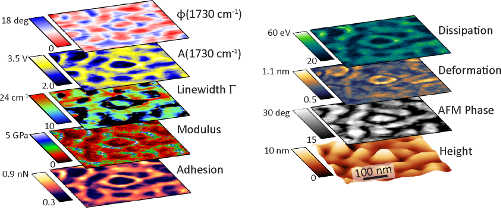
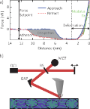
- ]. However, the tapping phase is also affected by the intermittent formation of a capillary water neck between tip and sample as the cantilever oscillates, which can lead to either net attractive or net repulsive regimes depending on tapping amplitude, relative humidity, and local curvature of the tip and
- or capillary forces). It can reflect variations in the Hamaker constant of the van der Waals interaction, surface charges, or hydrophilicity [32]. It has been observed in PS-b-PMMA that PS preferentially adsorbs onto a gold surface compared to PMMA [33]. Thus, the higher attractive forces over PS
- operating in the repulsive capillary force regime. Tip–surface capillary forces are most studied in the context of resonant cantilever motion instead of the slower, nonresonant distance modulation employed in PF-QNM. Nonetheless, our modulation amplitude (15 nm), measured tip radius (16–25 nm), and the
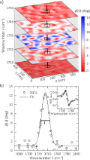


![[Graphic 9]](/bjnano/content/inline/2190-4286-7-53-i10.png?max-width=637&scale=1.18182) (1730 ...
(1730 ...
Single pyrimidine discrimination during voltage-driven translocation of osmylated oligodeoxynucleotides via the α-hemolysin nanopore
Beilstein J. Nanotechnol. 2016, 7, 91–101, doi:10.3762/bjnano.7.11
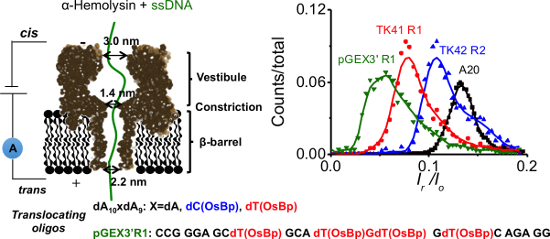
- dA10dCdA9 is monitored by capillary electrophoresis (CE) analysis. Any side-reaction, or any backbone degradation, or oxidative damage would have been detectable as additional peaks with typical detectability of 0.1%. Any product formed by these processes is expected to retain some nucleotides, and
- pore we also tested the later with a dA25 tail added either to the 3’- or the 5’-end (Table 1). The oligos used in this study were purchased from Integrated DNA Technologies, as PAGE-purified and desalted materials (Table 1). They were analyzed by capillary electrophoresis (CE) to assess purity, and
- ) testable. Experimental Part A, Materials, oligos, preparation of osmylated oligos, capillary electophoresis (CE) analysis, and high performance liquid chromatography (HPLC) analysis: HPCE grade solution of 50 mM sodium tetraborate pH 9.3 was purchased from Agilent Technologies. A 4% aqueous osmium



pH-Triggered release from surface-modified poly(lactic-co-glycolic acid) nanoparticles
Beilstein J. Nanotechnol. 2015, 6, 2504–2512, doi:10.3762/bjnano.6.260
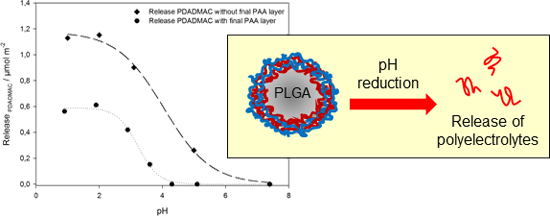
- sample solutions were prepared in D2O. For quantitative NMR measurements of PDADMAC, a solution of resorcinol in D2O was used as an external standard. It was filled into a melting point capillary, which was flame-sealed on both ends and inserted on the central axis of an NMR tube containing the sample


Green synthesis, characterization and catalytic activity of natural bentonite-supported copper nanoparticles for the solvent-free synthesis of 1-substituted 1H-1,2,3,4-tetrazoles and reduction of 4-nitrophenol
Beilstein J. Nanotechnol. 2015, 6, 2300–2309, doi:10.3762/bjnano.6.236
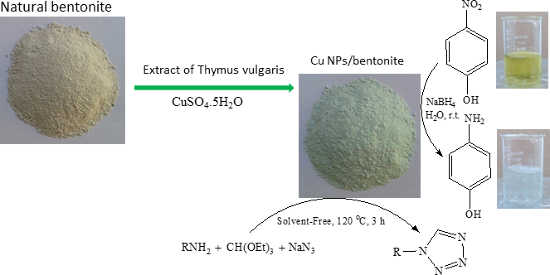
- NMR spectra were obtained on a Brucker Avance 90 MHz spectrometer, using tetramethylsilane (TMS) as an internal standard. The melting points were taken in open capillary tubes with a Büchi 510 melting point apparatus and were uncorrected. Thin-layer chromatography (TLC) was performed on silica gel


A simple and efficient quasi 3-dimensional viscoelastic model and software for simulation of tapping-mode atomic force microscopy
Beilstein J. Nanotechnol. 2015, 6, 2233–2241, doi:10.3762/bjnano.6.229
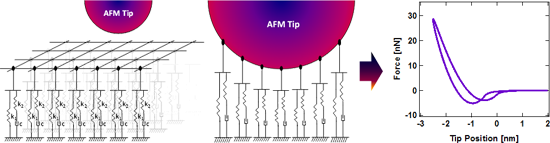
- forces (such as dispersion, electrostatic, magnetic), adhesive forces (such as chemical, capillary), viscoelastic forces, plastic forces, etc. For the case of viscoelasticity, in the most elaborate case one would need to solve the relaxation of the surface in 3D with the appropriate constitutive relation



Comprehensive characterization and understanding of micro-fuel cells operating at high methanol concentrations
Beilstein J. Nanotechnol. 2015, 6, 2000–2006, doi:10.3762/bjnano.6.203
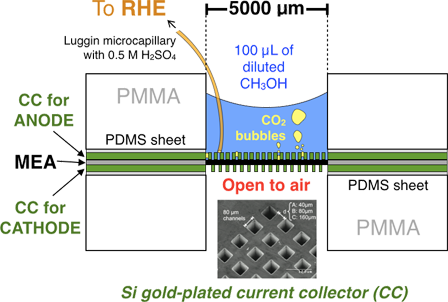
- ]. The use of a reference hydrogen electrode (RHE) allows one to studying the fuel crossover and the performance of the anode and the cathode, separately [19][20][21]. Unfortunately, this method requires the modification of the electrode compartments. On the other hand, through a Luggin capillary placed
- , in a simple and straightforward way, the performance of each electrode of a passive, air-breathing µDMFC, submitted to CH3OH up to 20 M. The stabilization and fuel consumption in the micro-system are also discussed. Results and Discussion E–I characteristics of the µDMFC The Luggin capillary was
- ) was achieved when adding 20 M CH3OH, but it lasted only 7.1 s as the fuel quickly poisoned the cathode. These observations were acquired by means of an RHE with a micro-capillary. It is simple and can be equally used for studying the performance of the anode and the cathode of other small fuel cells



Electrospray deposition of organic molecules on bulk insulator surfaces
Beilstein J. Nanotechnol. 2015, 6, 1927–1934, doi:10.3762/bjnano.6.195
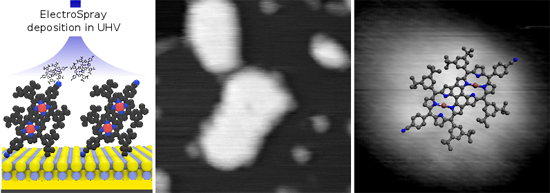
- performed with a modified commercial MolecularSpray setup [33], of which a scheme is shown in Figure 1. The mixture of solvent and molecules is introduced by a syringe pump and a needle (1) into the first vacuum chamber (3) trough a capillary (2) by applying a bias of several kilovolts (1 to 5 kV). Behind
- the entrance capillary, three chambers (3, 4, 5) are used to pump solvent molecules and to reach the high vacuum level in the preparation chamber (7). The extra vacuum chamber (6) was added to further decrease the vacuum level during deposition, typical vacuum ranges are indicated in millibars. Two
- at an Ar+ pressure of p = 3 × 10⁻⁶ bar. The ESI setup (Figure 1) is connected to the UHV preparation chamber of the system. It is a commercial system from MolecularSpray [14][33]. After the spray is formed in air, highly charged droplets [49][50][51] enter by a capillary into the differential pumping


Temperature-dependent breakdown of hydrogen peroxide-treated ZnO and TiO2 nanoparticle agglomerates
Beilstein J. Nanotechnol. 2015, 6, 1897–1903, doi:10.3762/bjnano.6.193
- the temperature. The suspension was placed into a folded capillary cell for zeta potential measurement and the zeta potential of the NPs was measured at 30 °C. All experiments were performed at least three times. Results and Discussion Representative TEM images of the ZnO and TiO2 NPs are provided in