Search results
Search for "depletion" in Full Text gives 188 result(s) in Beilstein Journal of Nanotechnology.
Photoresponse from single upright-standing ZnO nanorods explored by photoconductive AFM
Beilstein J. Nanotechnol. 2013, 4, 208–217, doi:10.3762/bjnano.4.21
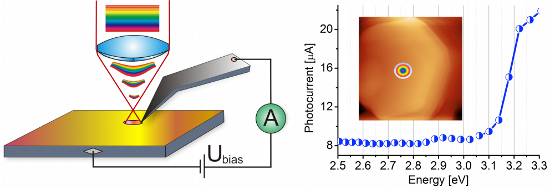
- than the band gap of ZnO (3.37 eV). Discussion The standard model to explain the photoresponse in ZnO involves the photodesorption of oxygen molecules [22]. Adsorption of oxygen on the ZnO surface causes the capture of electrons leading to the formation of a negatively charged layer and a depletion
- holes move toward the surface in the electric field of the surface depletion region and recombine with the electrons there . This results in an excess of electrons, which were generated by the light absorption contributing to the photocurrent when the sample is biased. This model implies also that the



Nanostructure-directed chemical sensing: The IHSAB principle and the dynamics of acid/base-interface interaction
Beilstein J. Nanotechnol. 2013, 4, 20–31, doi:10.3762/bjnano.4.3
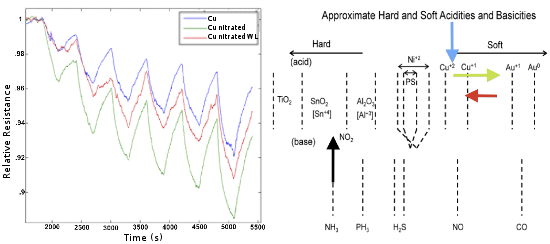
- PS interface and attempts to extract electrons, the sensor resistance rises rapidly to a point where the electron depletion reaches a limiting value as nanostructured TiO2 islands coupled to the PS interface prevent further electron withdrawal and reverse the flow of electrons so as to increase the


Diamond nanophotonics
Beilstein J. Nanotechnol. 2012, 3, 895–908, doi:10.3762/bjnano.3.100
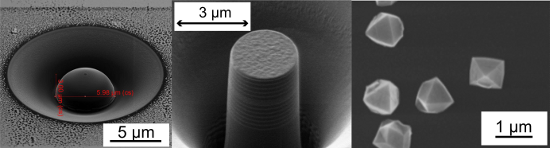
- of a single implanted color center obtained with nonlinear optical excitation in ground state depletion (GSD) mode [6]. In this imaging mode, the color center is illuminated with a doughnut-shaped beam of high optical intensity. The saturation behavior of the optical transition provides a nonlinear
- (N+) are effectively stopped by the mask. The ions entering the channel create an implanted ion spot with a FWHM of about 100 nm, limited by straggle. Nonlinear optical microscopy of implanted color centers by using ground-state-depletion microscopy mode. (a) Images of a color center obtained with
- increasing depletion laser power. (b) Measured optical resolution as a function of laser power. The solid line shows a theoretical fit for the achievable resolution , where c is a proportionality constant, P is the optical power and r∞ represents the maximum achievable resolution at infinite power, which is





Pinch-off mechanism in double-lateral-gate junctionless transistors fabricated by scanning probe microscope based lithography
Beilstein J. Nanotechnol. 2012, 3, 817–823, doi:10.3762/bjnano.3.91
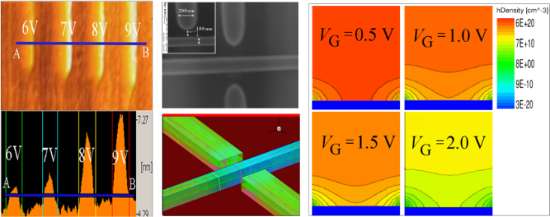
- normally in the on state and is driven into the off state by the application of a positive gate voltage. We demonstrate that the depletion starts from the bottom corner of the channel facing the gates and expands toward the center and top of the channel. Redistribution of the carriers due to the electric
- the gates and cause an off state. The transfer characteristic curves also show that the device has on–off ratio of 106 and 107 for the fabricated and simulated device between VG = 0 V and VG = 2 V, respectively. In the case of accumulation MOSFETs (AMOSFETs) and JLTs (gated resistors), the depletion
- proper gate voltage [5][23], but in a pinch-off device such as a DGJLT, the operation is implemented in the reverse direction, in order to force the device into the off state from the on state. The mechanism of depletion due to the lateral gate voltage can be demonstrated by the hole distribution in the


Friction and durability of virgin and damaged skin with and without skin cream treatment using atomic force microscopy
Beilstein J. Nanotechnol. 2012, 3, 731–746, doi:10.3762/bjnano.3.83
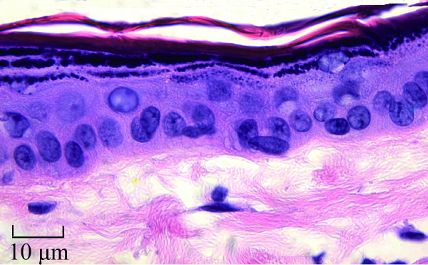
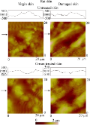
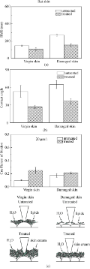
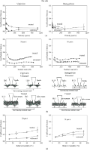
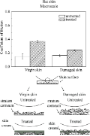
- induces a chapped and scaly appearance. Scanning electron microscope studies of SDS-treated stratum corneum revealed selective depletion of the lipids from the intercellular spaces accompanied by marked disruption of multiple lamellae structures, and lipid analysis showed a considerable and selective loss





Zeolites as nanoporous, gas-sensitive materials for in situ monitoring of DeNOx-SCR
Beilstein J. Nanotechnol. 2012, 3, 667–673, doi:10.3762/bjnano.3.76
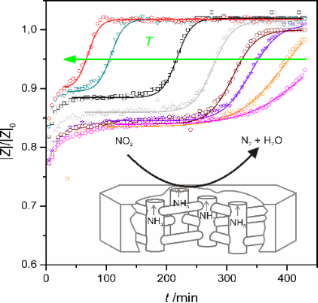
- by pure as well as by Fe- or Cu-loaded H-form zeolites [28][29][30][31][32]. Due to the NH3 sensitivity of the zeolites, the loading of the catalyst with NH3 as well as the depletion due to the SCR reaction may be directly monitored by IS. A first step in this direction was made by Kubinski and
- impedance |Z| at 1 Hz was recorded (in steps of 5 min) to monitor NH3 depletion in the zeolite layer. The same measurements were repeated under SCR-like conditions, and the data are presented in Figure 3 as time-dependence plots of the normalized absolute value of the impedance |Z|/|Z|0 at 1 Hz, whereas |Z


Focused electron beam induced deposition: A perspective
Beilstein J. Nanotechnol. 2012, 3, 597–619, doi:10.3762/bjnano.3.70
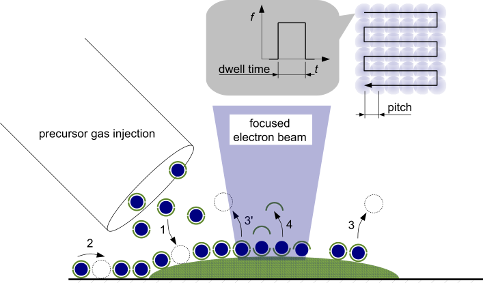
- depletion rate kd defined as and the depleted adsorbate density nd = sJ/kd. The initial adsorbate density n(t = 0) was set to the adsorbate density after long times nr in the absence of the dissociation term. It is defined by the replenishment rate kr given by via the relation nr = sJ/kr. The important


Functionalised zinc oxide nanowire gas sensors: Enhanced NO2 gas sensor response by chemical modification of nanowire surfaces
Beilstein J. Nanotechnol. 2012, 3, 368–377, doi:10.3762/bjnano.3.43
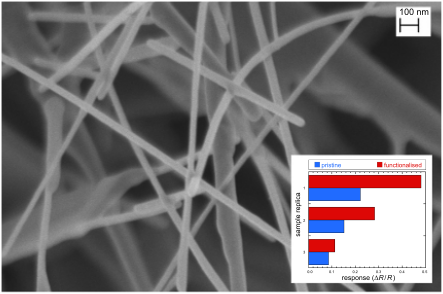
- . It is proposed that the ΔR/R enhancement in this case originates from the changes induced in the depletion-layer width of the ZnO nanoparticles that bridge ZnO nanowires resulting from THMA ligand binding to the surface of the particle coating. The heightened response and selectivity to the NO2
- chemisorption involves electronic charge transfer, functionalisation of the surface of a metal-oxide semiconductor gas sensor with an organic monolayer will strongly influence the electronic properties of the surface. Transfer of electron density into the semiconductor will reduce the depletion layer, which is
- , which is comparable with the depth of the depletion region, the nanoparticles are likely to be fully depleted of electrons, different to the case of nanowires, which feature a depleted surface layer but also possess an unaltered “bulk” core due to their much larger diameter (about 50 nm, from Figure 1


Structural, electronic and photovoltaic characterization of multiwalled carbon nanotubes grown directly on stainless steel
Beilstein J. Nanotechnol. 2012, 3, 360–367, doi:10.3762/bjnano.3.42
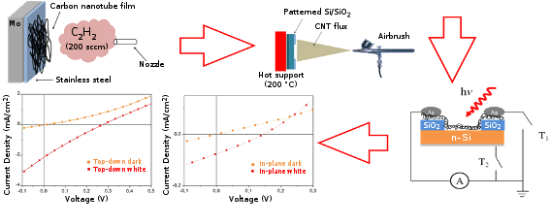
- depletion layer are collected before reaching the electrode and recombine. Further improvements should be devoted to enhance the efficiency of the device by improving the quality of the metallic contact, to avoid parasitic additional resistances. Experimental A sheet of AISI 316-SS (30 × 40 mm2, from


Ultraviolet photodetection of flexible ZnO nanowire sheets in polydimethylsiloxane polymer
Beilstein J. Nanotechnol. 2012, 3, 353–359, doi:10.3762/bjnano.3.41
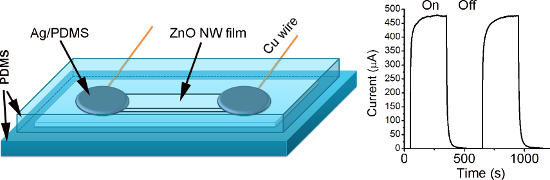
- -type semiconductor: O2(g) + e− → O2–(ad). This produces a depletion layer near the nanowire surface, resulting in an upward band bending near the surface. Due to the large surface-to-volume ratio, the adsorption of O2 significantly reduces the conductivity of the nanowires. UV-light illumination with a
- -section indicates a depletion layer near the surface; (c) Under UV illumination the oxygen molecules desorb from ZnO and diffuse into the molecule network. Illustration for the device fabrication process. Acknowledgements We thank the QUT Vice-Chancellor’s Research Fellowship for financially supporting


Formation of SiC nanoparticles in an atmospheric microwave plasma
Beilstein J. Nanotechnol. 2011, 2, 665–673, doi:10.3762/bjnano.2.71
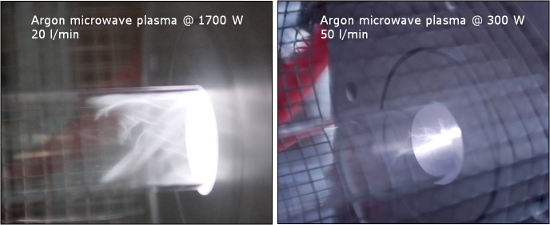
- nanoparticle for a large supersaturation of the system p"SiC" >> pv, as depicted in Figure 2: The high ambipolar diffusion coefficient of the species in the plasma results in the fast growth of the particle accompanied by the fast depletion of the educt in the plasma, which of course contradicts the simple



Influence of water on the properties of an Au/Mpy/Pd metal/molecule/metal junction
Beilstein J. Nanotechnol. 2011, 2, 384–393, doi:10.3762/bjnano.2.44
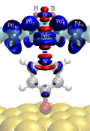
- bonds. The calculated patterns suggest a hybridization between the pz orbitals of NMpy and Ow, and the orbital of the Pdb atoms upon the formation of the NMpy–Pdb–O contact with z being the coordinate along the surface normal. However, the regions of the charge depletion are relatively localized in the
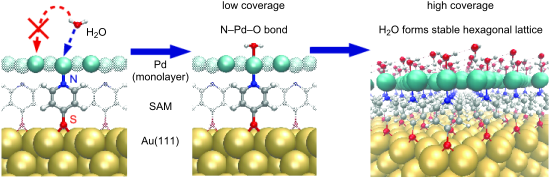
- molecule further increases, but the electron depletion at the Au electrode remains practically unaltered. This means that the S–Au bond is hardly affected by the adsorption of water on the palladium layer. This is also reflected in the length of the S–Au bond, which does not change upon the water
- adsorption, remaining at 2.57 Å. The electron gain of Mpy due to the H2O→Pd→Mpy charge transfer is accompanied by charge depletion on the H2O molecule and a further polarization within the Pd layer through charge transfer from Pdb to Pdn. This inner polarization explains why a single H2O molecule does not

![[Graphic 1]](/bjnano/content/inline/2190-4286-2-44-i1.png?max-width=637&scale=0.945456) )R3...
)R3...


![[Graphic 2]](/bjnano/content/inline/2190-4286-2-44-i2.png?max-width=637&scale=1.18182) = 1/3 ML. Plott...
= 1/3 ML. Plott...
Schottky junction/ohmic contact behavior of a nanoporous TiO2 thin film photoanode in contact with redox electrolyte solutions
Beilstein J. Nanotechnol. 2011, 2, 127–134, doi:10.3762/bjnano.2.15
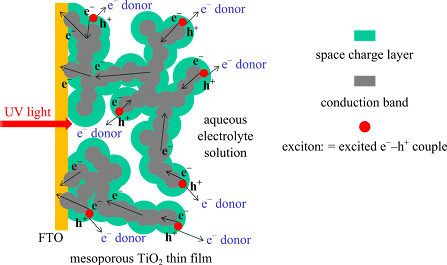
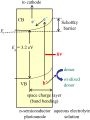
- solution) negatively charged. As the result the band structure of the SC (both the valence band (VB) and the conduction band) is bent as shown in Figure 3. This curved portion of the band structure is called a space charge layer (also called a depletion layer, where electrons are depleted). Under this
- representation for the formation of continuous Schottky junctions with space charge layer (i.e., depletion layer, green region) and conduction band (CB, gray region) in a nanoporous n-TiO2 thin film formed at the interface with an aqueous electrolyte solution containing an electron donor. In the space charge