Search results
Search for "ferromagnetic" in Full Text gives 187 result(s) in Beilstein Journal of Nanotechnology.
Nanoscaled alloy formation from self-assembled elemental Co nanoparticles on top of Pt films
Beilstein J. Nanotechnol. 2011, 2, 473–485, doi:10.3762/bjnano.2.51
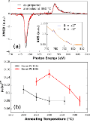
- support easily overwhelms the total magnetic moment of the tiny amount of ferromagnetic material in the NPs. In the present system one can benefit from the paramagnetic response of the Pt(111) film and paramagnetic impurities in MgO compensating the diamagnetic signal of the substrate. Since the
- diamagnetism of MgO is temperature independent and the paramagnetic signal follows Curie’s law at low temperatures [40], compensation can be achieved at an appropriate temperature, which is experimentally determined to be around 29 K for our samples. As the non-ferromagnetic background was strongly reduced, a




Effect of large mechanical stress on the magnetic properties of embedded Fe nanoparticles
Beilstein J. Nanotechnol. 2011, 2, 268–275, doi:10.3762/bjnano.2.31
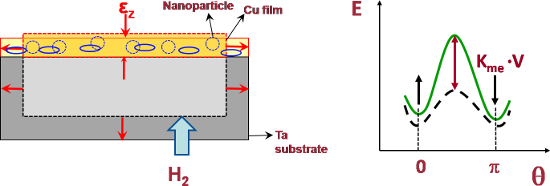
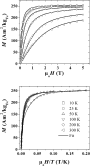
- with a straight line and has been subtracted from the data. Note that the total ferromagnetic moment of Fe nanoparticles (8.3·10−6 emu) in saturation is only about 2% of the paramagnetic signal of the Ta substrate at 5000 Oe. At this temperature, the particles show a ferromagnetic behaviour. It should
- observed at 300 K compared to 10 K, there is a small remnant magnetization indicating that at least some of the particles show ferromagnetic behaviour at 300 K. This may be attributed to the presence of a small fraction of larger Fe nanoparticles (as indicated by the size distribution given in Figure 1


Extended X-ray absorption fine structure of bimetallic nanoparticles
Beilstein J. Nanotechnol. 2011, 2, 237–251, doi:10.3762/bjnano.2.28
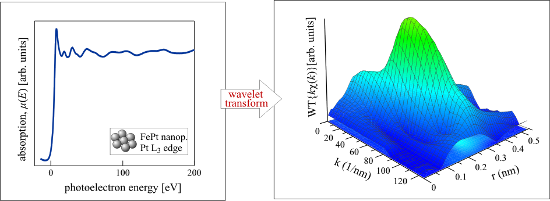
- larger lattice parameters, but all the changes are rather small. Similar trends are reported for other ferromagnetic or antiferromagnetic materials, e.g. for bcc and fcc Fe [95]. Experimentally, the magnetic moments of FePt nanoparticles were found to be reduced with respect to the correspondent bulk


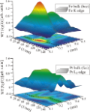

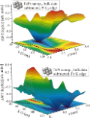
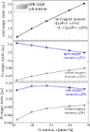
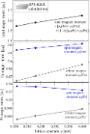
Structural and magnetic properties of ternary Fe1–xMnxPt nanoalloys from first principles
Beilstein J. Nanotechnol. 2011, 2, 162–172, doi:10.3762/bjnano.2.20
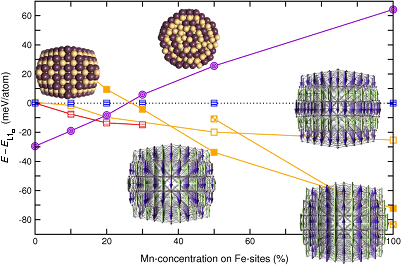
- functional devices. Conclusion: Addition of Mn effectively increases the stability of single crystalline L10 particles over multiply twinned morphologies. This, however, compromises the stability of the ferromagnetic phase due to an increased number of antiferromagnetic interactions. The consequence is that
- effective interlayer coupling and mediates an indirect ferromagnetic (FM) interaction between the adjacent 3d layers, which overrides the smaller direct antiferromagnetic coupling across the Pt layer. The validity of this model has been verified in large scale first principles calculation of a partially
- below for FePt). The ferromagnetic, ordered icosahedron, which is nearly degenerate for Fe265Pt296, has become unstable in the Mn–Pt system for sizes above 147 atoms. During the geometric optimization procedure it transforms downhill to a perfect L10 cuboctahedron. This proves that the Mackay path is a


Structure, morphology, and magnetic properties of Fe nanoparticles deposited onto single-crystalline surfaces
Beilstein J. Nanotechnol. 2011, 2, 47–56, doi:10.3762/bjnano.2.6
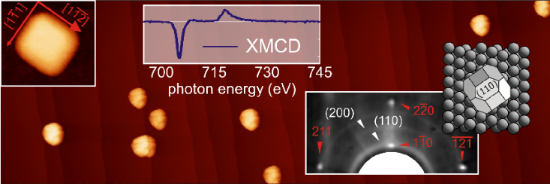
- process might be accompanied by a complex reshaping of the particles. Keywords: epitaxy; iron; magnetic nanoparticles; Ni(111); RHEED; spontaneous self-alignment; STM; W(110); XMCD; Introduction Ferromagnetic clusters and nanoparticles have gained huge interest due to their interesting fundamental
- properties as well as their possible applications in data storage media, chemistry, biotechnology and medicine [1][2][3][4]. First, Stern–Gerlach measurements proved that ferromagnetic particles may exhibit enhanced and strongly size-dependent magnetic moments [5]; and even non-magnetic materials can show
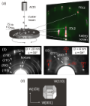
- Experiments on exposed mass-filtered Fe nanoparticles on (ferromagnetic) supports require in situ cluster deposition as well as surface sensitive analysis techniques performed under ultrahigh vacuum conditions. To motivate the need of our combined approach, we first introduce the arc cluster ion source (ACIS

Magnetic interactions between nanoparticles
Beilstein J. Nanotechnol. 2010, 1, 182–190, doi:10.3762/bjnano.1.22
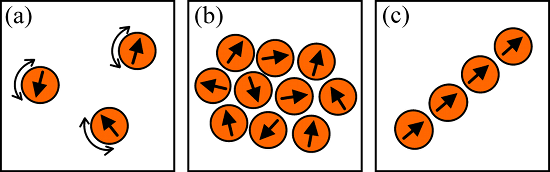
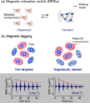
- 10.3762/bjnano.1.22 Abstract We present a short overview of the influence of inter-particle interactions on the properties of magnetic nanoparticles. Strong magnetic dipole interactions between ferromagnetic or ferrimagnetic particles, that would be superparamagnetic if isolated, can result in a
- magnetic dipole interactions can have a strong influence on, e.g., the magnetic dynamics in samples containing ferromagnetic or ferrimagnetic nanoparticles. If nanoparticles or thin films are in close proximity, exchange interactions between surface atoms can be significant. An important example of
- magnetic proximity effects is exchange bias, which manifests itself as a shift of the hysteresis curves obtained after field cooling of a ferromagnetic or ferrimagnetic material in contact with an antiferromagnetic material [1][2][3]. This was first observed in nanoparticles consisting of a core of



Magnetic nanoparticles for biomedical NMR-based diagnostics
Beilstein J. Nanotechnol. 2010, 1, 142–154, doi:10.3762/bjnano.1.17
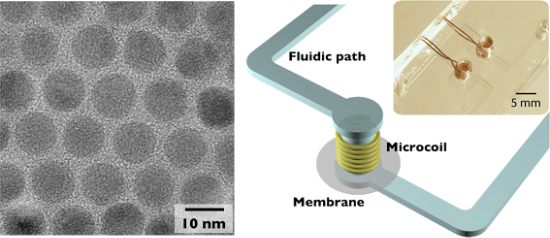
- spin state (typically ferromagnetic or ferrimagnetic). This superparamagnetic property enables MNPs to avoid spontaneous aggregation in solution, a feature that makes them suitable for many biomedical applications. In its simplest form, an MNP is comprised of an inorganic magnetic core and a
- applications. Doped-ferrite nanoparticles The magnetization of ferrite nanoparticles can be further enhanced by doping the ferrite with ferromagnetic elements such as manganese (Mn), cobalt (Co) or nickel (Ni) [23][27][45]. Among the singly-doped ferrite MNPs, MnFe2O4 nanoparticles were found to exhibit the


Ultrafine metallic Fe nanoparticles: synthesis, structure and magnetism
Beilstein J. Nanotechnol. 2010, 1, 108–118, doi:10.3762/bjnano.1.13
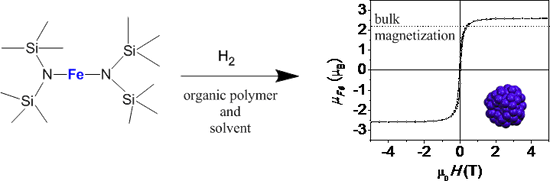
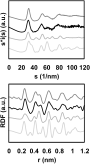
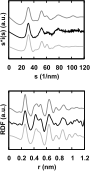
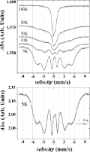
- temperature. The gyromagnetic ratio measured by ferromagnetic resonance is of the same order as that of bulk Fe, which allows us to conclude that the orbital and spin contributions increase at the same rate. A large magnetic anisotropy for metallic Fe has been measured up to (3.7 ± 1.0)·105 J/m3. Precise
- ferromagnetic metals [1][2][3][4]. More surprisingly, the study of small Rh NPs revealed a paramagnetic to ferromagnetic phase transition induced by size reduction for clusters containing less than 40 atoms [5]. Band structure calculations have investigated the role of size reduction and demonstrated that it
- ferromagnetic 3d metals. In the case of free-standing Fe clusters, Billas and coworkers have demonstrated the enhancement of the magnetic moment µFe when the cluster contains less than 1000 atoms [2][3]. In this size range some oscillations of µFe with cluster size have also been revealed. Similarly, supported





Magnetic coupling mechanisms in particle/thin film composite systems
Beilstein J. Nanotechnol. 2010, 1, 101–107, doi:10.3762/bjnano.1.12
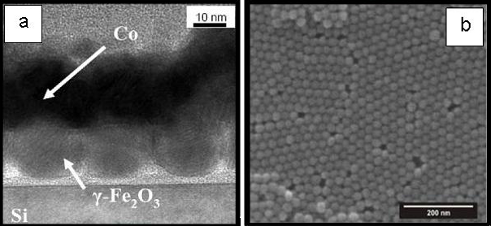
- cooled, implying that its origin should be ascribed to an antiferromagnetic/ferromagnetic (AF/FM) coupling [31][32][33][34][35]. The magnetic exchange interaction between an AF and an FM layer can usually be observed as a horizontal shift of the magnetic hysteresis loop, when cooling the material from a
- ferrimagnetic maghemite NPs and a ferromagnetic Co thin film, it is necessary to account for the presence of an extra AF component. A possible explanation is that the Co layer is partially oxidized to AF CoO. The Co layer is capped with a protective Cu layer, and therefore, oxidation is more likely to occur at


Review and outlook: from single nanoparticles to self-assembled monolayers and granular GMR sensors
Beilstein J. Nanotechnol. 2010, 1, 75–93, doi:10.3762/bjnano.1.10
- response to an external magnetic field resembles the Langevin behavior of paramagnetic materials but with the high susceptibility and magnetization values of the ferromagnetic materials they are composed of, compare Figure 7. With even smaller particles, surface effects become dominant and a fully quantum
- ferromagnetic particles mutually align their magnetic dipole moments which entails an attractive coupling and may result in different geometrical patterns such as particle chains or rings [55][56]. An example of a dipole interaction dominated arrangement is shown in Figure 10(a): Co particles with a bimodal
- structured sample, a suspension of ferromagnetic particles can be placed on the substrate in the presence of an external magnetic field. For manufacturing of particle layers, a homogeneous magnetic field needs to be employed; inhomogeneous fields result in the accumulation of nanoparticles along the area




Uniform excitations in magnetic nanoparticles
Beilstein J. Nanotechnol. 2010, 1, 48–54, doi:10.3762/bjnano.1.6
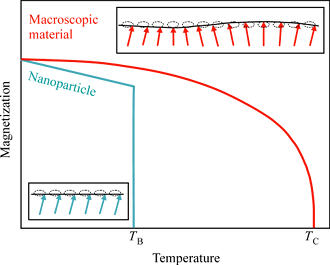
- of the magnetization in nanoparticles. In this paper we give a short review of the spin dynamics in non-interacting nanoparticles below the blocking temperature. Ferromagnetic and ferrimagnetic nanoparticles First, we consider a ferromagnetic or ferrimagnetic material with cubic crystal structure and
- difference between adjacent spin wave states is small and the quantized states are well approximated by a continuous distribution of energies. Furthermore, the magnetic anisotropy is usually neglected in the calculations [9][10]. In ferromagnetic and ferrimagnetic materials at low temperatures, spin wave


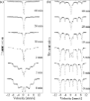
![[Graphic 3]](/bjnano/content/inline/2190-4286-1-6-i22.png?max-width=637&scale=1.18182) as a function of temperature for particles of magneti...
as a function of temperature for particles of magneti...


Preparation and characterization of supported magnetic nanoparticles prepared by reverse micelles
Beilstein J. Nanotechnol. 2010, 1, 24–47, doi:10.3762/bjnano.1.5
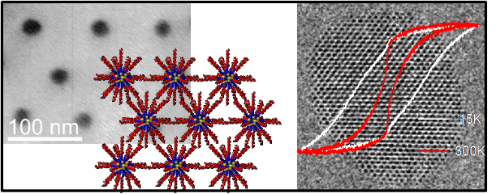
- , saturation magnetizations, and Curie temperatures. Technologically important is the report of the last noted group, that after annealing of FePt NPs as small as 4 nm, ferromagnetic behavior is observed even at ambient temperature corresponding to magnetic anisotropies close to those of the bulk material [52
- already mentioned in the introduction, a vast variety of preparation approaches have been developed and more or less successfully tested for their application to fabricate ferromagnetic metal NPs. Success, in this context, may not be an appropriate term, since it critically hinges on the specific