


Search results
Search for "modelling" in Full Text gives 187 result(s) in Beilstein Journal of Nanotechnology.
A highly pH-sensitive nanowire field-effect transistor based on silicon on insulator
Beilstein J. Nanotechnol. 2013, 4, 330–335, doi:10.3762/bjnano.4.38
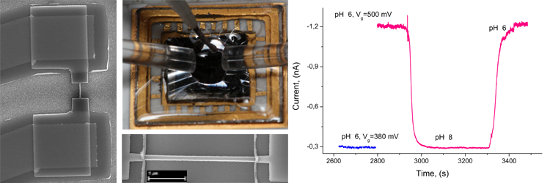
- transport-current fluctuations SI by considering an equivalent scheme with a series connection of resistors modelling NW and Schottky barriers with uncorrelated fluctuation generators: Our four-probe measurements of the NW resistance R and Schottky barrier resistance RB at room temperature show that R >> RB


Determining cantilever stiffness from thermal noise
Beilstein J. Nanotechnol. 2013, 4, 227–233, doi:10.3762/bjnano.4.23
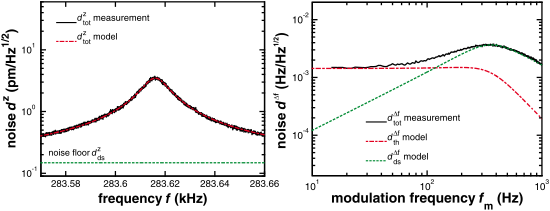
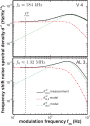
- derived from a thermal measurement and do not require any modelling to relate geometric cantilever properties to oscillation properties. Displacement noise spectral density measured for the fundamental mode of cantilever V 4. Measurements represent the average of 50,000 spectra. (a) Measurement yielding
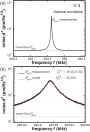
![[Graphic 34]](/bjnano/content/inline/2190-4286-4-23-i40.png?max-width=637&scale=1.18182) measured for the fundamental mode of cantilever V 4. Measureme...
measured for the fundamental mode of cantilever V 4. Measureme...
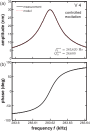
![[Graphic 23]](/bjnano/content/inline/2190-4286-4-23-i29.png?max-width=637&scale=1.18182) measured for cantilever V 4 (A0 = 16.8 nm, demodulator band...
measured for cantilever V 4 (A0 = 16.8 nm, demodulator band...
Thermal noise limit for ultra-high vacuum noncontact atomic force microscopy
Beilstein J. Nanotechnol. 2013, 4, 32–44, doi:10.3762/bjnano.4.4
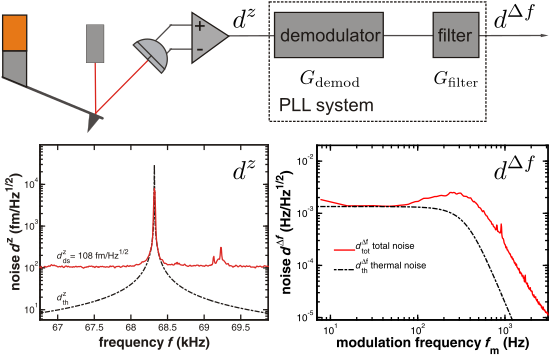
- of modelling noise in the NC-AFM system in combination with the experimental practice described here provides a clear guideline for system design and the choice of experimental parameters for thermal-noise-limited operation. The analysis shows that for a noise-optimised NC-AFM measurement, the right


![[Graphic 53]](/bjnano/content/inline/2190-4286-4-4-i64.png?max-width=637&scale=1.18182) =
= ![[Graphic 32]](/bjnano/content/inline/2190-4286-4-4-i43.png?max-width=637&scale=1.18182) f...
f...


![[Graphic 56]](/bjnano/content/inline/2190-4286-4-4-i67.png?max-width=637&scale=1.18182) using three diff...
using three diff...

Calculation of the effect of tip geometry on noncontact atomic force microscopy using a qPlus sensor
Beilstein J. Nanotechnol. 2013, 4, 10–19, doi:10.3762/bjnano.4.2
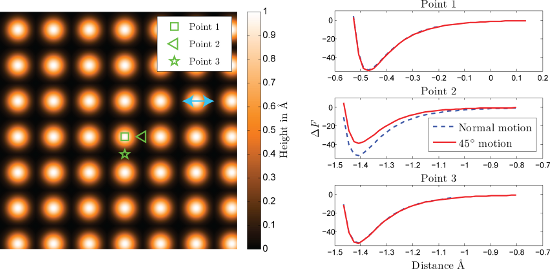
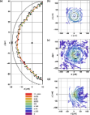
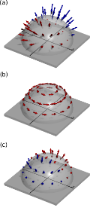
- imaging in the first eigenmode. We calculate the effect the lateral motion has on the measured frequency shift, and hence, how this affects calibration, imaging, and spectroscopy. Results and Discussion Modelling the tine of the qPlus sensor as an Euler–Bernoulli beam [16] of length L, we can write where


Towards atomic resolution in sodium titanate nanotubes using near-edge X-ray-absorption fine-structure spectromicroscopy combined with multichannel multiple-scattering calculations
Beilstein J. Nanotechnol. 2012, 3, 789–797, doi:10.3762/bjnano.3.88
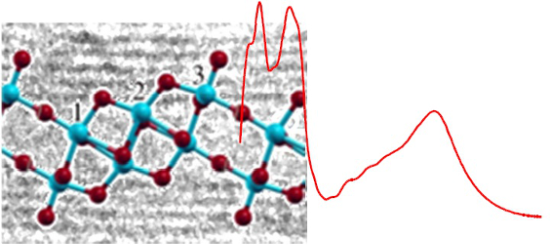
- theoretical modelling. Taking the example of isolated bundles of hydrothermally prepared sodium titanate nanotubes ((Na,H)TiNTs) we are able to unravel the complex nanoscale structure from the NEXAFS–TXM data using multichannel multiple-scattering calculations, to the extent of being able to associate
- ]. However, we show in the current study that the combination of NEXAFS–TXM with high-level theoretical modelling allows us to move beyond this spatial-resolution limit and extract more spatially refined information [8]. Indeed this combination of theory and spectroscopy paves the way towards atomic-scale
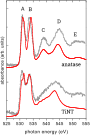
- layers of the nanostructure. The excellent agreement between the experimental data and the theoretical modelling confirms the assignment of the (Na,H)TiNT structure to a layered titanate of the H2TinO2n+1 family. High-level spectroscopic modelling appears to be an important way to extend further the



Analysis of fluid flow around a beating artificial cilium
Beilstein J. Nanotechnol. 2012, 3, 163–171, doi:10.3762/bjnano.3.16
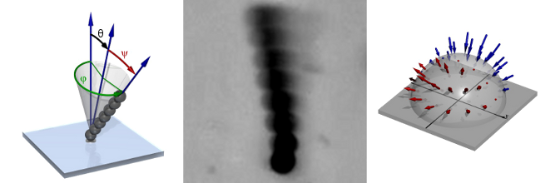
- experiment. Analytical calculation of the average flow velocity A very basic approach to modelling the flows around a beating cilium, regardless of its precise beat pattern, consists of replacing the cilium with a small hypothetical particle circling along a tilted elliptical trajectory [19]. We have shown


Effect of the tip state during qPlus noncontact atomic force microscopy of Si(100) at 5 K: Probing the probe
Beilstein J. Nanotechnol. 2012, 3, 25–32, doi:10.3762/bjnano.3.3
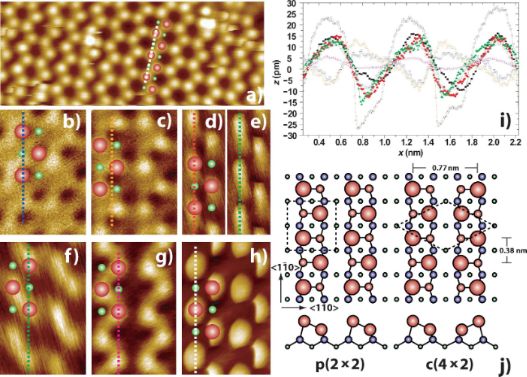
- the modelling community that will lead to the investigation of more-realistic tip structures, and their respective tip–sample interaction and contrast mechanisms. The role of the tip was investigated by imaging the well studied Si(100) surface. The Si(100) surface is now understood to form a stable c
- results will inspire further debate in the modelling community, and help further understanding of contrast mechanisms in NC-AFM imaging of semiconductor surfaces. In particular we note that by operating at zero bias, the influence of tunnelling electrons is eliminated, highlighting the fact that the


Distance dependence of near-field fluorescence enhancement and quenching of single quantum dots
Beilstein J. Nanotechnol. 2011, 2, 645–652, doi:10.3762/bjnano.2.68
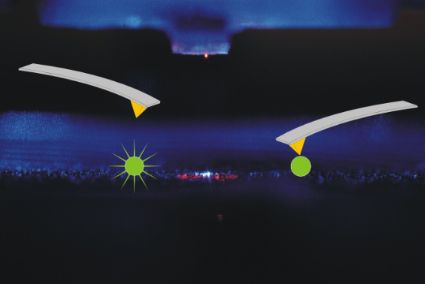
- the tip distance. Modelling the system with a MDP approach unveiled the multivalent interplay of incident and emitted electromagnetic fields at the boundary of different media. Our results represent an important step en route towards being able to controllably address and manipulate fluorescently


Intermolecular vs molecule–substrate interactions: A combined STM and theoretical study of supramolecular phases on graphene/Ru(0001)
Beilstein J. Nanotechnol. 2011, 2, 365–373, doi:10.3762/bjnano.2.42
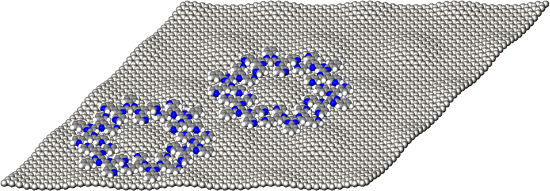
- theoretical study [39]. These surfaces coordinates were then kept fixed in the subsequent relaxation of adsorbed PTCDA and BTP molecules. The interactions between molecule–graphene and molecule–Ru were treated as being additive. For the modelling of the molecule–graphene interactions, a single molecule was


Superhydrophobicity in perfection: the outstanding properties of the lotus leaf
Beilstein J. Nanotechnol. 2011, 2, 152–161, doi:10.3762/bjnano.2.19
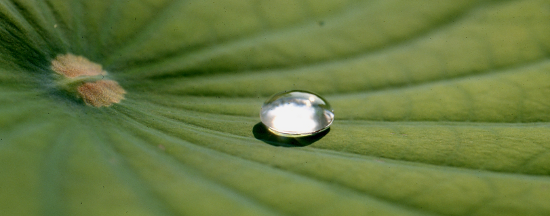
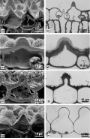
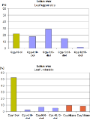
- contact with water [20] and to prove the theories such as those of Wenzel or Cassie and Baxter. For precise modelling of the behaviour of natural water repellent surfaces, an exact knowledge of the chemical composition and molecular structure are essential. Resistance against environmental stress The







Capillary origami: superhydrophobic ribbon surfaces and liquid marbles
Beilstein J. Nanotechnol. 2011, 2, 145–151, doi:10.3762/bjnano.2.18
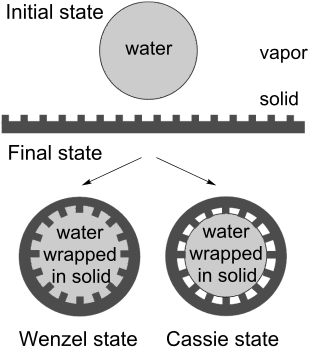
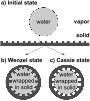
- roughness factor rW and using the definition of the equilibrium contact angle on a rigid substrate of cosθe = (γSV − γSL)/γLV gives, Defining the Cassie–Baxter combination cosθCB = φscosθe − (1−φs), which is familiar from the modelling of droplets on superhydrophobic surfaces, gives, The similarity of



The description of friction of silicon MEMS with surface roughness: virtues and limitations of a stochastic Prandtl–Tomlinson model and the simulation of vibration-induced friction reduction
Beilstein J. Nanotechnol. 2010, 1, 163–171, doi:10.3762/bjnano.1.20
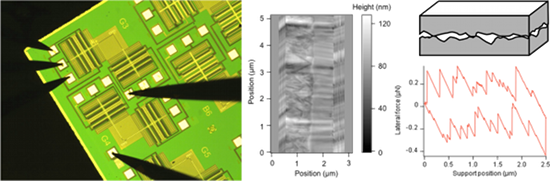
- systems (MEMS) devices with sliding surfaces. This new model is shown to exhibit the same features as previously reported experimental MEMS friction loop data. The correlation function of the surface roughness is shown to play a critical role in the modelling. It is experimentally obtained by probing the





