Search results
Search for "nickel" in Full Text gives 186 result(s) in Beilstein Journal of Nanotechnology.
Continuous parallel ESI-MS analysis of reactions carried out in a bespoke 3D printed device
Beilstein J. Nanotechnol. 2013, 4, 285–291, doi:10.3762/bjnano.4.31
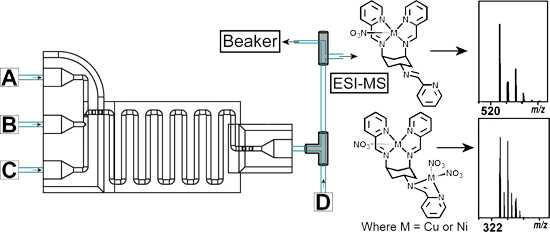
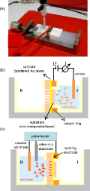
- nickel(II), with the Cu complex ion previously observed by ESI-MS (see Scheme 1) [25]. The ttop and metal-salt solutions are introduced to the device through pumps, via the device inlets, and by changing the pump speed (hence altering the flow rate and reaction conditions inside the device), using an in


Micro- and nanoscale electrical characterization of large-area graphene transferred to functional substrates
Beilstein J. Nanotechnol. 2013, 4, 234–242, doi:10.3762/bjnano.4.24
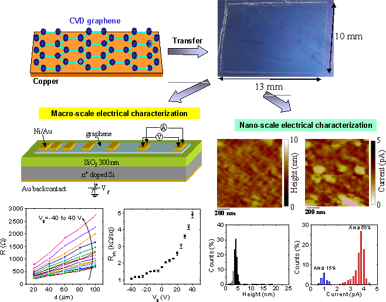
- chemical vapour deposition (CVD) on catalytic metals [9], are more suitable for large-area applications, as has been demonstrated in the past few years. Considering the case of CVD, the two main catalytic metals used for graphene growth are nickel and copper [16]. In the case of CVD growth on copper foils
- than in the case of the same nickel–gold contacts on graphene exfoliated onto SiO2 [25]. The hole conductance σ = 1 / Rsh in graphene is related to the hole mobility μp and density p by the following relation where p has been expressed as the sum of p0, i.e., the doping at Vg = 0, and of the doping
- isolated from the external membrane by lithographically defining and opening a rectangular frame in a hard mask resist and by performing graphene etching of the frame by O2 plasma treatments. Subsequently, a set of nickel-gold rectangular contacts were deposited by sputtering and defined by the lift-off



Functionalization of vertically aligned carbon nanotubes
Beilstein J. Nanotechnol. 2013, 4, 129–152, doi:10.3762/bjnano.4.14
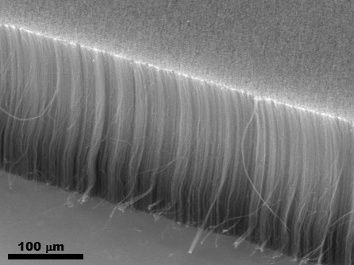
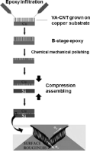
- if the pores were vertical. Later, in 1998, the synthesis of very straight, aligned multiwalled CNTs on nickel-coated glass at temperatures as low as 666 °C was obtained by Ren et al. [24] using plasma-enhanced hot-filament chemical vapor deposition (PE-HF-CVD). Reported in 1999 by Fan et al. [25], a








Nanostructure-directed chemical sensing: The IHSAB principle and the dynamics of acid/base-interface interaction
Beilstein J. Nanotechnol. 2013, 4, 20–31, doi:10.3762/bjnano.4.3
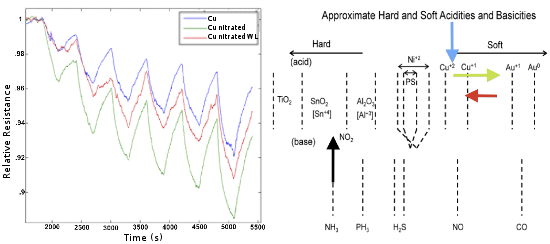
- used as a basis to develop selectivity. Results obtained with nanostructured deposits generated from electroless gold, tin, nickel and copper, as well as nanotitania are considered in this study. With the exception of the gold depositions, all of the nanostructured metals deposited to the PS surface


Diamond nanophotonics
Beilstein J. Nanotechnol. 2012, 3, 895–908, doi:10.3762/bjnano.3.100
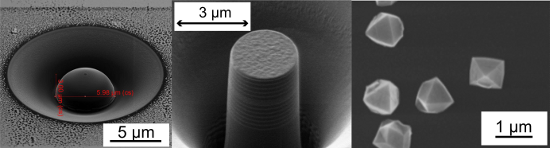
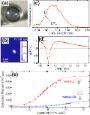
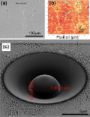
- incorporate color centers based on nickel and tungsten, in situ into diamond using microwave-plasma-enhanced chemical vapor deposition. The fabrication of silicon–vacancy centers in nanodiamonds by microwave-plasma-enhanced chemical vapor deposition is discussed in addition. Keywords: CVD diamond doping
- reason two main challenges need to be addressed by diamond researchers: New color centers in diamond with favorable properties for quantum-information-processing technologies need to be identified. A reproducible fabrication method for color centers (such as the nickel-related NE8-center) in high-quality
- MWPECVD. Emphasis was placed on a reproducible dopant addition to the growth process aiming at a targeted in situ incorporation of color centers based on nickel and tungsten impurities. A very promising single-photon-emitting defect for quantum-cryptographic applications is the so-called NE8-center [17





Characterization and properties of micro- and nanowires of controlled size, composition, and geometry fabricated by electrodeposition and ion-track technology
Beilstein J. Nanotechnol. 2012, 3, 860–883, doi:10.3762/bjnano.3.97
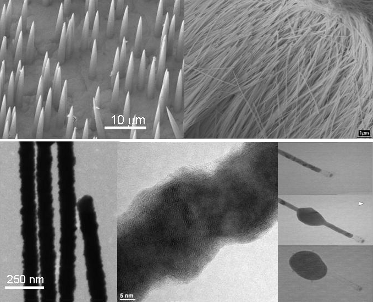
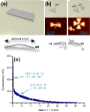
- nanowires were successfully grown from nickel [57], cobalt [79], and iron [80]. The growth of Fe-based nanowires with controllable size, aspect ratio, and magnetic anisotropy in FeCl3 and FeCl2 solutions was investigated by Song et al. They employed FeCl3 and FeCl2 solutions, studied the nanowire growth








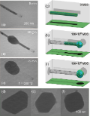
Highly ordered ultralong magnetic nanowires wrapped in stacked graphene layers
Beilstein J. Nanotechnol. 2012, 3, 846–851, doi:10.3762/bjnano.3.95
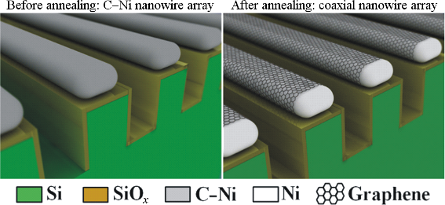
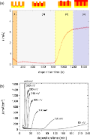
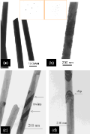
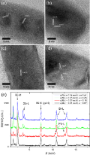
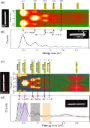
- ) 240 373 959 Department of Mechanical Engineering, Stevens Institute of Technology, Hoboken, NJ 07030, USA 10.3762/bjnano.3.95 Abstract We report on the synthesis and magnetic characterization of ultralong (1 cm) arrays of highly ordered coaxial nanowires with nickel cores and graphene stacking shells
- (also known as metal-filled carbon nanotubes). Carbon-containing nickel nanowires are first grown on a nanograted surface by magnetron sputtering. Then, a post-annealing treatment favors the metal-catalyzed crystallization of carbon into stacked graphene layers rolled around the nickel cores. The
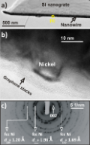
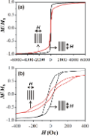
- the quality of the nickel nanowires after annealing attributed to a decrease of the roughness of the nickel surface and to a reduction of the defect density. This new type of graphene–ferromagnetic-metal nanowire appears to be an interesting building block for spintronic applications. Keywords


Strong spin-filtering and spin-valve effects in a molecular V–C60–V contact
Beilstein J. Nanotechnol. 2012, 3, 589–596, doi:10.3762/bjnano.3.69
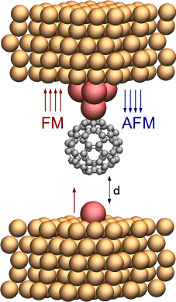
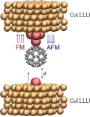
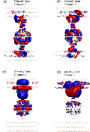
- different sites on the C60 molecule. It can be seen that nickel has the strongest binding energy but with zero total magnetization (MT), and thus, is probably not interesting for investigations of spin transport. On the other hand, chromium enjoys the largest MT, due to its largest unpaired electronic



Nanotribology at high temperatures
Beilstein J. Nanotechnol. 2012, 3, 586–588, doi:10.3762/bjnano.3.68

- ; therefore, only a maximum of three electrons on the surface can have stable bonding between them. Consequently, this leads to the possibility that the remaining one or two electrons of each surface atom in diamond react readily with other materials like iron, nickel and even silicon [16] in a tribological

Analysis of fluid flow around a beating artificial cilium
Beilstein J. Nanotechnol. 2012, 3, 163–171, doi:10.3762/bjnano.3.16
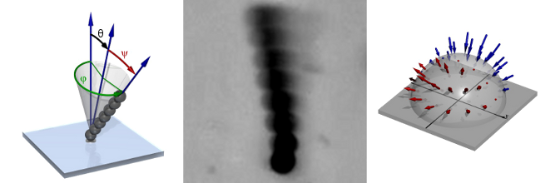
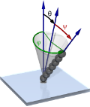
- diameter 55 nm [24]) in water. To prevent aggregation of the beads, we coated them with BSA (bovine serum albumin), 10 mg/mL, for 4 h in an ultrasonic bath. One end of the assembled chain was attached to the surface through prefabricated ferromagnetic-nickel anchoring sites. The nickel dots were
- manufactured by using a combination of photolithography and etching: First a 200 nm thick nickel layer was deposited on a microscope glass slide by a standard evaporation technique. A layer of negative photoresist (SU-8 2025, Microchem, adhesion promoter TI Prime, Microchemicals GmbH) was spin-coated onto the
- deflectors (A.A. Opto-electronic, DTSXY-400-405) and a beam-steering controller (Aresis, d.o.o., BSC-160). After the photoresist was developed, the sample was ashed in post-glow oxygen plasma for 60 s and hard baked at 200 °C, leaving an SU-8 dot-array structure on nickel-covered glass. The slide was dipped


Magnetic nanoparticles for biomedical NMR-based diagnostics
Beilstein J. Nanotechnol. 2010, 1, 142–154, doi:10.3762/bjnano.1.17
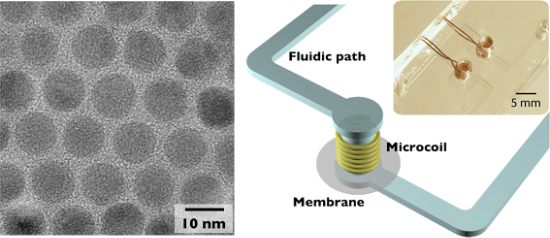
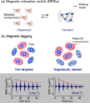
- applications. Doped-ferrite nanoparticles The magnetization of ferrite nanoparticles can be further enhanced by doping the ferrite with ferromagnetic elements such as manganese (Mn), cobalt (Co) or nickel (Ni) [23][27][45]. Among the singly-doped ferrite MNPs, MnFe2O4 nanoparticles were found to exhibit the