Search results
Search for "permeability" in Full Text gives 190 result(s) in Beilstein Journal of Nanotechnology.
Optical properties and electrical transport of thin films of terbium(III) bis(phthalocyanine) on cobalt
Beilstein J. Nanotechnol. 2014, 5, 2070–2078, doi:10.3762/bjnano.5.215
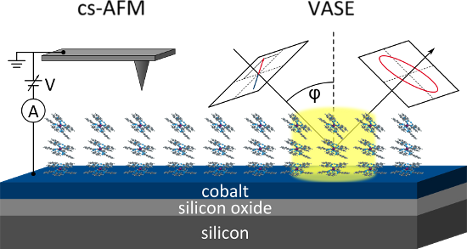
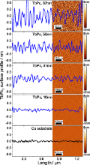
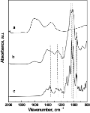
- the Q and B band, of phthalocyanines are highlighted in Figure 2. They correspond to ligand-related π–π* transitions [15]. For organic semiconductors we can consider the relative magnetic permeability to be µr ≈ 1. Thus, we can easily determine the optical constants from the diagonal elements εii of



Effect of silver nanoparticles on human mesenchymal stem cell differentiation
Beilstein J. Nanotechnol. 2014, 5, 2058–2069, doi:10.3762/bjnano.5.214
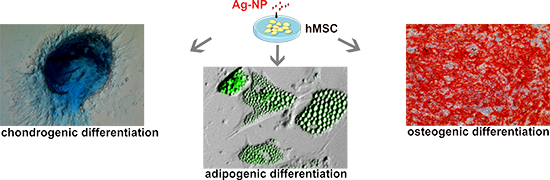
- rapidly to biomolecules, such as DNA [27], negatively charged cell-wall components and the sulfhydryl groups of metabolic enzymes [7][28][29], which results in the inhibition of DNA-replication, an increase in membrane permeability and the disturbance of different metabolic pathways [30]. In contrast to


Spin annihilations of and spin sifters for transverse electric and transverse magnetic waves in co- and counter-rotations
Beilstein J. Nanotechnol. 2014, 5, 1887–1898, doi:10.3762/bjnano.5.199
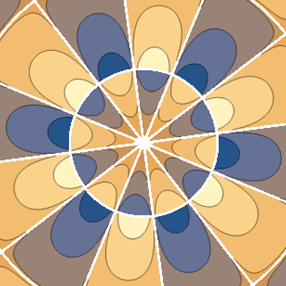
- limits |q| → 0 and |q| → ∞ refer, respectively, to the pure TM and pure TE modes. Besides, |q|2 ≡ q*·q, and ε is the permittivity, which is positive for dielectric media so that ε ≡ n2 with n being the refractive index. In addition, μ = 1 is the permeability for non-magnetic materials. Note that both ε


![[Graphic 44]](/bjnano/content/inline/2190-4286-5-199-i70.png?max-width=637&scale=1.18182) . (b) The scaled coefficient
. (b) The scaled coefficient ![[Graphic 45]](/bjnano/content/inline/2190-4286-5-199-i71.png?max-width=637&scale=1.18182) of the optical chirality C for the counter-rotatio...
of the optical chirality C for the counter-rotatio...


![[Graphic 104]](/bjnano/content/inline/2190-4286-5-199-i130.png?max-width=637&scale=1.18182) in the (kx,ky)-plane. (a) The co-rotational case. (b) The counter-rotational case ...
in the (kx,ky)-plane. (a) The co-rotational case. (b) The counter-rotational case ...


![[Graphic 125]](/bjnano/content/inline/2190-4286-5-199-i151.png?max-width=637&scale=1.18182) for the counter-rotational case plotted over 0 ≤ ρ ≡ kr ≤ 4 for m = 3, Rρ ≡ kR = 1...
for the counter-rotational case plotted over 0 ≤ ρ ≡ kr ≤ 4 for m = 3, Rρ ≡ kR = 1...

Molecular biology approaches in bioadhesion research
Beilstein J. Nanotechnol. 2014, 5, 983–993, doi:10.3762/bjnano.5.112
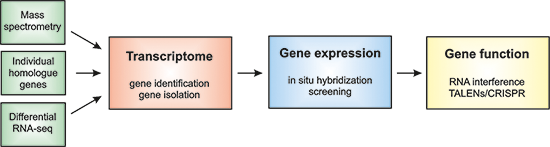
- be required. Critical steps are the fixation and the achievement of permeability of the tissue without losing endogenous mRNA or structural tissue integrity. Usually, good results are achieved with a fixation using 4% paraformaldehyde and proteinase K treatment. Treatment times and concentrations
- vary depending on tissue hardness and size and must be empirically tested for every tissue. If permeability and transparency cannot be achieved in a whole mount specimen, it may be necessary to perform the ISH on tissue sections [48]. After pre-treatments of the tissue, the DIG-labelled RNA probe is


Manipulation of isolated brain nerve terminals by an external magnetic field using D-mannose-coated γ-Fe2O3 nano-sized particles and assessment of their effects on glutamate transport
Beilstein J. Nanotechnol. 2014, 5, 778–788, doi:10.3762/bjnano.5.90
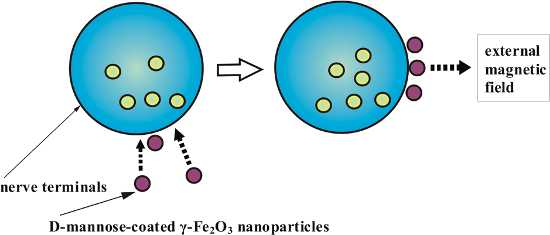
- away, the inner magnetization of nanoparticles disappears, and therefore their agglomeration, which carries the risk of embolization of the capillary vessels, can be avoided [3]. A key issue for enhancing of permeability of iron oxide nanoparticles through the cell membrane is the modification of their



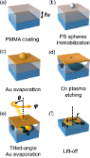
Hole-mask colloidal nanolithography combined with tilted-angle-rotation evaporation: A versatile method for fabrication of low-cost and large-area complex plasmonic nanostructures and metamaterials
Beilstein J. Nanotechnol. 2014, 5, 577–586, doi:10.3762/bjnano.5.68
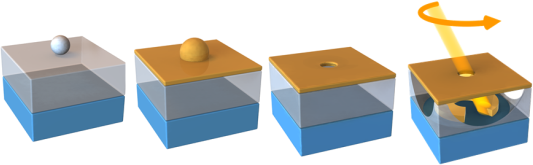
- based on metallic split-ring resonators (SRRs) were able to simultaneously demonstrate negative dielectric permittivity as well as magnetic permeability, which leads to a negative refractive index [11]. In hybrid solar cells and organic light emitting diodes, plasmonic nanostructures enhanced the


Near-infrared dye loaded polymeric nanoparticles for cancer imaging and therapy and cellular response after laser-induced heating
Beilstein J. Nanotechnol. 2014, 5, 313–322, doi:10.3762/bjnano.5.35
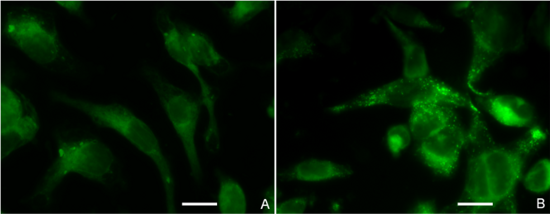
- advantage of NPs is that they are passively targeted to tumor sites because of the enhanced permeability and retention (EPR) effect. This effect occurs as a result of a combination of factors, including increased pore sizes of tumor vasculature, fast tumor angiogenesis from increased secretion of vascular


En route to controlled catalytic CVD synthesis of densely packed and vertically aligned nitrogen-doped carbon nanotube arrays
Beilstein J. Nanotechnol. 2014, 5, 219–233, doi:10.3762/bjnano.5.24
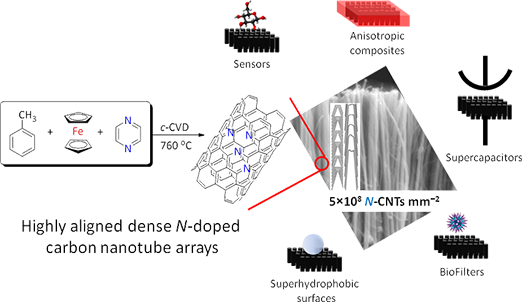
- areal density of up to 5 × 10⁸ N-CNTs per mm2 in the array was gained for nanotubes of OD equal to 26 ± 15 nm grown at [Pz] = 5 wt % and [FeCp2] = 9.6 wt %. These results make N-CNTs the perfect construction material for separation membranes of tuneable permeability. N-CNTs of a high N-doping level can


Novel composite Zr/PBI-O-PhT membranes for HT-PEFC applications
Beilstein J. Nanotechnol. 2013, 4, 481–492, doi:10.3762/bjnano.4.57
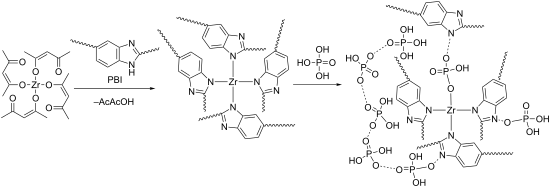
- design of an advanced membrane for HT-PEFC applications necessitates the finding of an appropriate compromise between proton conductivity on the one hand and good mechanical properties as well as low gas permeability on the other hand. Various PBI-based composites have been proposed in order to achieve
- low hydrogen permeability. Indeed, the measured hydrogen crossover-currents (Figure 9) are about 3 mA·cm−2 for all samples of the membranes. This is lower than the 4–5 mA·cm−2 reported by Neyerlin et al. [20] for PBI membranes from a commercial Celtec P-1000 MEA (BASF). Polarisation curves of fuel


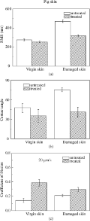
Friction and durability of virgin and damaged skin with and without skin cream treatment using atomic force microscopy
Beilstein J. Nanotechnol. 2012, 3, 731–746, doi:10.3762/bjnano.3.83
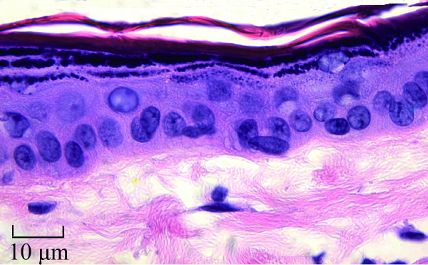
- epidermis, hair-follicle density, epidermal turnover kinetics, lipid composition and the biophysical properties of the lipids [27][28], and similar permeability, i.e., the fluxes through the skin and concentrations in the skin are of the same order of magnitude for both tissues [25][26]. Understanding the





Focused electron beam induced deposition: A perspective
Beilstein J. Nanotechnol. 2012, 3, 597–619, doi:10.3762/bjnano.3.70


Functionalised zinc oxide nanowire gas sensors: Enhanced NO2 gas sensor response by chemical modification of nanowire surfaces
Beilstein J. Nanotechnol. 2012, 3, 368–377, doi:10.3762/bjnano.3.43
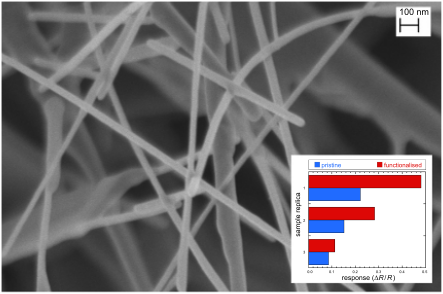
- crystallites into larger masses tends to reduce the gas permeability through the matrix [14]. It also increases the influence of the interagglomerate contact resistance on the gas response of the sensors. Analysis of transmission electron microscope images of these ZnO materials reveals that the primary


Ultraviolet photodetection of flexible ZnO nanowire sheets in polydimethylsiloxane polymer
Beilstein J. Nanotechnol. 2012, 3, 353–359, doi:10.3762/bjnano.3.41
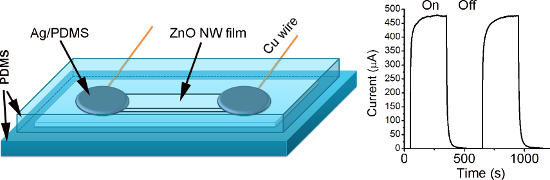
- ), which is an optically clear, UV-transparent silicone polymer that has been used in the fabrication of contact lenses, microfluidic devices, and stretchable displays. Due to its excellent gas permeability this polymer has been applied as a membrane for gas separation [15]. In our work, we combine free
- polymer structure that is highly permeable. PDMS has a high oxygen permeability due to the large free volume from the flexibility of the siloxane (–SiO–) linkages; the oxygen concentration in PDMS has been reported as 2 mM [23]. The diffusion coefficient of oxygen in PDMS is reported as 3.55 × 10⁻⁵ cm2·s
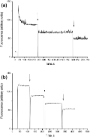
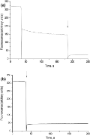
- polymer with higher oxygen permeability would have a faster UV photoresponse. The UV penetration depth in ZnO is less than 100 nm, whereas the thickness of the nanowire film is several micrometers, indicating that the contribution to the photoconduction of a nanowire sheet comes mostly from the top layers


Magnetic interactions between nanoparticles
Beilstein J. Nanotechnol. 2010, 1, 182–190, doi:10.3762/bjnano.1.22
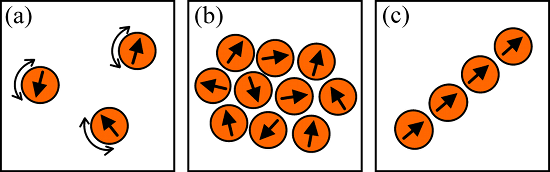
- nanoparticles can have a significant influence on the magnetic properties. In a sample of randomly distributed nanoparticles with average magnetic moment μ and average separation d, the dipole interaction energy of a particle is on the order of [9] where μ0 is the permeability of free space. In samples with



Review and outlook: from single nanoparticles to self-assembled monolayers and granular GMR sensors
Beilstein J. Nanotechnol. 2010, 1, 75–93, doi:10.3762/bjnano.1.10
- magnetization MS, and is given by where µ0 is the vacuum permeability. In this work, we focus on particles of sizes between 5 to 20 nm; the single domain limits of cobalt and iron nanocrystals are on this size scale. The crystalline microstructure introduces energetically favorable easy axes and directions of