Search results
Search for "plasmon" in Full Text gives 316 result(s) in Beilstein Journal of Nanotechnology. Showing first 200.
Ta2N3 nanocrystals grown in Al2O3 thin layers
Beilstein J. Nanotechnol. 2017, 8, 2162–2170, doi:10.3762/bjnano.8.215
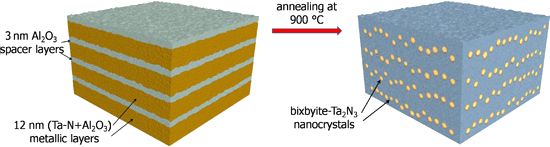
- light to nano-scale structures via local surface plasmon resonance (LSPR) [1]. LSPR produces a strong near-field enhancement and a local heating [2][3], which are considered to be promising in several applications ranging from surface-enhanced Raman scattering [4], to catalysis [5] and heat-assisted



Substrate and Mg doping effects in GaAs nanowires
Beilstein J. Nanotechnol. 2017, 8, 2126–2138, doi:10.3762/bjnano.8.212
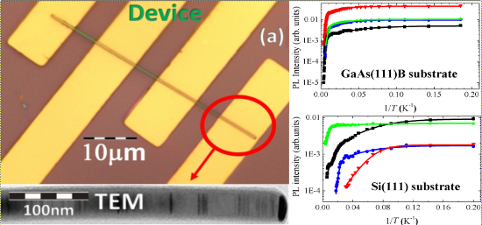
- ). For two of the investigated nanowires, our values are in good agreement with a recent result (≈31 cm2/Vs) in p-type Si-doped GaAs nanowires, obtained by measuring the plasmon–phonon interactions using transmission Raman spectroscopy [59] and, on average, clearly higher than the reported value (0.417


Synthesis and characterization of noble metal–titania core–shell nanostructures with tunable shell thickness
Beilstein J. Nanotechnol. 2017, 8, 2083–2093, doi:10.3762/bjnano.8.208
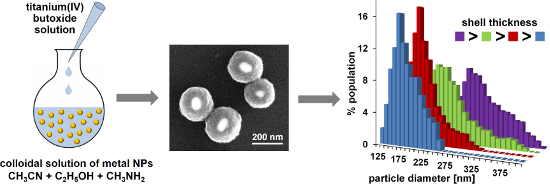
- , Kaliskiego 2 Str. 00-908 Warsaw, Poland 10.3762/bjnano.8.208 Abstract Core–shell nanostructures have found applications in many fields, including surface enhanced spectroscopy, catalysis and solar cells. Titania-coated noble metal nanoparticles, which combine the surface plasmon resonance properties of the
- great potential for use in these applications [18][19]. Surface plasmon resonance properties of gold and silver NPs can increase the optical absorption of titania and extend its absorption band to the visible light region. Such CSNs could allow one of the most important limitations in broader use of
- titania to be overcome: the limitation of photocatalytic capability to UV light (λ < 400 nm). In addition, they may serve as a precursor for plasmon-sensitized colloidal perovskites, which are materials of great interest for solar cell applications [20]. The limiting factor in the broader use of Ag@TiO2


Imidazolium-based ionic liquids used as additives in the nanolubrication of silicon surfaces
Beilstein J. Nanotechnol. 2017, 8, 1961–1971, doi:10.3762/bjnano.8.197
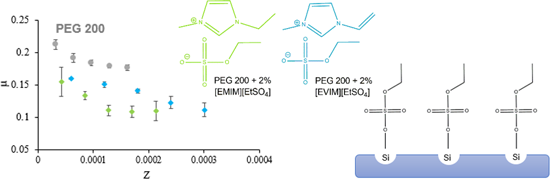
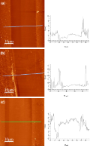
- (S 2p3/2 + S 2p1/2), which is superposed to the Si 2s plasmon loss. Comparison was, therefore, based on the S 2s peaks. In both samples, the signal to noise ratio is very poor (Figure 7b). Anyway, the smoothed data (full black lines) show different S 2s peaks in the sample treated with PEG + [EMIM




Methionine-mediated synthesis of magnetic nanoparticles and functionalization with gold quantum dots for theranostic applications
Beilstein J. Nanotechnol. 2017, 8, 1734–1741, doi:10.3762/bjnano.8.174
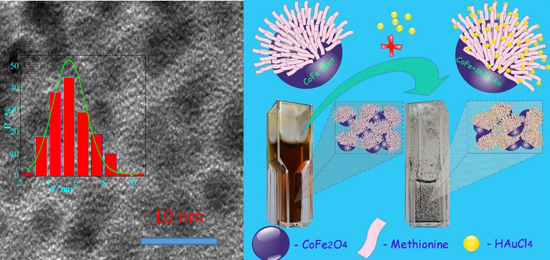
- at 291 nm is observed. The UV–vis absorption spectrum of the solution containing the gold species collected from the surface of the cobalt ferrite NPs (Figure 3, plot 3) exhibits two absorption shoulders at 522 and 377 nm. The former seems to be originated from the surface plasmon absorption of


Near-infrared-responsive, superparamagnetic Au@Co nanochains
Beilstein J. Nanotechnol. 2017, 8, 1680–1687, doi:10.3762/bjnano.8.168
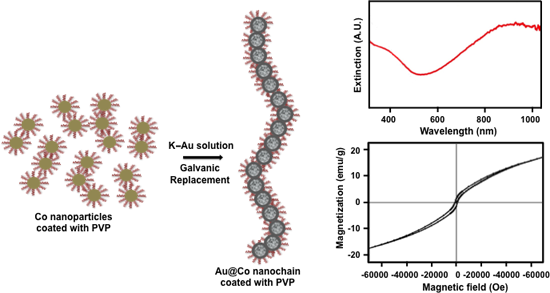
- nanoparticles not only renders the nanoparticles biocompatible but also gives rise to distinct optical properties [18][19]. Noble metal nanoparticles, such as gold and silver, possess the unique property of surface plasmon resonance (SPR); the latter exhibit a strong extinction band in the visible region [19
- arising from the difference between their reduction potentials. Cobalt cores were oxidized by H+ from aqueous HAuCl4 solution until Co nanoparticles were completely consumed, which led to the formation of the hollow gold nanostructures. The surface plasmon resonance of these particles appeared at 628 nm
- related nanostructures [28][29][30]. This considerable increase can be attributed to the formation of both the hollow interior and the chain structure in the present materials. Previous research on Au and Ag nanochains demonstrated that the plasmon resonance of two interacting particles undergoes a red


Two-dimensional carbon-based nanocomposites for photocatalytic energy generation and environmental remediation applications
Beilstein J. Nanotechnol. 2017, 8, 1571–1600, doi:10.3762/bjnano.8.159


Fixation mechanisms of nanoparticles on substrates by electron beam irradiation
Beilstein J. Nanotechnol. 2017, 8, 1523–1529, doi:10.3762/bjnano.8.153
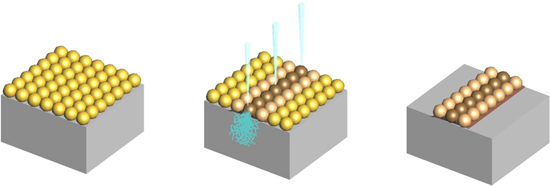
- been attracting attention because these arrays and patterns offer unique electrical and optical properties. One of the applications of such nanostructure arrays is plasmonic waveguides, in which the energy of light propagates because of the localized surface plasmon resonance (LSPR) effect [1][2]. In
- particular, arrays of gold or silver nanostructures can be used for such waveguides, as nanostructures made of these materials interact with visible light. Such LSPR structures would make the development of smaller optical circuits and devices possible. Plasmon propagation through nanowires or rows of



A top-down approach for fabricating three-dimensional closed hollow nanostructures with permeable thin metal walls
Beilstein J. Nanotechnol. 2017, 8, 1231–1237, doi:10.3762/bjnano.8.124
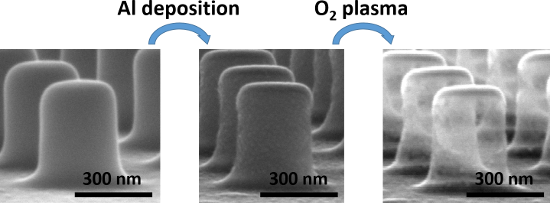
- previous work [11], the SU-8 nanopillar array reflectance exhibits two dips: at λ ≈ 640 nm, due to a metal-assisted, guided mode resonance (MaGMR), and at λ ≈ 840 nm, due to a surface plasmon polariton (SPP). Both of these dips are related to the Al layer (Si substrate coating) of thickness 100 nm on which
- field (Ex) and y-component of the magnetic field (Hy) at the reflectance peak (λ = 700 nm) are shown in Figure 4. Ex and Hy are enhanced and localized at the edges and on top of the metal disk, respectively, suggesting the excitation of a localized surface plasmon resonance (LSPR). On another hand, the


Surface-enhanced Raman spectroscopy of cell lysates mixed with silver nanoparticles for tumor classification
Beilstein J. Nanotechnol. 2017, 8, 1183–1190, doi:10.3762/bjnano.8.120

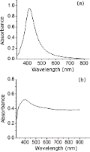
- absorption band of silver (Ag) nanoparticles corresponds to the maximum of the plasmon resonance which is near 415 nm (Figure 1a). Shifting the plasmon resonance of our nanoparticles to the near-IR spectral region was achieved by aggregation using potassium chloride (KCl). When nanoparticles aggregate, they
- become electronically coupled, which results in a change of the surface plasmon resonance compared to individual particles. Figure 1b shows the effect of adding KCl to Ag nanoparticles on the optical absorption characteristics. The aggregated nanoparticles have a broad absorption band that allowed for



Optical response of heterogeneous polymer layers containing silver nanostructures
Beilstein J. Nanotechnol. 2017, 8, 1065–1072, doi:10.3762/bjnano.8.108
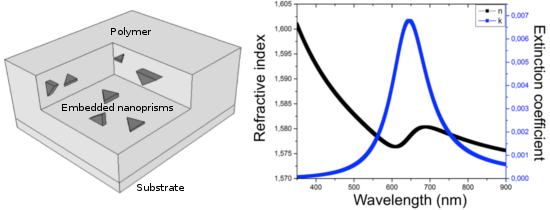
- wavelength range. The optical properties of these metallic NPs are induced by localized surface plasmon resonances, which are size, shape, material and environment dependent [7]. At the localized surface plasmon resonance wavelengths, the conduction electrons of the NPs oscillate coherently, which induces an
- control the absorption of thin film layers by embedding different NPs. When included in polymer thin film layers (such as poly(vinylpyrrolidone) (PVP)), the plasmon resonance wavelengths of the NPs are red-shifted with respect to the resonance wavelengths in water. This environment dependence can easily


Nanoantenna-assisted plasmonic enhancement of IR absorption of vibrational modes of organic molecules
Beilstein J. Nanotechnol. 2017, 8, 975–981, doi:10.3762/bjnano.8.99
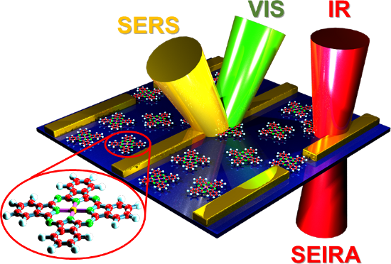
- . Keywords: cobalt phthalocyanine; cortisol; localized surface plasmon resonance; metal nanoantennas; Raman scattering; surface-enhanced infrared absorption (SEIRA); Introduction Organic semiconductors have been extensively investigated during the past few decades due to their wide range of applications in
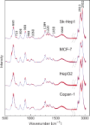
- surface plasmon energy of the nanoantennas to the energy of the molecular vibrations. Along with SEIRA, SERS is also traditionally used to study the vibrational spectra of various organic and biological substances [18], which may be present in very low quantities down to single molecules [19]. Raman
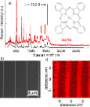
- can be explained by the resonant SERS effect, as the energy of the local surface plasmon resonance (LSPR) of nanoclusters is located in the red spectral region, which is in resonance with the excitation energy. In the case of nanoantennas, the energy of longitudinal LSPR modes polarized along the



Near-field surface plasmon field enhancement induced by rippled surfaces
Beilstein J. Nanotechnol. 2017, 8, 956–967, doi:10.3762/bjnano.8.97
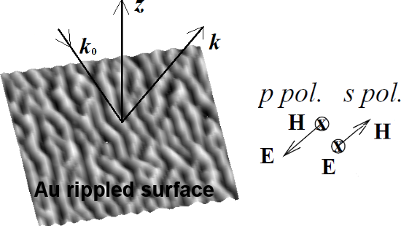
- , Yokohama, Japan Harvard Medical School, 64 Sydney Street, Suite 170, Cambridge, 02139 MA, USA, Network System Research Institute, National Institute of Information and Communications Technology, 4-2-1 Nukui-kita, Koganei, Tokyo 184-8795, Japan 10.3762/bjnano.8.97 Abstract The occurrence of plasmon
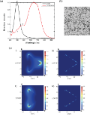
- of local surface patterns in the tuning of these resonances as a function of wavelength and electric field polarization. The effect of nanoscale roughness on the surface plasmon polaritons of randomly patterned gold films is numerically investigated. The field enhancement and relation to specific
- scanning near-field optical microscopy. Keywords: aperture scanning near-field optical microscopy; gold rippled surface; localized hot spots; metal–dielectric−metal nanogaps; surface plasmon resonance; Introduction Metal nanostructures capable of producing localized surface plasmon polaritons (SPPs) are


Selective detection of Mg2+ ions via enhanced fluorescence emission using Au–DNA nanocomposites
Beilstein J. Nanotechnol. 2017, 8, 762–771, doi:10.3762/bjnano.8.79
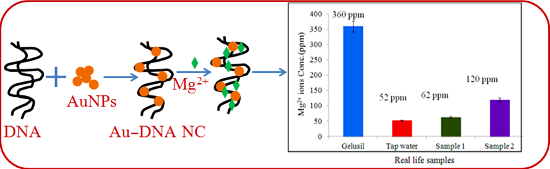
- from the observed changes in the optical absorption, plasmon band, zeta potential, DLS particle size distribution, as well as TEM and AFM surface morphology analysis. Circular dichroism studies also revealed that DNA-functionalized AuNP binding caused a conformational change in the DNA structure. Due
- various DNA detection schemes. The high sensitivity of the plasmon spectra towards the particle size and the local dielectric environment also offers new methods for the detection of free DNA or other biomolecules [2], where the detection signal is exclusively based on the color changes during assay or
- absorption of different bare and DNA-modified AuNPs (AuNS-1, AuNS-2, AuNS-3 and AuNS-4) is shown in Supporting Information File 1, Figure S1. It was found that due to their size dependency [17], the plasmon band shift (summarized in Supporting Information File 1, Table S1) occurred towards longer wavelengths




α-((4-Cyanobenzoyl)oxy)-ω-methyl poly(ethylene glycol): a new stabilizer for silver nanoparticles
Beilstein J. Nanotechnol. 2017, 8, 627–635, doi:10.3762/bjnano.8.67
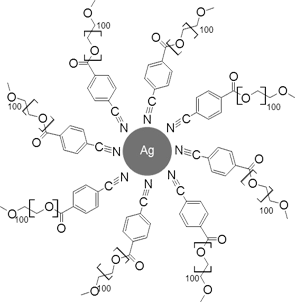
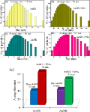
- ][53][54]. Figure 2D shows that the UV–vis spectra exhibit significant changes upon treatment of the nanoparticles with the polymer. Initially the samples exhibit a single, rather broad plasmon band at 385 nm. After modification with the polymer, two bands at 393 and 545 nm are visible. Stability of


Thin SnOx films for surface plasmon resonance enhanced ellipsometric gas sensing (SPREE)
Beilstein J. Nanotechnol. 2017, 8, 522–529, doi:10.3762/bjnano.8.56
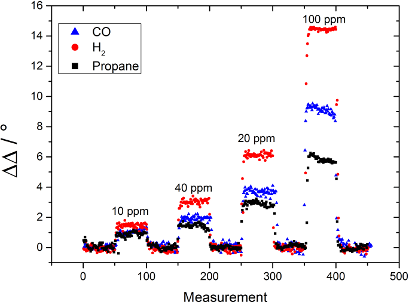
- the problems of cross sensitivity of the MOS concept. Results: Undoped tin oxide (SnOx) and iron doped tin oxide (Fe:SnOx) thin add-on films were prepared by magnetron sputtering on the top of the actual surface plasmon resonance (SPR) sensing gold layer. The films were tested for their sensitivity to
- several gas species in the surface plasmon resonance enhanced (SPREE) gas measurement. It was found that the undoped tin oxide (SnOx) shows higher sensitivities to propane (C3H8) then to carbon monoxide (CO). By using Fe:SnOx, this relation is inverted. This behavior was explained by a change of the
- sensing devices with different coated SPREE sensors. Keywords: doped tin oxide; ellipsometry; gas sensing; surface plasmon resonance; thin films; transparent conductive oxides; Introduction Gas sensors are an important tool for example in the fields of process monitoring, workplace safety or


Self-assembly of silicon nanowires studied by advanced transmission electron microscopy
Beilstein J. Nanotechnol. 2017, 8, 440–445, doi:10.3762/bjnano.8.47
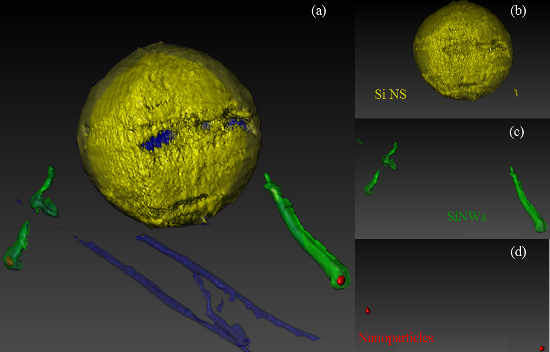
- . Energy-filtered TEM (EFTEM) images, acquired in correspondence to the Si plasmon loss (17 eV) and SiO2 plasmon loss (23 eV), display a common core–shell Si–SiO2 internal structure for both the NSs and the NWs (see Figure 1b and Figure 1c). Further EFTEM investigations conducted on hundreds of NWs
- Visualiser Kai software was used for visualization. (a) Typical SEM image showing the morphology of the as-collected sample; EFTEM images obtained at (b) the Si plasmon loss (17 eV) and (c) the SiO2 plasmon loss (23 eV), revealing the Si–SiO2 core–shell structure and the structural continuity between the Si


Fabrication of black-gold coatings by glancing angle deposition with sputtering
Beilstein J. Nanotechnol. 2017, 8, 434–439, doi:10.3762/bjnano.8.46
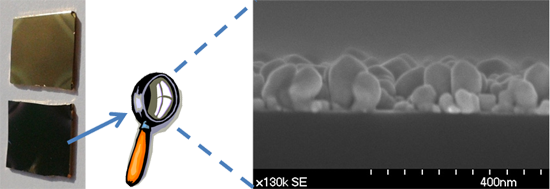
- properties of gold nanostructures are dominated by the existence of localized surface plasmon resonances (LSPRs), and that these LSPRs induce enhanced scattering, it is reasonable to assume that such low reflectance is due to the combined effect of the LSPRs and the light trapping associated with multiple


Comparison of four methods for the biofunctionalization of gold nanorods by the introduction of sulfhydryl groups to antibodies
Beilstein J. Nanotechnol. 2017, 8, 372–380, doi:10.3762/bjnano.8.39
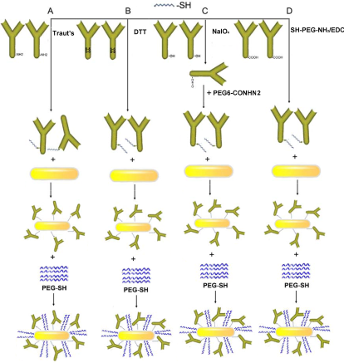
- biomedicine, including biosensing [1][2][3], photothermal therapy [4][5][6], molecular imaging [7][8], and controlled drug delivery [5][9] because of their distinct optical properties, i.e., high refractive index sensitivity and a tunable longitudinal plasmon band by varying the aspect ratio [10][11]. However
- containing 1% BSA (pH 7.4) as described previously in our work [17], to eliminate non-specific binding and adsorption. GNRs exhibit a unique optical transduction because of their localized surface plasmon resonance (LSPR). The particular sensitivity of the longitudinal plasmon band could induce a significant
- change in longitudinal plasmon wavelength when the refractive index alteration was elicited by target binding to the GNRs surface [10][14]. Figure 2 shows the absorption spectra of GNRs after conjugating with various thiolated anti-IgG. This conjugation resulted in a red shift in the longitudinal peak of


Colorimetric gas detection by the varying thickness of a thin film of ultrasmall PTSA-coated TiO2 nanoparticles on a Si substrate
Beilstein J. Nanotechnol. 2017, 8, 229–236, doi:10.3762/bjnano.8.25
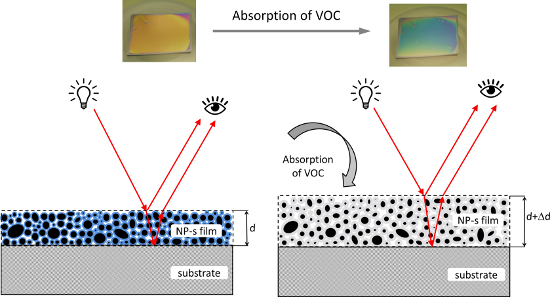
- was previously utilized both in localized surface plasmon resonance (LSPR) devices and porous Bragg stacks [17]. As mentioned before, the NPs in our samples are covered with PTSA. This functional coating ensures selectivity and different responses to different VOCs. Figure 6 shows that the proposed NP


Influence of hydrofluoric acid treatment on electroless deposition of Au clusters
Beilstein J. Nanotechnol. 2017, 8, 183–189, doi:10.3762/bjnano.8.19
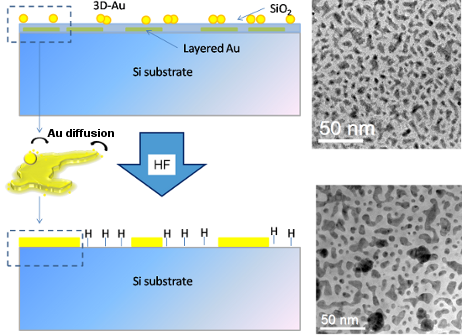
- shown quite interesting applications in the fields of Si nanowire (SiNW) catalysis [1][2][3], metal-assisted etching (MAE) [4] or even as electrical contacts in standard miniaturized devices [5]. Their ability to display enhanced surface plasmon resonance (SPR) at optical frequencies makes them


Tunable plasmons in regular planar arrays of graphene nanoribbons with armchair and zigzag-shaped edges
Beilstein J. Nanotechnol. 2017, 8, 172–182, doi:10.3762/bjnano.8.18
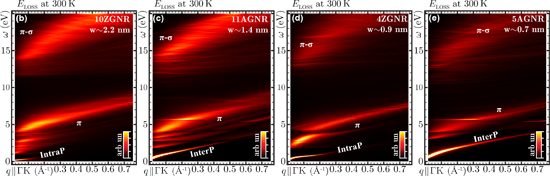
- scrutinize the main geometric and conformation factors, which can be used to modulate these collective modes in the infrared-to-terahertz frequency band. Here, we show how the extrinsic plasmon structure of regular planar arrays of graphene nanoribbons, with perfectly symmetric edges, is influenced by the
- been attracting significant interest, due their capability to couple with light and other charged particles, thus paving the way to novel applications in a wide range of technologies, as diverse as biosensing, light harvesting or quantum information [1][2][3][4][5]. On more fundamental grounds, plasmon
- platform for controlling the propagation of surface-plasmon waves [15], because of its unique electronic and optical properties [16]. In particular, the extrinsic plasmons of this one-atom-thick hexagonal lattice of sp-bonded carbon atoms have shown much stronger confinement, larger tunablity and lower


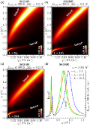
![[Graphic 8]](/bjnano/content/inline/2190-4286-8-18-i16.png?max-width=637&scale=1.18182) , Equation 6) and EL function (ELOSS, Equation 8) at room temperature for the GNR arrays of Figure 1 ...
, Equation 6) and EL function (ELOSS, Equation 8) at room temperature for the GNR arrays of Figure 1 ...


Surface-enhanced Raman scattering of self-assembled thiol monolayers and supported lipid membranes on thin anodic porous alumina
Beilstein J. Nanotechnol. 2017, 8, 74–81, doi:10.3762/bjnano.8.8
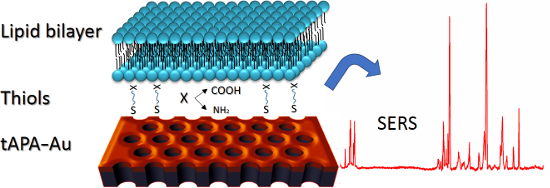
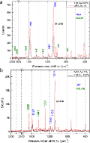
- plasmon resonances of this thin film, emerges. The same effect may also be used on the SLBs, at the later stage of the model system fabrication. For the selected lipids, we first tested the Raman spectra of the powders and then of the SLB form, on both the flat Au and nanoporous tAPA–Au. The molecular



Grazing-incidence optical magnetic recording with super-resolution
Beilstein J. Nanotechnol. 2017, 8, 28–37, doi:10.3762/bjnano.8.4
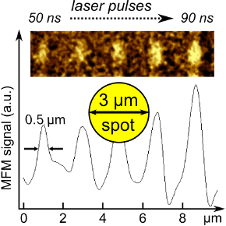
- surface-plasmon resonator as a highly localized heat source, as part of a near-field transducer (NFT), the current industry concepts still fail to deliver drives with sufficient lifetime. This study presents a method to aid conventional NFT-designs by additional grazing-incidence laser illumination, which
- during fabrication to assure the highest possible energy product. At the heart of HAMR devices is a near-field transducer (NFT): a device which consists of a light-capturing unit like a coupling grating, a waveguide structure and a surface plasmon resonator (SPR) positioned in immediate proximity to the


Streptavidin-coated gold nanoparticles: critical role of oligonucleotides on stability and fractal aggregation
Beilstein J. Nanotechnol. 2017, 8, 1–11, doi:10.3762/bjnano.8.1
- relevant ligands has led to dramatic progresses in both living cells as well as biomolecular diagnostic assays [3][4][5]. In particular, optical sensing exploiting the surface plasmon resonance (SPR) effect has been widely investigated and plays a significant role in biomolecular detection [6][7]. In this
- Equation 1: where εs and εm represent the dielectric constant of the shell (SA) and the surrounding medium (water), respectively, λp is the bulk metal plasmon wavelength (131 nm for gold [32]), λmax,bare is the wavelength of maximum absorption for AuNPs (520 nm, Figure 2), g is the fraction of nanoparticle
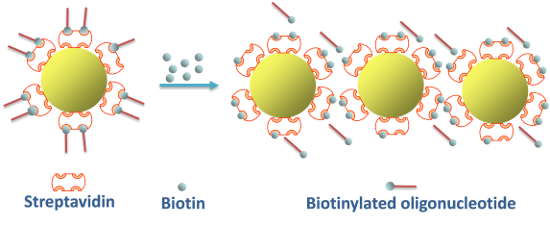
- oligonucleotide from AuNP-SA-BiotinDNA by free biotin was performed in our case. The addition of an increased amount of free biotin to AuNP-SA-BiotinDNA dispersions caused a gradual decrease of the intensity of the characteristic plasmon band at 528 nm while a plasmon band around 600 nm gradually emerged (Figure