


Search results
Search for "spring constant" in Full Text gives 184 result(s) in Beilstein Journal of Nanotechnology.
qPlus magnetic force microscopy in frequency-modulation mode with millihertz resolution
Beilstein J. Nanotechnol. 2012, 3, 174–178, doi:10.3762/bjnano.3.18
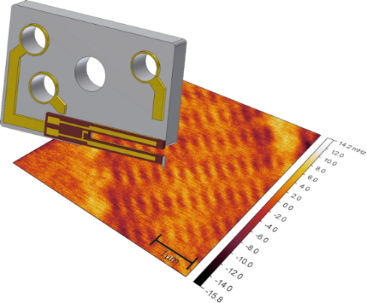
- fork. The qPlus sensor [8] is based on a quartz tuning fork, in which one prong is attached to a carrier substrate. The large spring constant of the qPlus, k = 1800 Nm−1, allows one to overcome the snap-to-contact-problem in small-amplitude operation [9]. In this mode, the qPlus setup is customized for
- noise Here A is the cantilever amplitude, f0 the undisturbed resonance frequency of the cantilever, k the spring constant, Q the quality factor of the oscillation, nq the deflection-noise density, B the bandwidth of the measurement, kB the Boltzmann constant and T the temperature. In each term, the
- necessary in order to reduce the noise by reducing the bandwidth. In Figure 2b the flattened raw data of the frequency-shift channel gathered in lift-mode show an image contrast of ±5 mHz along the bit tracks. According to the resonance frequency f0 = 24097 Hz and spring constant k = 1250 Nm−1 of the sensor


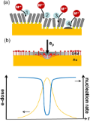
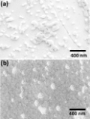
Self-assembly of octadecyltrichlorosilane: Surface structures formed using different protocols of particle lithography
Beilstein J. Nanotechnol. 2012, 3, 114–122, doi:10.3762/bjnano.3.12
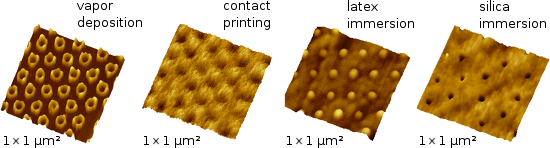
- reflex coating, with a spring constant of 48 N/m (Nanoscience Instruments, Phoenix, AZ). For contact-mode images, V-shaped tips (Veeco Probes, Santa Barbara, CA) with an average force constant of 0.5 N/m were used. Data files were processed by using Gwyddion open-source software, which is freely




Electron-beam patterned self-assembled monolayers as templates for Cu electrodeposition and lift-off
Beilstein J. Nanotechnol. 2012, 3, 101–113, doi:10.3762/bjnano.3.11
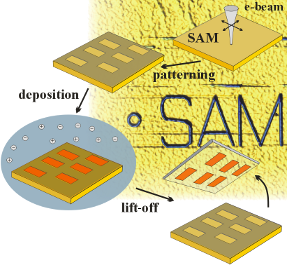
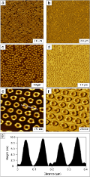
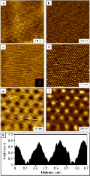
- structures were characterised by scanning electron microscopy (Hitachi S4800) and atomic force microscopy (PicoPlus, Molecular Imaging). Using Veeco NPS10 nonconductive silicon nitride tips (spring constant 0.06 N/m) AFM images were recorded in contact mode by using forces between 7 and 13 nN and scan rates





Direct monitoring of opto-mechanical switching of self-assembled monolayer films containing the azobenzene group
Beilstein J. Nanotechnol. 2011, 2, 834–844, doi:10.3762/bjnano.2.93
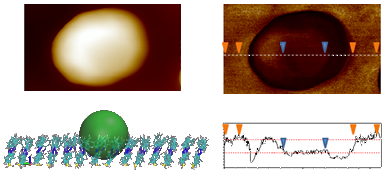
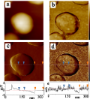
- measurement, Au and glass are considered equally stiff since the modulus signal saturates at about 5 GPa due to the limits of the cantilever spring constant and the signal sensitivities. The glass surface then serves as an in situ reference to which the film modulus can be compared. Scanning these samples



Manipulation of gold colloidal nanoparticles with atomic force microscopy in dynamic mode: influence of particle–substrate chemistry and morphology, and of operating conditions
Beilstein J. Nanotechnol. 2011, 2, 85–98, doi:10.3762/bjnano.2.10
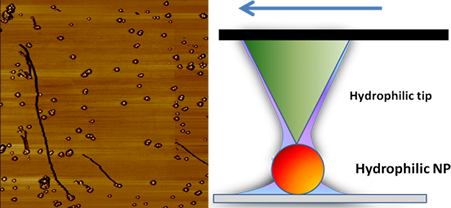
- amplitude of a piezo-element coupled to the cantilever, f0, k and Q are the resonance frequency, the spring constant and the quality factor of the free cantilever, respectively, and is the phase shift caused by the interaction between the tip and the underlying particles or surface. The calculation of the


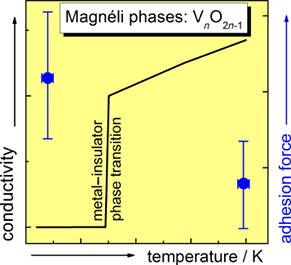
Switching adhesion forces by crossing the metal–insulator transition in Magnéli-type vanadium oxide crystals
Beilstein J. Nanotechnol. 2011, 2, 59–65, doi:10.3762/bjnano.2.8
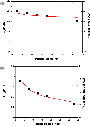
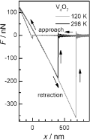
- the MIT temperature are shown in Figure 3. The plot shows the force interaction during approach and retraction of the spherical AFM tip from the sample surface. During retraction the tip adheres to the sample until the spring constant of the cantilever overcomes the adhesion force and the cantilever
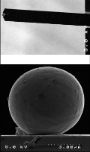
- to the sample acceptance stage. The actual temperature of the sample plates is taken from a calibration curve with an accuracy of ±20 K as provided by the manufacturer. The spring constant of the cantilevers with attached microsphere (typically 3.0 ± 0.2 N/m) was determined by means of the reference
- cantilever technique, where the cantilever under test was deflected in situ against a cantilever with a precisely known spring constant [40][41]. The spring constant of the reference cantilever (Park Scientific Instruments) was determined by a calculation based on geometrical dimensions and resonance



Oriented growth of porphyrin-based molecular wires on ionic crystals analysed by nc-AFM
Beilstein J. Nanotechnol. 2011, 2, 34–39, doi:10.3762/bjnano.2.4
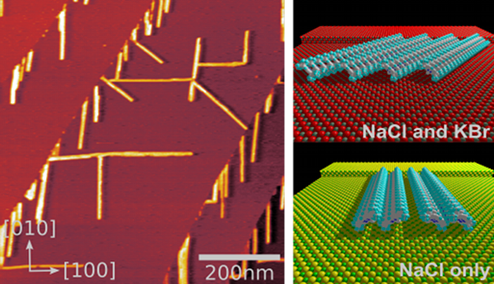
- maintaining a constant shift of the first flexural resonance frequency f1st with respect to the resonance far from the surface. Highly doped silicon cantilevers with integrated tips (Nanosensors, NCL), a typical resonance frequency f1st ≈ 160 kHz and a spring constant k ≈ 30 N/m were employed as a force


The description of friction of silicon MEMS with surface roughness: virtues and limitations of a stochastic Prandtl–Tomlinson model and the simulation of vibration-induced friction reduction
Beilstein J. Nanotechnol. 2010, 1, 163–171, doi:10.3762/bjnano.1.20
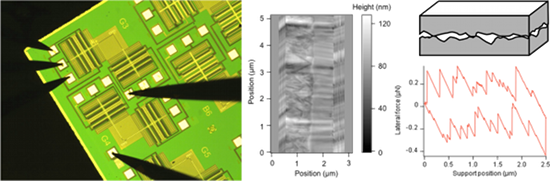
- the spring constant of the device. This calibration has been implemented by designing two MEMS tribometers on the same chip, which have identical springs, but a known difference in mass. From the difference in resonance frequency we extract the spring constant, being 2.0 ± 0.2 N/m for the device used


Sensing surface PEGylation with microcantilevers
Beilstein J. Nanotechnol. 2010, 1, 3–13, doi:10.3762/bjnano.1.2
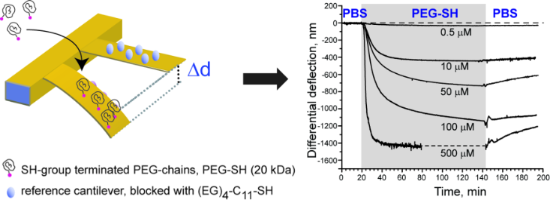
- . Rectangular-shaped Si3N4 AFM-cantilevers (Biolever, Olympus/OBL, Veeco) with V-shaped tips were used in all measurements. Spring constant calibrations typically fell within a 20% margin of error from the nominal spring constant of 0.005 N/m. The radius of curvature of each AFM-cantilever tip (Rtip) was
- the AFM-cantilever spring constant kAFM. For the force curves the F vs Z data were converted to F vs tip - sample approach distance (D) by further subtraction of the AFM-cantilever deflection from Z [32]. The AFM contact mode images were obtained at a scan rate of ~1.5 µm/s. (A) Scanning electron



Other Beilstein-Institut Open Science Activities



