


Search results
Search for "tapping mode" in Full Text gives 188 result(s) in Beilstein Journal of Nanotechnology.
Nano-FTIR chemical mapping of minerals in biological materials
Beilstein J. Nanotechnol. 2012, 3, 312–323, doi:10.3762/bjnano.3.35
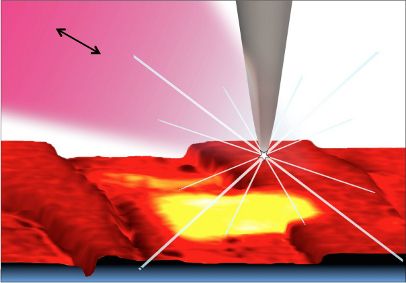
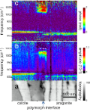
- scattering near-field microscope based on AFM (NeaSNOM, neaspec.com) equipped with a standard metalized tip (NCPt arrow, nanoandmore.com). It is operated in AFM tapping mode to modulate the near-field interaction between the tip and sample, and records the backscattered infrared signal simultaneously with





Wavelet cross-correlation and phase analysis of a free cantilever subjected to band excitation
Beilstein J. Nanotechnol. 2012, 3, 294–300, doi:10.3762/bjnano.3.33
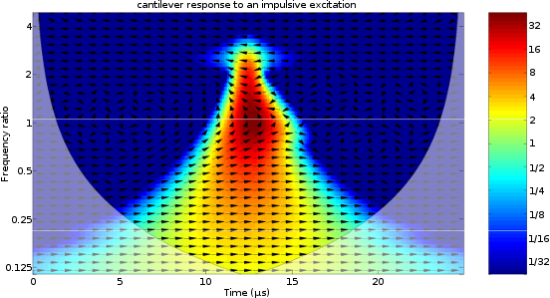
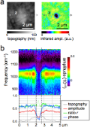
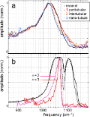
- of the superposition of spectral contributions generated at different times. In amplitude-modulation AFM (tapping mode) wavelet analysis is useful to track the time evolution of the nonlinearities in tip–surface dynamics. The wavelet analysis allows one to follow more than a single flexural mode


Mesoporous MgTa2O6 thin films with enhanced photocatalytic activity: On the interplay between crystallinity and mesostructure
Beilstein J. Nanotechnol. 2012, 3, 123–133, doi:10.3762/bjnano.3.13
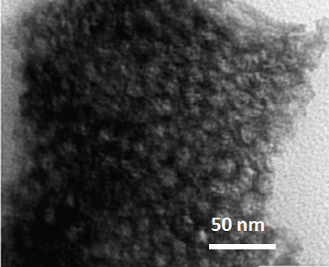
- . Atomic force microscopy (AFM) investigations were conducted with a Nanoscope III, Digital Instruments, in tapping mode. Transmission electron microscopy (TEM) images were taken with a Zeiss EM 912Ω instrument at an acceleration voltage of 120 kV. The small-angle X-ray scattering (SAXS) and X-ray






Self-assembly of octadecyltrichlorosilane: Surface structures formed using different protocols of particle lithography
Beilstein J. Nanotechnol. 2012, 3, 114–122, doi:10.3762/bjnano.3.12
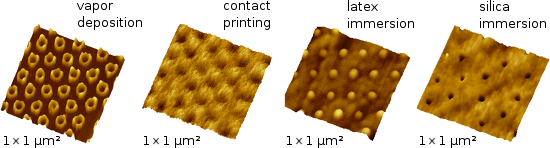
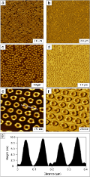
- models 5420 and 5500 scanning probe microscopes operated in contact or tapping-mode AFM. (Agilent Technologies, Chandler, AZ). Lateral force images were acquired for either the trace or retrace views corresponding to the scan direction of the selected topography frames. The color scales of lateral-force
- images indicate differences in tip–surface interactions, but were not normalized for the comparison of friction changes between different tips or experiments. The tips were silicon nitride probes. Tips used with tapping-mode AFM were rectangular shaped ultrasharp silicon tips that have an aluminium




Direct monitoring of opto-mechanical switching of self-assembled monolayer films containing the azobenzene group
Beilstein J. Nanotechnol. 2011, 2, 834–844, doi:10.3762/bjnano.2.93
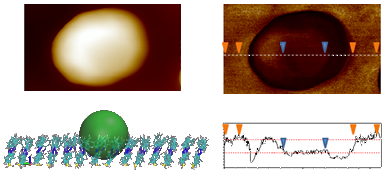
- . Tapping mode AFM measurements were carried out in air with a Multimode Nanoscope V AFM (Veeco, Woodbury, NY). Integrated Si tips (Olympus AC240, resonance frequency ca. 70 kHz) were used for these measurements. Images of the morphology of bare Au and the azobenzene on Au on Si samples are shown in Figure
- acquisition of the tapping-mode image. This is done by analysis of higher harmonics in the oscillating cantilever signal in order to extract full force versus distance curves. A full description of the technique can be found in the literature [19][25]. Since the force curves and stiffness data are derived



Self-organizing bioinspired oligothiophene–oligopeptide hybrids
Beilstein J. Nanotechnol. 2011, 2, 525–544, doi:10.3762/bjnano.2.57
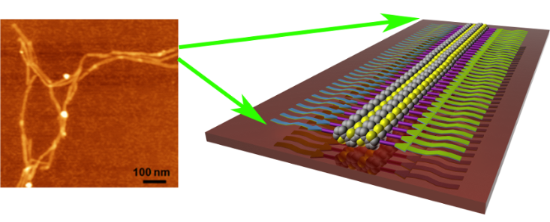
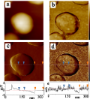
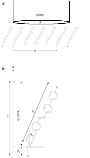
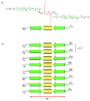
- force microscopy (AFM) as a powerful tool to visualize superstructures in the nano- and micrometer regime [22][23]. The substrate employed was muscovite mica, and tapping mode was chosen for scanning. For deprotection, the triblock oligothiophene–oligopeptide compound 1 (Scheme 1) was first treated with




Tip-enhanced Raman spectroscopic imaging of patterned thiol monolayers
Beilstein J. Nanotechnol. 2011, 2, 509–515, doi:10.3762/bjnano.2.55
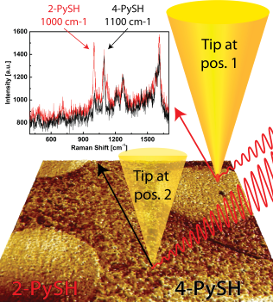
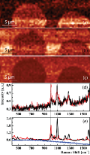
- investigated Raman bands. Each pixel in the TERS experiments corresponds to one spectrum from an area of roughly 25 nm in diameter. In measurements with larger pixel to pixel distances, only the probed area contributed to the respective Raman spectrum. (a), (c) 30/10 μm AFM tapping mode phase images of
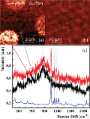
- of the spectroscopic image in (a). (c) 120 s reference SERS spectrum of 2-PySH (blue) and 2 s TERS spectra from (a) on the thiol (red) and on the bare gold surface (black). Spectra have been offset (red) and rescaled (blue) for better visibility. 20 μm tapping mode AFM image of microcontact printed 2




Dense lying self-organized GaAsSb quantum dots on GaAs for efficient lasers
Beilstein J. Nanotechnol. 2011, 2, 333–338, doi:10.3762/bjnano.2.39
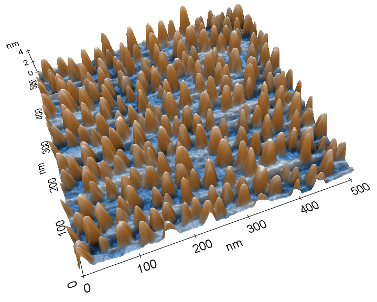
- GaSb QDs were grown on an As-rich surface. The nominal coverage for all samples was 3 monolayers (ML) with a growth rate of ≈0.3 ML/s. The samples were cooled down to room temperature under the adjusted Sb flux immediately after the QD growth for topographic tapping-mode measurements with a Park XE-70


Recrystallization of tubules from natural lotus (Nelumbo nucifera) wax on a Au(111) surface
Beilstein J. Nanotechnol. 2011, 2, 261–267, doi:10.3762/bjnano.2.30
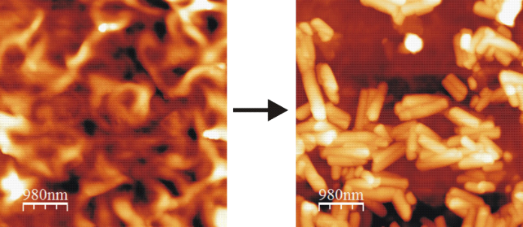
- (XRD) and electron diffraction (ED) techniques [10][11]. Koch and co-workers applied tapping mode AFM to study the continuous growth of nonacosan-10-ol tubules on HOPG [8]. By applying a 10 µL droplet of natural wax molecules derived from nasturtium (Tropaeolum majus) and lotus (Nelumbo nucifera


Manipulation of gold colloidal nanoparticles with atomic force microscopy in dynamic mode: influence of particle–substrate chemistry and morphology, and of operating conditions
Beilstein J. Nanotechnol. 2011, 2, 85–98, doi:10.3762/bjnano.2.10
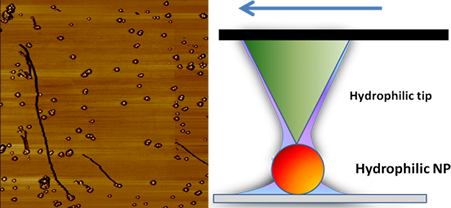
- intermittent tapping mode. The first mode used in AFM was the contact mode. Manipulation of large C60 islands on NaCl was performed by Lüthi et al. using contact AFM [11]. Even if the shear between islands and crystal surface can be derived from the frictional forces experienced by the AFM tip while scanning
- lateral force threshold, particle sliding was observed, which has allowed the transition from static to kinetic friction to be quantified [18]. A compromise between the contact and non-contact AFM techniques is the intermittent mode, the so called tapping mode. In this mode the phase shift of the
- nanoparticles deposited on highly oriented pyrolitic graphite using AFM in tapping mode. NPs were selectively moved as a function of their size varying from 24 up to 42 nm in diameter and the energy detachment threshold of NPs was estimated accordingly [19]. Sitti and coworkers have also manipulated nanoscale


Biomimetics inspired surfaces for drag reduction and oleophobicity/philicity
Beilstein J. Nanotechnol. 2011, 2, 66–84, doi:10.3762/bjnano.2.9








A collisional model for AFM manipulation of rigid nanoparticles
Beilstein J. Nanotechnol. 2010, 1, 158–162, doi:10.3762/bjnano.1.19
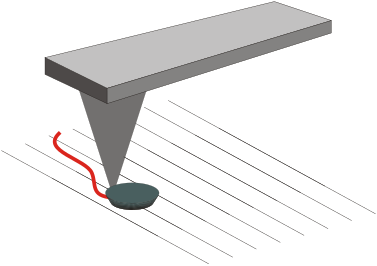
- is possible in simple cases of practical interest. Specifically, we assume that the AFM is operated in tapping mode (although some conclusions may be extended to contact mode), the particles are rigid and the frictional forces between particles and substrate can be neglected when the particles collide
- where rP defines the position of the point of contact P with respect to the COM. The direction of the force F depends on the operating mode of the AFM. In tapping mode the tip oscillates in the z direction with a frequency in the order of 100 kHz with an amplitude of some tens of nm. This corresponds to
- and r' is the first derivative of r(φ) with respect to φ (Figure 1b). In contact mode the tip hits the particle along the x direction and the force F can be oriented as in tapping mode only if the static friction force f between tip and particle is high enough to prevent sliding along the island profile


Scanning probe microscopy and related methods
Beilstein J. Nanotechnol. 2010, 1, 155–157, doi:10.3762/bjnano.1.18

- Microscopy, FMM: Force Modulation Microscopy, ic-AFM: intermittent contact AFM, TMAFM: tapping mode AFM, nc-AFM: non-contact AFM, KPFM: Kelvin probe force microscopy, EFM: Electrostatic force microscopy, MFM: Magnetic force microscopy, MRFM: Magnetic resonance force microscopy, NSOM: Near-field scanning




