


Search results
Search for "tension" in Full Text gives 205 result(s) in Beilstein Journal of Nanotechnology. Showing first 200.
Synthesis of Pt nanoparticles and their burrowing into Si due to synergistic effects of ion beam energy losses
Beilstein J. Nanotechnol. 2014, 5, 1864–1872, doi:10.3762/bjnano.5.197
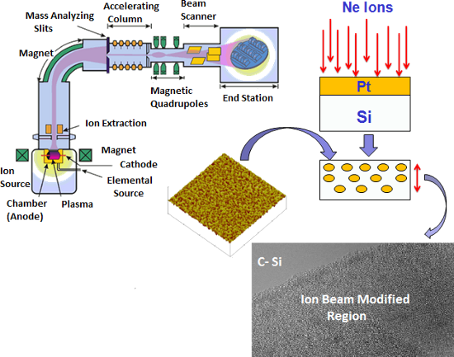
- coupling. The melting of materials along the ion trajectory generates a surface tension gradient due to an imbalance of the surface and the interface energies, which further gives rise to mass transport through capillary action. The migration of metallic atoms and subsequent agglomeration can result in the



Equilibrium states and stability of pre-tensioned adhesive tapes
Beilstein J. Nanotechnol. 2014, 5, 1725–1731, doi:10.3762/bjnano.5.182
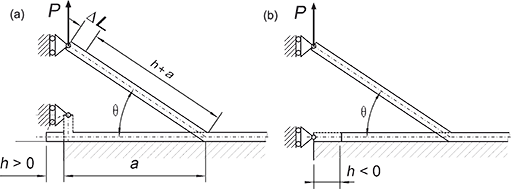
- , United Kingdom 10.3762/bjnano.5.182 Abstract In the present paper we propose a generalization of the model developed in Afferrante, L.; Carbone, G.; Demelio, G.; Pugno, N. Tribol. Lett. 2013, 52, 439–447 to take into account the effect of the pre-tension in the tape. A detailed analysis of the peeling
- the presence of pre-tension in the tape does not modify the stability behavior of the system, but significantly affects the pull-off force which can be sustained by the tape before complete detachment. Moreover, above a critical value of the pre-tension, which depends on the surface energy of adhesion
- hairy adhesive systems is pointed out. In this paper, we focus our attention on some yet unclear aspects of the peeling process and, in particular, on the stability of this mechanism in presence of a pre-tension. The peeling process of a thin elastic tape In this section, we extend the formulation given

![[Graphic 5]](/bjnano/content/inline/2190-4286-5-182-i14.png?max-width=637&scale=1.18182) as a function of the peeling angle θeq at equilibrium (a); the tot...
as a function of the peeling angle θeq at equilibrium (a); the tot...


![[Graphic 11]](/bjnano/content/inline/2190-4286-5-182-i20.png?max-width=637&scale=1.18182) as a function of the peeling angle θeq at equilibrium, for differen...
as a function of the peeling angle θeq at equilibrium, for differen...
Surface topography and contact mechanics of dry and wet human skin
Beilstein J. Nanotechnol. 2014, 5, 1341–1348, doi:10.3762/bjnano.5.147
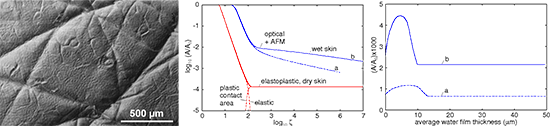
- regions covered by water is described by where γ is the surface tension of water. If ΔA is the surface area occupied by the capillary bridges then the attractive force is The contact area and the distribution of interfacial separations are determined by using the Persson contact mechanics model with the


Model systems for studying cell adhesion and biomimetic actin networks
Beilstein J. Nanotechnol. 2014, 5, 1193–1202, doi:10.3762/bjnano.5.131
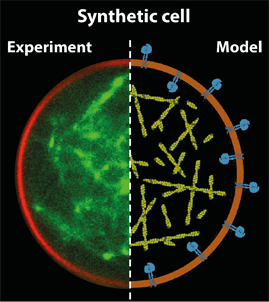
- regulation of morphological changes in such synthetic cells was explained by a balance of actomyosin cortical tension and mechanical resistance to rupture [71]. For the functional encapsulation of cytoskeletal proteins into lipid vesicles high physiological salt levels are mandatory and the fabrication


Physical principles of fluid-mediated insect attachment - Shouldn’t insects slip?
Beilstein J. Nanotechnol. 2014, 5, 1160–1166, doi:10.3762/bjnano.5.127
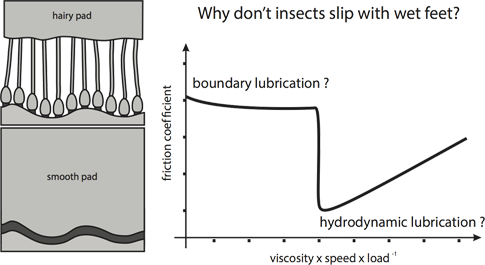
- , undeformable disk and substrate with a mediating continuous fluid-layer (see Figure 2 and [30][38][39][40][41][42]). In this simple model, the total adhesive force is basically the sum of three components: the surface tension of the fluid, the Laplace pressure (both often combined as “capillary forces”) and
- mediating fluid volume should decline over time. In a static adhesive pad with a Newtonian fluid, only the (negligible) surface tension and the small Laplace pressure would thus determine the overall adhesive force of the insect foot (Table 1). Fluid-mediated friction forces In a fluid mediated system with
- a continuous Newtonian fluid film, the friction forces between the substrates can in general be described by using two basic principles: the surface tension of the mediating fluid and the laws of hydrodynamic lubrication [55][56]. Surface tension The contribution of the surface tension of the


Nanoforging – Innovation in three-dimensional processing and shaping of nanoscaled structures
Beilstein J. Nanotechnol. 2014, 5, 1066–1070, doi:10.3762/bjnano.5.118
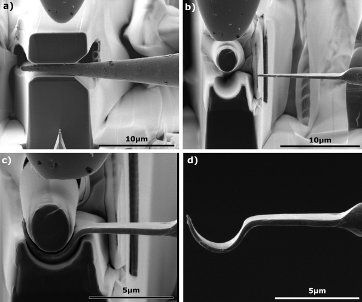
- also limited by the surface tension of the cast-material. Some complex three dimensional shapes were realized by casting of metal with a low melting temperature [3][4]. Dimensions of cast details are in the submillimeter- and microscale, and due to the mentioned limitations, applications in the


The study of surface wetting, nanobubbles and boundary slip with an applied voltage: A review
Beilstein J. Nanotechnol. 2014, 5, 1042–1065, doi:10.3762/bjnano.5.117
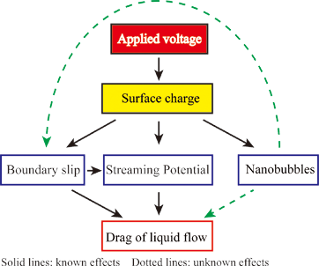
- section, a summary and an outlook are provided. Review 1 Contact angle and contact angle hysteresis with applied voltage When a voltage is applied to a droplet deposited on a solid surface, the surface tension between solid and liquid changes, which leads to a change of the wettability of the surface, the
- so called electrowetting [10][11][64][65]. The surface tension between solid and liquid decreases with increasing applied voltage, leading to a decrease of the CA. The change of the CA with the applied voltage V can be expressed by the Young–Lippmann equation [64][66] as: where θ0 is the original CA
- in the absence of an voltage, C is the capacitance of the dielectric layer, and γlv is the surface tension between liquid and vapor. In 1875, Lippmann found the electrowetting phenomenon and presented the Young–Lippmann equation, which is acknowledged as the basic of the electrowetting theory. In










Direct observation of microcavitation in underwater adhesion of mushroom-shaped adhesive microstructure
Beilstein J. Nanotechnol. 2014, 5, 903–909, doi:10.3762/bjnano.5.103
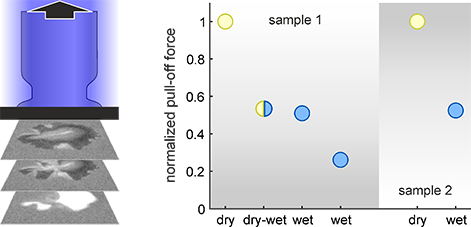
- negative pressure (tension), the pull-off forces were consistently lower, around 50%, of those measured under ambient conditions. This result supports the assumption that the recently observed strong underwater adhesion of MSAMS is due to an air layer between individual MSAMSs [Kizilkan, E.; Heepe, L
- hypothesized that the enhanced underwater adhesion may be a result of cavitation under each individual MSAMS when entrapped water in the contact area is subjected to a negative pressure (tension) during pull-off and the liquid water turns into vapor at a certain cavitation threshold [19]. This effect would
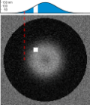
- a dry contact underwater, (2) MSAMS and glass are separated by (thin) water layer. Instead we observed that water inclusions present at the interface are subjected to negative pressure (tension) during applied pull-off. However, for individual MSAMSs used in this work, we did not observe higher


The optimal shape of elastomer mushroom-like fibers for high and robust adhesion
Beilstein J. Nanotechnol. 2014, 5, 630–638, doi:10.3762/bjnano.5.74
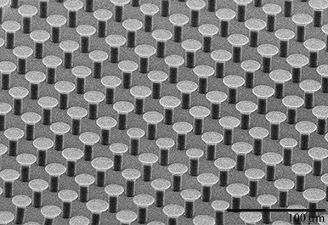
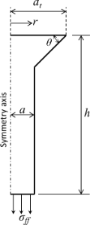
- increasing far field displacement causes a cohesive zone to form at the edge first. Since δc is relatively large for low χ, increase in tension does not immediately result in a crack to initiate at the edge. In the meantime the stress in the center gradually increases reaching σo at which a second cohesive



Hairy suckers: the surface microstructure and its possible functional significance in the Octopus vulgaris sucker
Beilstein J. Nanotechnol. 2014, 5, 561–565, doi:10.3762/bjnano.5.66
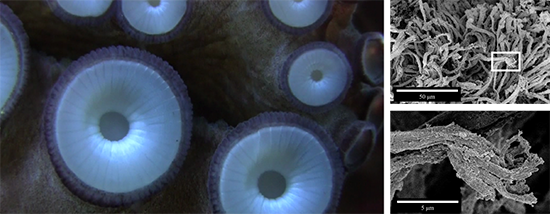
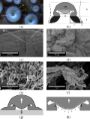
- Figure 1g), responsible for the detachment of the acetabular protuberance from the upper surface of the side wall of the orifice, needs to be balanced. In [5], such a force is balanced by the cohesive forces of the water in the infundibular portion (the water under tension behaves like a solid) (please
Calibration of quartz tuning fork spring constants for non-contact atomic force microscopy: direct mechanical measurements and simulations
Beilstein J. Nanotechnol. 2014, 5, 507–516, doi:10.3762/bjnano.5.59
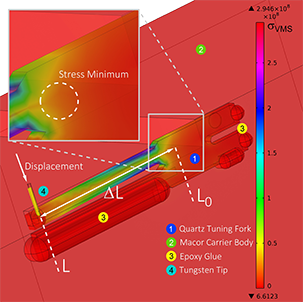
- , Fachbereich Bauingenieurwesen) for the tension-test of the “Torr Seal” samples as well as Werner David and Stephan Diekmann (“Feinmechanische Werkstatt”, Physikalisches Institut, WWU Münster) for support and fruitful discussion. Financial support by the Deutsche Forschungsgemeinschaft (DFG) through the




Nanoscale particles in technological processes of beneficiation
Beilstein J. Nanotechnol. 2014, 5, 458–465, doi:10.3762/bjnano.5.53
- side of the vapor, and η and σ are the viscosity and surface tension of the liquid, respectively. The set of equations of gas-dynamics, which is solved together with the van der Waals equation of state describes the vapor motion as well as the pressure, the temperature, and the internal energy inside


Tensile properties of a boron/nitrogen-doped carbon nanotube–graphene hybrid structure
Beilstein J. Nanotechnol. 2014, 5, 329–336, doi:10.3762/bjnano.5.37
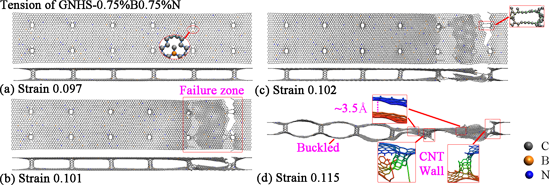
- materials. Keywords: doping; graphene; molecular dynamics simulation; nanotubes; tension; Young’s modulus; Introduction In recent years, low-dimensional structures such as carbon nanotubes (CNT) and graphene have attracted huge attention of the scientific community, because of their excellent performance
- and graphene sheets are connected. After the bonds begin to break, the hybrid structure quickly fails. This phenomenon is indicated by the sharp decrease of the stress (Figure 2a), which indicates a brittle behavior. Such brittle behavior can be easily explained as the tension loading direction is


Fabrication of carbon nanomembranes by helium ion beam lithography
Beilstein J. Nanotechnol. 2014, 5, 188–194, doi:10.3762/bjnano.5.20
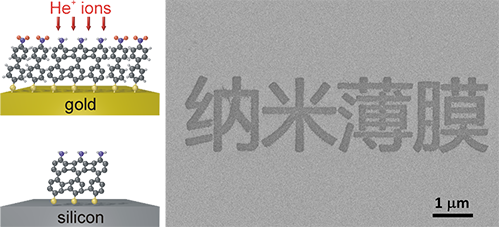
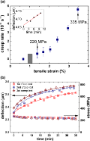
- approximately 200 µC/cm2 and approximately 480 µC/cm2, respectively. A possible explanation for this behaviour can be found by considering the in-plane tension of cross-linked SAMs. It is known that free-standing CNMs from fully cross-linked NBPT SAMs exhibit an in-plane tensile residual strain of about 1% [4


Size-dependent characteristics of electrostatically actuated fluid-conveying carbon nanotubes based on modified couple stress theory
Beilstein J. Nanotechnol. 2013, 4, 771–780, doi:10.3762/bjnano.4.88
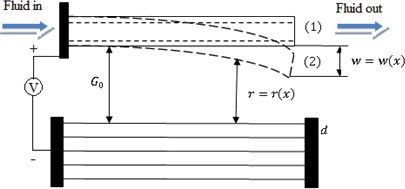
- static pull-in voltage is decreased because of a lowered stiffness. This can be attributed to the axial force that is induced by the fluid flow. For the cantilevered CNT, the axial force is tension because the free end does not apply any external force on the system. However, for the doubly clamped


Large-scale atomistic and quantum-mechanical simulations of a Nafion membrane: Morphology, proton solvation and charge transport
Beilstein J. Nanotechnol. 2013, 4, 567–587, doi:10.3762/bjnano.4.65
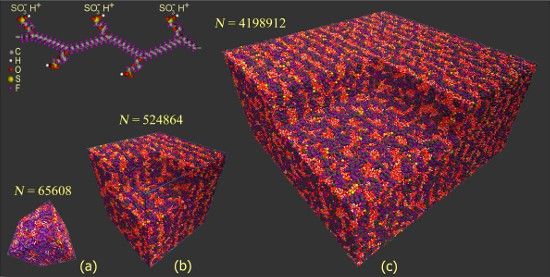
- incompatible H and P units can form thin channels and slits permeating through a matrix of a majority hydrophobic component [76]. The origin of such morphologies has been discussed for these materials and the physical forces responsible are well recognized. Essentially interfacial tension controls their
- morphologies. The interfacial tension tends to decrease interfacial stretching, thereby leading to the formation of highly curved monolayers consisting of amphiphilic units with their polar groups in contact with water and hydrophobic groups shielded from contacting the water. When the concentration of these


Ni nanocrystals on HOPG(0001): A scanning tunnelling microscope study
Beilstein J. Nanotechnol. 2013, 4, 406–417, doi:10.3762/bjnano.4.48
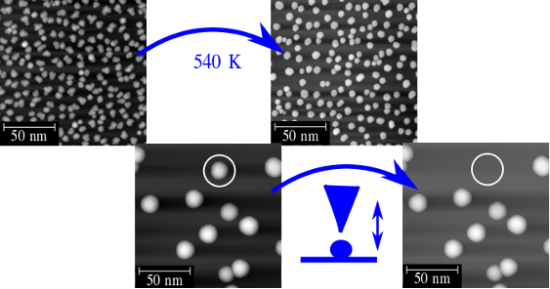
- theory [27]), i.e., in the limit of small deformations. Thus, the adhesive force can be written as where γx is the surface tension and R the radius of the cluster, assuming a spherical particle. With γHOPG = 1.75 J/m2, γNi = 2.45 J/m2, and R = 5.9 nm, a pull off force of Fa = −4.36 nN is expected. The



High-resolution nanomechanical analysis of suspended electrospun silk fibers with the torsional harmonic atomic force microscope
Beilstein J. Nanotechnol. 2013, 4, 243–248, doi:10.3762/bjnano.4.25
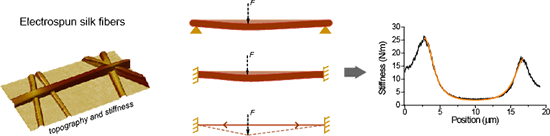
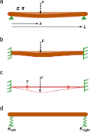
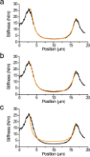
- the influence of tension and bending modulus on the response of the suspended structures. Here we report mechanical measurements on electrospun silk fibers with various treatments that allow discriminating among the different mechanisms that determine the mechanical behavior of these complex
- structures. In particular we were able to identify the role of tension and boundary conditions (pinned versus clamped) in determining the mechanical response of electrospun silk fibers. Our findings show that high-resolution mechanical imaging with torsional harmonic atomic force microscopy provides a
- example, the use of local interaction models provides limited information in the case of suspended structures where bending modulus, geometry, and mechanical tension are the key determinants of tip–sample interactions. The interpretation of measurements on these kinds of samples requires simultaneous


Electrospinning preparation and electrical and biological properties of ferrocene/poly(vinylpyrrolidone) composite nanofibers
Beilstein J. Nanotechnol. 2013, 4, 189–197, doi:10.3762/bjnano.4.19

- morphologies of the fibers. It is considered that the viscosity and surface tension of the solution changes with increasing Fc content, which leads to this result [30][31]. The characterization of typical samples obtained was summarized in Table 1. In the experiment we found that when the amount of the Fc was


Hydrogen-plasma-induced magnetocrystalline anisotropy ordering in self-assembled magnetic nanoparticle monolayers
Beilstein J. Nanotechnol. 2013, 4, 164–172, doi:10.3762/bjnano.4.16
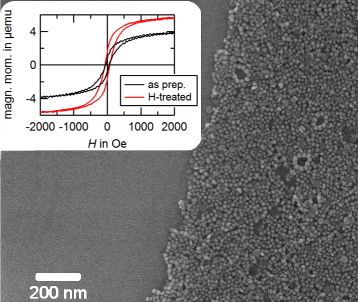
- equilibrium states. The experimental results will be compared to numerical calculations based on the idea that the plasma induces a process comparable to the time-dependent creep under tension in which the plasma acts as thermal activation. Experimental Measurements were carried out with two different species
- comparable to mechanical creep under tension with the hydrogen plasma acting as the thermal actuator. With the stray-field energy minimum obtained for an in-plane magnetic configuration, the easy magnetocrystalline axes of individual particles should migrate into the particle plane, resembling the respective
- with the stray field of contiguous nanocrystals. The process is comparable to the time-dependent creep under tension with the plasma acting as the thermal activation. For uniaxial magnetocrystalline anisotropy, the migration of the magnetocrystalline easy axes results in an increase of the effective




Size-dependent phase diagrams of metallic alloys: A Monte Carlo simulation study on order–disorder transitions in Pt–Rh nanoparticles
Beilstein J. Nanotechnol. 2012, 3, 1–11, doi:10.3762/bjnano.3.1
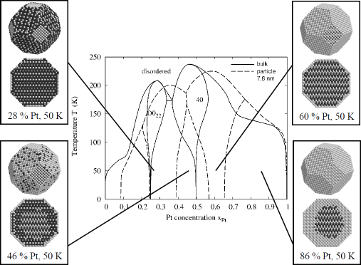
- surface in the microcanonical ensemble can be a useful theoretical tool, because convex intruders of the entropy can be used as a concept to assign first-order transitions even in finite systems, and additional quantities, such as the interface tension between phases, become accessible [9]. A quantitative


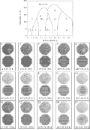


![[Graphic 37]](/bjnano/content/inline/2190-4286-3-1-i43.png?max-width=637&scale=1.18182) up to 8th neighbors for a Pt...
up to 8th neighbors for a Pt...

![[Graphic 28]](/bjnano/content/inline/2190-4286-3-1-i34.png?max-width=637&scale=1.18182) (lower points) and
(lower points) and ![[Graphic 29]](/bjnano/content/inline/2190-4286-3-1-i35.png?max-width=637&scale=1.18182) (upper points) WC-order parameters versus temperature for di...
(upper points) WC-order parameters versus temperature for di...


![[Graphic 31]](/bjnano/content/inline/2190-4286-3-1-i37.png?max-width=637&scale=1.18182) (lower points) and
(lower points) and ![[Graphic 32]](/bjnano/content/inline/2190-4286-3-1-i38.png?max-width=637&scale=1.18182) (upper points). The Pt concentration is ...
(upper points). The Pt concentration is ...

![[Graphic 33]](/bjnano/content/inline/2190-4286-3-1-i39.png?max-width=637&scale=1.18182) (lower points) and
(lower points) and ![[Graphic 34]](/bjnano/content/inline/2190-4286-3-1-i40.png?max-width=637&scale=1.18182) (upper points) constrained to a core region...
(upper points) constrained to a core region...

![[Graphic 39]](/bjnano/content/inline/2190-4286-3-1-i45.png?max-width=637&scale=1.18182) and
and ![[Graphic 38]](/bjnano/content/inline/2190-4286-3-1-i44.png?max-width=637&scale=1.18182) of three different particle sizes and bulk material a...
of three different particle sizes and bulk material a...

Direct monitoring of opto-mechanical switching of self-assembled monolayer films containing the azobenzene group
Beilstein J. Nanotechnol. 2011, 2, 834–844, doi:10.3762/bjnano.2.93
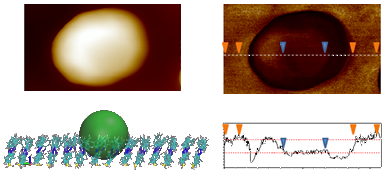
- molecular-level mechanical manipulators. As an example, macroscopic transport at the solid–liquid interface was driven by modifying the solid–liquid surface tension at a droplet front by using a molecular switch based on a SAM of rotaxane [8]. Central to the function of such systems are changes in the inter



Mechanical characterization of carbon nanomembranes from self-assembled monolayers
Beilstein J. Nanotechnol. 2011, 2, 826–833, doi:10.3762/bjnano.2.92
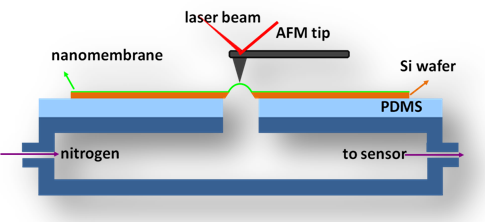
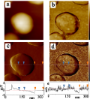
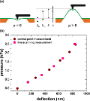
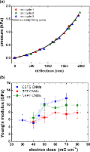
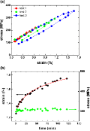
- [10]. In this system, the tension of the CNM is assumed to be the main contribution balancing the AFM tip force. The force contributed by the bending stiffness and the adhesion between the tip and the membrane was neglected. For a pressurized membrane, the indentation depth δ decreases with increasing

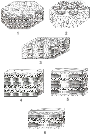
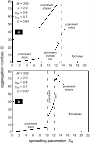
Surface induced self-organization of comb-like macromolecules
Beilstein J. Nanotechnol. 2011, 2, 569–584, doi:10.3762/bjnano.2.61
- . The free energy was calculated by summation of the bending energy of the wormlike chain of the backbone, the Maier–Saupe contribution for LC ordering of side LC chains, the stretching energy of the amorphous block, the surface tension and the mixing Flory–Huggins contributions. Later studies [95][96
- of two different cylindrical and four different types of lamellar phases were found (Figure 3). Conditions for stability of each structure can be summarized as follows [96]: Amorphous cylinders: Long macromolecules; high fraction of the B and C (LC) units; any values of the surface tension
- coefficients satisfying the strong segregation conditions. Liquid crystalline cylinders: Long macromolecules; high fraction of the A units and small enough fraction of the liquid crystalline units; any values of the surface tension coefficients satisfying the strong segregation conditions. AB lamellae: Long




Simulation of bonding effects in HRTEM images of light element materials
Beilstein J. Nanotechnol. 2011, 2, 394–404, doi:10.3762/bjnano.2.45
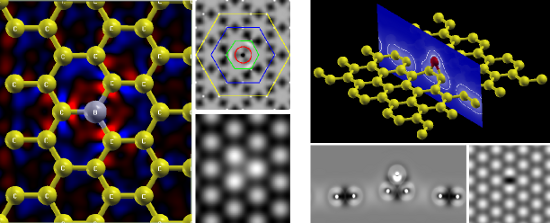
- low spatial frequencies resulting in enhanced contrast of the substitution defects. The other parameters were: High tension 80 kV and spherical aberration Cs = 0.02 mm. Higher order aberrations were not taken into account in this study. The resulting micrographs for the boron substitution are shown in





