


Search results
Search for "tunneling" in Full Text gives 317 result(s) in Beilstein Journal of Nanotechnology. Showing first 200.
Obtaining and doping of InAs-QD/GaAs(001) nanostructures by ion beam sputtering
Beilstein J. Nanotechnol. 2017, 8, 12–20, doi:10.3762/bjnano.8.2
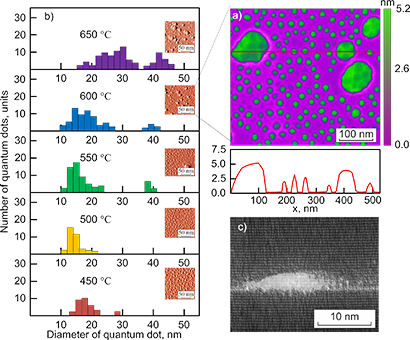
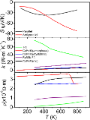
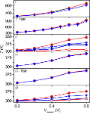
- 0.5 V. In contrast, sector 2 exhibit different changes in the current with increasing doping level. For a concentration of 1016 cm−3 a change of the transfer mechanism from thermionic to resonant tunneling can be seen at a bias voltage higher than 1.5 V because of field-assisted tunneling [42
- ]. Simultaneously, the width of the potential barrier is decreasing. Therefore, the tunneling probability through the GaAs barrier layer significantly increases. The main mechanism of carrier transport from InAs QDs becomes a tunneling current. As can be seen from Figure 9 the increase in doping concentration of


Solvent-mediated conductance increase of dodecanethiol-stabilized gold nanoparticle monolayers
Beilstein J. Nanotechnol. 2016, 7, 2057–2064, doi:10.3762/bjnano.7.196
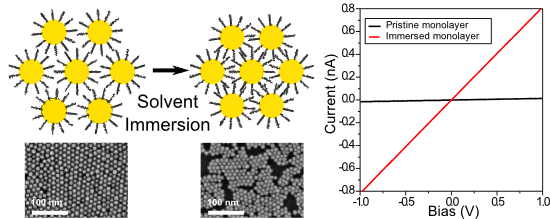
- chains are known to form interdigitated layers revealed by scanning tunneling microscopy [22][23]. Interestingly, the measured decreases in lattice constant after solvent immersion correspond to two and four times the distance between three carbon atoms in an alkyl chain. The conductance, G, of a metal



Monolayer graphene/SiC Schottky barrier diodes with improved barrier height uniformity as a sensing platform for the detection of heavy metals
Beilstein J. Nanotechnol. 2016, 7, 1800–1814, doi:10.3762/bjnano.7.173
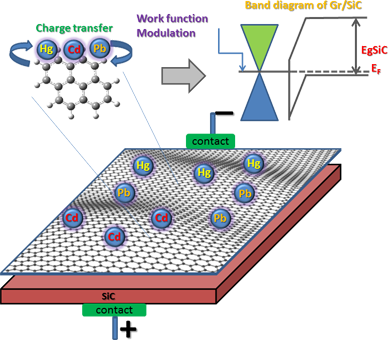
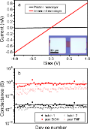
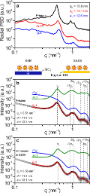
- that the diode exhibits almost ideal behavior, implying only a minor occurrence of interface states, generation-recombination, tunneling and even spatial inhomogeneity. The high quality of the graphene surface and the low density of defects promote also the low series resistance of the diode and the




Thickness-modulated tungsten–carbon superconducting nanostructures grown by focused ion beam induced deposition for vortex pinning up to high magnetic fields
Beilstein J. Nanotechnol. 2016, 7, 1698–1708, doi:10.3762/bjnano.7.162
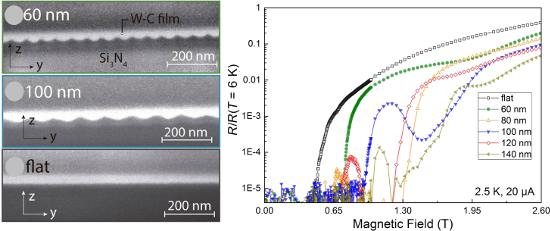
- ][14][15][16][17][18][19]. Interestingly, these W–C films are amorphous or nanocrystalline and the intrinsic pinning is low. Even small surface corrugations of just a few percent of the total thickness allow the observation of vortex-lattice matching effects by means of scanning tunneling microscopy


Analysis of self-heating of thermally assisted spin-transfer torque magnetic random access memory
Beilstein J. Nanotechnol. 2016, 7, 1676–1683, doi:10.3762/bjnano.7.160
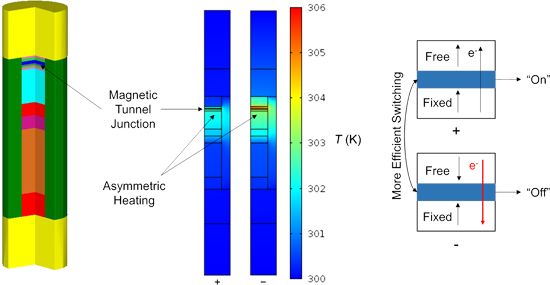
- simulations in order to understand the relative contributions of Joule, thermoelectric Peltier and Thomson, and tunneling junction heating. A 2D rotationally symmetric numerical model is used to solve the coupled electro-thermal equations including thermoelectric effects and heat absorbed or released at the
- tunneling junction. We compare self-heating for different common passivation materials, positive and negative electrical current polarity, and different device thermal anchoring and boundaries resistance configurations. The variations considered are found to result in significant differences in maximum
- , positive polarity, and low thermal anchoring with thermal boundary resistance configurations. Interestingly it is also found that due to the tunneling heat, Peltier effect, device geometry, and numerous interfacial layers around the magnetic tunnel junction (MTJ), most of the heat is dissipated on the





Hydrophilic silver nanoparticles with tunable optical properties: application for the detection of heavy metals in water
Beilstein J. Nanotechnol. 2016, 7, 1654–1661, doi:10.3762/bjnano.7.157
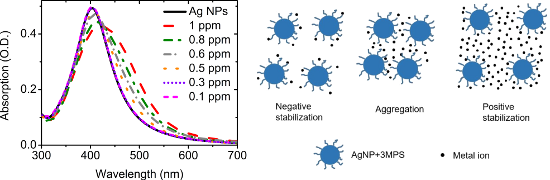
- ), zeta potential (ζ-potential) measurements and scanning tunneling microscopy (STM). Further, to demonstrate the environmental application of our AgNPs, we also applied them for heavy metal sensing by detecting visible color modification due to SPR spectral changes. We found that these negatively charged
- the Smolukovsky equation [55]. The scanning tunneling microscope (Tops System, WA Technology) consists of a UHV attachment with an antivibration stacking and a piezoelectric tube with 2 mm maximum scanning area for the tip movement. The lateral resolution of the microscope is ±1 Å and the accuracy in


Scanning probe microscopy studies on the adsorption of selected molecular dyes on titania
Beilstein J. Nanotechnol. 2016, 7, 1642–1653, doi:10.3762/bjnano.7.156
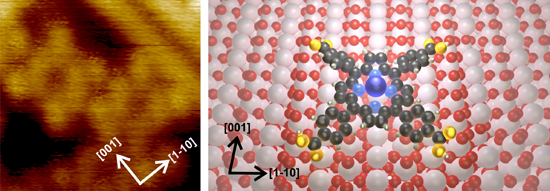
- dianhydride (PTCDA); phtalocyanines; porphyrins; rutile; scanning probe microscopy; scanning tunneling microscopy (STM); titanium dioxide (TiO2); Introduction Today it comes as no surprise that photovoltaic devices can be made of materials other than silicon. Nanocrystalline materials accompanied by organic


Dynamic of cold-atom tips in anharmonic potentials
Beilstein J. Nanotechnol. 2016, 7, 1543–1555, doi:10.3762/bjnano.7.148
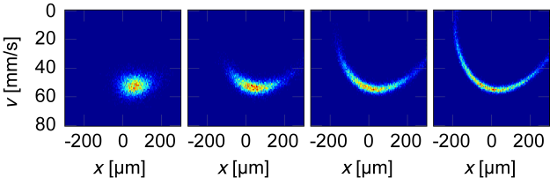
- -control. Keywords: anharmonic motion; cold-atom scanning probe microscopy; dephasing; dynamic mode; tip oscillation; Introduction The development of novel scanning probe techniques has lead to tremendous improvements in investigating nanomaterials [1]. Starting with conventional force and tunneling




Nanostructured germanium deposited on heated substrates with enhanced photoelectric properties
Beilstein J. Nanotechnol. 2016, 7, 1492–1500, doi:10.3762/bjnano.7.142
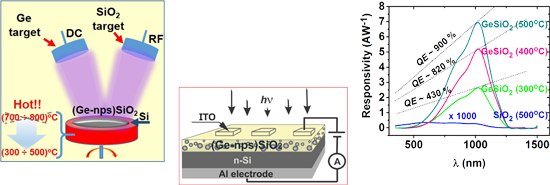
- darkness, the current behavior of the Al/n-Si/Ge:SiO2/ITO structure (schematically presented in Figure 5) is determined by the electrons tunneling from the ITO top electrode into the Ge-nps located in the SiO2 oxide layer and the electron transport in Ge:SiO2 film by a tunneling mechanism between
- neighboring Ge-nps [9][37]. The investigated (Ge-nps):SiO2 system behaves like a resistor network where each Ge-np is connected with its neighboring Ge-nps by a finite tunneling resistor. In this way, the activated carriers in the Ge-nps would tunnel to the nearest Ge-nps, following the path with the lowest
- generated in the Ge-nps and in the Si substrate and they move by tunneling between neighboring Ge-nps. During transport, the positively charged holes are dynamically trapped within the Ge-nps incorporated into SiO2 matrix improving the electron injection, leading to an increase of negative photoconductivity




A composite structure based on reduced graphene oxide and metal oxide nanomaterials for chemical sensors
Beilstein J. Nanotechnol. 2016, 7, 1421–1427, doi:10.3762/bjnano.7.133
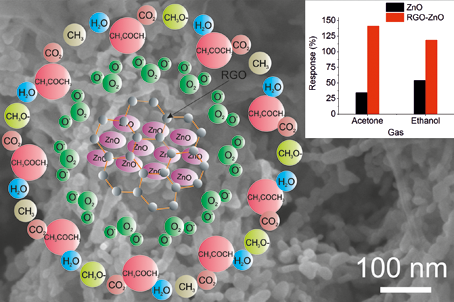
- potential barrier for electron tunneling acting as a highly conductive electrical path for the transport of electrons through the nanostructure [34]. Therefore, RGO improves the sensing performance of ZnO. Due to this reason, in our future investigations we will study the sensing properties of the composite


Advanced atomic force microscopy techniques III
Beilstein J. Nanotechnol. 2016, 7, 1052–1054, doi:10.3762/bjnano.7.98

- microscopy (AFM) celebrates its 30th anniversary this year. It was presented by Binnig, Quate and Gerber in 1986 as an extension of the scanning tunneling microscope (STM) with the possibility to measure forces as small as 10−18 N [1]. Since then many different variations of the force detection method and
Phenalenyl-based mononuclear dysprosium complexes
Beilstein J. Nanotechnol. 2016, 7, 995–1009, doi:10.3762/bjnano.7.92
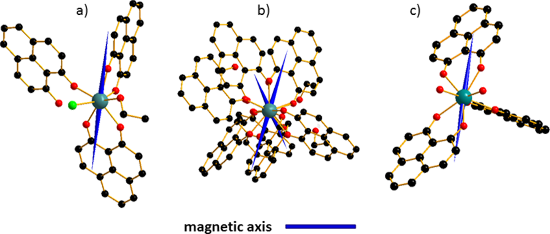
- relaxation process to be 43.8 K, and the respective pre-exponential factor τ0 to have a value of 3.3 × 10⁻⁶ s. Additionally, a saturation of about 5 × 10⁻⁴ s, relative to the quantum-tunneling process, is obtained below 5 K. In relaxation processes of SMMs that are to a certain extent subjected to quantum
- effects, the application of a small dc field can remove the state degeneracy, and accordingly also the probability of quantum tunneling. Aiming to explore the relaxation process and to evaluate the quantum tunneling effect, the frequency dependence of the ac susceptibility was estimated at 1.8 K under a
- suppressed quantum tunneling of the magnetization (QTM) [52]. Lastly, ac susceptibilities as a function of the temperature have been measured under a dc field of 200 Oe to estimate the effective relaxation time (Figure 5). The data were fitted with an Arrhenius law function in the temperature range between


A terahertz-vibration to terahertz-radiation converter based on gold nanoobjects: a feasibility study
Beilstein J. Nanotechnol. 2016, 7, 983–989, doi:10.3762/bjnano.7.90
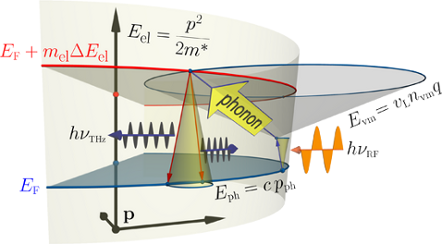
- [17][18], a tunneling of acoustic phonons across nanoscale gaps became an issue of priority. Meanwhile, already in 2010 Beardsley et al. [19] described a working 0.44 THz saser (on the basis of semiconductor superlattices). It seems that metallic nanobars/nanorings supposed to serve as resonators for
- LAVMs, taken in combination with a THz saser (possibly in a different realisation than that of [19]) and interconnected by the phonon tunneling “leaks” between the nanoobjects, may serve as elements of the THz acoustic phononic circuitry. Another idea is that metallic nanobars/nanorings could be used



Noncontact atomic force microscopy III
Beilstein J. Nanotechnol. 2016, 7, 946–947, doi:10.3762/bjnano.7.86
- tunneling microscopy (STM) relies on quantum mechanical tunneling of electrons to enable the atomic-resolution imaging of (semi-)conducting sample surfaces, it was the atomic force microscope (AFM) that eventually allowed for nanometer-scale imaging of sample surfaces with no limitations on electrical
The role of morphology and coupling of gold nanoparticles in optical breakdown during picosecond pulse exposures
Beilstein J. Nanotechnol. 2016, 7, 869–880, doi:10.3762/bjnano.7.79
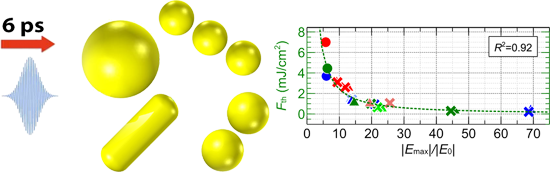
- medium, which models a biological environment, can initiate breakdown (i) through multiphoton absorption and the tunneling effect, usually referred to as laser-induced optical breakdown (LIOB) [26][27]; (ii) through a thermal initiation pathway also known as laser-induced thermal breakdown (LITB) [28][29
- full Keldysh theory for multiphoton ionization [54], the tunneling effect, avalanche ionization, thermal ionization [28][36], diffusion, and recombination losses and photo-thermal emission (PTE) [30] of hot electrons from the gold surface, was solved to determine the dynamics of the free-electron




Thermo-voltage measurements of atomic contacts at low temperature
Beilstein J. Nanotechnol. 2016, 7, 767–775, doi:10.3762/bjnano.7.68
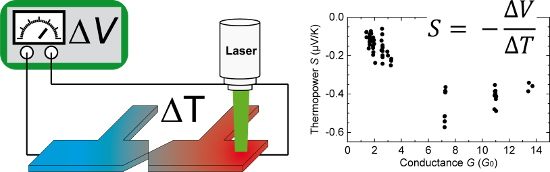
- ]. Experimental techniques such as scanning tunneling microscopy (STM) and the mechanically controlled break-junction (MCBJ) technique allow investigation of transport properties of atomic-scale devices [18]. Therefore, most approaches for measurements of thermo-voltage, or simultaneous measurements of
- from reduced lifetime, is largely facilitated. Furthermore, temperature-dependent effects of the transmission function that are expected in resonant tunneling situations can be revealed. Thus the ability to measure at variable temperature represents a considerable improvement compared to fixed


Fabrication and properties of luminescence polymer composites with erbium/ytterbium oxides and gold nanoparticles
Beilstein J. Nanotechnol. 2016, 7, 630–636, doi:10.3762/bjnano.7.55
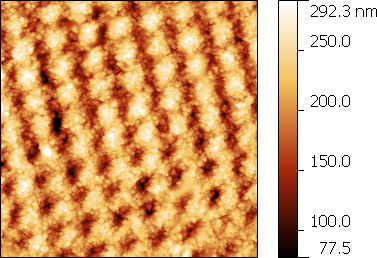
- , which fill the volume of the composite rather uniformly because of our synthesis technology, and the gold nanoparticles are also attached there, the plasmon field of excited AuNPs can enhance the quantum yield of luminescence. Of course, they should be separated by 5–10 nm, to prevent tunneling of the


Charge and heat transport in soft nanosystems in the presence of time-dependent perturbations
Beilstein J. Nanotechnol. 2016, 7, 439–464, doi:10.3762/bjnano.7.39
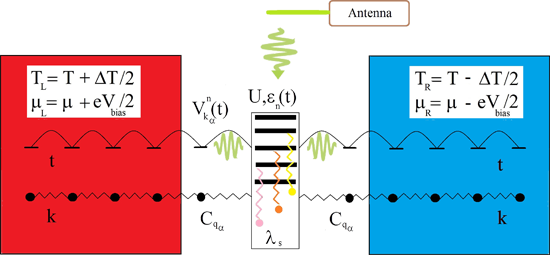
- described above. However, the characteristic frequencies of the external drive are much larger than the electronic tunneling rate. In fact, in these conditions, an effective phase-shift can be produced due to electron–electron interactions, which is intrinsically generated by a non-adiabatic blockade of
- tunneling [40]. However, it has been pointed out that higher frequencies are necessary to observe pumping currents of the same order of magnitude of those observed when a two-parameter pumping mechanism is present [41][42][43][44][45]. Another particularly interesting experiment has been carried out in [46
- frequencies are smaller than the electronic tunneling rates of the device and close to the frequency of the internal vibrational mode. Indeed, in the absence of an internal degree of freedom, it has been theoretically demonstrated that single-parameter charge pumping through a quantum dot in the this regime






Rigid multipodal platforms for metal surfaces
Beilstein J. Nanotechnol. 2016, 7, 374–405, doi:10.3762/bjnano.7.34

- junctions are based on either electrochemical break junctions [13][14][15] or mechanically controlled break junctions (MCBJ) [7] as well as on scanning tunneling microscopy (STM) [9][16][17]. The ultimate goal of molecular electronics is to use assemblies of molecules or even single molecules as functional
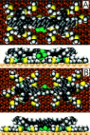
- were characterized by XPS, Fourier transform infrared absorption spectroscopy (FT-IRRAS), near-edge X-ray absorption fine structure spectroscopy (NEXAFS), and a scanning tunneling microscopy (STM) analysis. As revealed by XPS and NEXAFS analysis, the monolayers derived from the thiol-terminated
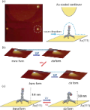
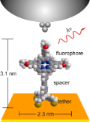
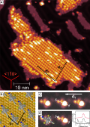
- dispersed bright spots (ca. 3–5 nm), fitted to the single or aggregated molecule, placed perpendicularly to the Au(111) surface. This STM-junction operating in the tunneling regime was irradiated with a short excitation pulse to measure the molecular electroluminescence when excited by local electron










Molecular machines operating on the nanoscale: from classical to quantum
Beilstein J. Nanotechnol. 2016, 7, 328–350, doi:10.3762/bjnano.7.31
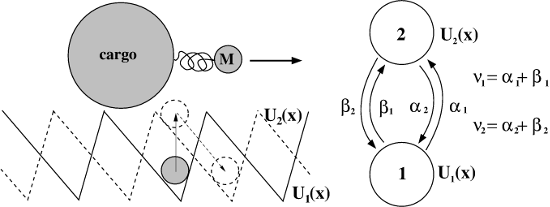
- correspond to the states of a proton pump driven by a nonequilibrium electron flow. This is a minimalist toy model for pumps like the cytochrome c oxidase proton pump [1][37]. The driving force is provided by electron energy, Δμ, released by dissipative tunneling of electrons between donor and acceptor
- electron transfer (ET) between two heme metalloclusters seems to be a rate limiting step. Such ET presents vibrationally assisted electron tunneling between two localized quantum states [38][39]. Given the weak electron tunneling coupling between the electronic states, the rate can be calculated using the
- a quantum prefactor, where Vtun is the tunneling coupling, and λ is the reorganization energy of the medium. The energy released in the electron transport is used to pump protons against their electrochemical gradient, Δμp, which corresponds to 2πfL within the previous model. Hence, R = Δμp/|Δμ|. Of

![[Graphic 40]](/bjnano/content/inline/2190-4286-7-31-i86.png?max-width=637&scale=1.18182) with depth ε. Bias Δμ < 0 per one rotation tur...
with depth ε. Bias Δμ < 0 per one rotation tur...

![[Graphic 48]](/bjnano/content/inline/2190-4286-7-31-i94.png?max-width=637&scale=1.18182) , for the most asymmetric sawtooth mod...
, for the most asymmetric sawtooth mod...


Synthesis and applications of carbon nanomaterials for energy generation and storage
Beilstein J. Nanotechnol. 2016, 7, 149–196, doi:10.3762/bjnano.7.17















Single-molecule magnet behavior in 2,2’-bipyrimidine-bridged dilanthanide complexes
Beilstein J. Nanotechnol. 2016, 7, 126–137, doi:10.3762/bjnano.7.15
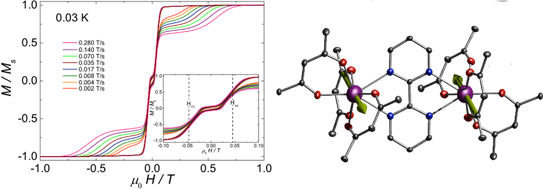
- ), 2; Dy(III), 3; Ho(III), 4 and Er(III), 5) has been synthesized and characterized. Sublimation of [Tb(tmhd)3]2bpm onto a Au(111) surface leads to the formation of a homogeneous film with hexagonal pattern, which was studied by scanning tunneling microscopy (STM). The bulk magnetic properties of all
- was measured using AC, DC and micro-SQUID magnetometry techniques. The homo-dinuclear complexes of Dy(III) and Er(III) show single-molecule magnet behavior featuring hysteresis loops. The [Tb(tmhd)3]2bpm was sublimated on Au(111) surfaces and scanning tunneling microscopy results are presented in this
- with a Perkin Elmer Spectrum GX FT-IR system spectrophotometer. Elemental analysis data were collected on an ELEMENTAR Vario Micro Cube. NMR spectra were carried out on a Bruker Ultrashield 500 PLUS spectrometer. Scanning tunneling microscopy. The STM measurements were realized with a homebuilt


Linear and nonlinear optical properties of hybrid metallic–dielectric plasmonic nanoantennas
Beilstein J. Nanotechnol. 2016, 7, 111–120, doi:10.3762/bjnano.7.13
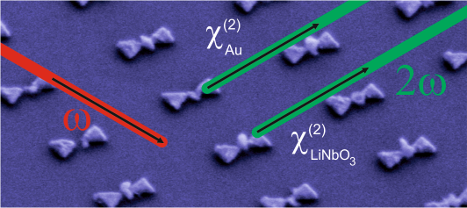
- fundamentally limits the field strength and what values can actually be achieved. Ultimately, the electric field strength might be limited by either electron tunneling processes between the extremely close spaced metallic nanoparticles [75][76] or by so-called nonlocal effects where the dielectric function of


Charge injection and transport properties of an organic light-emitting diode
Beilstein J. Nanotechnol. 2016, 7, 47–52, doi:10.3762/bjnano.7.5
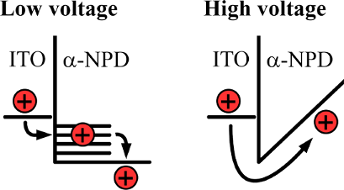
- ]. However, the 2C-SCLC model is fully valid only if no injection barrier is present at metal–organic semiconductor interface. Previous studies revealed that observed current density–voltage characteristics can be also associated with thermionic emission or Fowler–Nordheim tunneling [14][15][16]. Hence, to


Effects of electronic coupling and electrostatic potential on charge transport in carbon-based molecular electronic junctions
Beilstein J. Nanotechnol. 2016, 7, 32–46, doi:10.3762/bjnano.7.4
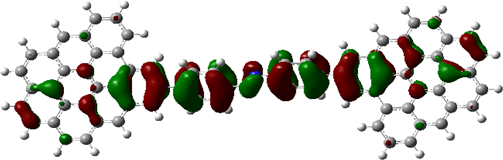
- coupling between the molecules and the contacts is demonstrated by the formation of hybrid orbitals in the model structure, which have significant electron density on both the graphene and the molecule. The energies of such hybrid orbitals correlate with tunneling barriers determined experimentally, and
- absent only when the two planes are orthogonal. Coupling also results in partial charge transfer between the graphene contacts and the molecular layer, which results in a shift in electrostatic potential which affects the observed tunneling barrier. Although the degree of partial charge transfer is
- “compression” of tunneling barriers predicted to range over 2.4 eV based on the free molecule energy levels to an observed range of 1.3 ± 0.2 eV in carbon-based MJs [31][34]. The current report describes the application of density functional theory (DFT) to carbon-based MJs, in order to investigate which





