


Search results
Search for "DNA nanostructures" in Full Text gives 10 result(s) in Beilstein Journal of Nanotechnology.
Facile synthesis of platinated DNA nanoparticles with radiosensitizing potential
Beilstein J. Nanotechnol. 2026, 17, 1117–1127, doi:10.3762/bjnano.17.76
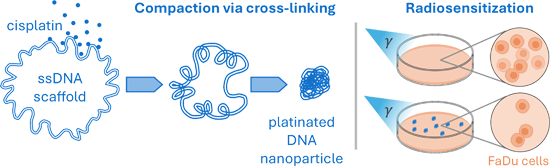
- Sciences, Kralovopolska 135, 612 65 Brno, Czech Republic Department of Analytical Chemistry, University of Chemistry and Technology, Technická 5, 166 28 Prague, Czech Republic 10.3762/bjnano.17.76 Abstract DNA nanostructures are promising drug delivery platforms but often suffer from limited structural
- stability and high production complexity. Cisplatin can cross-link DNA and act as a therapeutic agent, offering a simplified approach to stabilize DNA nanostructures while incorporating therapeutic functionality. Here, we explore cisplatin-mediated compaction of a single-stranded DNA scaffold to form stable
- . These platinated DNA nanoparticles represent a promising platform for further development of scalable DNA-based radiosensitizers with high drug loading, monodispersity, stability, and versatility for further functionalization. Keywords: AFM; cisplatin; DNA nanostructures; radiosensitization


Ion beam processing of DNA origami nanostructures
Beilstein J. Nanotechnol. 2024, 15, 207–214, doi:10.3762/bjnano.15.20
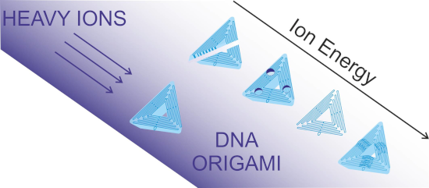
- DNA origami nanostructures is rarely explored, yet promising applications are foreseen to require such information. DNA nanostructures have been explored as drug delivery vessels for chemotherapeutics [1][2]. With the constant pursuit of effective targeting strategies [3], they could eventually be
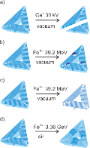
- the folded DNA nanostructures deposited on the surface remains conserved even upon significant energy input. The ions at low and medium energies can be used to shape the nanostructures via trimming, as demonstrated using FIB, or via crater formation, as demonstrated using 56Fe25+ (0.7 MeV/u) ion
- interfaces. While we demonstrate here that the trimming of individual DNA nanostructures within the lattice is possible, the collective response of the lattice and defect formation as a response to ion impact represents an interesting direction for future studies. The processes leading to height modification


Molecular architectonics of DNA for functional nanoarchitectures
Beilstein J. Nanotechnol. 2020, 11, 124–140, doi:10.3762/bjnano.11.11
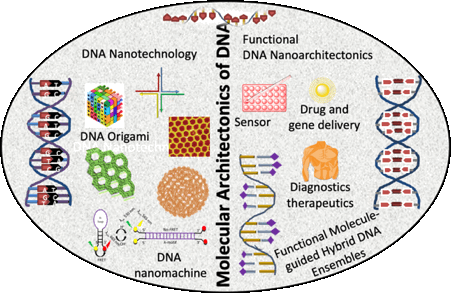
- tiles or bricks, which staple in a programmed fashion to form crystalline assembly structures with well-defined geometries, constitute the guiding principles of specific nucleobase pairing-driven DNA nanostructures (DNA nanotechnology) [16][17]. In other words, DNA origami involves the programmed
- geometries, patterns, or crystals that facilitate the positional assembly of nanoparticles along the DNA nanostructures [42]. The dynamic DNA nanotechnology includes DNA nanomachines with potential applications ranging from sensing to delivery and robotics [43]. Inspired by the complementary base pairing


Review on nanoparticles and nanostructured materials: history, sources, toxicity and regulations
Beilstein J. Nanotechnol. 2018, 9, 1050–1074, doi:10.3762/bjnano.9.98



Increasing the stability of DNA nanostructure templates by atomic layer deposition of Al2O3 and its application in imprinting lithography
Beilstein J. Nanotechnol. 2017, 8, 2363–2375, doi:10.3762/bjnano.8.236
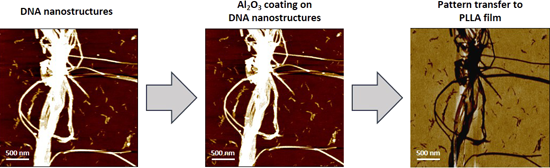
- conformal coating with a nanometer-thin protective inorganic oxide layer created using atomic layer deposition (ALD). DNA nanotubes and origami triangles were coated with ca. 2 nm to ca. 20 nm of Al2O3. Nanoscale features of the DNA nanostructures were preserved after the ALD coating and the patterns are
- complex features. Therefore, self-assembled DNA nanostructures are considered to be an ideal template for nanofabrication because it is easy to control their structural complexity and diversity at the nanoscale. Many approaches have been developed to use DNA nanostructures as templates to pattern a wide
- range of materials, such as proteins [16][17][18][19], carbon nanotubes [20][21][22][23] and metal nanoparticles through the direct assembly of these materials onto the DNA nanostructures [16][18][24][25][26][27][28][29]. The metallized DNA nanostructures have been used to pattern graphene [30]. DNA



Dielectrophoresis of gold nanoparticles conjugated to DNA origami structures
Beilstein J. Nanotechnol. 2016, 7, 948–956, doi:10.3762/bjnano.7.87
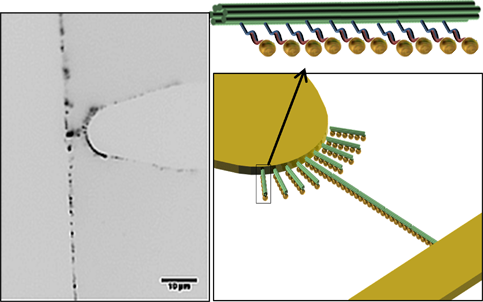
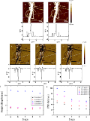
- Chemistry, University of Alberta, Edmonton, T6G2G2, Canada Kurt-Schwabe-Institut für Mess- und Sensortechnik Meinsberg e.V., 04736 Waldheim, Germany 10.3762/bjnano.7.87 Abstract DNA nanostructures are promising construction materials to bridge the gap between self-assembly of functional molecules and
- between electrodes at applied frequencies in the megahertz range was observed. The long-range chain formation is caused by a local, gold nanoparticle-induced field concentration along the DNA nanostructures, which in turn, creates dielectrophoretic forces that enable the observed self-alignment of the
- this aim, one important task is the precise positioning and alignment of DNA structures on technically patterned surfaces, e.g., their controlled deposition into microstructured electrode arrays. Recent studies address the alignment of DNA nanostructures to pre-structured surfaces that include (i


Hierarchical coassembly of DNA–triptycene hybrid molecular building blocks and zinc protoporphyrin IX
Beilstein J. Nanotechnol. 2016, 7, 697–707, doi:10.3762/bjnano.7.62
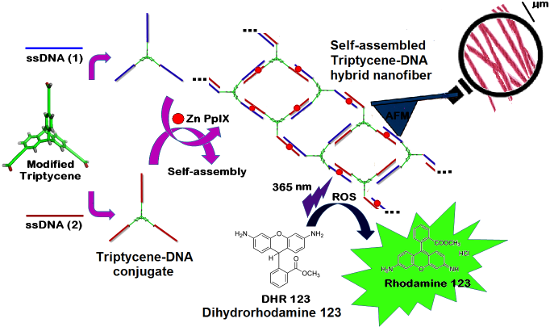
- composite DNA nanostructures by the self-assembly of complementary symmetrical 2,6,14-triptycenetripropiolic acid (TPA)–DNA building blocks and zinc protoporphyrin IX (Zn PpIX). DNA–organic molecule scaffolds for the composite DNA nanostructure were constructed through covalent conjugation of TPA with 5
- composite DNA nanostructures was observed. Native PAGE, circular dichroism (CD) and atomic force microscopy (AFM) have been utilized for analyzing the formation of DNA nanofibers after the coassembly. Computational methods were applied to discern the theoretical dimension of the DNA–TPA molecular building
- well-defined DNA nanostructures [40]. Additionally; these DNA–organic hybrids are endowed with better base pairing fidelity, stability, DNA economy and others [41][42]. Supramolecular structures having a confined space can accommodate small molecules that are suitable for catalysis and other


Mismatch detection in DNA monolayers by atomic force microscopy and electrochemical impedance spectroscopy
Beilstein J. Nanotechnol. 2016, 7, 220–227, doi:10.3762/bjnano.7.20
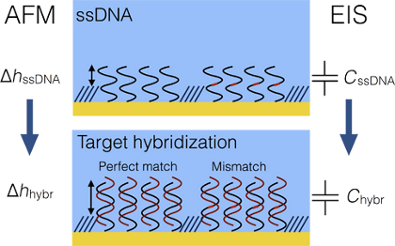
- schematic representation of the AFM-based assay. We immobilize by means of nanografting on a gold surface two ssDNA sequences, differing by one base (reported as a red mark), and carefully measure the height of the DNA nanostructures with respect to the surrounding biorepellent self-assembled monolayer


DNA–melamine hybrid molecules: from self-assembly to nanostructures
Beilstein J. Nanotechnol. 2015, 6, 1432–1438, doi:10.3762/bjnano.6.148
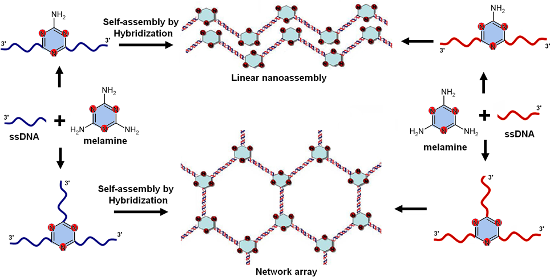
- structures [8][9][10]. This promising strategy of building DNA nanostructures involving DNA–organic hybrid building blocks has been used to create electrochemical DNA sensors and systems that displayed redox, photophysical, photochemical or catalytic activities [11][12]. While there are definite advantages
- could be used for various potential applications including templated polymerization or metallization. Several strategies have been developed to generate self-assembled DNA nanostructures based on DNA–organic hybrid molecular building blocks. The selection of organic molecule and the DNA sequence are the



DNA origami deposition on native and passivated molybdenum disulfide substrates
Beilstein J. Nanotechnol. 2014, 5, 501–506, doi:10.3762/bjnano.5.58
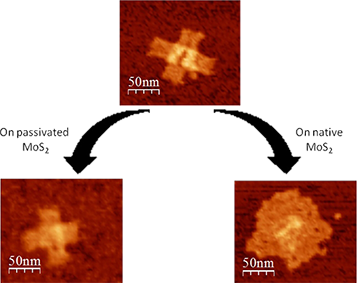
- proposed and implemented by Rothmund in 2006 [1], DNA origami has offered a promising pathway for the construction of precisely programmed molecular architectures [2]. Through programmed, specific oligonucleotide recognition and hybridization, these DNA nanostructures can be used to combine, and therefore
- roughness (RMS) of the MoS2 surface was found to be 0.92 Å, indicating that MoS2 presents an ideal physical surface for the deposition of flat DNA nanostructures. Importantly, AFM imaging reveals that shape and structure of the DNA origami constructs tended to be lost (Figure 2b) when the DNA origami was
- constructs. While the surface roughness increased significantly to 5.3 Å after surface modification (Figure 3a), we found that DNA nanostructures remained intact in the presence of the 1-pyrenemethylamine adhesion layer (Figure 3b–d), in contrast to the DNA nanostructures deposited on the bare MoS2 surface





