


Search results
Search for "Grüneisen parameter" in Full Text gives 5 result(s) in Beilstein Journal of Nanotechnology.
Further insights into the thermodynamics of linear carbon chains for temperatures ranging from 13 to 300 K
Beilstein J. Nanotechnol. 2025, 16, 1818–1825, doi:10.3762/bjnano.16.125
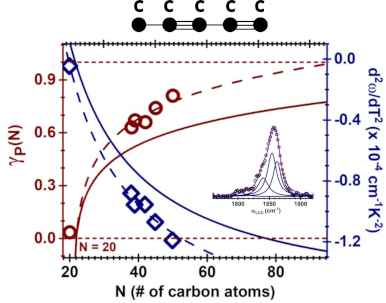
- , coefficient of linear thermal expansion, specific heat, thermal strain, and Grüneisen parameter at constant pressure) were empirically determined for the first time in the range of temperatures 70 < T < 293 K. These observables were all correlated with the C-band frequency (ωLCC) dependence on the temperature
- linear thermal expansion (α), thermal strain (εT), and Grüneisen parameter at constant pressure (γp). The present work is intended to explore some important points that were left open by Costa and collaborators [30]. These points mainly regard the influence of the number of CNT walls in the LCC
- is the thermal strain between T and T + dT, and γP is the T-independent Grüneisen parameter at constant P. Equation 1 in turn is expected to follow the empirical relation: where the second derivative magnitude is N-dependent (see Figure 3). Figure 2a confirms that this is the case: the solid lines


![[Graphic 23]](/bjnano/content/inline/2190-4286-16-125-i25.svg?max-width=637&scale=1.18182)
First-principles study of the structural, optoelectronic and thermophysical properties of the π-SnSe for thermoelectric applications
Beilstein J. Nanotechnol. 2021, 12, 1101–1114, doi:10.3762/bjnano.12.82
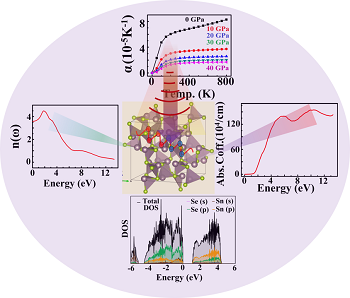
- of temperature as well as pressure on TD parameters, such as the Grüneisen parameter (γ), Debye temperature (θD), thermal expansion coefficient (α), heat capacity (CV), and volume. We employed the quasi-harmonic Debye model [60][61] to explore the TD properties of the π-SnSe alloy. We obtained the TD
- . Finally, the Grüneisen parameter (γ) and the Debye temperature (θD) have been predicted with a temperature variation at zero pressure. These TD parameters have practical importance and are two of the most important thermodynamic parameters linked to the various material properties. The Grüneisen parameter
- defined as the highest temperature which can be reached due to individual vibration modes. Thus, these two important quantities (i.e., the Grüneisen parameter (γ) and the Debye temperature (θD)) are calculated as a function of temperature at zero pressure and presented in Figure 8. It can be seen that the


Properties of graphene deposited on GaN nanowires: influence of nanowire roughness, self-induced nanogating and defects
Beilstein J. Nanotechnol. 2021, 12, 566–577, doi:10.3762/bjnano.12.47
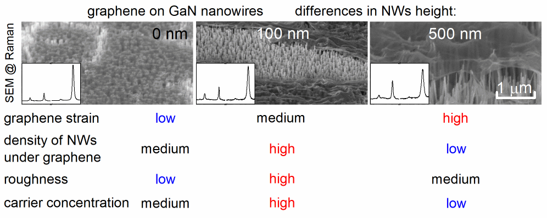
- interactions with a single NW. The graphene strain can be studied by the analysis of the position of the 2D band energy and its full width at half maximum (FWHM). The dependence of graphene strain on the 2D band energy shift is described by Equation 1 [35]: where γ2D is the Grüneisen parameter, Δε is a value
- of strain, and the value of 2D band energy for unstrained graphene was reported to be 2677.6 cm−1 [14]. Positive values of Δε correspond to tensile strain while negative values correspond to compressive strain. The Grüneisen parameter determines the change rate of a given phonon frequency in a
- crystal with respect to strain. Its value depends on the strain type and substantial differences between values of the Grüneisen parameter for uniaxial and biaxial strain were observed [14][36][37][38][39]. Thus, a description of strain in the structure of graphene deposited on a large number of




The effect of atmospheric doping on pressure-dependent Raman scattering in supported graphene
Beilstein J. Nanotechnol. 2018, 9, 704–710, doi:10.3762/bjnano.9.65
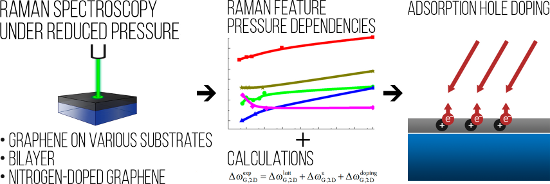
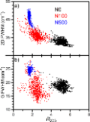
- -induced doping groups [3][13]. Thus, the experimental peak shift due to pressure change can be written as: The first term is defined by the following expression [5]: where and are normal G and 2D peak positions, respectively; γG,2D is a Grüneisen parameter for corresponding E2g and A1g phonon modes


Impact of thermal frequency drift on highest precision force microscopy using quartz-based force sensors at low temperatures
Beilstein J. Nanotechnol. 2014, 5, 407–412, doi:10.3762/bjnano.5.48
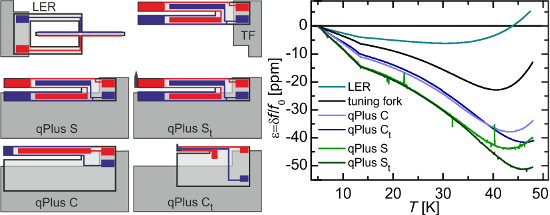
- f0 is not increasing monotonically with T but shows a local minimum around 20 K [19]. This resembles qualitatively the temperature dependence of the Grüneisen parameter γ, which relates thermal expansion to vibrational properties [20]. The calculated values for γ show a maximum around 30 K decreasing
- Grüneisen parameter γ. For tuning fork based sensors, ε still decreases, and ∂ε/∂T changes its sign at temperatures between 40–47 K. In the temperature range from 5–12 K the slopes η can be obtained from a linear fit to the data in Figure 2. The determined values for η are all in the order of 1 ppm/K and


Other Beilstein-Institut Open Science Activities



