


Search results
Search for "Himalayan lakes" in Full Text gives 1 result(s) in Beilstein Journal of Nanotechnology.
Microplastic pollution in Himalayan lakes: assessment, risks, and sustainable remediation strategies
Beilstein J. Nanotechnol. 2025, 16, 2144–2167, doi:10.3762/bjnano.16.148
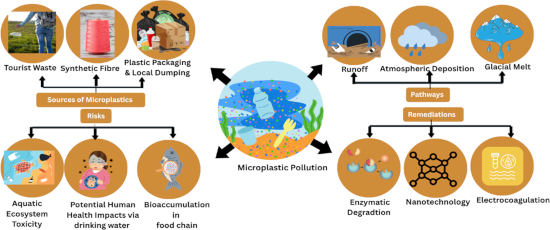
- in the ecologically sensitive Himalayan lakes, posing a threat to biodiversity, water quality, and human habitation. These high-altitude freshwater ecosystems are being increasingly polluted through human use, tourism, glacier melt, and atmospheric deposition. Microplastic quantification in such
- isolated locations is, however, limited by factors such as harsh climatic conditions, logistical challenges, and the need for expert analytical techniques like microscopy and spectroscopy. The present review considers sources, pathways, and ecological impacts of microplastics in Himalayan lakes compared to
- present scenario and promotes novel, environmentally friendly remedial measures, regulatory policies, cooperative initiatives to combat microplastic pollution, and vulnerabilities in the fragile Himalayan freshwater aquatic ecosystems. Keywords: biofilms; freshwater system; Himalayan lakes; microplastic


Other Beilstein-Institut Open Science Activities



