


Search results
Search for "Salvia officinalis" in Full Text gives 2 result(s) in Beilstein Journal of Nanotechnology.
Restorative potential of laser-synthesized silver nanoparticles with Salvia officinalis for periodontal disease treatment: an in vitro study
Beilstein J. Nanotechnol. 2026, 17, 781–795, doi:10.3762/bjnano.17.55
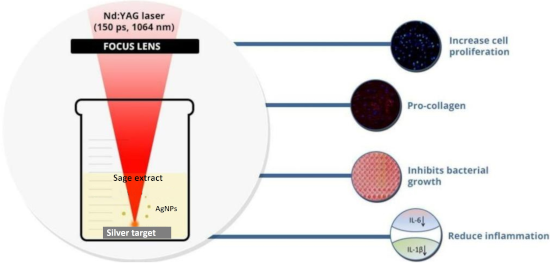
- local damage, systemic associations highlight the urgent need for innovative therapies. Herein, we present an eco-friendly synthesis of silver nanoparticles (AgNPs) by picosecond pulsed laser ablation in liquid (PLAL), using Salvia officinalis aqueous extract (sage extract) as both medium and stabilizer
- inflammation. This dual antibacterial and regenerative action demonstrates the high potential of sage-assisted PLAL-synthesized AgNPs as a safe, sustainable strategy for periodontal disease treatment. Keywords: cell proliferation; periodontal disease; pulsed laser ablation in liquid (PLAL); Salvia officinalis
- not only a clean, environmentally friendly method that avoids the use of hazardous chemicals; the obtained nanoparticles could also retain the properties of both nanoparticles and plant extract, thus achieving synergistic effects. Salvia officinalis L. (sage) is a medicinal herb commonly used in



Antimicrobial nanospheres thin coatings prepared by advanced pulsed laser technique
Beilstein J. Nanotechnol. 2014, 5, 872–880, doi:10.3762/bjnano.5.99
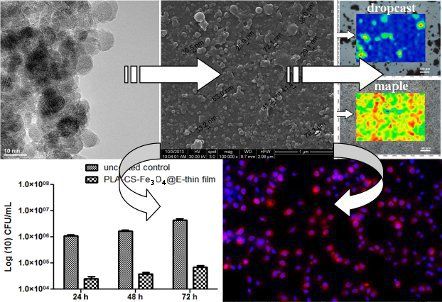
- nanosystems to obtain improved, antimicrobial coatings for biomedical applications [7][8]. Nonpolar functionalized magnetite nanostructures alone [9][10] or combined with different natural products, such as usnic acid (UA) [11] or essential oils (Mentha piperita [12], Anethum graveolens [13], Salvia
- officinalis [14], Eugenia carryophyllata [15]), showed improved antibiofilm effects on different types of microbial strains. Usually, these types of phyto-nano-coatings have been applied to a variety of medical surfaces in order to improve their resistance to microbial colonization [16]. Matrix assisted




Other Beilstein-Institut Open Science Activities



