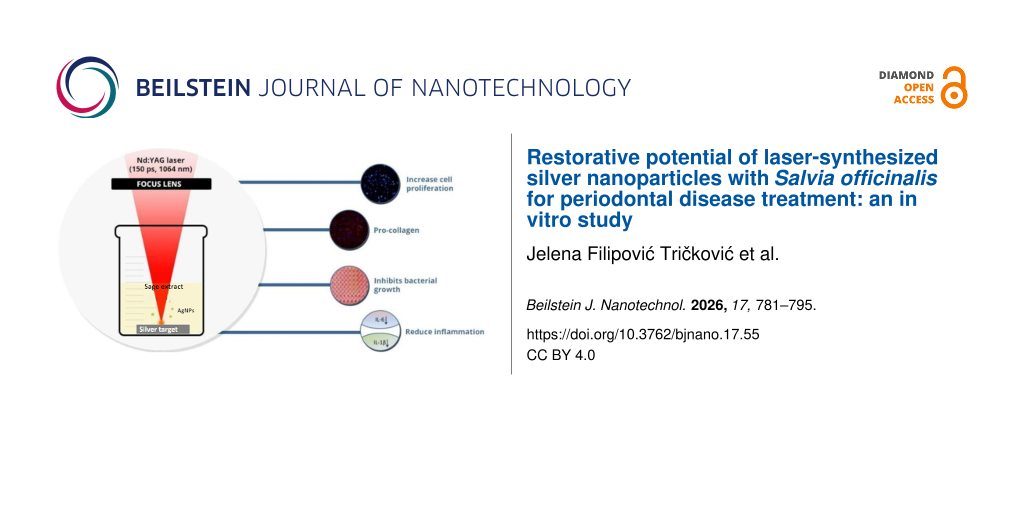
Abstract
Periodontal disease is one of the most prevalent human pathologies initiated by microbial dysbiosis and the inflammatory reaction that leads to gingival fibroblasts apoptosis, connective tissue damage, and atrophy, resulting in tooth loss. Beyond local damage, systemic associations highlight the urgent need for innovative therapies. Herein, we present an eco-friendly synthesis of silver nanoparticles (AgNPs) by picosecond pulsed laser ablation in liquid (PLAL), using Salvia officinalis aqueous extract (sage extract) as both medium and stabilizer. AgNPs were synthesized at two laser pulse energies (2 and 6 mJ), in sage extract and deionized water, and characterized by dynamic light scattering, transmission electron microscopy, and inductively coupled plasma optical emission spectroscopy. Synthesis at 6 mJ in sage extract (SageAgNPs6mJ) yielded well-dispersed, spherical nanoparticles (7.98 ± 2.9 nm) at a concentration of 21.6 ± 1.75 mg·L−1. SageAgNPs6mJ exhibited potent antibacterial activity against Aggregatibacter actinomycetemcomitans, Fusobacterium nucleatum, and Porphyromonas gingivalis (MIC = 5.4 mg·L−1), and showed equal or superior antibacterial activity compared to 0.2% chlorhexidine. Importantly, at MIC concentration, SageAgNPs6mJ were non-cytotoxic to primary human gingival fibroblasts and enhanced their proliferation by approximately 50% after 24 h. This was shown by increased Ki-67 proliferation index, increased type-I and total collagen production up to 11% after 24 h and significantly reduced IL-6 by 23% after 24 h, which returned to the baseline levels after 48 h. These findings define a clear therapeutic window, where the same concentration that eradicates bacteria also promotes gingival cell regeneration and reduces inflammation. This dual antibacterial and regenerative action demonstrates the high potential of sage-assisted PLAL-synthesized AgNPs as a safe, sustainable strategy for periodontal disease treatment.
Introduction
Synthesis of silver nanoparticles (AgNPs) is a promising nanotechnology with numerous biomedical applications, especially in the field of tissue restoration and regeneration [1]. The most commonly used methods in AgNP synthesis are (i) chemical methods, which employ silver nitrate as a precursor and different reducing agents as a stabilizer, (ii) biological methods, which use natural precursors like bacteria, enzymes, and plant extracts, and (iii) physical methods based on arc discharge, sputtering, physical vapor deposition, or laser ablation [2]. While chemical synthesis offers size control, it typically involves toxic reducing agents, raising biocompatibility concerns [3]. AgNP synthesis using plant extracts has gained attention due to environmental friendliness, but it lacks precise control over size and dispersity of AgNPs. Laser synthesis, specifically pulsed laser ablation in liquid (PLAL), involves laser ablation of a metal target immersed in a liquid, upon which a laser plasma is produced and nanoparticles are generated [4]. To the best of our knowledge, although PLAL is traditionally associated with lower yields compared to conventional chemical synthesis [5,6], recent advances in laser systems have significantly improved its scalability. Importantly, the absence of chemical reagents and purification steps reduces downstream processing costs, making PLAL a promising and economically feasible approach for the production of high-purity AgNPs in biomedical applications. PLAL addresses the limitations of both biosynthesis and chemical synthesis by offering a reproducible, contaminant-free method with high reproducibility and size control. Combining laser ablation of a metal target with natural compounds is a unique concept that provides not only a clean, environmentally friendly method that avoids the use of hazardous chemicals; the obtained nanoparticles could also retain the properties of both nanoparticles and plant extract, thus achieving synergistic effects.
Salvia officinalis L. (sage) is a medicinal herb commonly used in dentistry with anti-inflammatory, antigenotoxic, and anti-plaque properties [7]. While several studies reported the green synthesis of AgNPs by the chemical reduction of AgNO3 using sage extract [8-12], to the best of our knowledge, the picosecond laser ablation of a silver metal target using aqueous sage extract as a stabilizer has not been reported. In the work conducted by Déné and co-workers [8], antifungal properties of sage-synthesized AgNPs were reported; but neither antibacterial effects nor effects on the eukaryotic cells were evaluated, and the synthesis relied on a chemical approach. In contrast, Mostafavi and colleagues [10], investigated the wound-healing potential of combined AgNP and sage extract treatment in an in vivo mouse skin model, indicating possible synergistic effects between silver and sage. Nevertheless, the antibacterial activity was not evaluated, and sage was not utilized in the nanoparticle synthesis itself. Importantly, none of these studies reported the exact silver concentrations used in treatments, which limits the assessment of their safety and potential clinical applicability. We have previously demonstrated that sage leaf extract obtained by aqueous extraction and lyophilization exhibits potent antioxidant, antigenotoxic, and immunomodulatory activities with potential applications in preventing or treating inflammatory conditions [13]. Additionally, we have shown that AgNPs synthesized by PLAL using citrate solution possess antibacterial activity and can modulate cell viability and oxidative stress in a size- and concentration-dependent manner [14]. Based on these findings, we hypothesize that AgNPs produced by PLAL in an aqueous sage extract environment could maintain the bioactive properties of both AgNPs and sage extract, leading to enhanced biological effects.
Periodontal disease is considered to be one of the most common diseases in humans with prevalence estimated to be approximately 42% to 62% of the world population, among which 7.8% to 23.6% are severe forms, according to the National Health and Nutrition Examination Surveys data [15,16]. Its origin stands on microbial dysbiosis induced by the maturation of dental plaque, which, in susceptible hosts, leads to polymorphonuclear and mononuclear cell infiltration, initiating gingival inflammation followed by excessive production of pro-inflammatory cytokines. Progressively, connective tissue damage occurs, beginning with fibroblast alteration and secretion of metalloproteinases, which degrade collagen and other components of the extracellular matrix [17,18]. Eventually, fibroblast apoptosis and inhibition of collagen production ensue, causing overall gingival atrophy and irreversible damage to the periodontal ligament. Current strategies for the prevention and the treatment of periodontitis are oriented towards improved dental hygiene, scaling and root planning, but also restrictive or regenerative surgical approaches [19,20]. Optimal treatment should be oriented towards the elimination of pathogenic microbes and reduction of inflammation and gingival atrophy, but also toward collagen production.
This study aimed to evaluate the biological properties of AgNPs synthesized by PLAL, where the varying parameters were different laser pulse energies (2 and 6 mJ) and distinct synthesis media, namely, (i) aqueous sage extract and (ii) deionized water. To the best of our knowledge, this study is the first to report the synthesis of AgNPs via PLAL using aqueous sage extract as a stabilizing medium. The objective was to investigate the influence of synthesis parameters on AgNP properties and to evaluate their biological effects, including antibacterial activity against the key periodontal pathogens Porphyromonas gingivalis, Fusobacterium nucleatum, and Aggregatibacter actinomycetemcomitans, and modulatory effects on primary human gingival fibroblast cell (GFC) viability, proliferation, collagen production, and inflammatory responses. This approach aims to explore the potential effects of PLAL-generated AgNPs in sage extract for improved periodontal treatment strategies.
Materials and Methods
Preparation and characterization of aqueous sage leaf extract
Aqueous sage leaf extract (sage) was prepared prior to nanoparticle synthesis, as previously described [13]. Commercially available S. officinalis leaves (Serial No. 23380723, Institute of Medicinal Plant Research “Dr Josif Pančić”, Belgrade, Serbia) were ground, infused with boiling water, and cooled to room temperature. The extract was filtered (5–13 μm, Lab Logistic Group), frozen at −20 °C overnight, and lyophilized under 400 Pa vacuum pressure. The lyophilizate was subsequently filtered (0.2 μm, Minisart®, Sartorius) and reconstituted in sterile water to a concentration of 100 mg·mL−1. After preparing the extract, the concentration of selected phenolic acids was analyzed.
Analysis of selected phenolic acids in sage extract
Sage extract was dissolved in deionized water, homogenized, and used to determine the content of selected phenolic acids, that is, vanillic, caffeic, ferulic, and rosmarinic acids using high-performance chromatography (HPLC) with a diode array detector. Phenolic acids were selected according to literature data regarding biologically active sage constituents that possess reducing and stabilizing roles in AgNP formation [21-25]. A series of phenolic acids standard solutions (Merck, Darmstadt, Germany) in water in the concentration range of 5–500 μg·mL−1 was prepared. 5 μL of sample was injected and separation was performed on a Zorbax Eclipse XDB-C18 column (150 mm × 4.6 mm, 5 μm) at 35 °C. The components were eluted with a mobile phase based on a 0.1% aqueous solution of formic acid (A) and methanol (B), at a flow rate of 1.0 mL·min−1, in gradient mode: 0 min 10% B, 10 min 10% B, 20 min 20% B, 30 min 70% B, 40 min 100% B. The UV–vis signal was monitored in the range of 200–600 nm. To determine the content of phenolic acids, chromatograms were recorded at 220, 260, 290, and 325 nm. To determine the content of vanillic acid, the areas of the peaks from the chromatogram recorded at 260 nm were read, and for caffeic and rosmarinic acids the ones at 325 nm. Phenolic acid concentrations were determined using the external standard method. Chromatograms were processed in ChemStation software (Agilent Technologies).
Laser synthesis of AgNPs
AgNP synthesis was performed by PLAL of a silver metal target (silver foil, 1 mm thickness, 99.99% purity, Alfa Aesar, USA) using a picosecond Nd:YAG EKSPLA SL 212/SH/FH laser system (EKSPLA, Lithuania) operating at the fundamental wavelength of 1064 nm with a 150 ps pulse duration and a repetition rate of 10 Hz. Two different pulse energies (2 and 6 mJ), corresponding to fluences of 0.04 and 0.12 J·cm−2 and a laser-irradiated area of approximately 0.05 cm2 on the target surface, were used with or without sage extract to evaluate the influence of laser energy on nanoparticle synthesis. The laser beam was focused through a lens having a focal length of 15.2 cm with the target placed at 16.2 cm from this lens, that is, under slightly defocused conditions. An automated x–y translation stage ensured continuous movement of the target during ablation so that fresh surface irradiation could be achieved. Four AgNPs samples were obtained, namely, SageAgNPs2mJ and SageAgNPs6mJ, which were synthesized in the presence of sage extract (100 µL), as well as dwAgNPs2mJ and dwAgNPs6mJ, which were prepared in 8 mL of deionized water (18 MΩ·cm) under the same laser conditions. After synthesis, characterization of the AgNP samples was performed.
AgNP characterization
The total concentration of silver in obtained colloidal solutions was determined using inductively coupled plasma optical emission spectroscopy (ICP-OES, iCap7400 DUO, Thermo Fisher, USA) and expressed as mg·L−1 ± SD.
The hydrodynamic diameters (dH) of the obtained nanoparticles were analyzed by using the dynamic light scattering (DLS) technique using a Zetasizer NanoZS90 (Malvern Panalytical, UK) with a 633 nm He–Ne laser source and 90° detection optics. The measurements were performed in disposable polystyrene cuvettes (DTS0012, Malvern Panalytical, UK) at ambient temperature (25 ± 0.1 °C).
The selected AgNPs that displayed antimicrobial effects were further analyzed by transmission electron microscopy (TEM), to evaluate their size, shape, and dispersity. An FEI Talos F200X microscope, operating at 200 keV with an X-FEG source and point-to-point resolution below 0.24 nm, was used to analyze nanoparticles after periods of two days and one month after synthesis. The photomicrographs were captured in the conventional mode and recorded on the CCD camera with a resolution of 4096 × 4096 pixels. The size distribution was measured manually, measuring at least 1000 nanoparticles using the image capture software (SemAfore, Version 5.21, Finland). Following the AgNP characterization, antibacterial testing, as well as the assessment of their effects on human GFCs was performed.
Experimental design and treatments
Antimicrobial testing was performed to determine the minimal inhibitory concentrations (MICs) of all obtained AgNPs. Upon antimicrobial assessment, cytotoxicity evaluation was done to investigate the range of non-cytotoxic AgNP concentrations by testing concentrations of 0.5 × MIC, 1 × MIC, and 2 × MIC. The proliferative capacity of selected, non-cytotoxic treatments was analyzed to estimate the restorative potential of selected AgNPs. Finally, following the identification of AgNPs that possess antibacterial properties and stimulate cell proliferation, we evaluated their potential to impact collagen production (type-I and total collagen production) and inflammation reduction by monitoring levels of interleukins IL-1β and IL-6.
Antimicrobial testing
Following AgNP synthesis and characterization, the antibacterial potential was evaluated in microdilution assays against Aggregatibacter actinomycetemcomitans (ATCC 29552), Porphyromonas gingivalis (ATCC 33277), and Fusobacterium nucleatum (ATCC 25586) in accordance to ISO 20776-1. The strains were cultured in Shaedler broth (Thermo Fisher Scientific, Waltham, MA, USA) supplemented with vitamin K and hemin at 37 °C for 72 h in an anaerobic chamber.
MICs as well as minimal bactericidal concentrations (MBCs) were determined according to the method previously described in [26]. Inoculum containing 2 × 10⁴ CFU per well (105 CFU·mL−1) of bacteria was added to each well after the serial dilution of the NPs. After the 24 h incubation, resazurin was used as a growth indicator, and it was introduced at a final concentration per well of 0.0675 mg·mL−1. After 3 h of incubation with resazurin, wells with no color changes (with no visible bacterial growth) and the lowest concentration were determined as those with the MICs of NPs. Additionally, MBCs were determined by plating from the wells with no noticeable growth onto Brucella blood agar.
Cytotoxicity testing (XTT assay)
The cytotoxic effect of AgNPs was determined on human primary GFCs provided by courtesy of the School of Dental Medicine, Department of Biology and Human Genetics, University of Belgrade. All volunteers read and signed the informed consent, and the study was conducted in agreement with the Declaration of Helsinki and approved by the Ethics Committee of the Vinča Institute of Nuclear Sciences, Serbia (approval no. 116-17-2/2020-000).
The cytotoxicity assessment was performed by applying the 2,3-bis-(2-methoxy-4-nitro-5-sulfophenyl)-2H-tetrazolium-5-carboxanilide (XTT) assay according to the standard procedures [27]. Upon seeding in 24-well plates at a density of 0.05 × 10⁶ and reaching the subconfluent level, the cells were treated with concentrations of 0.5 × MIC, 1 × MIC, and 2 × MIC for 24 and 48 h. Absorbance was measured at 470 nm on a microplate reader (Sunrise, Tecan Group Ltd., Switzerland). The results are presented as the percentage of viable cells compared to the untreated control (100% of viable cells).
Cell proliferation assay
Ki-67 immunofluorescent staining was performed to analyze the effects of AgNPs on the proliferation rate of GFCs. The cells were seeded on polylysine-coated slides (Merck, Germany) and treated with selected AgNPs for 24 and 48 h. Following treatment, the cells were fixed with 4% formaldehyde solution, permeabilized with 0.25% Triton-X (Merck, Germany), and blocked with 1% bovine serum albumin (BSA, Merck, Germany). The cells were hybridized overnight at 4 °C with directly labeled anti-Ki-67 antibody (SolA15, FITC, eBioscience™, Termo Fisher Scientific, USA). The slides were stained with DAPI-Vectashield solution (Vector Laboratories, United Kingdom) and analyzed using a Zeiss-Axioimager A1 microscope and the ISIS imaging software package (MetaSystems, Altlussheim, Germany). The results are presented as the proliferation index (PI), that is, the ratio between the number of immunoreactive (Ki-67+) cells and the total number of cells. At least 1000 cells per treatment were analyzed.
Assessment of collagen production
The collagen production rate was monitored by immunofluorescent staining of type-I collagen and colorimetric detection of the total collagen content (TCC).
Type-I collagen immunofluorescent staining was performed on the GFCs seeded on polylysin-coated slides, as described above. After the treatment, fixation, and permeabilization, the cells were incubated overnight at 4 °C with type-I collagen polyclonal antibody (PA1-26204, Invitrogen, Thermo Fisher Scientific, USA), washed and incubated with goat anti-rabbit IgG (H+L) cross-adsorbed secondary antibody, Cyanine3 (Cy3, A10520, Invitrogen, Thermo Fisher Scientific, USA). Type-I collagen was monitored qualitatively using a Zeiss-Axioimager A1 microscope and the ISIS imaging software package.
Quantitative analysis of TCC after treatments was assessed using the Total Collagen Assay Kit (Abcam, Cambridge, United Kingdom) according to the manufacturer’s instructions. Briefly, after the treatments, cells were collected and lysed by freeze-thawing, and the protein concentration for each sample was determined as previously described [28]. Optical densities were detected by a microplate reader at 560 nm (Sunrise, Tecan). The collagen standard was used to construct the calibration curve, and the values were normalized per milligram of proteins in the samples. Results were presented as percentage of TCC compared to the control.
Analysis of pro-inflammatory cytokine levels
The effects of AgNPs on inflammation were determined by measuring the levels of interleukin 1β (IL-1β) and interleukin 6 (IL-6) in GFCs after inflammation induction with 10 mg·mL−1 lipopolysaccharides from Escherichia coli (EcLPS, Scientific Laboratory Supplies Ltd, United Kingdom) [29]. Interleukins were determined in cell culture media using the commercial LEGEND MAX™ Human IL-1β and IL-6 ELISA Kits (BioLegend, Inc., San Diego, CA, USA) according to the manufacturer’s instructions. The optical densities were measured at 450 nm on a microplate reader (Sunrise, Tecan). The results are presented as pg·mL−1 of IL-1β and IL-6.
Statistical analysis
For all performed assays, two independent experiments were performed, each in three replicas. The results are presented as mean value ± standard error of mean (SEM). Statistical analysis was performed using One-way ANOVA statistical test from SPSS 10 statistical package for Windows (IBM, Armonk, NY, USA). P values < 0.05 were accepted as the level of significance.
Results
Determination of selected phenolic acids
The analysis of selected phenolic acids in the aqueous sage extract in this study showed that among the four phenolic acids analyzed, rosmarinic acid was the most abundant (41.1 ± 0.8 mg·g−1) and caffeic acid was found at a concentration of 410 ± 20 µg·g−1, while ferulic and vanillic acids were below the detection limit.
AgNP synthesis and characterization
Four types of AgNPs were synthesized by silver target ablation in deionized water or sage extract using two different laser pulse energies (2 and 6 mJ) (Table 1). The reported values represent the total silver concentration in the colloidal solution and do not directly reflect nanoparticle number concentration due to differences in particle size distribution. Although the applied pulse energies are relatively low, the corresponding fluences are sufficient to induce efficient ablation due to the short pulse duration of the picosecond laser. Our results showed that higher laser pulse energy (6 mJ) and surrounding sage extract increase total silver concentration and reduce the hydrodynamic diameters (dH). The smallest nanoparticles with the highest concentration were produced by applying a laser energy of 6 mJ in the sage solution (SageAgNPs6mJ).
Table 1: AgNP synthesis parameters, concentrations (ICP-OES), and hydrodynamic diameters (DLS).
| AgNP type | Laser energy |
Ag concentration
(mg·L−1 ± SD) |
Sage extract concentration
(mg·L−1) |
Hydrodynamic diameter, dH
(nm ± SD) |
| SageAgNPs2mJ | 2 mJ | 8.4 ± 1.5 | 800 | 89.6 ± 17.2 |
| SageAgNPs6mJ | 6 mJ | 21.6 ± 1.75 | 800 | 14.6 ± 3.1 |
| dwAgNPs2mJ | 2 mJ | 3.5 ± 1.2 | — | 115.5 ± 21.4 |
| dwAgNPs6mJ | 6 mJ | 15.2 ± 2.1 | — | 68.4 ± 16.2 |
The two AgNP types with the higher concentration and the smaller particle size, with and without sage extract, that is SageAgNPs6mJ and dwAgNPs6mJ, respectively, underwent TEM analysis. SageAgNPs6mJ were well dispersed, spherical, and in the narrow size range from 2.1 to 16.3 nm, with an average particle size of 7.98 ± 2.90 nm. Minor agglomeration after one month was observed, suggesting high stability of the nanoparticles (Figure 1a,b). dwAgNPs6mJ were spherical and pseudospherical in shape, with particle diameters ranging from 9.0 to 48.8 nm, with an average particle size of 24.59 ± 8.25 nm, with minor agglomeration that was more pronounced after one month (Figure 1d,e).
![[2190-4286-17-55-1]](/bjnano/content/figures/2190-4286-17-55-1.jpg?scale=2.0&max-width=1024&background=FFFFFF)
Figure 1: Photomicrographs of SageAgNPs6mJ and dwAgNPs6mJ two days after synthesis (a and d, scale bar 20 nm), and one month after synthesis (b and e, scale bar 50 nm) and corresponding log–normal particle size distributions two days after synthesis (c and f) measured by TEM.
Figure 1: Photomicrographs of SageAgNPs6mJ and dwAgNPs6mJ two days after synthesis (a and d, scale bar 20 nm)...
Antibacterial testing
The primary step in exploring the AgNPs’ potential in periodontal disease management was the determination of their inhibitory potential against the most common periodontopathogens. AgNPs synthesized using the low laser energy of 2 mJ, did not display any antibacterial activity (Table 2).
Table 2: Antibacterial activity of AgNPs, sage extract, and 0.2% chlorhexidine against Aggregatibacter actinomycetemcomitans, Fusobacterium nucleatum, and Porphyromonas gingivalis.a
| Aggregatibacter actinomycetemcomitans | Fusobacterium nucleatum | Porphyromonas gingivalis | ||||
| MIC (mg·L−1) | MBC (mg·L−1) | MIC (mg·L−1) | MBC (mg·L−1) | MIC (mg·L−1) | MBC (mg·L−1) | |
| SageAgNPs2mJ | n.d. | n.d. | n.d. | n.d. | n.d. | n.d. |
| SageAgNPs6mJ | 5.4 | 5.4 | 5.4 | 5.4 | 5.4 | 5.4 |
| dwAgNPs2mJ | n.d. | n.d. | n.d. | n.d. | n.d. | n.d. |
| dwAgNPs6mJ | 7.6 | 7.6 | 7.6 | 7.6 | 7.6 | 7.6 |
| sage extract | 25000 | 50000 | 12500 | 25000 | 12500 | 25000 |
| 0.2% chlorhexidine | 6.62 | 6.62 | 6.62 | 6.62 | 3.31 | 3.31 |
an.d. – not determined.
In contrast, both AgNP samples synthesized with the higher laser energy of 6 mJ displayed high inhibitory potential against all tested bacterial strains, and SageAgNPs6mJ showed the highest antibacterial potential. The potential was even higher than that of 0.2% chlorhexidine against A. actinomycetemcomitans and F. nucleatum (Table 2). The antibacterial effect of pure aqueous sage extract was achieved at much higher concentrations compared to the sage concentration in SageAgNPs6mJ; the calculated sage concentration in the SageAgNPs6mJ colloidal solution at 1 × MIC concentration was 200 mg·L−1.
Viability assessment and proliferation potential
The viability of GFCs was evaluated after treatment with concentrations of 0.5 × MIC, 1 × MIC, and 2 × MIC of SageAgNPs6mJ and dwAgNPs6mJ to identify the range of non-cytotoxic concentrations. The results of the XTT assay showed that SageAgNPs6mJ did not display cytotoxic effects after 24 and 48 h of treatment up to a concentration of 5.4 mg·L−1 (1 × MIC). In contrast, dwAgNPs6mJ at the concentration of 1 × MIC (7.6 mg·L−1) significantly reduced the number of viable cells to 37.76% after 24 h of treatment (Figure 2a, p < 0.001). The reduction in cellular survival was greater after 48 h of treatment with dwAgNPs6mJ (36.41%), suggesting a cytotoxic effect at 1 × MIC concentration after both exposure times. In contrast, pure sage extract led to a moderate increase in cell viability after 24 h of treatment, significant at the concentration that corresponds to 1 × MIC of SageAgNPs6mJ (p < 0.01), while 48 h of treatment induced mild concentration-dependent decrease in cell viability (Figure 2a). Considering the cytotoxic effects of the 1 × MIC concentration of dwAgNPs6mJ, the potential of SageAgNPs6mJ to accelerate the proliferation of GFCs was examined only for SageAgNPs6mJ by applying Ki-67 immunofluorescent staining. Concentrations of 0.5 × MIC and 1 × MIC of SageAgNPs6mJ increased GFC proliferation rate for both treatment times, highlighting their proliferative potential (Figure 2b and Figure 3). However, a higher concentration of 2 × MIC significantly reduced the proliferation index, supporting the XTT results and the cytotoxicity of higher concentrations.
![[2190-4286-17-55-2]](/bjnano/content/figures/2190-4286-17-55-2.jpg?scale=2.0&max-width=1024&background=FFFFFF)
Figure 2: Cell viability after treatment with SageAgNPs6mJ, dwAgNPs6mJ, and sage extract at concentrations corresponding to 0.5 × MIC, 1 × MIC, and 2 × MIC (a), and proliferation index after treatment with SageAgNPs6mJ (b) for 24 and 48 h. *p < 0.05, **p < 0.01, ***p < 0.001, treatments vs control; ###p < 0.001, SageAgNPs6mJ vs dwAgNPs6mJ.
Figure 2: Cell viability after treatment with SageAgNPs6mJ, dwAgNPs6mJ, and sage extract at concentrations co...
![[2190-4286-17-55-3]](/bjnano/content/figures/2190-4286-17-55-3.png?scale=2.0&max-width=1024&background=FFFFFF)
Figure 3: Ki-67 immunofluorescent staining of untreated GFCs after 24 h (a) and 48 h (c) and GFCs treated with SageAgNPs6mJ at 1 × MIC concentration for 24 h (b) and 48 h (d). The left panel shows DAPI-stained nuclei, the middle panel shows proliferative active Ki67+ cells (FITC labeled, green), and the right panel shows merged photomicrographs. Scale bar = 100 μm.
Figure 3: Ki-67 immunofluorescent staining of untreated GFCs after 24 h (a) and 48 h (c) and GFCs treated wit...
Assessment of collagen production
The identification of a “therapeutic window” in which SageAgNPs6mJ demonstrate antimicrobial efficacy against periodontal pathogens while also increasing GFC proliferation represents a critical advancement for potential clinical translation as it allows for effective bacterial elimination at concentrations that do not compromise host tissue integrity. Therefore, the monitoring of collagen production rates and interleukins levels was performed only for these sage-synthesized AgNPs at 1 × MIC concentration.
Immunofluorescent staining showed that after 24 h of treatment, type-I collagen production intensified compared to the untreated control (Figure 4b). 48 h of treatment induced a more pronounced difference in collagen production, causing not only an increase in intracellular type-I collagen, but also its extracellular secretion (Figure 4d). TCC analysis also showed a statistically significant increase in total collagen production rate by 11% after 24 h (from 100% in control, to 111.65% ± 0.94% in SageAgNPs6mJ-treated cells) and 5% after 48 h (from 100% to 105.68% in SageAgNPs6mJ-treated cells). The increase after 48 h of treatment is probably higher than the colorimetric measurement showed since extracellular collagen deposition of type-I collagen was observed through immunofluorescent staining (Figure 4d).
![[2190-4286-17-55-4]](/bjnano/content/figures/2190-4286-17-55-4.png?scale=2.0&max-width=1024&background=FFFFFF)
Figure 4: Photomicrographs of type-I collagen immunofluorescent staining of GFCs treated with SageAgNPs6mJ for 24 h (b) and 48 h (d), and of untreated cells (a, c). The left panel shows DAPI-stained nuclei, the middle panel shows type-I collagen (Cy3-labeled, red), and the right panel shows merged photomicrographs. Scale bar = 100 μm.
Figure 4: Photomicrographs of type-I collagen immunofluorescent staining of GFCs treated with SageAgNPs6mJ fo...
Pro-inflammatory cytokine measurement
Proinflammatory cytokine measurements (IL-1β and IL-6) were performed in the cell cultures treated with EcLPS and SageAgNPs6mJ. SageAgNPs6mJ treatment discreetly reduced IL-1β levels compared to EcLPS treatment after both exposure times (Figure 5a). However, the levels of IL-6 were significantly reduced after SageAgNPs6mJ treatment compared to EcLPS treatment (Figure 5b). Upon 48 h of treatment, the IL-6 levels were reduced to the levels of untreated control, indicating a stronger anti-inflammatory impact after longer treatment duration.
![[2190-4286-17-55-5]](/bjnano/content/figures/2190-4286-17-55-5.png?scale=2.0&max-width=1024&background=FFFFFF)
Figure 5: IL-1β (a) and IL-6 values (b) in cell culture supernatants after treatment with EcLPS (10 µg·mL−1) and EcLPS + 1 × MIC SageAgNPs6mJ for 24 and 48 h, expressed as pg·mL−1. *p < 0.05, ***p < 0.001, treatment vs control; ###p < 0.001, SageAgNPs6mJ+EcLPS vs EcLPS.
Figure 5: IL-1β (a) and IL-6 values (b) in cell culture supernatants after treatment with EcLPS (10 µg·mL−1) ...
Discussion
This study describes the synthesis of AgNPs via PLAL using aqueous sage extract as a stabilizing medium, thereby integrating a contaminant-free physical approach with bioactive plant-derived compounds. This strategy enables the potential preservation and enhancement of both nanoparticle and phytochemical properties, while avoiding chemical reagents. Furthermore, the work provides a novel, comprehensive evaluation of these nanoparticles in the context of periodontal therapy by simultaneously assessing their antibacterial, anti-inflammatory, and regenerative effects on primary human gingival fibroblasts in vitro.
Our previous comprehensive characterization of aqueous sage extract obtained by lyophilization revealed high levels of total phenolics (162.00 ± 3.51 mg GAE·g−1 DE) and flavonoids (39.47 ± 4.31 mg QE·g−1 DE), confirming that it can be suitable for green nanoparticle synthesis [13]. The HPLC quantification of selected phenolic acids identified high concentrations of rosmarinic and caffeic acids, while vanillic and ferulic acids were below the detection limit, probably due to the lower polarity of the used solvent. We chose water extraction over organic solvents to reach a balance between safety and bioactivity; the therapeutic potential of the obtained nanoparticles could be compromised by the organic solvents, even though they usually extract higher levels of phytoconstituents [30]. In contrast, aqueous extraction relies on eco-friendly principles that reduce toxicity and support the biocompatibility of the obtained nanoparticles. The high concentration of rosmarinic acid in our extract is particularly important for AgNP synthesis and stabilization since it possesses potent reducing properties to convert Ag+ ions to AgNPs [25]. This reduction is enhanced by caffeic acid, which acts synergistically to facilitate nanoparticle formation and stabilization [31,32], suggesting that the sage extract obtained in our study could increase stability and bioactivity of silver nanoparticles. Additionally, our previous study revealed a relatively high content of camphor (approximately 15%), suggesting that, besides phenolics, terpenoids may also contribute to nanoparticle synthesis [13]. To the best of our knowledge, there are no studies that directly investigated the role of camphor in the synthesis of AgNPs. However, literature findings indicate that plant extracts rich in camphor may contribute to nanoparticle formation by acting as both reducing and stabilizing agent, suggesting its role in AgNP synthesis. Other terpenes and flavonoids were present in low concentrations and were therefore considered unlikely to contribute to the AgNP synthesis [13,33].
To assess the influence of sage extract and laser energy on the AgNP synthesis efficiency, four samples of AgNPs were synthesized. Higher laser pulse energies and sage liquid environment synergistically increased nanoparticle concentration while reducing particle size. The simultaneous reduction in particle size with higher laser energy is in line with our previous results for citrate-stabilized AgNPs [14], highlighting the influence of laser operating parameters on size and concentration of the nanoparticles. A shorter pulse time, 150 ps pulses in our experimental setup, leads to quick evaporation, minimum heating of the target area, and very low absorbed energy, thereby enhancing ablation efficiency. The aqueous liquid sage extract environment significantly influenced both concentration and size parameters. It also improved their dispersity and stability, as shown by DLS and TEM, confirming that sage acts as a reducing and stabilizing agent during the synthesis. The differences in the measured dH and TEM diameters reside in the fact that the resulting dH value represents the nanoparticle size in a hydrated state, along with the adjacent layers of water or sage extract molecules, expanding the hydrodynamic diameter, which cannot be observed by TEM. These differences are more pronounced for dwAgNPs6mJ, suggesting a certain extent of particle agglomeration in suspension, which was confirmed by TEM imaging. Stronger agglomeration of dwAgNPs6mJ one month after synthesis compared to SageAgNPs6mJ confirmed that sage acts as a potent reducing and stabilizing agent during the synthesis. As mentioned above, this phenomenon is probably a result of high contents of rosmarinic and caffeic acids in the sage extract since they act as efficient capping agents that stabilize nascent AgNPs during the critical post-ablation period [25,31,32]. AgNPs obtained by PLAL in liquid sage extract environment, with smaller particle size and higher concentration, could possesses several biological benefits. While the higher concentration provides greater local therapeutic doses, the smaller particle size allows for greater cellular internalization by endocytosis [34]. The narrow size distribution of SageAgNPs6mJ could also contribute to the consistent biological outcomes.
Since microbial dysbiosis is the primary step in periodontal disease pathogenesis, we first examined the potential of the obtained nanoparticles to inhibit the growth of common periodontal pathogens. It was reported that the antibacterial activity of AgNPs is directly proportional to their concentration and inversely proportional to their size, which is consistent with our findings [35,36]. AgNPs obtained with the lower laser energy had lower concentrations and larger diameters, and did not display antibacterial activities even at the highest tested concentrations. The antibacterial efficacy of AgNPs depends on their concentration but also on their size. Smaller nanoparticles exhibit a higher surface-area-to-volume ratio, which enhances their reactivity and interaction with bacterial cells. Moreover, reduced particle size enables more efficient penetration of the bacterial cell membrane, thereby contributing to their antimicrobial activity [37,38]. In contrast, both AgNP samples obtained with higher laser energy had higher concentrations and smaller particle sizes, and showed high inhibitory potential; SageAgNPs6mJ exhibited the highest antibacterial effects among all tested nanoparticles. The superior antibacterial efficacy of SageAgNPs6mJ against the tested bacterial strains can be attributed to several mechanisms. Sage’s phenolic compounds, especially rosmarinic and caffeic acids, increase the antimicrobial activity through bacterial cell membrane damage and interaction with bacterial metabolic processes [39,40]. These compounds contribute to the antimicrobial mechanisms of AgNPs, including disruption of bacterial cell wall synthesis, interference with DNA replication, and generation of reactive oxygen species (ROS) [36]. The same MIC and MBC values observed for SageAgNPs6mJ indicate bactericidal activity rather than bacteriostatic effects. This characteristic is valuable for the treatment of periodontal disease as it ensures complete bacterial elimination rather than growth inhibition, thereby reducing the risk of bacterial resistance development [41]. Remarkably, SageAgNPs6mJ demonstrated a more potent antibacterial activity against F. nucleatum and A. actinomycetemcomitans in comparison to the positive control, 0.2% chlorhexidine, outlining their efficacy against periodontal pathogens.
Despite the admirable antibacterial properties of AgNPs synthesized with the higher laser energy of 6 mJ, their use in dental medicine could be limited due to bystander toxicity [42]. The results of cell viability testing showed that only SageAgNPs6mJ did not reduce cell viability after both treatment times at 1 × MIC concentration, suggesting that the sage extract used for AgNP synthesis mitigates their cytotoxicity. This result is probably the effect of sage on the physicochemical properties of the AgNPs, as well as the effect of sage constituents on the cell viability (Figure 2a). However, a higher concentration of SageAgNPs6mJ also significantly reduced the percentage of viable cells, outlining the concentration limit. Previous studies also showed that the toxicity of AgNPs strongly depends on the size, concentration, and surface modification, and that the synthesis with phytochemicals could reduce their toxicity and improve biocompatibility [43,44]. SageAgNPs6mJ exhibited significantly lower cytotoxic effects than their uncoated counterparts, probably by attenuating the release of Ag+ ions and through sage’s inherent antioxidant activity that helps scavenge ROS, thus decreasing oxidative cellular damage [45,46]. In biological media, silver speciation is highly dynamic due to interactions with proteins and ions, which makes direct quantification of free Ag+ ions challenging [47].
Interestingly, SageAgNPs6mJ demonstrated toxicity toward bacterial cells without decreasing the viability of GFCs at the same concentration, thus achieving antimicrobial efficacy without cellular damage. Selective toxicity toward periodontal Gram-negative pathogens could originate from both structural and biochemical differences between prokaryotic and eukaryotic cells. Their negatively charged envelope enables electrostatic interaction with AgNPs, promoting membrane destabilization and their intake; internalized AgNPs induce high levels of ROS, damaging essential biomolecules [48]. In contrast, eukaryotic cells internalize nanoparticles primarily via endocytosis, enabling partial localization in endo-lysosomal compartments, which, together with more efficient repair mechanisms, contribute to the selective antibacterial activity of AgNPs with comparatively lower cytotoxicity toward mammalian cells [49]. This selectivity is essential for potential applications where treatment should eliminate pathogenic bacteria and maintain the viability of gingival cells responsible for tissue repair and regeneration. The differences between bacterial and eukaryotic cell metabolisms may be the cause of this selectivity. Eukaryotic cells have strong antioxidant systems that can neutralize ROS as long as particle concentrations stay within therapeutic ranges [50]. The sage extract compounds enhance this selectivity by providing additional antioxidant protection to human cells [13] while maintaining antimicrobial efficacy against bacteria.
Since only SageAgNPs6mJ displayed selective toxicity towards tested bacteria and GFCs, the subsequent biological evaluations regarding proliferation, collagen production, and inflammation reduction, were performed exclusively on SageAgNPs6mJ. The cytotoxic effects observed with AgNPs synthesized in deionized water would hamper interpretation of these biological parameters since cellular damage would challenge their assessment. The increased proliferation of GFCs, demonstrated by Ki67 staining after 24 and 48 h of treatment indicated that SageAgNPs6mJ at 1 × MIC concentration promote cell division without inducing cytotoxic effects. The concentration- and size-dependent influence of AgNPs on the proliferation of human peripheral blood lymphocytes, human keratinocytes, and dermal fibroblasts was previously reported [14,42,51,52]; it was mostly attributed to the suppression of proinflammatory pathways, the activation of anti-inflammatory pathways, and the selective inhibition of the cyclooxygenase-2 (COX-2) pathway [53]. Sage extract used for the synthesis likely contributes to this effect by increasing the cyclin D1 expression level, thus accelerating and promoting cellular proliferation [54]. Additionally, rosmarinic acid promotes cell growth and proliferation by lowering inflammation, preserving mitochondrial function, and triggering the PI3K/Akt signaling pathway [55,56]. Increased Ki67 expression after both 24 and 48 h of treatment suggests sustained proliferative activity, indicating that SageAgNPs6mJ maintain their bioactivity over extended treatment periods. This effect is crucial for periodontal regeneration as it allows for continuous tissue repair and remodeling of the extracellular matrix (ECM). However, consistent with cell viability results, higher concentration of 2 × MIC decreased cell proliferation, probably by excessive ROS production, which overcomes cellular defense mechanisms, outlining the concentration limit.
Collagen production and remodeling are crucial stages in tissue restoration and regeneration [57]. Besides the reported role of AgNPs in improved collagen deposition during wound healing [58,59], using plant extracts during nanoparticles synthesis was found to promote wound healing and collagen modeling in vivo [60]; but, to the best of our knowledge, the effects of AgNPs synthesized in the presence of sage on collagen production have not been previously reported. In the present study, enhanced intracellular total collagen production and ECM deposition of type-I collagen following both treatment times with SageAgNPs6mJ reflect important advancements for periodontal regeneration. Previous studies also reported positive effects of AgNPs on collagen synthesis and deposition in vivo by activation of the TGF-β/Smad signaling pathway, a key regulator of collagen gene expression [61,62]. Furthermore, sage extract enhances the bioactivity of AgNPs by stimulating fibroblast proliferation and collagen synthesis [54], thus contributing to the pro-collagen effect.
During the progression of periodontal disease, the increase in secretion of the pro-inflammatory cytokines IL-1β and IL-6 contributes to periodontal detachment and alveolar bone loss, recognizing them as targets for periodontal disease treatment [63-65]. In the present study, modest reduction in IL-1β and significant reduction in IL-6 levels were detected after 24 h of treatment, while a longer treatment time of 48 h reduced the levels IL-6 to the those of the untreated control. The anti-inflammatory effect of SageAgNPs6mJ observed in our study can be attributed to the AgNPs’ capacity to interact with the NF-κB signaling pathway by preventing its nuclear translocation and activation [66]. Since NF-κB upregulates the expression of pro-inflammatory genes, including IL-1β and IL-6, the inhibition of its nuclear translocation could suppress their transcription, leading to inflammation reduction [67]. Additionally, rosmarinic acid exhibits potent anti-inflammatory properties by downregulation of the NF-κB signaling pathway and the inhibition of COX-2 activity, thus contributing to the anti-inflammatory effects of the silver nanoparticles [68]. It was previously demonstrated that high levels of IL-6 upregulate the expression of certain matrix metalloproteinases, enzymes involved in the degradation of the extracellular matrix, causing collagen degradation and disturbed tissue remodeling [69,70]. The combined effects of SageAgNPs6mJ on interleukin level reduction and increased collagen synthesis and ECM deposition, especially after the longer treatment time, show a promising restorative potential.
While the findings of the present work highlight the promising biological potential of sage-synthesized AgNPs by PLAL, several aspects should be taken into account when interpreting the results. All biological evaluations were performed in vitro, which cannot entirely imitate the complex microenvironment of periodontal tissues in vivo. In addition, the biological analyses were focused primarily on the AgNPs synthesized with the higher laser energy (SageAgNPs6mJ) since nanoparticles obtained in deionized water exhibited cytotoxic effects that could hinder the interpretation of cellular responses. While this approach enabled a clearer evaluation of regenerative and anti-inflammatory effects, it limited direct biological comparisons among all synthesized nanoparticle formulations. Moreover, under clinical conditions, maintaining a precise intrapocket concentration under continuous gingival crevicular fluid flow is a key challenge. However, this can be addressed by incorporating nanoparticles into controlled-release local delivery systems, enabling sustained therapeutic levels while avoiding cytotoxic peaks. Future studies incorporating optimized concentrations or surface modifications may allow for a broader comparative biological assessment.
Conclusion
AgNPs synthesized by picosecond PLAL in aqueous Salvia officinalis extract with laser pulse energies of 6 mJ exhibited superior properties compared to those produced in water, including reduced particle size, higher yield, and enhanced antibacterial activity against key periodontal pathogens. Notably, at MIC concentration, these nanoparticles simultaneously promoted gingival fibroblast proliferation, collagen synthesis, and anti-inflammatory responses, indicating a desirable therapeutic profile. To the best of our knowledge, this is the first report of PLAL sage-mediated AgNP synthesis, demonstrating a novel, contaminant-free strategy that integrates nanotechnology with plant-derived phytochemicals to achieve positive therapeutic effects relevant for periodontal therapy. Future work should be focused on in vivo validation, mechanistic insights, and the development of clinically translatable formulations for targeted periodontal applications.
Funding
This work was supported by the Ministry of Science, Technological Development and Innovation of the Republic of Serbia (Grant no. 451-03-33/2026-03/200017), and The Innovation Fund of the Republic of Serbia (program Proof of Concept, Grant no. 5490, program Technology Transfer, Grant no. 1121).
Data Availability Statement
Data generated and analyzed during this study is available from the corresponding author upon reasonable request.
References
-
Babu, P. J.; Tirkey, A.; Paul, A. A.; Kristollari, K.; Barman, J.; Panda, K.; Sinha, N.; Babu, B. R.; Marks, R. S. Eng. Regener. 2024, 5, 326–341. doi:10.1016/j.engreg.2024.07.001
Return to citation in text: [1] -
Abbas, R.; Luo, J.; Qi, X.; Naz, A.; Khan, I. A.; Liu, H.; Yu, S.; Wei, J. Nanomaterials 2024, 14, 1425. doi:10.3390/nano14171425
Return to citation in text: [1] -
Huang, Y.-W.; Cambre, M.; Lee, H.-J. Int. J. Mol. Sci. 2017, 18, 2702. doi:10.3390/ijms18122702
Return to citation in text: [1] -
Alhajj, M.; Ghoshal, S. K. J. Mol. Liq. 2024, 414, 126130. doi:10.1016/j.molliq.2024.126130
Return to citation in text: [1] -
Sportelli, M. C.; Izzi, M.; Volpe, A.; Clemente, M.; Picca, R. A.; Ancona, A.; Lugarà, P. M.; Palazzo, G.; Cioffi, N. Antibiotics (Basel, Switz.) 2018, 7, 67. doi:10.3390/antibiotics7030067
Return to citation in text: [1] -
Zhang, X.-F.; Liu, Z.-G.; Shen, W.; Gurunathan, S. Int. J. Mol. Sci. 2016, 17, 1534. doi:10.3390/ijms17091534
Return to citation in text: [1] -
Ghadaksaz, S.; Farajnia, S.; Pournaghiazar, F.; Ebrahimzadeh Leylabadlo, H.; Salahlou, R.; Delazar, A.; Zandesh, A. J. Adv. Periodontol. Implant Dent. 2025, 17, 46–53. doi:10.34172/japid.025.3710
Return to citation in text: [1] -
Dėnė, L.; Chrapačienė, S.; Laurinaitytė, G.; Rudinskaitė, A.; Viškelis, J.; Viškelis, P.; Balčiūnaitienė, A. Plants 2024, 13, 1611. doi:10.3390/plants13121611
Return to citation in text: [1] [2] -
Grigoras, A. G.; Grigoras, V. C. Sustainable Chem. 2024, 5, 215–228. doi:10.3390/suschem5030014
Return to citation in text: [1] -
Mostafavi, S.; Soorki, M. N.; Kesmati, M.; Dorostghoal, M.; Andashti, B. Nanomed. Res. J. 2024, 9, 329–338. doi:10.22034/nmrj.2024.03.010
Return to citation in text: [1] [2] -
Moussa, H.; Hamid, S.; Mameri, A.; Lekmine, S.; Tahraoui, H.; Kebir, M.; Touzout, N.; Dahmoune, F.; Ola, M. S.; Zhang, J.; Amrane, A. Bioengineering 2024, 11, 1205. doi:10.3390/bioengineering11121205
Return to citation in text: [1] -
Karagözlü, N.; Özeşer, T. Czech J. Food Sci. 2024, 42, 163–173. doi:10.17221/4/2024-cjfs
Return to citation in text: [1] -
Šobot, A. V.; Janić, M.; Popović, I.; Lazarević-Pašti, T.; Momić, T.; Krstić, A.; Tričković, J. F. Arh. Hig. Rada Toksikol. 2024, 75, 137–146. doi:10.2478/aiht-2024-75-3836
Return to citation in text: [1] [2] [3] [4] [5] [6] -
Filipović Tričković, J.; Momčilović, M.; Joksić, G.; Živković, S.; Ilić, B.; Ognjanović, M.; Novaković, M.; Valenta Šobot, A. Nanomater. Nanotechnol. 2023, 9854356. doi:10.1155/2023/9854356
Return to citation in text: [1] [2] [3] -
Eke, P. I.; Borgnakke, W. S.; Genco, R. J. Periodontol. 2000 2020, 82, 257–267. doi:10.1111/prd.12323
Return to citation in text: [1] -
Trindade, D.; Carvalho, R.; Machado, V.; Chambrone, L.; Mendes, J. J.; Botelho, J. J. Clin. Periodontol. 2023, 50, 604–626. doi:10.1111/jcpe.13769
Return to citation in text: [1] -
Liu, X.; Li, J.; Yue, Y.; Li, J.; Wang, M.; Hao, L. Oral Dis. 2024, 30, 895–902. doi:10.1111/odi.14566
Return to citation in text: [1] -
Natarajan, P. M.; Ganesan, A.; Varma, S. R.; Shetty, N. Y. J. Pharm. BioAllied Sci. 2024, 16 (Suppl. 2), S1080–S1083. doi:10.4103/jpbs.jpbs_1249_23
Return to citation in text: [1] -
Bowen, W. H.; Burne, R. A.; Wu, H.; Koo, H. Trends Microbiol. 2018, 26, 229–242. doi:10.1016/j.tim.2017.09.008
Return to citation in text: [1] -
Kwon, T.; Lamster, I. B.; Levin, L. Int. Dent. J. 2021, 71, 462–476. doi:10.1111/idj.12630
Return to citation in text: [1] -
Al-Zahrani, S.; Astudillo-Calderón, S.; Pintos, B.; Pérez-Urria, E.; Manzanera, J. A.; Martín, L.; Gomez-Garay, A. Plants 2021, 10, 1671. doi:10.3390/plants10081671
Return to citation in text: [1] -
Alamri, E. S.; El Rabey, H. A. J. Diabetes Res. 2024, 4873544. doi:10.1155/2024/4873544
Return to citation in text: [1] -
Li, D.; Chen, L.; Qiu, X. Int. J. Biol. Macromol. 2024, 277, 134471. doi:10.1016/j.ijbiomac.2024.134471
Return to citation in text: [1] -
Pereira, O. R.; Catarino, M. D.; Afonso, A. F.; Silva, A. M. S.; Cardoso, S. M. Molecules 2018, 23, 3169. doi:10.3390/molecules23123169
Return to citation in text: [1] -
Royji Albeladi, S. S.; Malik, M. A.; Al-thabaiti, S. A. J. Mater. Res. Technol. 2020, 9, 10031–10044. doi:10.1016/j.jmrt.2020.06.074
Return to citation in text: [1] [2] [3] -
Vasilijević, B.; Mitić-Ćulafić, D.; Djekic, I.; Marković, T.; Knežević-Vukčević, J.; Tomasevic, I.; Velebit, B.; Nikolić, B. Food Control 2019, 100, 247–256. doi:10.1016/j.foodcont.2019.01.025
Return to citation in text: [1] -
Roehm, N. W.; Rodgers, G. H.; Hatfield, S. M.; Glasebrook, A. L. J. Immunol. Methods 1991, 142, 257–265. doi:10.1016/0022-1759(91)90114-u
Return to citation in text: [1] -
Lowry, O. H.; Rosebrough, N. J.; Farr, A. L.; Randall, R. J. J. Biol. Chem. 1951, 193, 265–275. doi:10.1016/s0021-9258(19)52451-6
Return to citation in text: [1] -
Sun, L.; He, L.; Wu, W.; Luo, L.; Han, M.; Liu, Y.; Shi, S.; Zhong, K.; Yang, J.; Li, J. Int. J. Oral Sci. 2021, 13, 39. doi:10.1038/s41368-021-00144-2
Return to citation in text: [1] -
Jakovljević, M.; Jokić, S.; Molnar, M.; Jašić, M.; Babić, J.; Jukić, H.; Banjari, I. Plants 2019, 8, 55. doi:10.3390/plants8030055
Return to citation in text: [1] -
Guo, D.; Dou, D.; Ge, L.; Huang, Z.; Wang, L.; Gu, N. Colloids Surf., B 2015, 134, 229–234. doi:10.1016/j.colsurfb.2015.06.070
Return to citation in text: [1] [2] -
Pushpanathan, S.; yahya, S.; Gunasekaran, A.; Natarajan, S. R.; Kannan, K.; Krishnan, K. Next Nanotechnol. 2025, 7, 100105. doi:10.1016/j.nxnano.2024.100105
Return to citation in text: [1] [2] -
Janić, M.; Zdolšek, N.; Marinković, J.; Lazarević-Pašti, T.; Momić, T.; Brković, S.; Valenta Šobot, A.; Filipović Tričković, J. J. Mol. Liq. 2025, 434, 127995. doi:10.1016/j.molliq.2025.127995
Return to citation in text: [1] -
Wu, M.; Guo, H.; Liu, L.; Liu, Y.; Xie, L. Int. J. Nanomed. 2019, 14, 4247–4259. doi:10.2147/ijn.s201107
Return to citation in text: [1] -
Ahmed, O.; Sibuyi, N. R. S.; Fadaka, A. O.; Madiehe, M. A.; Maboza, E.; Meyer, M.; Geerts, G. Pharmaceutics 2022, 14, 380. doi:10.3390/pharmaceutics14020380
Return to citation in text: [1] -
More, P. R.; Pandit, S.; De Filippis, A.; Franci, G.; Mijakovic, I.; Galdiero, M. Microorganisms 2023, 11, 369. doi:10.3390/microorganisms11020369
Return to citation in text: [1] [2] -
Ershov, V. A.; Ershov, B. G. Toxics 2024, 12, 801. doi:10.3390/toxics12110801
Return to citation in text: [1] -
Ali, A. Y.; Alani, A.-A. K.; Ahmed, B. O.; Hamid, L. L. OpenNano 2024, 20, 100213. doi:10.1016/j.onano.2024.100213
Return to citation in text: [1] -
Ivanov, M.; Kostić, M.; Stojković, D.; Soković, M. S. Afr. J. Bot. 2022, 146, 521–527. doi:10.1016/j.sajb.2021.11.050
Return to citation in text: [1] -
Khan, F.; Bamunuarachchi, N. I.; Tabassum, N.; Kim, Y.-M. J. Agric. Food Chem. 2021, 69, 2979–3004. doi:10.1021/acs.jafc.0c07579
Return to citation in text: [1] -
Huh, A. J.; Kwon, Y. J. J. Controlled Release 2011, 156, 128–145. doi:10.1016/j.jconrel.2011.07.002
Return to citation in text: [1] -
Joksić, G.; Stašić, J.; Filipović, J.; Šobot, A. V.; Trtica, M. Toxicol. Lett. 2016, 247, 29–34. doi:10.1016/j.toxlet.2016.02.007
Return to citation in text: [1] [2] -
Cho, Y.-M.; Mizuta, Y.; Akagi, J.-i.; Toyoda, T.; Sone, M.; Ogawa, K. J. Toxicol. Pathol. 2018, 31, 73–80. doi:10.1293/tox.2017-0043
Return to citation in text: [1] -
Vidyasagar; Patel, R. R.; Singh, S. K.; Singh, M. Mater. Adv. 2023, 4, 1831–1849. doi:10.1039/d2ma01105k
Return to citation in text: [1] -
Fahim, M.; Shahzaib, A.; Nishat, N.; Jahan, A.; Bhat, T. A.; Inam, A. JCIS Open 2024, 16, 100125. doi:10.1016/j.jciso.2024.100125
Return to citation in text: [1] -
Ödemiş, Ö.; Özdemir, S.; Gonca, S.; Arslantaş, A.; Ağirtaş, M. S. Turk. J. Chem. 2022, 46, 1417–1428. doi:10.55730/1300-0527.3448
Return to citation in text: [1] -
Levard, C.; Hotze, E. M.; Lowry, G. V.; Brown, G. E., Jr. Environ. Sci. Technol. 2012, 46, 6900–6914. doi:10.1021/es2037405
Return to citation in text: [1] -
Karataş, H.; Eker, F.; Akdaşçi, E.; Bechelany, M.; Karav, S. Int. J. Mol. Sci. 2026, 27, 927. doi:10.3390/ijms27020927
Return to citation in text: [1] -
Porter, G. C.; Duncan, W. J.; Jude, A.; Abdelmoneim, D.; Easingwood, R. A.; Coates, D. E. Nanomedicine (N. Y., NY, U. S.) 2021, 33, 102355. doi:10.1016/j.nano.2020.102355
Return to citation in text: [1] -
Jomova, K.; Raptova, R.; Alomar, S. Y.; Alwasel, S. H.; Nepovimova, E.; Kuca, K.; Valko, M. Arch. Toxicol. 2023, 97, 2499–2574. doi:10.1007/s00204-023-03562-9
Return to citation in text: [1] -
Galandáková, A.; Franková, J.; Ambrožová, N.; Habartová, K.; Pivodová, V.; Zálešák, B.; Šafářová, K.; Smékalová, M.; Ulrichová, J. Hum. Exp. Toxicol. 2016, 35, 946–957. doi:10.1177/0960327115611969
Return to citation in text: [1] -
Liu, X.; Lee, P.-y.; Ho, C.-m.; Lui, V. C. H.; Chen, Y.; Che, C.-m.; Tam, P. K. H.; Wong, K. K. Y. ChemMedChem 2010, 5, 468–475. doi:10.1002/cmdc.200900502
Return to citation in text: [1] -
Carvalho-Silva, J. M.; Cândido dos Reis, A. Heliyon 2024, 10, e34564. doi:10.1016/j.heliyon.2024.e34564
Return to citation in text: [1] -
Farahpour, M. R.; Pirkhezr, E.; Ashrafian, A.; Sonboli, A. Biomed. Pharmacother. 2020, 128, 110120. doi:10.1016/j.biopha.2020.110120
Return to citation in text: [1] [2] -
Jeong, M.-J.; Lim, D.-S.; Kim, S. O.; Park, C.; Leem, S.-H.; Lee, H.; Kim, G.-Y.; Jeong, S.-J.; Choi, Y. H. Biotechnol. Bioprocess Eng. 2022, 27, 171–182. doi:10.1007/s12257-021-0248-1
Return to citation in text: [1] -
Luo, W.; Tao, Y.; Chen, S.; Luo, H.; Li, X.; Qu, S.; Chen, K.; Zeng, C. Front. Pharmacol. 2022, 13, 860944. doi:10.3389/fphar.2022.860944
Return to citation in text: [1] -
Guo, S.; DiPietro, L. A. J. Dent. Res. 2010, 89, 219–229. doi:10.1177/0022034509359125
Return to citation in text: [1] -
Choudhury, H.; Pandey, M.; Lim, Y. Q.; Low, C. Y.; Lee, C. T.; Marilyn, T. C. L.; Loh, H. S.; Lim, Y. P.; Lee, C. F.; Bhattamishra, S. K.; Kesharwani, P.; Gorain, B. Mater. Sci. Eng., C 2020, 112, 110925. doi:10.1016/j.msec.2020.110925
Return to citation in text: [1] -
Fu, J.; Meng, K.; Yuan, Q. Cell Biochem. Biophys. 2025, 83, 1713–1723. doi:10.1007/s12013-024-01580-7
Return to citation in text: [1] -
Lakkim, V.; Reddy, M. C.; Lekkala, V. V. V.; Lebaka, V. R.; Korivi, M.; Lomada, D. Pharmaceutics 2023, 15, 1517. doi:10.3390/pharmaceutics15051517
Return to citation in text: [1] -
Li, C.-w.; Wang, Q.; Li, J.; Hu, M.; Shi, S.-j.; Li, Z.-w.; Wu, G.-l.; Cui, H.-h.; Li, Y.-y.; Zhang, Q.; Yu, X.-h.; Lu, L.-c. Int. J. Nanomed. 2016, 11, 373–387. doi:10.2147/ijn.s91975
Return to citation in text: [1] -
Younis, N. S.; Mohamed, M. E.; El Semary, N. A. Mar. Drugs 2022, 20, 56. doi:10.3390/md20010056
Return to citation in text: [1] -
Cheng, R.; Wu, Z.; Li, M.; Shao, M.; Hu, T. Int. J. Oral Sci. 2020, 12, 2. doi:10.1038/s41368-019-0068-8
Return to citation in text: [1] -
Kim, T. S.; Silva, L. M.; Theofilou, V. I.; Greenwell-Wild, T.; Li, L.; Williams, D. W.; Ikeuchi, T.; Brenchley, L.; NIDCD/NIDCR Genomics and Computational Biology Core; Bugge, T. H.; Diaz, P. I.; Kaplan, M. J.; Carmona-Rivera, C.; Moutsopoulos, N. M. J. Exp. Med. 2023, 220, e20221751. doi:10.1084/jem.20221751
Return to citation in text: [1] -
Nolde, M.; Alayash, Z.; Reckelkamm, S. L.; Kocher, T.; Ehmke, B.; Holtfreter, B.; Baurecht, H.; Georgakis, M. K.; Baumeister, S.-E. Front. Immunol. 2023, 14, 1160148. doi:10.3389/fimmu.2023.1160148
Return to citation in text: [1] -
Abdellatif, A. A. H.; Rasheed, Z.; Alhowail, A. H.; Alqasoumi, A.; Alsharidah, M.; Khan, R. A.; Aljohani, A. S. M.; Aldubayan, M. A.; Faisal, W. Int. J. Nanomed. 2020, 15, 8479–8493. doi:10.2147/ijn.s274098
Return to citation in text: [1] -
Liu, T.; Zhang, L.; Joo, D.; Sun, S.-C. Signal Transduction Targeted Ther. 2017, 2, 17023. doi:10.1038/sigtrans.2017.23
Return to citation in text: [1] -
Noor, S.; Mohammad, T.; Rub, M. A.; Raza, A.; Azum, N.; Yadav, D. K.; Hassan, M. I.; Asiri, A. M. Arch. Pharmacal Res. 2022, 45, 205–228. doi:10.1007/s12272-022-01378-2
Return to citation in text: [1] -
Cathcart, J. M.; Banach, A.; Liu, A.; Chen, J.; Goligorsky, M.; Cao, J. Oncotarget 2016, 7, 61107–61120. doi:10.18632/oncotarget.11243
Return to citation in text: [1] -
Kothari, P.; Pestana, R.; Mesraoua, R.; Elchaki, R.; Khan, K. M. F.; Dannenberg, A. J.; Falcone, D. J. J. Immunol. 2014, 192, 349–357. doi:10.4049/jimmunol.1301906
Return to citation in text: [1]
| 25. | Royji Albeladi, S. S.; Malik, M. A.; Al-thabaiti, S. A. J. Mater. Res. Technol. 2020, 9, 10031–10044. doi:10.1016/j.jmrt.2020.06.074 |
| 31. | Guo, D.; Dou, D.; Ge, L.; Huang, Z.; Wang, L.; Gu, N. Colloids Surf., B 2015, 134, 229–234. doi:10.1016/j.colsurfb.2015.06.070 |
| 32. | Pushpanathan, S.; yahya, S.; Gunasekaran, A.; Natarajan, S. R.; Kannan, K.; Krishnan, K. Next Nanotechnol. 2025, 7, 100105. doi:10.1016/j.nxnano.2024.100105 |
| 34. | Wu, M.; Guo, H.; Liu, L.; Liu, Y.; Xie, L. Int. J. Nanomed. 2019, 14, 4247–4259. doi:10.2147/ijn.s201107 |
| 35. | Ahmed, O.; Sibuyi, N. R. S.; Fadaka, A. O.; Madiehe, M. A.; Maboza, E.; Meyer, M.; Geerts, G. Pharmaceutics 2022, 14, 380. doi:10.3390/pharmaceutics14020380 |
| 36. | More, P. R.; Pandit, S.; De Filippis, A.; Franci, G.; Mijakovic, I.; Galdiero, M. Microorganisms 2023, 11, 369. doi:10.3390/microorganisms11020369 |
| 45. | Fahim, M.; Shahzaib, A.; Nishat, N.; Jahan, A.; Bhat, T. A.; Inam, A. JCIS Open 2024, 16, 100125. doi:10.1016/j.jciso.2024.100125 |
| 46. | Ödemiş, Ö.; Özdemir, S.; Gonca, S.; Arslantaş, A.; Ağirtaş, M. S. Turk. J. Chem. 2022, 46, 1417–1428. doi:10.55730/1300-0527.3448 |
| 47. | Levard, C.; Hotze, E. M.; Lowry, G. V.; Brown, G. E., Jr. Environ. Sci. Technol. 2012, 46, 6900–6914. doi:10.1021/es2037405 |
| 42. | Joksić, G.; Stašić, J.; Filipović, J.; Šobot, A. V.; Trtica, M. Toxicol. Lett. 2016, 247, 29–34. doi:10.1016/j.toxlet.2016.02.007 |
| 43. | Cho, Y.-M.; Mizuta, Y.; Akagi, J.-i.; Toyoda, T.; Sone, M.; Ogawa, K. J. Toxicol. Pathol. 2018, 31, 73–80. doi:10.1293/tox.2017-0043 |
| 44. | Vidyasagar; Patel, R. R.; Singh, S. K.; Singh, M. Mater. Adv. 2023, 4, 1831–1849. doi:10.1039/d2ma01105k |
| 36. | More, P. R.; Pandit, S.; De Filippis, A.; Franci, G.; Mijakovic, I.; Galdiero, M. Microorganisms 2023, 11, 369. doi:10.3390/microorganisms11020369 |
| 41. | Huh, A. J.; Kwon, Y. J. J. Controlled Release 2011, 156, 128–145. doi:10.1016/j.jconrel.2011.07.002 |
| 37. | Ershov, V. A.; Ershov, B. G. Toxics 2024, 12, 801. doi:10.3390/toxics12110801 |
| 38. | Ali, A. Y.; Alani, A.-A. K.; Ahmed, B. O.; Hamid, L. L. OpenNano 2024, 20, 100213. doi:10.1016/j.onano.2024.100213 |
| 39. | Ivanov, M.; Kostić, M.; Stojković, D.; Soković, M. S. Afr. J. Bot. 2022, 146, 521–527. doi:10.1016/j.sajb.2021.11.050 |
| 40. | Khan, F.; Bamunuarachchi, N. I.; Tabassum, N.; Kim, Y.-M. J. Agric. Food Chem. 2021, 69, 2979–3004. doi:10.1021/acs.jafc.0c07579 |
| 48. | Karataş, H.; Eker, F.; Akdaşçi, E.; Bechelany, M.; Karav, S. Int. J. Mol. Sci. 2026, 27, 927. doi:10.3390/ijms27020927 |
| 49. | Porter, G. C.; Duncan, W. J.; Jude, A.; Abdelmoneim, D.; Easingwood, R. A.; Coates, D. E. Nanomedicine (N. Y., NY, U. S.) 2021, 33, 102355. doi:10.1016/j.nano.2020.102355 |
| 50. | Jomova, K.; Raptova, R.; Alomar, S. Y.; Alwasel, S. H.; Nepovimova, E.; Kuca, K.; Valko, M. Arch. Toxicol. 2023, 97, 2499–2574. doi:10.1007/s00204-023-03562-9 |
| 58. | Choudhury, H.; Pandey, M.; Lim, Y. Q.; Low, C. Y.; Lee, C. T.; Marilyn, T. C. L.; Loh, H. S.; Lim, Y. P.; Lee, C. F.; Bhattamishra, S. K.; Kesharwani, P.; Gorain, B. Mater. Sci. Eng., C 2020, 112, 110925. doi:10.1016/j.msec.2020.110925 |
| 59. | Fu, J.; Meng, K.; Yuan, Q. Cell Biochem. Biophys. 2025, 83, 1713–1723. doi:10.1007/s12013-024-01580-7 |
| 60. | Lakkim, V.; Reddy, M. C.; Lekkala, V. V. V.; Lebaka, V. R.; Korivi, M.; Lomada, D. Pharmaceutics 2023, 15, 1517. doi:10.3390/pharmaceutics15051517 |
| 55. | Jeong, M.-J.; Lim, D.-S.; Kim, S. O.; Park, C.; Leem, S.-H.; Lee, H.; Kim, G.-Y.; Jeong, S.-J.; Choi, Y. H. Biotechnol. Bioprocess Eng. 2022, 27, 171–182. doi:10.1007/s12257-021-0248-1 |
| 56. | Luo, W.; Tao, Y.; Chen, S.; Luo, H.; Li, X.; Qu, S.; Chen, K.; Zeng, C. Front. Pharmacol. 2022, 13, 860944. doi:10.3389/fphar.2022.860944 |
| 57. | Guo, S.; DiPietro, L. A. J. Dent. Res. 2010, 89, 219–229. doi:10.1177/0022034509359125 |
| 53. | Carvalho-Silva, J. M.; Cândido dos Reis, A. Heliyon 2024, 10, e34564. doi:10.1016/j.heliyon.2024.e34564 |
| 54. | Farahpour, M. R.; Pirkhezr, E.; Ashrafian, A.; Sonboli, A. Biomed. Pharmacother. 2020, 128, 110120. doi:10.1016/j.biopha.2020.110120 |
| 13. | Šobot, A. V.; Janić, M.; Popović, I.; Lazarević-Pašti, T.; Momić, T.; Krstić, A.; Tričković, J. F. Arh. Hig. Rada Toksikol. 2024, 75, 137–146. doi:10.2478/aiht-2024-75-3836 |
| 14. | Filipović Tričković, J.; Momčilović, M.; Joksić, G.; Živković, S.; Ilić, B.; Ognjanović, M.; Novaković, M.; Valenta Šobot, A. Nanomater. Nanotechnol. 2023, 9854356. doi:10.1155/2023/9854356 |
| 42. | Joksić, G.; Stašić, J.; Filipović, J.; Šobot, A. V.; Trtica, M. Toxicol. Lett. 2016, 247, 29–34. doi:10.1016/j.toxlet.2016.02.007 |
| 51. | Galandáková, A.; Franková, J.; Ambrožová, N.; Habartová, K.; Pivodová, V.; Zálešák, B.; Šafářová, K.; Smékalová, M.; Ulrichová, J. Hum. Exp. Toxicol. 2016, 35, 946–957. doi:10.1177/0960327115611969 |
| 52. | Liu, X.; Lee, P.-y.; Ho, C.-m.; Lui, V. C. H.; Chen, Y.; Che, C.-m.; Tam, P. K. H.; Wong, K. K. Y. ChemMedChem 2010, 5, 468–475. doi:10.1002/cmdc.200900502 |
| 54. | Farahpour, M. R.; Pirkhezr, E.; Ashrafian, A.; Sonboli, A. Biomed. Pharmacother. 2020, 128, 110120. doi:10.1016/j.biopha.2020.110120 |
| 63. | Cheng, R.; Wu, Z.; Li, M.; Shao, M.; Hu, T. Int. J. Oral Sci. 2020, 12, 2. doi:10.1038/s41368-019-0068-8 |
| 64. | Kim, T. S.; Silva, L. M.; Theofilou, V. I.; Greenwell-Wild, T.; Li, L.; Williams, D. W.; Ikeuchi, T.; Brenchley, L.; NIDCD/NIDCR Genomics and Computational Biology Core; Bugge, T. H.; Diaz, P. I.; Kaplan, M. J.; Carmona-Rivera, C.; Moutsopoulos, N. M. J. Exp. Med. 2023, 220, e20221751. doi:10.1084/jem.20221751 |
| 65. | Nolde, M.; Alayash, Z.; Reckelkamm, S. L.; Kocher, T.; Ehmke, B.; Holtfreter, B.; Baurecht, H.; Georgakis, M. K.; Baumeister, S.-E. Front. Immunol. 2023, 14, 1160148. doi:10.3389/fimmu.2023.1160148 |
| 61. | Li, C.-w.; Wang, Q.; Li, J.; Hu, M.; Shi, S.-j.; Li, Z.-w.; Wu, G.-l.; Cui, H.-h.; Li, Y.-y.; Zhang, Q.; Yu, X.-h.; Lu, L.-c. Int. J. Nanomed. 2016, 11, 373–387. doi:10.2147/ijn.s91975 |
| 62. | Younis, N. S.; Mohamed, M. E.; El Semary, N. A. Mar. Drugs 2022, 20, 56. doi:10.3390/md20010056 |
| 1. | Babu, P. J.; Tirkey, A.; Paul, A. A.; Kristollari, K.; Barman, J.; Panda, K.; Sinha, N.; Babu, B. R.; Marks, R. S. Eng. Regener. 2024, 5, 326–341. doi:10.1016/j.engreg.2024.07.001 |
| 5. | Sportelli, M. C.; Izzi, M.; Volpe, A.; Clemente, M.; Picca, R. A.; Ancona, A.; Lugarà, P. M.; Palazzo, G.; Cioffi, N. Antibiotics (Basel, Switz.) 2018, 7, 67. doi:10.3390/antibiotics7030067 |
| 6. | Zhang, X.-F.; Liu, Z.-G.; Shen, W.; Gurunathan, S. Int. J. Mol. Sci. 2016, 17, 1534. doi:10.3390/ijms17091534 |
| 13. | Šobot, A. V.; Janić, M.; Popović, I.; Lazarević-Pašti, T.; Momić, T.; Krstić, A.; Tričković, J. F. Arh. Hig. Rada Toksikol. 2024, 75, 137–146. doi:10.2478/aiht-2024-75-3836 |
| 4. | Alhajj, M.; Ghoshal, S. K. J. Mol. Liq. 2024, 414, 126130. doi:10.1016/j.molliq.2024.126130 |
| 21. | Al-Zahrani, S.; Astudillo-Calderón, S.; Pintos, B.; Pérez-Urria, E.; Manzanera, J. A.; Martín, L.; Gomez-Garay, A. Plants 2021, 10, 1671. doi:10.3390/plants10081671 |
| 22. | Alamri, E. S.; El Rabey, H. A. J. Diabetes Res. 2024, 4873544. doi:10.1155/2024/4873544 |
| 23. | Li, D.; Chen, L.; Qiu, X. Int. J. Biol. Macromol. 2024, 277, 134471. doi:10.1016/j.ijbiomac.2024.134471 |
| 24. | Pereira, O. R.; Catarino, M. D.; Afonso, A. F.; Silva, A. M. S.; Cardoso, S. M. Molecules 2018, 23, 3169. doi:10.3390/molecules23123169 |
| 25. | Royji Albeladi, S. S.; Malik, M. A.; Al-thabaiti, S. A. J. Mater. Res. Technol. 2020, 9, 10031–10044. doi:10.1016/j.jmrt.2020.06.074 |
| 3. | Huang, Y.-W.; Cambre, M.; Lee, H.-J. Int. J. Mol. Sci. 2017, 18, 2702. doi:10.3390/ijms18122702 |
| 17. | Liu, X.; Li, J.; Yue, Y.; Li, J.; Wang, M.; Hao, L. Oral Dis. 2024, 30, 895–902. doi:10.1111/odi.14566 |
| 18. | Natarajan, P. M.; Ganesan, A.; Varma, S. R.; Shetty, N. Y. J. Pharm. BioAllied Sci. 2024, 16 (Suppl. 2), S1080–S1083. doi:10.4103/jpbs.jpbs_1249_23 |
| 2. | Abbas, R.; Luo, J.; Qi, X.; Naz, A.; Khan, I. A.; Liu, H.; Yu, S.; Wei, J. Nanomaterials 2024, 14, 1425. doi:10.3390/nano14171425 |
| 19. | Bowen, W. H.; Burne, R. A.; Wu, H.; Koo, H. Trends Microbiol. 2018, 26, 229–242. doi:10.1016/j.tim.2017.09.008 |
| 20. | Kwon, T.; Lamster, I. B.; Levin, L. Int. Dent. J. 2021, 71, 462–476. doi:10.1111/idj.12630 |
| 10. | Mostafavi, S.; Soorki, M. N.; Kesmati, M.; Dorostghoal, M.; Andashti, B. Nanomed. Res. J. 2024, 9, 329–338. doi:10.22034/nmrj.2024.03.010 |
| 14. | Filipović Tričković, J.; Momčilović, M.; Joksić, G.; Živković, S.; Ilić, B.; Ognjanović, M.; Novaković, M.; Valenta Šobot, A. Nanomater. Nanotechnol. 2023, 9854356. doi:10.1155/2023/9854356 |
| 68. | Noor, S.; Mohammad, T.; Rub, M. A.; Raza, A.; Azum, N.; Yadav, D. K.; Hassan, M. I.; Asiri, A. M. Arch. Pharmacal Res. 2022, 45, 205–228. doi:10.1007/s12272-022-01378-2 |
| 8. | Dėnė, L.; Chrapačienė, S.; Laurinaitytė, G.; Rudinskaitė, A.; Viškelis, J.; Viškelis, P.; Balčiūnaitienė, A. Plants 2024, 13, 1611. doi:10.3390/plants13121611 |
| 15. | Eke, P. I.; Borgnakke, W. S.; Genco, R. J. Periodontol. 2000 2020, 82, 257–267. doi:10.1111/prd.12323 |
| 16. | Trindade, D.; Carvalho, R.; Machado, V.; Chambrone, L.; Mendes, J. J.; Botelho, J. J. Clin. Periodontol. 2023, 50, 604–626. doi:10.1111/jcpe.13769 |
| 69. | Cathcart, J. M.; Banach, A.; Liu, A.; Chen, J.; Goligorsky, M.; Cao, J. Oncotarget 2016, 7, 61107–61120. doi:10.18632/oncotarget.11243 |
| 70. | Kothari, P.; Pestana, R.; Mesraoua, R.; Elchaki, R.; Khan, K. M. F.; Dannenberg, A. J.; Falcone, D. J. J. Immunol. 2014, 192, 349–357. doi:10.4049/jimmunol.1301906 |
| 8. | Dėnė, L.; Chrapačienė, S.; Laurinaitytė, G.; Rudinskaitė, A.; Viškelis, J.; Viškelis, P.; Balčiūnaitienė, A. Plants 2024, 13, 1611. doi:10.3390/plants13121611 |
| 9. | Grigoras, A. G.; Grigoras, V. C. Sustainable Chem. 2024, 5, 215–228. doi:10.3390/suschem5030014 |
| 10. | Mostafavi, S.; Soorki, M. N.; Kesmati, M.; Dorostghoal, M.; Andashti, B. Nanomed. Res. J. 2024, 9, 329–338. doi:10.22034/nmrj.2024.03.010 |
| 11. | Moussa, H.; Hamid, S.; Mameri, A.; Lekmine, S.; Tahraoui, H.; Kebir, M.; Touzout, N.; Dahmoune, F.; Ola, M. S.; Zhang, J.; Amrane, A. Bioengineering 2024, 11, 1205. doi:10.3390/bioengineering11121205 |
| 12. | Karagözlü, N.; Özeşer, T. Czech J. Food Sci. 2024, 42, 163–173. doi:10.17221/4/2024-cjfs |
| 66. | Abdellatif, A. A. H.; Rasheed, Z.; Alhowail, A. H.; Alqasoumi, A.; Alsharidah, M.; Khan, R. A.; Aljohani, A. S. M.; Aldubayan, M. A.; Faisal, W. Int. J. Nanomed. 2020, 15, 8479–8493. doi:10.2147/ijn.s274098 |
| 7. | Ghadaksaz, S.; Farajnia, S.; Pournaghiazar, F.; Ebrahimzadeh Leylabadlo, H.; Salahlou, R.; Delazar, A.; Zandesh, A. J. Adv. Periodontol. Implant Dent. 2025, 17, 46–53. doi:10.34172/japid.025.3710 |
| 13. | Šobot, A. V.; Janić, M.; Popović, I.; Lazarević-Pašti, T.; Momić, T.; Krstić, A.; Tričković, J. F. Arh. Hig. Rada Toksikol. 2024, 75, 137–146. doi:10.2478/aiht-2024-75-3836 |
| 67. | Liu, T.; Zhang, L.; Joo, D.; Sun, S.-C. Signal Transduction Targeted Ther. 2017, 2, 17023. doi:10.1038/sigtrans.2017.23 |
| 28. | Lowry, O. H.; Rosebrough, N. J.; Farr, A. L.; Randall, R. J. J. Biol. Chem. 1951, 193, 265–275. doi:10.1016/s0021-9258(19)52451-6 |
| 26. | Vasilijević, B.; Mitić-Ćulafić, D.; Djekic, I.; Marković, T.; Knežević-Vukčević, J.; Tomasevic, I.; Velebit, B.; Nikolić, B. Food Control 2019, 100, 247–256. doi:10.1016/j.foodcont.2019.01.025 |
| 27. | Roehm, N. W.; Rodgers, G. H.; Hatfield, S. M.; Glasebrook, A. L. J. Immunol. Methods 1991, 142, 257–265. doi:10.1016/0022-1759(91)90114-u |
| 13. | Šobot, A. V.; Janić, M.; Popović, I.; Lazarević-Pašti, T.; Momić, T.; Krstić, A.; Tričković, J. F. Arh. Hig. Rada Toksikol. 2024, 75, 137–146. doi:10.2478/aiht-2024-75-3836 |
| 33. | Janić, M.; Zdolšek, N.; Marinković, J.; Lazarević-Pašti, T.; Momić, T.; Brković, S.; Valenta Šobot, A.; Filipović Tričković, J. J. Mol. Liq. 2025, 434, 127995. doi:10.1016/j.molliq.2025.127995 |
| 14. | Filipović Tričković, J.; Momčilović, M.; Joksić, G.; Živković, S.; Ilić, B.; Ognjanović, M.; Novaković, M.; Valenta Šobot, A. Nanomater. Nanotechnol. 2023, 9854356. doi:10.1155/2023/9854356 |
| 31. | Guo, D.; Dou, D.; Ge, L.; Huang, Z.; Wang, L.; Gu, N. Colloids Surf., B 2015, 134, 229–234. doi:10.1016/j.colsurfb.2015.06.070 |
| 32. | Pushpanathan, S.; yahya, S.; Gunasekaran, A.; Natarajan, S. R.; Kannan, K.; Krishnan, K. Next Nanotechnol. 2025, 7, 100105. doi:10.1016/j.nxnano.2024.100105 |
| 13. | Šobot, A. V.; Janić, M.; Popović, I.; Lazarević-Pašti, T.; Momić, T.; Krstić, A.; Tričković, J. F. Arh. Hig. Rada Toksikol. 2024, 75, 137–146. doi:10.2478/aiht-2024-75-3836 |
| 30. | Jakovljević, M.; Jokić, S.; Molnar, M.; Jašić, M.; Babić, J.; Jukić, H.; Banjari, I. Plants 2019, 8, 55. doi:10.3390/plants8030055 |
| 25. | Royji Albeladi, S. S.; Malik, M. A.; Al-thabaiti, S. A. J. Mater. Res. Technol. 2020, 9, 10031–10044. doi:10.1016/j.jmrt.2020.06.074 |
| 29. | Sun, L.; He, L.; Wu, W.; Luo, L.; Han, M.; Liu, Y.; Shi, S.; Zhong, K.; Yang, J.; Li, J. Int. J. Oral Sci. 2021, 13, 39. doi:10.1038/s41368-021-00144-2 |
| 13. | Šobot, A. V.; Janić, M.; Popović, I.; Lazarević-Pašti, T.; Momić, T.; Krstić, A.; Tričković, J. F. Arh. Hig. Rada Toksikol. 2024, 75, 137–146. doi:10.2478/aiht-2024-75-3836 |
© 2026 Filipović Tričković et al.; licensee Beilstein-Institut.
This is an open access article licensed under the terms of the Beilstein-Institut Open Access License Agreement (https://www.beilstein-journals.org/bjnano/terms), which is identical to the Creative Commons Attribution 4.0 International License (https://creativecommons.org/licenses/by/4.0). The reuse of material under this license requires that the author(s), source and license are credited. Third-party material in this article could be subject to other licenses (typically indicated in the credit line), and in this case, users are required to obtain permission from the license holder to reuse the material.