


Search results
Search for "cationic nanoparticles" in Full Text gives 12 result(s) in Beilstein Journal of Nanotechnology.
Venom-loaded cationic-functionalized poly(lactic acid) nanoparticles for serum production against Tityus serrulatus scorpion
Beilstein J. Nanotechnol. 2025, 16, 1633–1643, doi:10.3762/bjnano.16.115
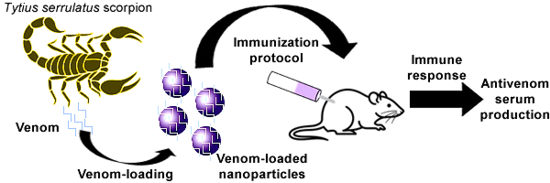
- as a biotechnological approach to immunotherapy against scorpion envenomation. Keywords: cationic nanoparticles; immunoadjuvant; polyethylenimine; poly(lactic acid); Tityus serrulatus; Introduction Accidents caused by scorpion envenoming are recognized as an important public health problem in
- polyethylenimine (PEI), to change the surface of nanoparticles to a positive potential, improving the interaction with negatively charged biomolecules, is one strategy successfully employed for gene delivery [20][23][24]. These cationic nanoparticles have an absent or weak electrostatic interaction with negatively
- (≈225 nm) and PDI (<0.3). In vitro protein release The Figure 4 shows the release profile of T. serrulatus venom protein-loaded PLA cationic nanoparticles with two different formulations containing 0.5% (Figure 4a) and 1.0% (Figure 4b) (w/w) of Tsv in the nanoparticle suspension. The in vitro protein


Development of a mucoadhesive drug delivery system and its interaction with gastric cells
Beilstein J. Nanotechnol. 2025, 16, 371–384, doi:10.3762/bjnano.16.28

- ± 6.7 mV), which is another indicator of successful coating (Table 1). From these results, it can be deduced that the synthesized cationic nanoparticles, which are smaller than the pores of gastric mucus, may have the advantage of adherence and diffusion to the gastric mucus. Encapsulation efficiency of


Polymer nanoparticles from low-energy nanoemulsions for biomedical applications
Beilstein J. Nanotechnol. 2023, 14, 339–350, doi:10.3762/bjnano.14.29
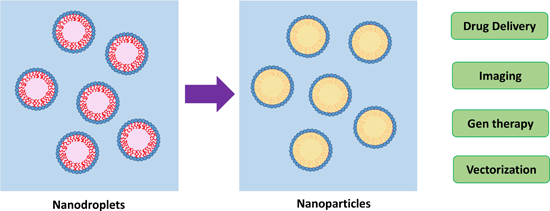
- Polymer Journal, vol. 120, by E. Soler Besumbes; C. Fornaguera; M. Monge; M. J. García-Celma; J. Carrión: C. Solans; A. Dols-Perez, “PLGA cationic nanoparticles, obtained from nanoemulsion templating, as potential DNA vaccines”, article No. 109229, Copyright (2019), with permission from Elsevier. This




Nanotechnology – a robust tool for fighting the challenges of drug resistance in non-small cell lung cancer
Beilstein J. Nanotechnol. 2023, 14, 240–261, doi:10.3762/bjnano.14.23
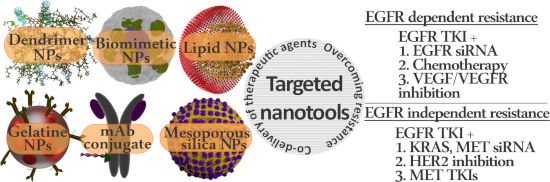
- tumor inhibition was achieved [115]. Lv et al. prepared multifunctional dendrimer nanoscale complexes composed of anti-EGFR aptamer-modified poly(amidoamine) (PAMAM) loaded with erlotinib and chloroquine (CQ) for NSCLC treatment. These cationic nanoparticles showed high condensation capacity for


Orally administered docetaxel-loaded chitosan-decorated cationic PLGA nanoparticles for intestinal tumors: formulation, comprehensive in vitro characterization, and release kinetics
Beilstein J. Nanotechnol. 2022, 13, 1393–1407, doi:10.3762/bjnano.13.115
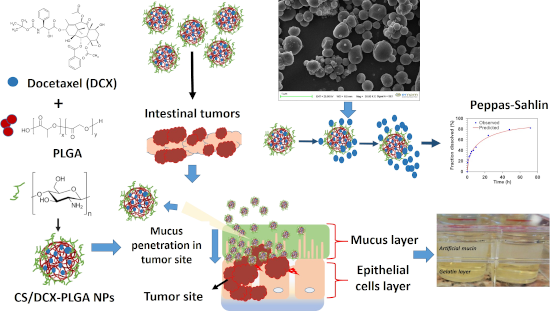
- literature, there are various studies showing consistency with our results. Varan et al. reported that cationic nanoparticles have a higher tendency to interact with the negatively charged cell membrane [67]. Accordingly, Verma et al. stated that the surface properties and charges of nanoparticles play an


Theranostic potential of self-luminescent branched polyethyleneimine-coated superparamagnetic iron oxide nanoparticles
Beilstein J. Nanotechnol. 2022, 13, 82–95, doi:10.3762/bjnano.13.6
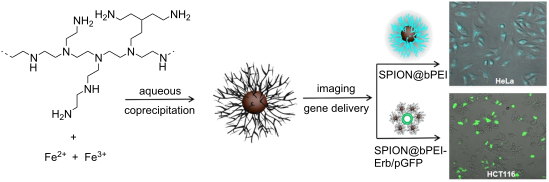
- positively charged PEI electrostatically condenses high molecular weight (MW) DNA to polypeptic nanoparticles (10–100 nm), which are capable of being absorbed by endocytosis [50][51]. Usually, the main purpose of using PEI coating on SPIONs is to provide cationic nanoparticles suitable for gene binding and




Key for crossing the BBB with nanoparticles: the rational design
Beilstein J. Nanotechnol. 2020, 11, 866–883, doi:10.3762/bjnano.11.72
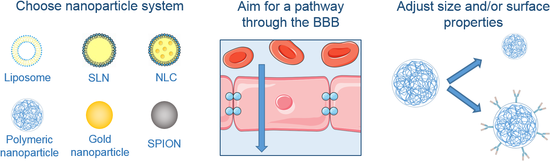
- therefore their brain delivery is reduced [133]. Furthermore, attention should be given to the toxicity of cationic nanoparticles, as they may alter cell membranes during adsorption. For instance, cationic gold nanoparticles have been shown to be 27 times more cytotoxic than their negative counterparts, due


Development of polycationic amphiphilic cyclodextrin nanoparticles for anticancer drug delivery
Beilstein J. Nanotechnol. 2017, 8, 1457–1468, doi:10.3762/bjnano.8.145
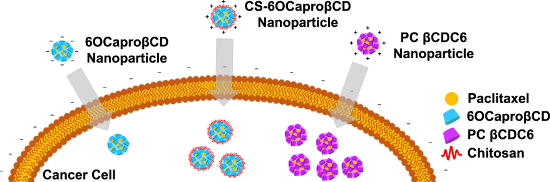
- , resulting in a 1.5-fold higher loading for this drug in cationic nanoparticles compared to the negatively charged 6OCaproβCD nanoparticles as seen in Table 3. According to these results, the CS coating increased drug loading capacity of anionic 6OCaproβCD nanoparticles by approximately 50%. In addition, the
- cells can be clearly seen in Figure 8. Anticancer activity increases with increasing surface charge of nanoparticles. It was known that the cell membrane is negatively charged so that cationic nanoparticles enhance interaction with the biological membrane. Positively charged nanoparticles can bind with


Cationic PEGylated polycaprolactone nanoparticles carrying post-operation docetaxel for glioma treatment
Beilstein J. Nanotechnol. 2017, 8, 1446–1456, doi:10.3762/bjnano.8.144
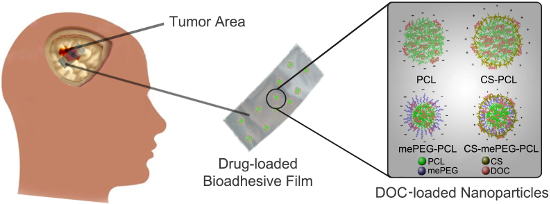
- agents of glioma. An interesting, biocompatible and simple approach is to coat the nanoparticles with cationic polymers to enhance cellular penetration and prolong retention at biological membranes. Cationic nanoparticles are able to pass through biological membranes with facilitated uptake by cells, due
- particles (which have neutral or near-neutral surface charge) are more prone to escape from the MPS. Cationic nanoparticles can also condense nucleic acid (DNA, RNA) or proteins to form polyplexes for intracellular gene/drug delivery. In this context, chitosan (CS) is used as a positively charged coating
- effect on RG2 cells. As a result, CS-coated nanoparticle formulations were found to be significantly more effective against glioma cells than nanoparticles that have negative surface charge (p < 0.05). Cationic nanoparticles may interact and pass the cell membrane more easily due to their opposite




Uptake of the proteins HTRA1 and HTRA2 by cells mediated by calcium phosphate nanoparticles
Beilstein J. Nanotechnol. 2017, 8, 381–393, doi:10.3762/bjnano.8.40
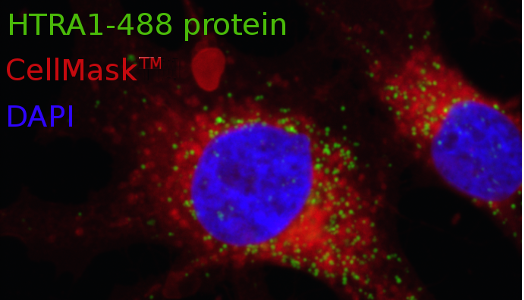
- polyethyleneimine (PEI; cationic nanoparticles) or carboxymethyl cellulose (CMC; anionic nanoparticles) and loaded with defined amounts of the fluorescently labelled proteins HTRA1, HTRA2, and BSA. The nanoparticles were purified by ultracentrifugation and characterized by dynamic light scattering and scanning
- usually taken up better and faster by cells because of the electrostatic interaction of the negatively charged cell membrane and the positively charged surface of the nanoparticles [47][50][51][52][53][54][55]. This was confirmed in our experiments: The uptake of proteins with cationic nanoparticles was
- higher than with anionic nanoparticles. The results of Table 4 indicate that in almost all cases, the cells did not take up the dissolved proteins, that anionic nanoparticles transported the proteins in some cases, and that cationic nanoparticles were always suitable carriers for the proteins. It is most


Comparative evaluation of the impact on endothelial cells induced by different nanoparticle structures and functionalization
Beilstein J. Nanotechnol. 2015, 6, 300–312, doi:10.3762/bjnano.6.28
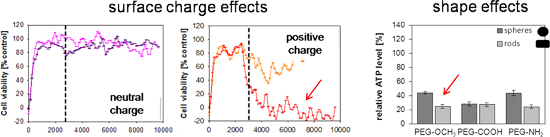
- -dependent uptake of anionic and cationic nanoparticles was commonly reported [43][60]. Some studies summarized that it is difficult to give general rules about a predicted internalization way depending on the type of nanoparticle [61]. Interestingly, in literature the internalization of nanoparticles seems




Functionalized polystyrene nanoparticles as a platform for studying bio–nano interactions
Beilstein J. Nanotechnol. 2014, 5, 2403–2412, doi:10.3762/bjnano.5.250
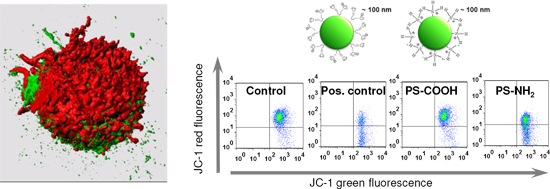
- nanosized polystyrene particles may behave totally different from the bulk material. The surface chemistry plays a crucial role determining the impact of nanoparticles on diverse biological systems. The amino-functionalized particles can be seen as a model for cationic nanoparticles, and the carboxyl
- -functionalized, as a model for anionic particles. The toxicity of cationic nanoparticles might be controlled by a reduction of the amount of positively charged groups on the particle surface, by conjugation of the cationic groups with appropriate moieties to shield the positive charge and to decrease the





