Search results
Search for "charge-transfer complex" in Full Text gives 10 result(s) in Beilstein Journal of Nanotechnology.
Supramolecular one-dimensional conducting nanofibers from a C3-symmetric tetrathiafulvalene derivative
Beilstein J. Nanotechnol. 2026, 17, 872–881, doi:10.3762/bjnano.17.63
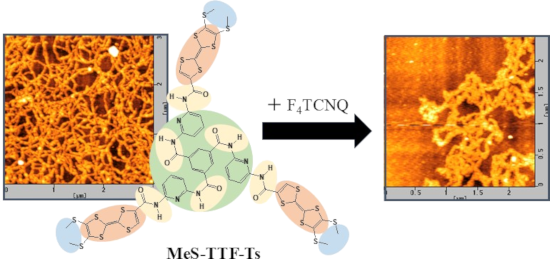
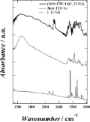
- resulting morphologies. Furthermore, MeS-TTF-Ts was combined with the strong electron acceptor F4TCNQ to form a charge-transfer complex, (MeS-TTF-Ts)(F4TCNQ)3, which yielded well-defined one-dimensional nanofibers. UV–vis and FTIR spectroscopic analyses confirmed substantial charge transfer from MeS-TTF-Ts
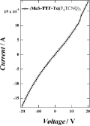
- S·cm−1. These findings demonstrate that rational molecular design combined with controlled supramolecular self-assembly provides an effective strategy for constructing one-dimensional conductive nanostructures based on organic charge-transfer systems. Keywords: charge-transfer complex; conducting
- nanofibers from C3-symmetric MeS-TTF-Ts and the (MeS-TTF-Ts)(F4TCNQ)3 charge-transfer complex In order to form conductive fibers using MeS-TTF-Ts, it was necessary to identify suitable conditions for controlling the formation of supramolecular structures. Atomic force microscopy (AFM) observations of cast


Silver-based SERS substrates fabricated using a 3D printed microfluidic device
Beilstein J. Nanotechnol. 2023, 14, 793–803, doi:10.3762/bjnano.14.65
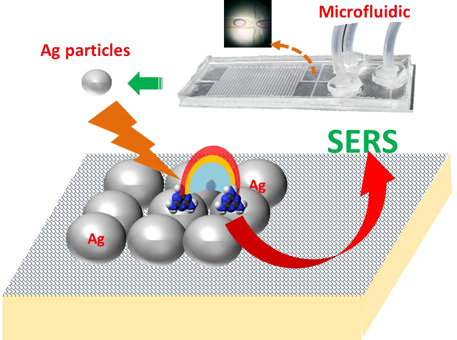
- formation of a charge-transfer complex between chemisorbed species and matrix material, which yields enhancement when the excitation frequency resonates with a charge-transfer transition [7]. Noble metal nanoparticles (NPs) have gained much popularity in various fields, such as analytical chemistry and



Interfacial charge transfer processes in 2D and 3D semiconducting hybrid perovskites: azobenzene as photoswitchable ligand
Beilstein J. Nanotechnol. 2020, 11, 466–479, doi:10.3762/bjnano.11.38
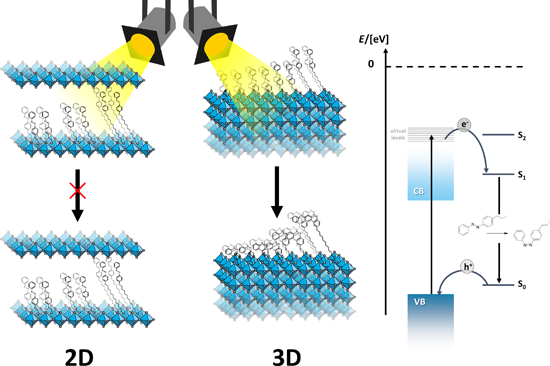
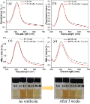
- system of a semiconductor. Torres et al. reported calculations of a charge-transfer complex of para-methyl red/TiO2 in the gas phase where the isomerisation is fully quenched. The photoexcited state is oxidized immediately through a charge transfer from the azobenzene to TiO2 and no conformational change
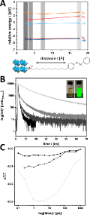
- photoswitching of azobenzene on semiconducting TiO2 is suppressed due to a sudden oxidation of the chromophore. The formation of a heterogeneous charge-transfer complex disturbs the isomerisation and no photoswitching is observed [37]. To clarify possible electronical processes, the relative energies of valence




Pure and mixed ordered monolayers of tetracyano-2,6-naphthoquinodimethane and hexathiapentacene on the Ag(100) surface
Beilstein J. Nanotechnol. 2019, 10, 1188–1199, doi:10.3762/bjnano.10.118
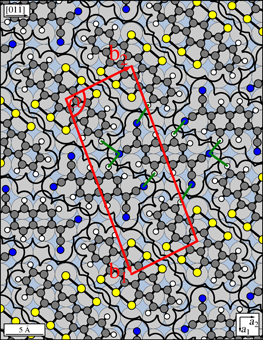
- combination with tetrathiafulvalene (TTF) on Au(111). TNAP is a flat planar molecule (C2h) with the ability to delocalize unpaired electrons in a charge-transfer complex [26]. We note that the crystal structure of TNAP is unknown and, as a consequence, we cannot compare the packing of TNAP on the Ag(100


Charge transfer from and to manganese phthalocyanine: bulk materials and interfaces
Beilstein J. Nanotechnol. 2017, 8, 1601–1615, doi:10.3762/bjnano.8.160
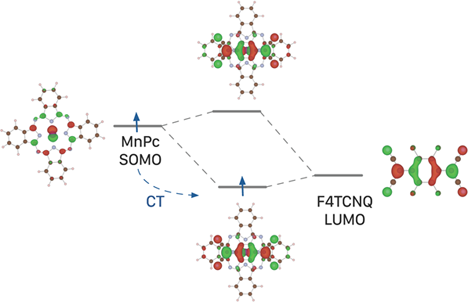
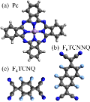
- . Both the disappearance of the spectral feature at lowest binding energy of MnPc as well as the broadening of the structures is well reproduced. The calculations also indicate that the hybrid state is too close to the MnPc HOMO to be resolved spectroscopically. The formation of the charge-transfer
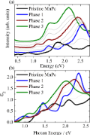
- complex MnPc/F4TCNQ also results in corresponding changes of the electronic excitation spectra in comparison to those from pure MnPc or F4TCNQ. This is illustrated in Figure 8, where the corresponding data from EELS are depicted. The measured spectrum of pure F4TCNQ is characterized by a rather large


Two-dimensional carbon-based nanocomposites for photocatalytic energy generation and environmental remediation applications
Beilstein J. Nanotechnol. 2017, 8, 1571–1600, doi:10.3762/bjnano.8.159
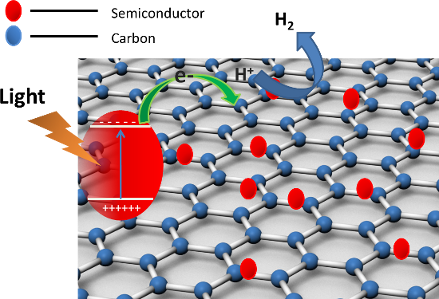
- demonstrated by Du et al. [129] on graphene–titania hybrid nanocomposites and explained as the interfacial charge transfer by using density functional calculations. They demonstrated the formation of a charge transfer complex at the interface of graphene and titania due to the work function difference of both


Spin-chemistry concepts for spintronics scientists
Beilstein J. Nanotechnol. 2017, 8, 1427–1445, doi:10.3762/bjnano.8.143
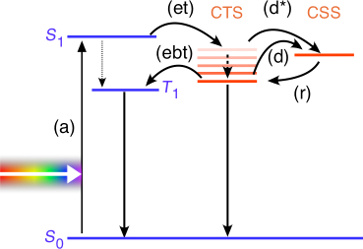
- negative polaron on the acceptor molecules with the positive polaron remaining on the donor molecules, is called the charge transfer state (CTS) or charge transfer complex. They have been reported to show the emission–absorption signatures in transient EPR as expected for SCRP [32]. The free charge carrier



Ultrasmall magnetic field-effect and sign reversal in transistors based on donor/acceptor systems
Beilstein J. Nanotechnol. 2017, 8, 1104–1114, doi:10.3762/bjnano.8.112
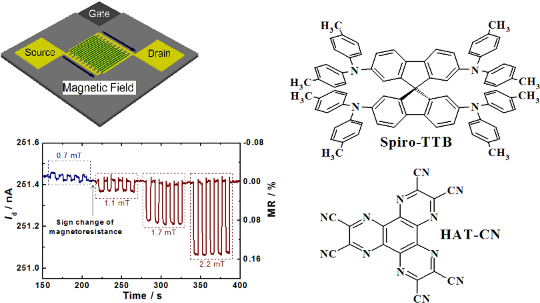
- transistors is the charge-transfer complex molecule, which this system has already shown magnetoresistive effects in organic diodes [17]. In a previous study we presented the first magnetoresistive effects in transistor structures based on a coevaporated (50:50) thin film materials system consisting of 2,2

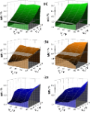


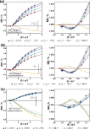

DFT study of binding and electron transfer from colorless aromatic pollutants to a TiO2 nanocluster: Application to photocatalytic degradation under visible light irradiation
Beilstein J. Nanotechnol. 2014, 5, 1016–1030, doi:10.3762/bjnano.5.115
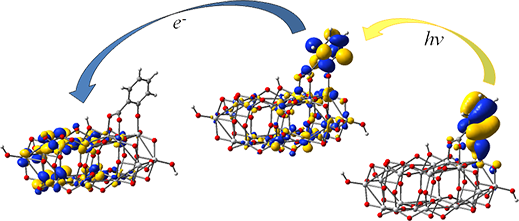
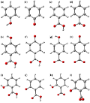
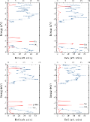
- has to be modified in various ways [6]. Alternative approaches to the modification of the TiO2 photocatalyst are the self-sensitized degradation of dyes which absorb visible light [7][8] and the photocatalytic degradation of colorless organic compounds by formation of a charge-transfer-complex, CTC [9



Nanostructure sensitization of transition metal oxides for visible-light photocatalysis
Beilstein J. Nanotechnol. 2014, 5, 696–710, doi:10.3762/bjnano.5.82
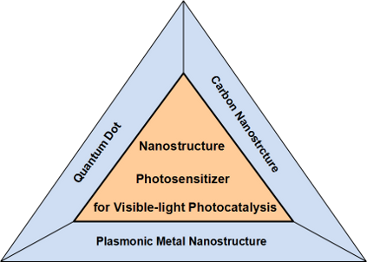
- several experimental and theoretical researches. For instance, Du et al. used ab initio calculations to demonstrate that a graphene/titania interface in the ground electronic state forms a charge-transfer complex due to the large difference of work functions between graphene and TiO2 [99]. Most