


Search results
Search for "circular economy" in Full Text gives 9 result(s) in Beilstein Journal of Nanotechnology.
Upcycling agroindustrial waste into graphene oxide supports for gold nanoparticles: toward sustainable nanomaterials
Beilstein J. Nanotechnol. 2026, 17, 489–504, doi:10.3762/bjnano.17.32
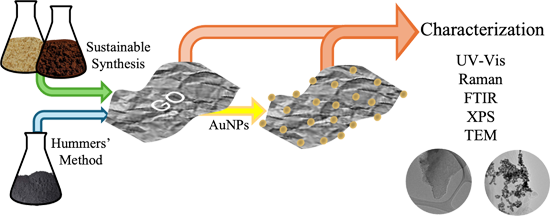
- as substrates for AuNP photodeposition to evaluate how their surface chemistry governs nanoparticle nucleation and dispersion. Agro-GO@AuNPs composites demonstrate a green, circular-economy approach with promising potential for applications in sensing, diagnostics, energy storage, and separation
- . Overall, the ability to tailor GO properties by carefully selecting agricultural precursors provides a versatile pathway for designing application-specific carbon–metal hybrids within a circular-economy framework. UV–vis absorption spectra of GO samples (GO, rGO, Agro-GOP, Agro-GOX, and Agro-GOC). Raman









Functional surface engineering for cultural heritage protection: the role of superhydrophobic and superoleophobic coatings – a comprehensive review
Beilstein J. Nanotechnol. 2026, 17, 63–96, doi:10.3762/bjnano.17.6










Missing links in nanomaterials research impacting productivity and perceptions
Beilstein J. Nanotechnol. 2025, 16, 2168–2176, doi:10.3762/bjnano.16.149
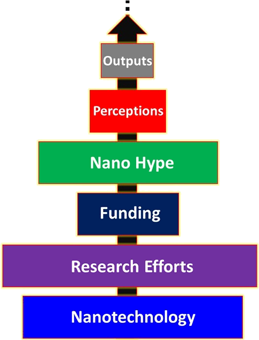
- by reducing trial-and-error paths. (8) Nanotechnology deployment must embed principles of sustainability and circular economy. Designing recyclable nanomaterials, minimizing energy-intensive synthesis, and developing green manufacturing processes will be game changers. Conclusion In the current era
Microplastic pollution in Himalayan lakes: assessment, risks, and sustainable remediation strategies
Beilstein J. Nanotechnol. 2025, 16, 2144–2167, doi:10.3762/bjnano.16.148
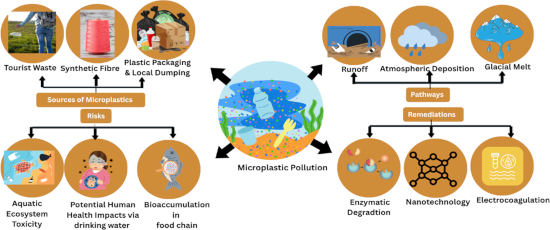
- filters for laundry, already taken up in France and debated in Australia, additionally limits MP discharge from clothes [137]. Encouraging a circular economy model can minimize plastic waste generation at the industrial level. EPR policies have been proposed to hold manufacturers accountable for post
- -consumer plastic waste, as emphasized in the EU’s Circular Economy Action Plan [138]. Additionally, industries should be incentivized to develop biodegradable alternatives, such as bioplastics, to reduce dependency on conventional plastics [139]. Due to the transboundary character of MP pollution
- implemented bans on microbeads, comprehensive regulations addressing other sources, such as textiles and industrial waste, are still lacking. A stronger policy framework, encompassing extended producer responsibility and circular economy models, is required to constrain MP pollution. Socioeconomic impacts


Current status of using adsorbent nanomaterials for removing microplastics from water supply systems: a mini review
Beilstein J. Nanotechnol. 2025, 16, 1837–1850, doi:10.3762/bjnano.16.127
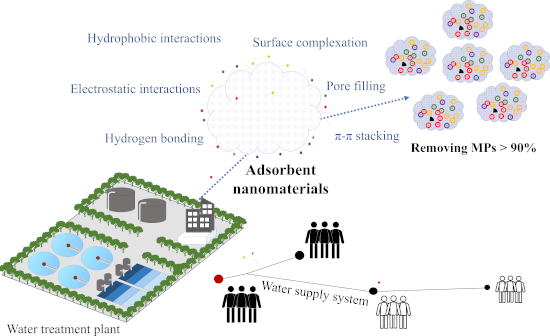
- -term ecological impacts of nanomaterials remain understudied, particularly in soil environments. Future research directions and recommendations Future research should prioritize the development of advanced adsorbent nanomaterials that align with sustainable development goals and support a circular
- economy in the long term. Nanomaterials with characteristics such as environmental durability and reusability should be considered to improve overall effectiveness. Many recent studies are focusing on porous and hybrid nanomaterials to enhance the efficiency and selectivity of MP removal in water


Supramolecular hydration structure of graphene-based hydrogels: density functional theory, green chemistry and interface application
Beilstein J. Nanotechnol. 2025, 16, 806–822, doi:10.3762/bjnano.16.61
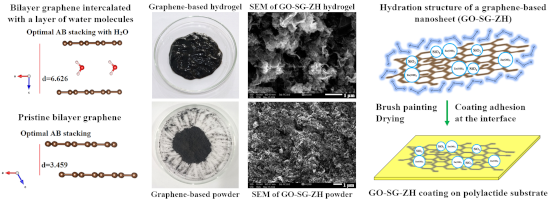
- circular economy [18][19][20][21]. Especially, GO nanosheets decorated with SG-ZH nanoparticles have hydrophilic surfaces to retain hydration layers in the hydrogel structure of the GO-SG-ZH nanocomposite. Hydration layers in the GO-SG-ZH hydrogel also function as lubricants at the nanomaterials interfaces


Green synthesis of biomass-derived carbon quantum dots for photocatalytic degradation of methylene blue
Beilstein J. Nanotechnol. 2024, 15, 755–766, doi:10.3762/bjnano.15.63
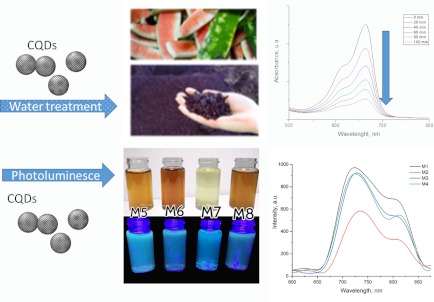
- precursors, this research aims to develop a more sustainable and cost-effective approach for producing CQDs as catalysts in the photocatalysis process. Utilizing watermelon peels and grape pomace as raw materials contributes to waste valorization and promotes a circular economy concept. The ultimate goal is


Mixed oxides with corundum-type structure obtained from recycling can seals as paint pigments: color stability
Beilstein J. Nanotechnol. 2023, 14, 467–477, doi:10.3762/bjnano.14.37
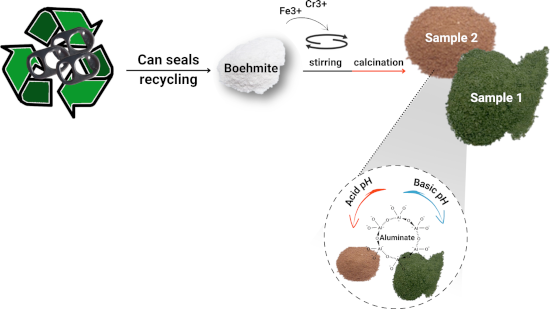
- . Keywords: circular economy; colorimetry; sustainability; Introduction The growing interest in industrial products that do not harm the environment triggered the development of diverse strategies to optimize recycling and green syntheses of materials. It is possible to combine economic and environmental
- interests to produce synthetic inorganic pigments [1] using metallic aluminium scrap as precursor to obtain a white matrix that can then be colored by chromophore ions as an approach within the circular economy of aluminium [1]. Aluminium production has one of the most significant energy consumption
- , with rates ranging from 25% to 85% worldwide [3]. In the last decade, interest in the circular economy issues has increased almost a hundredfold [5], accompanied by research and widespread awareness. However, circular economy is still a relatively new concept. It has been embraced as a concept based on





Topochemical engineering of composite hybrid fibers using layered double hydroxides and abietic acid
Beilstein J. Nanotechnol. 2019, 10, 589–605, doi:10.3762/bjnano.10.60

- these materials show different properties with regard to water repellency, oil absorption, tensile strength, and optical brightness. Composing renewable materials such as cellulose and abietic acid for customized product development is in the line of interests of circular-economy initiatives implemented





Other Beilstein-Institut Open Science Activities



