


Search results
Search for "circularly polarized light" in Full Text gives 8 result(s) in Beilstein Journal of Nanotechnology.
Chiral plasmonic nanostructures fabricated with circularly polarized light
Beilstein J. Nanotechnol. 2025, 16, 2245–2264, doi:10.3762/bjnano.16.154
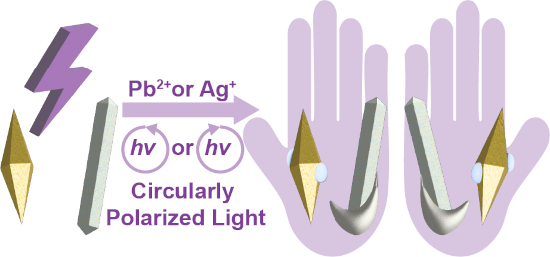
- Chiral plasmonic nanostructures (cPNSs) have garnered extensive interest across disciplines due to their strong interaction with circularly polarized light (CPL). Numerous fundamental studies have demonstrated the enhancement of chiroptic effects in molecular systems and quantum emitters facilitated by
- applications of cPNSs fabricated using CPL. Keywords: circular dichroism; circularly polarized light; plasmonic nanocrystals; Introduction An object is considered chiral when it cannot be superimposed on its mirror image. Homochirality is a feature of life on Earth. For example, amino acids in living
- lengths are usually required to obtain reliable experimental results. These challenges can be addressed using chiral plasmonic nanostructures (cPNSs). cPNSs enhance the intensity of the electromagnetic near field of circularly polarized light (CPL), which accelerates light absorption by molecules







A super-oscillatory step-zoom metalens for visible light
Beilstein J. Nanotechnol. 2022, 13, 1220–1227, doi:10.3762/bjnano.13.101
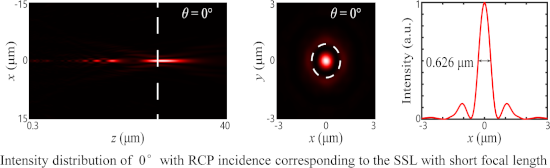
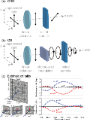
- -layer step-zoom metalens can be switched between two different focal lengths by controlling the handedness of the incident circularly polarized light. It is superior to the traditional zoom lens since there is no mechanical movement and the image plane of the double-layer step-zoom metalens keeps
- ) light. For the super-oscillatory phase, it takes the value of 0 or π, so the modulation remains invariant for incident left-handed or right-handed circularly polarized light. It means that the super-oscillatory step-zoom metalens can achieve super-resolution focusing for both left-handed and right
- -handed circularly polarized light. The proposed SSL can be achieved with the optimization method above. The phase distribution, in turn, of the front metasurfaces is finally obtained by superimposing the optimized super-oscillatory phase. As the LCP light impinges on the SSL, it works with a long focal


Monolayers of MoS2 on Ag(111) as decoupling layers for organic molecules: resolution of electronic and vibronic states of TCNQ
Beilstein J. Nanotechnol. 2020, 11, 1062–1071, doi:10.3762/bjnano.11.91
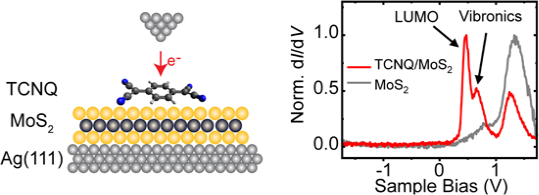
- and K′ by circularly polarized light [32]. The potential as decoupling layer for molecules may become even more appealing by the fact that monolayers of transition metal dichalcogenides can be grown in situ on different metal surfaces, where the precise hybridization and band alignment depend on the


Circular dichroism of chiral Majorana states
Beilstein J. Nanotechnol. 2018, 9, 1194–1199, doi:10.3762/bjnano.9.110
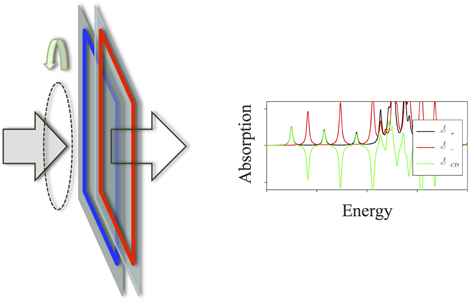
- the connection between chiral Majorana states and optical absorption. We expect that in presence of chiral Majorana states, the optical absorption of circularly polarized light will differ for clockwise and anti-clockwise polarizations. The difference, known as circular dichroism (CD) [23][24], can
- , mass m ≡ 1/2m1 ≡ 1 and a chosen length unit LU, typically LU ≈ 1 μm. The corresponding energy unit is then . Circular dichroism We compute the optical absorption cross section for right (+) and left (−) circularly-polarized light from where is the energy difference between particle (unoccupied) and


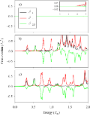
![[Graphic 14]](/bjnano/content/inline/2190-4286-9-110-i18.svg?max-width=637&scale=1.18182) . Panels a) and b) correspond to the phases in Figure 1d with one (ΔB = 2...
. Panels a) and b) correspond to the phases in Figure 1d with one (ΔB = 2...
![[Graphic 15]](/bjnano/content/inline/2190-4286-9-110-i19.svg?max-width=637&scale=1.18182) ,
, ![[Graphic 16]](/bjnano/content/inline/2190-4286-9-110-i20.svg?max-width=637&scale=1.18182) and
and ![[Graphic 17]](/bjnano/content/inline/2190-4286-9-110-i21.svg?max-width=637&scale=1.18182) defined in the main text. The shown results correspond to the spe...
defined in the main text. The shown results correspond to the spe...

![[Graphic 19]](/bjnano/content/inline/2190-4286-9-110-i23.svg?max-width=637&scale=1.18182) ,
, ![[Graphic 20]](/bjnano/content/inline/2190-4286-9-110-i24.svg?max-width=637&scale=1.18182) and
and ![[Graphic 21]](/bjnano/content/inline/2190-4286-9-110-i25.svg?max-width=637&scale=1.18182) for (a) a square of Lx = Ly = 20 LU), and for (b) a rectangle of L...
for (a) a square of Lx = Ly = 20 LU), and for (b) a rectangle of L...
Computing the T-matrix of a scattering object with multiple plane wave illuminations
Beilstein J. Nanotechnol. 2017, 8, 614–626, doi:10.3762/bjnano.8.66
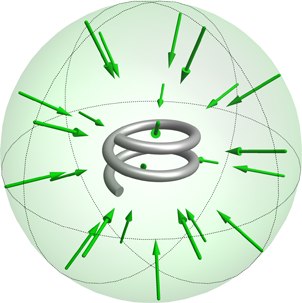
- -handed circularly polarized light. For the following considerations it is beneficial to introduce shortly the concept of duality symmetry. In free space, Maxwell’s equations are invariant under the transformation [47] where E is the electric field, H is the magnetic field, Z is the impedance and θ is an


Hole-mask colloidal nanolithography combined with tilted-angle-rotation evaporation: A versatile method for fabrication of low-cost and large-area complex plasmonic nanostructures and metamaterials
Beilstein J. Nanotechnol. 2014, 5, 577–586, doi:10.3762/bjnano.5.68
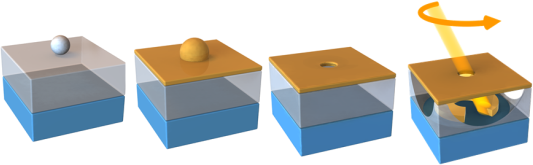
- observed at about 2 µm and 1 µm for 0° polarization (black dashed curve), and the second-order mode at around 1.2 µm for 90° polarization (red dashed curve). In order to study the chiral properties of our structures, we also measure the sample with circularly polarized light (solid line). Here, left-handed
- circularly polarized (LCP) light is defined as its electric field-vector performing a left-hand rotation during propagation towards the sample. The red curve describes the transmission spectrum with left-handed circularly polarized light and the black curve for right-hand circularly polarized (RCP) light. As
- circularly polarized light can be constructed from linearly polarized light by using the prescription x ± iy, all three SRR modes are visible simultaneously in the spectra [37]. The differences between the spectra measured with LCP- and RCP-light are obvious, which confirms the chiral characteristics as well


Tuning the properties of magnetic thin films by interaction with periodic nanostructures
Beilstein J. Nanotechnol. 2012, 3, 831–842, doi:10.3762/bjnano.3.93
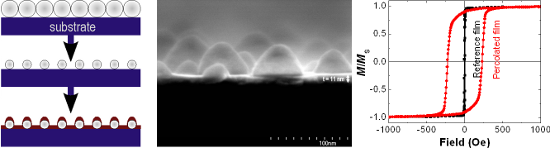
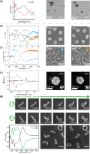
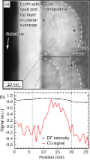
- description for Si/SiO2 substrates above. Two Fe-L3 images were measured by scanning the sample with left and right circularly polarized light. The ratio of the two images reveals the magnetic domain structures at a resolution of better than 25 nm at the PolLux beamline. Sensitivity to in-plane magnetization
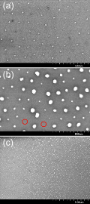
- transmission X-ray microscopy images of Fe films taken with right circularly polarized light at the Fe-L3 edge show PS particles as well as magnetic contrast in the film after sample demagnetization. Panel (b) presents the XMCD image of the identical sample spot. In (c) an XMCD image at higher resolution is
- polarized light. Some particles are clearly visible in the upper part of the sample while magnetic contrast of domains is directly observable. Enhancement of the magnetic signal can be achieved by division of STXM images taken with opposite helicities of X-rays at the price of losing the particle contrast


Preparation and characterization of supported magnetic nanoparticles prepared by reverse micelles
Beilstein J. Nanotechnol. 2010, 1, 24–47, doi:10.3762/bjnano.1.5






Other Beilstein-Institut Open Science Activities



