


Search results
Search for "computer modelling" in Full Text gives 4 result(s) in Beilstein Journal of Nanotechnology.
Comparative study on 3D morphologies of delignified, single tracheids and fibers of five wood species
Beilstein J. Nanotechnol. 2026, 17, 239–250, doi:10.3762/bjnano.17.16
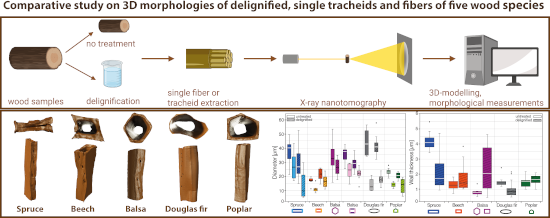
- insights for applications in computer modelling of mechanical properties of fibers and tracheids and for development of novel bio-inspired materials for the industry. Material and Methods Wood samples Wood samples of five different species were used in this study, namely, spruce (Picea abies (L.) H.Karst


Sulfur-, nitrogen- and platinum-doped titania thin films with high catalytic efficiency under visible-light illumination
Beilstein J. Nanotechnol. 2018, 9, 1629–1640, doi:10.3762/bjnano.9.155
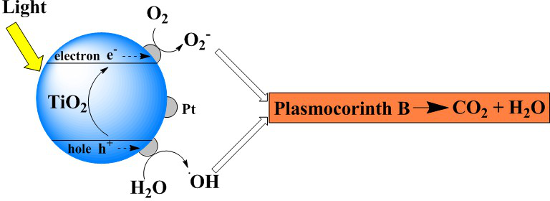
- Faculty of Chemistry and Chemical Technology for help with computer modelling.


Probing fibronectin–antibody interactions using AFM force spectroscopy and lateral force microscopy
Beilstein J. Nanotechnol. 2015, 6, 1164–1175, doi:10.3762/bjnano.6.118
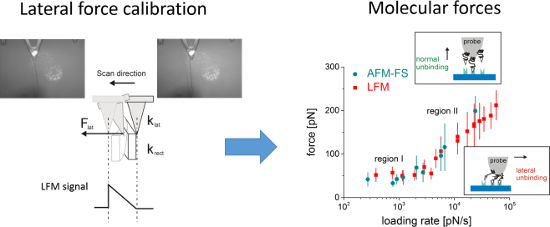
- force spectroscopy or lateral force spectroscopy). This likely indicates some differences in the vertical and lateral unbinding scenarios. The computer modelling of a similar unbinding event in an MCP1-IgG antibody complex showed that lateral unbinding forces are about 30% lower than those



Fibrillar adhesion with no clusterisation: Functional significance of material gradient along adhesive setae of insects
Beilstein J. Nanotechnol. 2014, 5, 837–845, doi:10.3762/bjnano.5.95
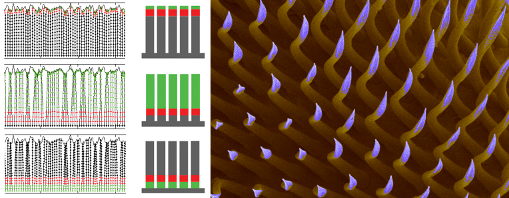
- various lineages of arthropods. Keywords: adhesion; attachment; biomechanics; computer modelling; cuticle; locomotion; material; surface; Introduction The contact formation of insect adhesive pads on various substrates depends on the pad ability to adapt to different surface topographies. The quality of


Other Beilstein-Institut Open Science Activities



