


Search results
Search for "dengue" in Full Text gives 9 result(s) in Beilstein Journal of Nanotechnology.
Ultrathin water layers on mannosylated gold nanoparticles
Beilstein J. Nanotechnol. 2025, 16, 2183–2198, doi:10.3762/bjnano.16.151
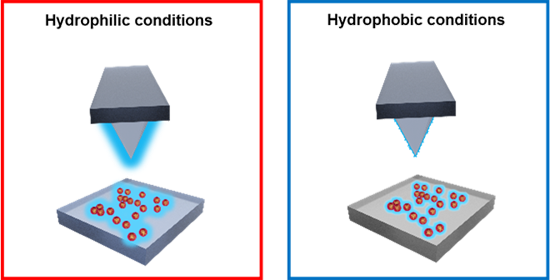
- viral spikes, which are crucial for virus “survival” during transmission [11][12]. For many, especially mammalian, viruses, transmission occurs in aqueous environments (e.g., Dengue [13] and Ebola [14]), and air humidity does not play any direct role. In contrast, humidity strongly affects the



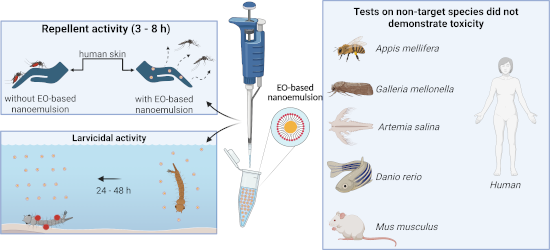
Targeting the vector of arboviruses Aedes aegypti with nanoemulsions based on essential oils: a review with focus on larvicidal and repellent properties
Beilstein J. Nanotechnol. 2025, 16, 1894–1913, doi:10.3762/bjnano.16.132
- crucial role in the transmission of arboviruses of global epidemiological relevance, such as dengue (DENV), yellow fever (YFV), zika (ZIKV), and chikungunya (CHIKV). In these diseases, high morbidity and mortality rates are observed, and they have a global distribution, particularly in tropical and
- humans. Among them, the Flaviviridae family includes pathogens such as dengue (DENV) and zika (ZIKV) viruses, while Alphaviruses include the chikungunya virus (CHIKV) [39][40]. These viruses are primarily transmitted by the Ae. aegypti mosquito, which relies on humans as its main amplification hosts [2
- transmission. According to data from the World Health Organization [52], arboviroses are seen as a major obstacle to public health, especially to dengue, zika, and chikungunya viruses, especially in subtropical and tropical countries [3]. In this scenarium, DENV causes more than 400 million infections annually


Chitosan nanocomposite containing rotenoids: an alternative bioinsecticidal approach for the management of Aedes aegypti
Beilstein J. Nanotechnol. 2025, 16, 1197–1208, doi:10.3762/bjnano.16.88
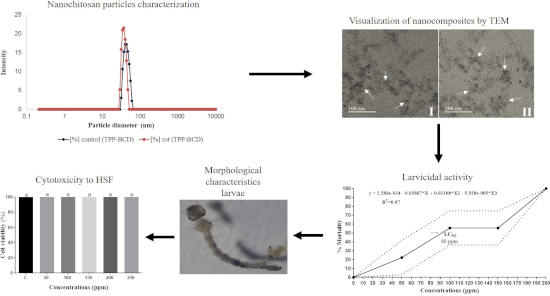
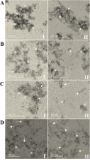
- Darcy Ribeiro, Campos dos Goytacazes/RJ, Brazil 10.3762/bjnano.16.88 Abstract Climate change has intensified the proliferation of disease vectors, such as Aedes aegypti, the primary transmitter of dengue, chikungunya, and zika viruses. Although the two recently licensed dengue vaccines represent a
- for vector control. Keywords: dengue; nanoparticle; pest management; phytochemicals; Introduction Climate change has significantly impacted public health, intensifying the proliferation of disease vectors such as those transmitted by the mosquito Aedes aegypti. Environmental conditions exacerbated
- by global warming, including rising temperatures, heavy rainfalls, and high humidity, have accelerated mosquito reproduction and expanded its geographic spread. In 2023, dengue reached a record 5 million cases in 80 countries, including historically non-endemic regions such as the United States



Green synthesis of silver nanoparticles derived from algae and their larvicidal properties to control Aedes aegypti
Beilstein J. Nanotechnol. 2024, 15, 1566–1575, doi:10.3762/bjnano.15.123

- aegypti (Stegomyia) Linnaeus (1762) (Diptera: Culicidae), known as the dengue mosquito, is a vector of important arboviroses, including Dengue, Zika, Chikungunya, and Yellow Fever [6]. Since there are no specific antiviral treatments for arboviruses and the endemicity of these diseases is determined by
- . These compounds act by reducing Ag+ ions to Ag0 and stabilize nanoparticles by capping [58] (Figure 2). Larvicidal activity of AgNPs against Aedes aegypti Aedes aegypti, also known as the dengue mosquito, is a vector of important arboviruses, including Dengue, Zika, Chikungunya and Yellow Fever [6][59
- ]. Among them, dengue fever is highlighted as this disease is endemic in more than 100 countries, proving to be an important public health problem. Its incidence has grown dramatically worldwide in recent decades, with cases reported to the WHO rising from 505,430 in 2000 to 5.2 million in 2019 [60


When nanomedicines meet tropical diseases
Beilstein J. Nanotechnol. 2024, 15, 830–832, doi:10.3762/bjnano.15.69

- Chagas disease. In addition, emerging diseases such as dengue, chikungunya, and zika infections are also considered NTDs. Historically, NTDs have long been overlooked in the global health agenda, attracting little attention and low funding. Currently, there are few tools available to diagnose and treat
- Aedes aegypti larvae [7]. This warrants further investigation on eco-friendly insecticides to fight Aedes aegypti, the primary vector of dengue, zika, and chikungunya. Overall, this article collection was conceived to be an original literature resource converging nanomedicine and NTDs. All high-quality
Development and characterization of potential larvicidal nanoemulsions against Aedes aegypti
Beilstein J. Nanotechnol. 2024, 15, 104–114, doi:10.3762/bjnano.15.10
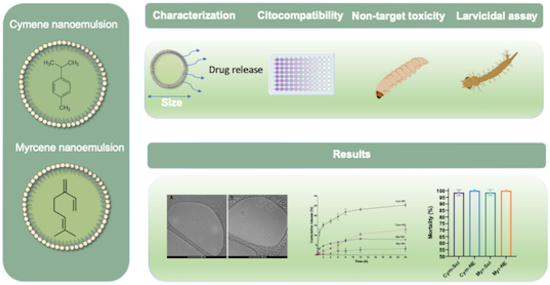
- involving Galleria mellonella larvae. Additionally, we investigated the insecticidal efficacy of monoterpenes against the mosquito Aedes aegypti, the primary dengue vector, via larval bioassay. Employing a low-energy approach, we successfully generated nanoemulsions. The cymene-based nanoemulsion exhibited
- ; drug delivery system; hydrophile–lipophile balance; monoterpenes; Introduction Aedes aegypti (Linnaeus, 1762) is a mosquito species that is cosmopolitan and well adapted to anthropized and peridomestic environments. It is an important vector of arboviruses, including dengue, chikungunya fever, zika
- , and urban yellow fever and can cause alarming socio-economic impacts in the affected regions [1]. The World Health Organization (WHO) considers dengue, zika, and chikungunya as neglected and emerging tropical diseases transmitted by mosquitoes and as one of the main concerns in developing countries


The origin of black and white coloration of the Asian tiger mosquito Aedes albopictus (Diptera: Culicidae)
Beilstein J. Nanotechnol. 2023, 14, 496–508, doi:10.3762/bjnano.14.41
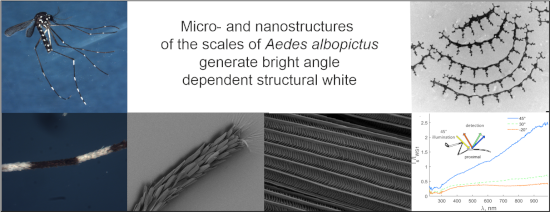
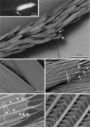
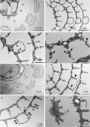
- 100 most invasive species in the world being an aggressive day-biting species. It is of high medical importance as a vector of chikungunya virus, dengue virus, and dirofilariasis [18]. Detailed studies regarding the optical properties of the body surface of insects, such as Ae. albopictus can be



DNA aptamer selection and construction of an aptasensor based on graphene FETs for Zika virus NS1 protein detection
Beilstein J. Nanotechnol. 2022, 13, 873–881, doi:10.3762/bjnano.13.78
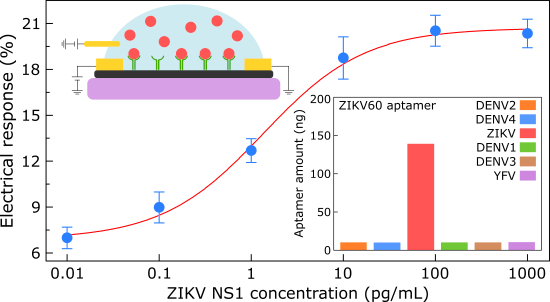
- other medically important flaviviruses with high global public health significance, such as dengue (DENV) and yellow fever (YFV) viruses. Correct diagnosis of a flavivirus infection can be challenging, particularly in world regions where more than one flavivirus co-circulates and YFV vaccination is
- public health problem in many tropical and sub-tropical countries. Viruses medically important in the genus Flavivirus include Zika virus (ZIKV), dengue virus (DENV), and yellow fever virus (YFV), mainly transmitted to humans by Aedesaegypti mosquitoes [1][2]. In 1947, ZIKV was first discovered in Uganda
- specificity and sensibility of ZIKV60 for NS1 may be an innovative tool for novel graphene-based biosensors for ZIKV NS1 protein detection. Experimental NS1 proteins Recombinant Zika virus (Uganda strain), dengue virus (serotypes 1, 2, 3, and 4) and yellow fever virus NS1 proteins expressed in mammalian



A review on nanostructured silver as a basic ingredient in medicine: physicochemical parameters and characterization
Beilstein J. Nanotechnol. 2021, 12, 440–461, doi:10.3762/bjnano.12.36
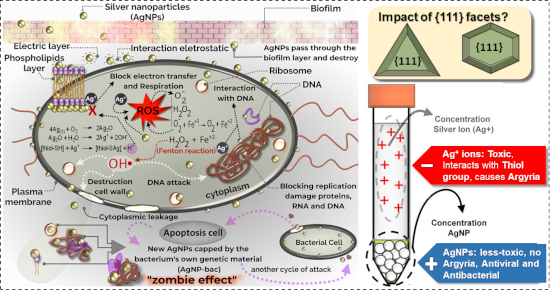
- used in the future against the increase of multidrug-resistant pathogenic strains. In addition, AgNPs can also be used to combat neglected diseases such as dengue, leishmaniasis, malaria, schistosomiasis, and trypanosomiasis (Chagas disease) among other applications [5][19][24]. The unprecedented
- toxicity and improved efficacy [86]. In vivo and in vitro studies have demonstrated the efficacy of AgNPs in treating neglected diseases, such as dengue [87][88], leishmaniasis [89][90][91][92], malaria [93][94][95], schistosomiasis [96][97], and trypanosomiasis (Chagas disease) [98][99]. Mechanism of


Other Beilstein-Institut Open Science Activities



