


Search results
Search for "dental applications" in Full Text gives 5 result(s) in Beilstein Journal of Nanotechnology.
On the road to sustainability – application of metallic nanoparticles obtained by green synthesis in dentistry: a scoping review
Beilstein J. Nanotechnol. 2025, 16, 1851–1862, doi:10.3762/bjnano.16.128
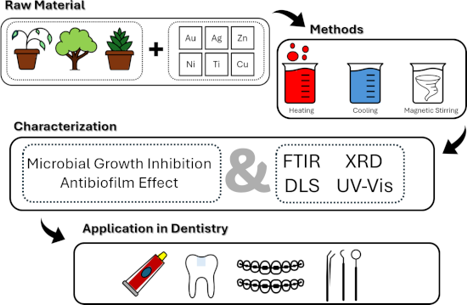
- , particularly in dentistry. This scoping review examines the rising focus on these nanoparticles regarding their antimicrobial, regenerative, and therapeutic potential in dental applications. Among the metals studied, silver and zinc oxide nanoparticles dominate because of their broad-spectrum antimicrobial
- bacteria, offers a sustainable alternative by leveraging natural reducing agents like polyphenols and flavonoids. These bioactive compounds not only facilitate nanoparticle formation but also improve stability and biological efficacy, making them ideal for dental applications such as caries prevention
- , Fabaceae and Lamiaceae, stood out as recurrent sources of phytochemicals used in the green synthesis of metallic nanoparticles [9][43]. Nanoparticles derived from these families have been incorporated into dental applications such as restorative materials and endodontic medicaments. In cariology, plant


Colloidal few layered graphene–tannic acid preserves the biocompatibility of periodontal ligament cells
Beilstein J. Nanotechnol. 2025, 16, 664–677, doi:10.3762/bjnano.16.51
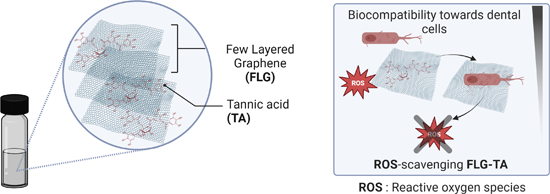
- , demonstrating no cytotoxicity to periodontal ligament cells up to 200 µg·mL−1 while promoting cellular adhesion and maintaining chromatin integrity. Overall, because of its favorable biocompatibility FLG–TA holds promise as a novel biomaterial for dental applications. Keywords: antioxidant properties
- ; biocompatibility; dental applications; few layered graphene–tannic acid biocomposite (FLG–TA); periodontal ligament cells (PDL); Introduction Dental diseases remain a global health challenge [1]. Dental biomaterials are crucial in both therapeutic and preventive strategies, with nanotechnology emerging as a
- biocompatibility with PDL cells. Importantly, our strategy indicates that the modified attributes of FLG–TA enhance its suitability for dental biomaterials, thereby paving the way for safer and more effective dental applications. Results and Discussion Synthesis of FLG–TA results in a few-layered structure with




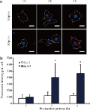
Cardiomyocyte uptake mechanism of a hydroxyapatite nanoparticle mediated gene delivery system
Beilstein J. Nanotechnol. 2020, 11, 1685–1692, doi:10.3762/bjnano.11.150
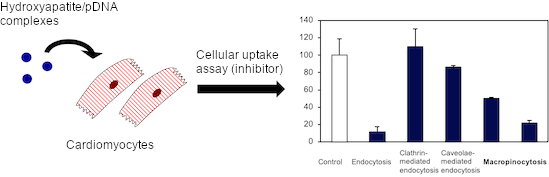
- medical and dental applications, such as dental implants, orthopedics, and drug delivery systems, since it has similar elements found in bone and teeth. In addition, CaP stabilizes the nucleic acid against nuclease degradation, forms ionic interactions with the phosphates of DNA, and its biodegradation is


Facile biogenic fabrication of hydroxyapatite nanorods using cuttlefish bone and their bactericidal and biocompatibility study
Beilstein J. Nanotechnol. 2020, 11, 285–295, doi:10.3762/bjnano.11.21
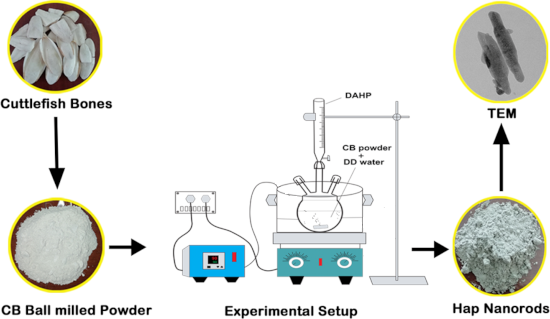
- Hap NRs will be highly useful in the fabrication of novel implants for orthopedic and dental applications. Materials and Methods The experiments were performed in a 1000 mL round bottom flask filled with calcium carbonate (CB powder), (NH4)2HPO4 and ammonia solution. The oil bath setup was used to


Nanomanipulation and environmental nanotechnology
Beilstein J. Nanotechnol. 2014, 5, 2079–2080, doi:10.3762/bjnano.5.216

- nanoparticles on enamel is important in dental applications, as shown by AFM nanomanipulation experiments. The motion of nanoparticles on a surface can be also driven by quartz tuning forks coupled to scanning electron microscopy. As mentioned above, these techniques hold great potential for a better
Other Beilstein-Institut Open Science Activities



