


Search results
Search for "dynamic resistance" in Full Text gives 5 result(s) in Beilstein Journal of Nanotechnology.
Quantum circuits with SINIS structures
Beilstein J. Nanotechnol. 2025, 16, 1931–1941, doi:10.3762/bjnano.16.134
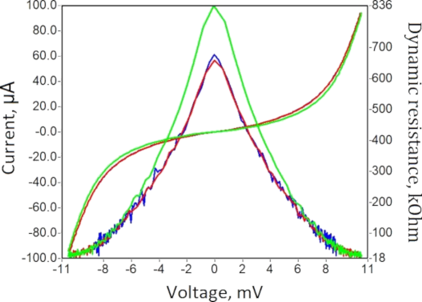
- in sorption 3He cryostat at 0.33 K, Figure 2b. The relatively low value of the resistance ratio (Rd/Rn – dynamic resistance/normal resistance) is associated with the high sensitivity of the interferometer to external noise. NIS thermometers The I–V characteristic and dynamic resistance of the NIS
- magnetron sputtering with separate lithography, and (f) single SINIS detector with suspended Hf absorber. Aharonov–Bohm structure. (а) SEM image of the sample made by Manhattan-type SINIS fabrication and (b) I–V curve and dynamic resistance of the Aharonov–Bohm interferometer at 330 mK. NIS thermometer
- , obtained from the general relation in Equation 3. (b) I–V curve and dynamic resistance for the SINIS thermometer. (c) Measured current with and without radiation. The resistance ratio is Rd/Rn = 15000 at 95 mK and does not respond to radiation at 5.5 K. Copper cooler cascade. Electron cooling from 392, 347


Numerical modeling of a multi-frequency receiving system based on an array of dipole antennas for LSPE-SWIPE
Beilstein J. Nanotechnol. 2022, 13, 865–872, doi:10.3762/bjnano.13.77
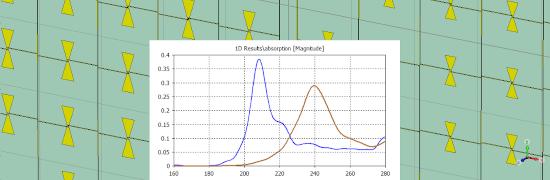
- matching of the CEB array with the SQUID readout system. The mismatching can happen if there is dynamic resistance of the CEB array at the working point with a parasitic resistance of connecting wires higher than 1 Ohm. Then the noise of the SQUID readout system is multiplied by the square root of the
- ratio of the obtained dynamic resistance of the CEB array and the connecting wires to the required value of 1 Ohm. The NEP estimations for different numbers of CEBs in a parallel array for 145, 210, and 240 GHz frequency channels accounting for possible mismatching with the SQUID readout system are


High dynamic resistance elements based on a Josephson junction array
Beilstein J. Nanotechnol. 2020, 11, 417–420, doi:10.3762/bjnano.11.32
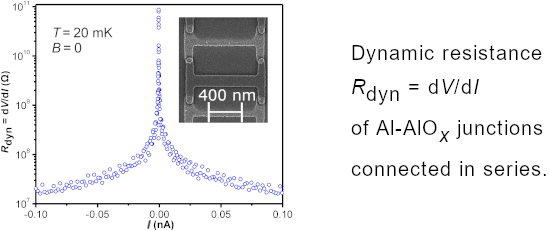
- field, the low current bias dynamic resistance can reach values of ≈1011 Ω. It was demonstrated that the system can provide a decent quality current biasing circuit, enabling the observation of Coulomb blockade and Bloch oscillations in ultra-narrow Ti nanowires associated with the quantum phase-slip
- effect. Keywords: dynamic resistance; Josephson junction array; nanoelectronics; quantum phase slip; superconductivity; Ti nanowires; Introduction The field of modern nanoelectronics is facing stagnation with respect to further miniaturization, deviating from Moore’s law [1]. Typically, two main reason
- observation of a pronounced Coulomb blockade has been observed in JJs using both a high-resistive dissipative environment [7][8] and nonlinear Josephson elements with high dynamic resistance and/or kinetic inductance [6][18]. However, extended attempts to observe Bloch oscillation phenomena at finite currents

Electrospun one-dimensional nanostructures: a new horizon for gas sensing materials
Beilstein J. Nanotechnol. 2018, 9, 2128–2170, doi:10.3762/bjnano.9.202







Nanostructure-directed chemical sensing: The IHSAB principle and the dynamics of acid/base-interface interaction
Beilstein J. Nanotechnol. 2013, 4, 20–31, doi:10.3762/bjnano.4.3
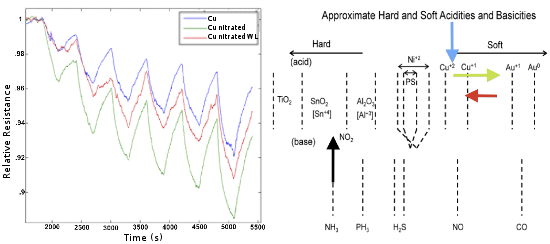
- sufficiently depleted such that it acts as a stronger acid than the NO radical [7]. Electrons are extracted from NO (acting as a base), and the dynamic resistance (increase in conductance) decreases as the semiconductor donor levels are repopulated. The oscillatory behavior, which is especially apparent at


Other Beilstein-Institut Open Science Activities



