


Search results
Search for "dynamic structural superlubricity" in Full Text gives 1 result(s) in Beilstein Journal of Nanotechnology.
Vibration-induced dynamic structural superlubricity on MoS2/Au(111) under ultrahigh vacuum
Beilstein J. Nanotechnol. 2026, 17, 1039–1046, doi:10.3762/bjnano.17.71
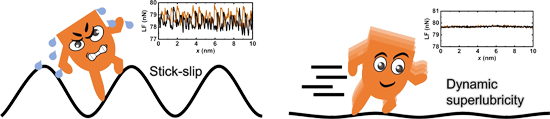
- Prague 6, Czech Republic 10.3762/bjnano.17.71 Abstract Achieving rapid and flexible control of friction across different material surfaces is of great significance and remains a longstanding challenging goal in modern tribology. Here, we demonstrate dynamic structural superlubricity in monolayer MoS2
- phononic friction model, reveal that torsional vibrations reduce energy barriers and promote transitions between atomic sites. This strategy provides a universal and reversible approach for active friction control at the nanoscale. Keywords: atomic force microscopy (AFM); dynamic structural superlubricity
- a dynamic structural superlubricity state. To systematically investigate the frequency dependence of the dynamic structural superlubricity, a frequency sweep from 0 to 625 kHz was performed with 256 sampling points (Figure 2a). The recorded tip vibration amplitude during frequency sweep and the mean


Other Beilstein-Institut Open Science Activities



