Abstract
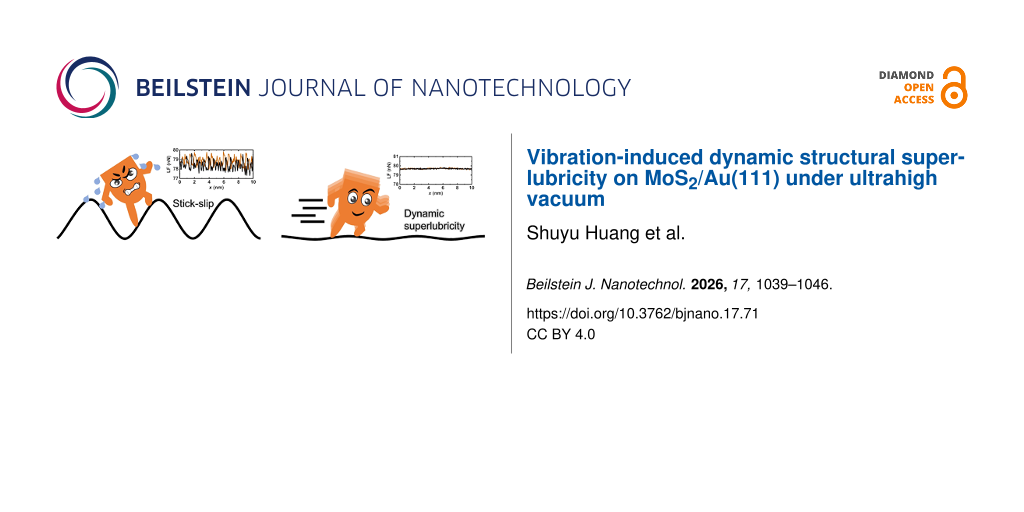
Achieving rapid and flexible control of friction across different material surfaces is of great significance and remains a longstanding challenging goal in modern tribology. Here, we demonstrate dynamic structural superlubricity in monolayer MoS2-coated gold surfaces induced by external mechanical actuation. By tuning the excitation frequency to the cantilever resonance, stick–slip motion is effectively suppressed, leading to a significant reduction in friction even under high-load conditions. Experimental results, supported by a modified phononic friction model, reveal that torsional vibrations reduce energy barriers and promote transitions between atomic sites. This strategy provides a universal and reversible approach for active friction control at the nanoscale.
Introduction
Friction at the nanoscale governs the performance, reliability, and lifetime of a wide range of emerging technologies, including micro- and nanoelectromechanical systems (MEMS/NEMS), data storage devices, and atomically precise manufacturing [1]. Unlike macroscopic friction, which is often described by empirical laws, nanoscale friction arises from non-linear stick–slip dynamics and is strongly influenced by energy dissipation pathways [2], thermal fluctuations [3], and external actuation [4]. A central challenge in nanotribology, therefore, is not only to understand the origin of frictional forces at atomic interfaces but also to actively regulate them in a controllable and reversible manner. Over the past decades, a variety of strategies have been developed to manipulate frictional forces, ranging from mechanical regulation [5-7] and electrical control [8,9] to structural engineering [10,11], and thermal control [12].
Thermal approaches primarily act by modifying the energy landscape experienced by the sliding interface. Increasing temperature assists atoms in overcoming potential energy barriers, and friction is expected to vanish at infinitely slow relative speeds due to thermal activation [3,7]. It works only within specific low-speed regimes, and elevated temperatures can lead to local material softening or accelerated degradation and oxidation of the sliding interface. By leveraging structural engineering, specifically through moiré superlattice modulation and in-plane straining, it is possible to achieve ultralow friction by suppressing moiré-level deformation and optimizing contact quality [11,13-16]. However, this method strongly depends on the intrinsic structural parameters, which are often difficult to change dynamically once the device is fabricated. Recently, electrical control has emerged as an important route for tuning nanoscale friction, particularly in low-dimensional materials [17,18]. For instance, the use of electric field or currents enable to change the electronic states or electrostatic interactions at the interface, offering high flexibility and fast response times. Despite these promising results, electrically driven friction control presents several inherent limitations. It is highly dependent on the interfacial electronic properties [8]. Furthermore, the degree of friction reduction is often positively correlated with interfacial conductivity, making these methods much less flexible or effective for insulating systems. Regulation through electric current inevitably generates Joule heating. This leads to a local temperature rise at the interface, which can intensify energy dissipation and accelerate material oxidation and wear [19].
Alongside these approaches, mechanical excitation offers a distinct advantage as a universal method for friction regulation [20-22]. Unlike electrical approaches, mechanical actuation does not require conductive contacts and can be applied to a wide range of materials, including insulating systems [4,23]. Moreover, it not only provides high flexibility for dynamically controlling frictional dissipation at the interface but also avoids unwanted chemical reactions induced by heating or electric fields. Indeed, dynamic mechanical control has already demonstrated considerable success in bulk and three-dimensional systems, where oscillatory inputs can stabilize smooth sliding and reduce friction through energy landscape modulation [24,25]. However, extending these concepts to atomically thin materials present new challenges due to their reduced dimensionality, enhanced flexibility, and strong coupling between in-plane and out-of-plane degrees of freedom.
In this work, we focus on mechanical excitation with an aim to achieve active and reversible friction control in a single-layer two-dimensional material. By exploiting dynamic modulation of the interfacial energy landscape, we demonstrate the ability to switch between distinct frictional states, including a superlubric regime. This approach avoids limitations imposed by material properties and provides a platform to study fundamental friction mechanisms in low-dimensional systems. Our findings contribute to bridging the gap between established mechanical control strategies in bulk materials and the emerging field of friction engineering in atomically thin interfaces, offering new insights into the design of tunable and energy-efficient nanoscale devices.
Results
The experimental setup for friction measurements is illustrated in Figure 1a. The experiments were performed at room temperature using a custom-built beam-deflection atomic force microscope (AFM) system under ultrahigh vacuum (UHV). A MoS2 flake on a Au(111) surface was scanned by an AFM tip under UHV conditions. Monolayer MoS2 flakes were synthesized following established protocols [15,26,27]. The mechanical actuation was implemented by applying a vertical sinusoidal excitation to the cantilever base through a piezoelectric actuator, introducing out-of-plane vibrations to the tip–sample contact. The friction force is calculated as half the difference between the forward and backward lateral force signals. In the absence of external actuation (Figure 1b), the friction force map exhibits a periodic stick–slip pattern, with a periodicity of approximately 0.315 nm, which corresponds to the lattice constant of MoS2. Although the lattice mismatch between MoS2 and Au(111) implies the existence of a moiré superstructure, such long-range features are not clearly resolved in the lateral force signals. This is attributed to the strong interfacial coupling, which suppresses moiré-induced corrugations and leaves the atomic-scale periodicity as the dominant contribution to friction [26].
![[2190-4286-17-71-1]](/bjnano/content/figures/2190-4286-17-71-1.png?scale=2.0&max-width=1024&background=FFFFFF)
Figure 1: (a) A schematic diagram showing the experimental setup for friction measurements under external actuation on MoS2/Au(111) under ultrahigh vacuum. (b) Friction force map without actuation and (c) with actuation at 554 kHz. Inset: friction loop extracted along the central line of the corresponding friction map.
Figure 1: (a) A schematic diagram showing the experimental setup for friction measurements under external act...
When actuation at an specific frequency of 554 kHz is applied, the stick–slip instability is effectively suppressed, as shown in Figure 1c. The mean friction force drops from 0.2 nN to near-zero level (0.006 nN). This transition is further evidenced by the individual friction loops shown in the insets. While the lateral force fluctuations are prominent in the unexcited state, they decrease to the noise level when the vibration is active. Quantitatively, the root-mean-square of the lateral force is reduced from 0.5 to 0.06 nN, confirming the successful suppression of atomic-scale stick–slip. These results indicate that the external vibration provides sufficient energy for the tip to overcome the local potential barriers. As a result, the tip slides in a nearly continuous manner rather than by stick–slip jumps, marking the onset of a dynamic structural superlubricity state.
To systematically investigate the frequency dependence of the dynamic structural superlubricity, a frequency sweep from 0 to 625 kHz was performed with 256 sampling points (Figure 2a). The recorded tip vibration amplitude during frequency sweep and the mean friction line profiles are displayed on the right panel of the map. The results suggest a clear correlation between significant friction drops and the specific frequencies where the tip vibration amplitude increases. This indicates that the friction reduction is driven by a resonance-like coupling between the tip–sample contact and the external actuation.
![[2190-4286-17-71-2]](/bjnano/content/figures/2190-4286-17-71-2.png?scale=2.0&max-width=1024&background=FFFFFF)
Figure 2: Effect of mechanical actuation on friction. (a) Friction force image measured as a function of actuation frequency in the range of 0 to 625 kHz. Scan parameters: 1024 × 1024 pixels, 0.2 nm excitation amplitude, and 2.6 nN normal load. (b–d) Forward (yellow) and backward (black) lateral force traces at actuation frequencies of 150, 339, and 554 kHz.
Figure 2: Effect of mechanical actuation on friction. (a) Friction force image measured as a function of actu...
To examine the atomic-scale friction in detail, individual friction loops were extracted from the frequency sweep at three representative frequencies (Figure 2b–d), also marked by circles in Figure 2a. At 150 kHz (Figure 2b), which is far from any resonance peak, the lateral force trace exhibits a distinct stick–slip pattern with significant hysteresis. In contrast, at 339 and 554 kHz (Figure 2c,d), where the vibration amplitude is high, the stick–slip instability is effectively suppressed. At these frequencies, the forward and backward lateral force traces almost overlap, and the friction is reduced to the noise floor. This frequency-selective behavior suggests that the suppression of stick–slip is a resonance-driven process, involving the mechanical eigenmodes of the sliding contact.
To clarify the physical origin of the observed friction reduction, the frequency-dependent friction was compared with the thermal noise spectra of the cantilever. Figure 3a shows the mean friction force (black) alongside the flexural (gray) and torsional (brown) thermal noise power spectral densities. For comparison, the thermal noise spectra of the free cantilever are provided in Figure S1 of Supporting Information File 1.
![[2190-4286-17-71-3]](/bjnano/content/figures/2190-4286-17-71-3.png?scale=2.0&max-width=1024&background=FFFFFF)
Figure 3: (a) Friction measured as a function of actuation frequency for a normal load of 2.6 nN. Right axis: corresponding thermal noise spectra of the vertical (gray) and torsional (brown) oscillations of the cantilever sliding on the MoS2/Au(111) surface at a frequency of 554 kHz. (b) Normal load dependence of friction at different actuation frequencies. (c) Mean friction (left axis) and tip amplitude (right axis) as functions of the applied normal load for actuation frequencies of 0 kHz and (d) 554 kHz.
Figure 3: (a) Friction measured as a function of actuation frequency for a normal load of 2.6 nN. Right axis:...
Through modal identification, the friction minima at 339 and 554 kHz are assigned to the second- and third-order flexural contact resonance frequencies (fc2 and fc3, respectively), while the peak at 414 kHz corresponds to the first-order torsional contact resonance (ft1). Due to experimental constraints, the first-order flexural resonance was not detected because of a high-pass filter used for signals below 100 kHz. Notably, a distinct feature observed near 375 kHz remains not fully understood. We propose that this peak may arise from potential couplings related to the moiré superstructure; however, its origin remains to be further investigated.
The stability of this superlubric state was investigated over a wide range of normal loads. Figure 3b compares the load dependence of friction at 0 and 554 kHz. In the absence of external vibration (0 kHz), the friction force increases linearly with the applied normal load, following the characteristic Amontons–Coulomb behavior for atomic-scale contacts. In contrast, at 554 kHz, the friction remains suppressed near the noise floor throughout the investigated load range, confirming that the dynamic structural superlubric state remains stable even under high normal loads. In addition, the scanned area was characterized both before and after the friction measurements. No noticeable changes in the MoS2 surface were observed in the lateral force images after the experiments, indicating that the monolayer MoS2 maintained its structural integrity throughout the measurements. These observations demonstrate the excellent durability of the MoS2 flakes under the experimental conditions.
To further understand the relationship between friction and tip vibration, the load was analyzed together with the vibration amplitude. At 0 kHz, the friction rises steadily with the load, while the vibration amplitude remains at the noise level, as shown on right axis of Figure 3c. The minor increase in amplitude at high loads is attributed to the increased vertical deflection of the cantilever. At 554 kHz, however, the mean friction remains near-zero regardless of the load. The corresponding tip vibration amplitude remains consistently high (right axis of Figure 3d), confirming that sustained mechanical excitation effectively assists the tip in overcoming interfacial potential barriers. This prevented the tip from being trapped in potential wells even under high normal loads, maintaining the superlubric state.
Discussion
Numerical simulations based on a modified one-dimensional phononic friction (PF) model were performed to elucidate the dynamic structural superlubricity observed on the MoS2/Au(111) surface, as shown in Figure 4a [28-30]. In the model, the top potential V1 with a MoS2 lattice constant of a1 and an amplitude of u1 describes the tip–MoS2 interaction. This is superimposed by a bottom potential V2 representing the MoS2–Au(111) interaction, characterized by a substrate periodicity of a2 and an amplitude of u2. The stiffness kt denotes the lateral spring constant of the cantilever, and k2 represents the local interfacial stiffness between the MoS2 and the gold substrate. As the cantilever support moves at a constant velocity of vs, the tip and the MoS2 flake are displaced by x1 and x2, respectively, representing the tip displacement and the in-plane deformation of the top layer. m1 and m2 are the effective masses of the tip and the moiré, respectively.
![[2190-4286-17-71-4]](/bjnano/content/figures/2190-4286-17-71-4.png?scale=2.0&max-width=1024&background=FFFFFF)
Figure 4: (a) A schematic diagram showing a one-dimensional PF model with a tip sliding on a composite structure comprising two periodic layers of MoS2 and Au(111). The top MoS2 layer exhibits perturbed energy corrugation stemming from out-of-plane external actuation. (b) A comparison of stick–slip friction with and without vibration. Mean friction as a function of (c) actuation frequency and (d) amplitude of perturbation.
Figure 4: (a) A schematic diagram showing a one-dimensional PF model with a tip sliding on a composite struct...
To account for the mechanical actuation, the potential energy landscape of the MoS2 layer undergoes a time-dependent perturbation with a amplitude of α and an actuation frequency of fa [31,32]. Therefore, the potential energy combined with vibration ![[Graphic 1]](/bjnano/content/inline/2190-4286-17-71-i4.svg?max-width=637&scale=1.18182) is:
is:
![[2190-4286-17-71-i1]](/bjnano/content/inline/2190-4286-17-71-i1.svg?max-width=590&scale=1.18182)
Thus, the total potential V of the dynamic friction system, including the tip–MoS2 and MoS2–Au(111) interactions (V1 and V2), the spring potential energy of the cantilever, and the moiré, is given by:
![[2190-4286-17-71-i2]](/bjnano/content/inline/2190-4286-17-71-i2.svg?max-width=590&scale=1.18182)
The dynamics of the system can be described by the Langevin equation of motion (see Section S2 in Supporting Information File 1 for more details),
![[2190-4286-17-71-i3]](/bjnano/content/inline/2190-4286-17-71-i3.svg?max-width=590&scale=1.18182)
The friction force is given by Ff = k1(vst − x1), and the resulting system of equations is integrated numerically using the fourth-order Runge–Kutta method. The simulation results for the instantaneous friction with and without excitation are compared in Figure 4b. To ensure consistency with the experimental findings, the potential amplitudes were set to u1 = 30 eV and u2 = 0.06 eV. The relatively small value of u2 reflects the minimal contribution of the moiré superstructure to the overall friction, resulting in the moiré-scale modulation not being clearly resolved in the calculated friction traces. Without excitation (0 kHz), the system exhibits a periodic stick–slip pattern with a periodicity of 0.315 nm, corresponding to the atomic lattice of MoS2. Upon applying a 468 kHz excitation, the friction force drops from an initial 66.63 nN to near-zero levels. In this state, the instantaneous friction force signal represents a superposition of the washboard frequency [28,29,33] and the external actuation frequency, as resolved by fast Fourier transform analysis (see Section S4 and Figure S3 in Supporting Information File 1). The dependence of the mean friction on the actuation frequency was further quantified through a frequency sweep (Figure 4c). The calculated friction exhibits several distinct drops. The first drop corresponds to the sixth harmonic of the washboard frequency [34], while the second and third drops align with the first-order (468 kHz) and third-order torsional contact resonances of the system, respectively (see Section S4 in Supporting Information File 1 for the determination of torsional contact resonance frequency in the PF model). As this is a one-dimensional model, the calculation specifically captures the torsional dynamics of the tip–sample contact, while vertical resonances are not included. These findings confirm that mechanical actuation at contact resonance modes effectively triggers a transition to a dynamic structural superlubric state, in good agreement with the experimental observations in Figure 2 and Figure 3. Furthermore, increasing the perturbation amplitude α leads to a rapid decay in the mean friction, which approaches zero and eventually saturates, as shown in Figure 4d. A larger vibration amplitude is equivalent to a lowering in the effective normal load or barrier height. The external energy provided by the vibration promotes tip escape from the atomic potential wells, effectively suppressing the stick–slip instability and leading to the robust friction reduction as observed experimentally.
Conclusion
In summary, we have demonstrated active and reversible friction control at the MoS2/Au(111) interface using external mechanical actuation under ultrahigh vacuum. Our experimental results reveal that the transition from stick–slip to dynamic structural superlubricity is dictated by the precise coupling between the excitation frequency and the cantilever’s mechanical modes. Remarkably, this resonance-induced superlubric state exhibits stability across a wide range of normal loads, effectively overcoming the traditional load-dependent increase in friction typically observed at the atomic scale. By using mechanical vibration rather than electrical or thermal methods, this approach avoids the inherent limitations of Joule heating, material degradation, or the requirement for interfacial conductivity discussed earlier.
Numerical simulations using a modified phononic friction model consistently support our findings, confirming that the modulation of the interfacial potential at torsional contact resonance frequency assists the tip in overcoming the corrugation, thereby suppressing stick–slip instabilities. Although the dominant resonance modes are clearly assigned, the specific friction drop at 375 kHz warrants further clarification. Investigating the coupling between high-order vibrations and the moiré superstructure may resolve this unexplained feature. This work bridges the gap between macroscopic mechanical control and 2D interface engineering, offering a practical pathway for enhancing the performance and operational lifetime of next-generation NEMS and atomically precise technologies.
Supporting Information
The Supporting Information includes the thermal noise spectra of the free cantilever, a detailed list of phononic friction model simulation parameters, and the methodology for determining torsional contact resonance frequency.
| Supporting Information File 1: Experimental and calculation details. | ||
| Format: PDF | Size: 4.2 MB | Download |
Funding
The authors gratefully acknowledge financial support from the Swiss National Science Foundation (SNSF) under grants Nanocontrol 200021L_219983, Sinergia CRSII5_213533, and project 10.001.697, as well as from the Werner Siemens Foundation (WSS) and the Swiss Nanoscience Institute (SNI). Y.S. acknowledges support from the Swiss National Science Foundation (SNSF) under grant CRSK-2_228934. A.C. acknowledges financial support from the Czech Science Foundation (project 24-12643L) and co-funding by the European Union under the project "Robotics and Advanced Industrial Production" (reg. no. CZ.02.01.01/00/22_008/0004590).
Data Availability Statement
Data generated and analyzed during this study is openly available in Zenodo at https://doi.org/10.5281/zenodo.19552234.
References
-
Hod, O.; Meyer, E.; Zheng, Q.; Urbakh, M. Nature 2018, 563, 485–492. doi:10.1038/s41586-018-0704-z
Return to citation in text: [1] -
Socoliuc, A.; Bennewitz, R.; Gnecco, E.; Meyer, E. Phys. Rev. Lett. 2004, 92, 134301. doi:10.1103/physrevlett.92.134301
Return to citation in text: [1] -
Krylov, S. Y.; Jinesh, K. B.; Valk, H.; Dienwiebel, M.; Frenken, J. W. M. Phys. Rev. E 2005, 71, 065101. doi:10.1103/physreve.71.065101
Return to citation in text: [1] [2] -
Socoliuc, A.; Gnecco, E.; Maier, S.; Pfeiffer, O.; Baratoff, A.; Bennewitz, R.; Meyer, E. Science 2006, 313, 207–210. doi:10.1126/science.1125874
Return to citation in text: [1] [2] -
Roth, R.; Fajardo, O. Y.; Mazo, J. J.; Meyer, E.; Gnecco, E. Appl. Phys. Lett. 2014, 104, 083103. doi:10.1063/1.4866427
Return to citation in text: [1] -
Gnecco, E.; Socoliuc, A.; Maier, S.; Gessler, J.; Glatzel, T.; Baratoff, A.; Meyer, E. Nanotechnology 2009, 20, 025501. doi:10.1088/0957-4484/20/2/025501
Return to citation in text: [1] -
Gnecco, E.; Maier, S.; Meyer, E. J. Phys.: Condens. Matter 2008, 20, 354004. doi:10.1088/0953-8984/20/35/354004
Return to citation in text: [1] [2] -
Park, J. Y.; Ogletree, D. F.; Thiel, P. A.; Salmeron, M. Science 2006, 313, 186. doi:10.1126/science.1125017
Return to citation in text: [1] [2] -
Song, A.; Zhao, J.-X.; Tang, X.; Wu, H.-J.; Xu, Z.; Cao, J.; Liu, X.; Wang, H.; Li, Q.; Hu, Y.-Z.; Li, X.; Luo, J.; Ma, T.-B. Nat. Commun. 2025, 16, 4704. doi:10.1038/s41467-025-59989-4
Return to citation in text: [1] -
Zheng, X.; Gao, L.; Yao, Q.; Li, Q.; Zhang, M.; Xie, X.; Qiao, S.; Wang, G.; Ma, T.; Di, Z.; Luo, J.; Wang, X. Nat. Commun. 2016, 7, 13204. doi:10.1038/ncomms13204
Return to citation in text: [1] -
Song, Y.; Gao, X.; Hinaut, A.; Scherb, S.; Huang, S.; Glatzel, T.; Hod, O.; Urbakh, M.; Meyer, E. Nano Lett. 2022, 22, 9529–9536. doi:10.1021/acs.nanolett.2c03667
Return to citation in text: [1] [2] -
Jinesh, K. B.; Krylov, S. Y.; Valk, H.; Dienwiebel, M.; Frenken, J. W. M. Phys. Rev. B 2008, 78, 155440. doi:10.1103/physrevb.78.155440
Return to citation in text: [1] -
Zhang, S.; Hou, Y.; Li, S.; Liu, L.; Zhang, Z.; Feng, X.-Q.; Li, Q. Proc. Natl. Acad. Sci. U. S. A. 2019, 116, 24452–24456. doi:10.1073/pnas.1907947116
Return to citation in text: [1] -
Song, Y.; Mandelli, D.; Hod, O.; Urbakh, M.; Ma, M.; Zheng, Q. Nat. Mater. 2018, 17, 894–899. doi:10.1038/s41563-018-0144-z
Return to citation in text: [1] -
Song, Y.; Hinaut, A.; Scherb, S.; Pellmont, Y.; Pawlak, R.; Huang, S.; Liu, Z.; Glatzel, T.; Meyer, E. Appl. Surf. Sci. 2022, 601, 154230. doi:10.1016/j.apsusc.2022.154230
Return to citation in text: [1] [2] -
Zhang, S.; Yao, Q.; Chen, L.; Jiang, C.; Ma, T.; Wang, H.; Feng, X.-Q.; Li, Q. Phys. Rev. Lett. 2022, 128, 226101. doi:10.1103/physrevlett.128.226101
Return to citation in text: [1] -
Song, A.; Shi, R.; Lu, H.; Wang, X.; Hu, Y.; Gao, H.-J.; Luo, J.; Ma, T. Nano Lett. 2022, 22, 1889–1896. doi:10.1021/acs.nanolett.1c04116
Return to citation in text: [1] -
Greenwood, G.; Kim, J. M.; Nahid, S. M.; Lee, Y.; Hajarian, A.; Nam, S.; Espinosa-Marzal, R. M. Nat. Commun. 2023, 14, 5801. doi:10.1038/s41467-023-41375-7
Return to citation in text: [1] -
Xu, Y.; Li, S.; Cui, L.; Sun, W.; Wang, D. Nano Res. 2026, 19, 94908406. doi:10.26599/nr.2026.94908406
Return to citation in text: [1] -
Guerra, R.; Vanossi, A.; Urbakh, M. Phys. Rev. E 2008, 78, 036110. doi:10.1103/physreve.78.036110
Return to citation in text: [1] -
Tshiprut, Z.; Filippov, A. E.; Urbakh, M. Phys. Rev. Lett. 2005, 95, 016101. doi:10.1103/physrevlett.95.016101
Return to citation in text: [1] -
Zaloj, V.; Urbakh, M.; Klafter, J. Phys. Rev. Lett. 1999, 82, 4823–4826. doi:10.1103/physrevlett.82.4823
Return to citation in text: [1] -
Vanossi, A.; Dietzel, D.; Schirmeisen, A.; Meyer, E.; Pawlak, R.; Glatzel, T.; Kisiel, M.; Kawai, S.; Manini, N. Beilstein J. Nanotechnol. 2018, 9, 1995–2014. doi:10.3762/bjnano.9.190
Return to citation in text: [1] -
Fajardo, O. Y.; Gnecco, E.; Mazo, J. J. Phys. Rev. B 2014, 89, 075423. doi:10.1103/physrevb.89.075423
Return to citation in text: [1] -
Meyer, E.; Gnecco, E. Friction 2014, 2, 106–113. doi:10.1007/s40544-014-0052-4
Return to citation in text: [1] -
Song, Y.; Wang, J.; Hinaut, A.; Scherb, S.; Huang, S.; Glatzel, T.; Tosatti, E.; Meyer, E. Phys. Rev. Lett. 2024, 133, 136201. doi:10.1103/physrevlett.133.136201
Return to citation in text: [1] [2] -
Yao, Y.; Song, Y.; Wu, B.; Scherb, S.; Huang, S.; Hinaut, A.; Glatzel, T.; Meyer, E.; Liu, Z.; Ouyang, W. Adv. Sci. 2025, 12, 2415884. doi:10.1002/advs.202415884
Return to citation in text: [1] -
Huang, S.; Wei, Z.; Duan, Z.; Sun, C.; Wang, Y.; Tao, Y.; Zhang, Y.; Kan, Y.; Meyer, E.; Li, D.; Chen, Y. Phys. Rev. Lett. 2024, 132, 056203. doi:10.1103/physrevlett.132.056203
Return to citation in text: [1] [2] -
Duan, Z.; Wei, Z.; Huang, S.; Wang, Y.; Sun, C.; Tao, Y.; Dong, Y.; Yang, J.; Zhang, Y.; Kan, Y.; Li, D.; Chen, Y. Nano Lett. 2021, 21, 4615–4621. doi:10.1021/acs.nanolett.1c00622
Return to citation in text: [1] [2] -
Huang, S.; Song, Y.; Hinaut, A.; Navarro-Marín, G.; Chen, Y.; Meyer, E.; Glatzel, T. ACS Nano 2025, 19, 17365–17373. doi:10.1021/acsnano.4c16817
Return to citation in text: [1] -
Steiner, P.; Roth, R.; Gnecco, E.; Baratoff, A.; Maier, S.; Glatzel, T.; Meyer, E. Phys. Rev. B 2009, 79, 045414. doi:10.1103/physrevb.79.045414
Return to citation in text: [1] -
Cao, J.; Li, Q. Friction 2022, 10, 1650–1659. doi:10.1007/s40544-021-0552-y
Return to citation in text: [1] -
Sun, C.; Huang, S.; Tao, Y.; Duan, Z.; Han, Q.; Chen, K.; Kan, Y.; Ni, Z.; Wei, Z.; Zhang, Y.; Chen, Y. Friction 2025, 13, 9441043. doi:10.26599/frict.2025.9441043
Return to citation in text: [1] -
Wang, Z.; Duan, Z.; Dong, Y.; Zhang, Y. Mater. Res. Express 2020, 7, 015089. doi:10.1088/2053-1591/ab6d32
Return to citation in text: [1]
| 28. | Huang, S.; Wei, Z.; Duan, Z.; Sun, C.; Wang, Y.; Tao, Y.; Zhang, Y.; Kan, Y.; Meyer, E.; Li, D.; Chen, Y. Phys. Rev. Lett. 2024, 132, 056203. doi:10.1103/physrevlett.132.056203 |
| 29. | Duan, Z.; Wei, Z.; Huang, S.; Wang, Y.; Sun, C.; Tao, Y.; Dong, Y.; Yang, J.; Zhang, Y.; Kan, Y.; Li, D.; Chen, Y. Nano Lett. 2021, 21, 4615–4621. doi:10.1021/acs.nanolett.1c00622 |
| 30. | Huang, S.; Song, Y.; Hinaut, A.; Navarro-Marín, G.; Chen, Y.; Meyer, E.; Glatzel, T. ACS Nano 2025, 19, 17365–17373. doi:10.1021/acsnano.4c16817 |
| 15. | Song, Y.; Hinaut, A.; Scherb, S.; Pellmont, Y.; Pawlak, R.; Huang, S.; Liu, Z.; Glatzel, T.; Meyer, E. Appl. Surf. Sci. 2022, 601, 154230. doi:10.1016/j.apsusc.2022.154230 |
| 26. | Song, Y.; Wang, J.; Hinaut, A.; Scherb, S.; Huang, S.; Glatzel, T.; Tosatti, E.; Meyer, E. Phys. Rev. Lett. 2024, 133, 136201. doi:10.1103/physrevlett.133.136201 |
| 27. | Yao, Y.; Song, Y.; Wu, B.; Scherb, S.; Huang, S.; Hinaut, A.; Glatzel, T.; Meyer, E.; Liu, Z.; Ouyang, W. Adv. Sci. 2025, 12, 2415884. doi:10.1002/advs.202415884 |
| 26. | Song, Y.; Wang, J.; Hinaut, A.; Scherb, S.; Huang, S.; Glatzel, T.; Tosatti, E.; Meyer, E. Phys. Rev. Lett. 2024, 133, 136201. doi:10.1103/physrevlett.133.136201 |
| 1. | Hod, O.; Meyer, E.; Zheng, Q.; Urbakh, M. Nature 2018, 563, 485–492. doi:10.1038/s41586-018-0704-z |
| 5. | Roth, R.; Fajardo, O. Y.; Mazo, J. J.; Meyer, E.; Gnecco, E. Appl. Phys. Lett. 2014, 104, 083103. doi:10.1063/1.4866427 |
| 6. | Gnecco, E.; Socoliuc, A.; Maier, S.; Gessler, J.; Glatzel, T.; Baratoff, A.; Meyer, E. Nanotechnology 2009, 20, 025501. doi:10.1088/0957-4484/20/2/025501 |
| 7. | Gnecco, E.; Maier, S.; Meyer, E. J. Phys.: Condens. Matter 2008, 20, 354004. doi:10.1088/0953-8984/20/35/354004 |
| 4. | Socoliuc, A.; Gnecco, E.; Maier, S.; Pfeiffer, O.; Baratoff, A.; Bennewitz, R.; Meyer, E. Science 2006, 313, 207–210. doi:10.1126/science.1125874 |
| 23. | Vanossi, A.; Dietzel, D.; Schirmeisen, A.; Meyer, E.; Pawlak, R.; Glatzel, T.; Kisiel, M.; Kawai, S.; Manini, N. Beilstein J. Nanotechnol. 2018, 9, 1995–2014. doi:10.3762/bjnano.9.190 |
| 4. | Socoliuc, A.; Gnecco, E.; Maier, S.; Pfeiffer, O.; Baratoff, A.; Bennewitz, R.; Meyer, E. Science 2006, 313, 207–210. doi:10.1126/science.1125874 |
| 24. | Fajardo, O. Y.; Gnecco, E.; Mazo, J. J. Phys. Rev. B 2014, 89, 075423. doi:10.1103/physrevb.89.075423 |
| 25. | Meyer, E.; Gnecco, E. Friction 2014, 2, 106–113. doi:10.1007/s40544-014-0052-4 |
| 3. | Krylov, S. Y.; Jinesh, K. B.; Valk, H.; Dienwiebel, M.; Frenken, J. W. M. Phys. Rev. E 2005, 71, 065101. doi:10.1103/physreve.71.065101 |
| 19. | Xu, Y.; Li, S.; Cui, L.; Sun, W.; Wang, D. Nano Res. 2026, 19, 94908406. doi:10.26599/nr.2026.94908406 |
| 2. | Socoliuc, A.; Bennewitz, R.; Gnecco, E.; Meyer, E. Phys. Rev. Lett. 2004, 92, 134301. doi:10.1103/physrevlett.92.134301 |
| 20. | Guerra, R.; Vanossi, A.; Urbakh, M. Phys. Rev. E 2008, 78, 036110. doi:10.1103/physreve.78.036110 |
| 21. | Tshiprut, Z.; Filippov, A. E.; Urbakh, M. Phys. Rev. Lett. 2005, 95, 016101. doi:10.1103/physrevlett.95.016101 |
| 22. | Zaloj, V.; Urbakh, M.; Klafter, J. Phys. Rev. Lett. 1999, 82, 4823–4826. doi:10.1103/physrevlett.82.4823 |
| 3. | Krylov, S. Y.; Jinesh, K. B.; Valk, H.; Dienwiebel, M.; Frenken, J. W. M. Phys. Rev. E 2005, 71, 065101. doi:10.1103/physreve.71.065101 |
| 7. | Gnecco, E.; Maier, S.; Meyer, E. J. Phys.: Condens. Matter 2008, 20, 354004. doi:10.1088/0953-8984/20/35/354004 |
| 17. | Song, A.; Shi, R.; Lu, H.; Wang, X.; Hu, Y.; Gao, H.-J.; Luo, J.; Ma, T. Nano Lett. 2022, 22, 1889–1896. doi:10.1021/acs.nanolett.1c04116 |
| 18. | Greenwood, G.; Kim, J. M.; Nahid, S. M.; Lee, Y.; Hajarian, A.; Nam, S.; Espinosa-Marzal, R. M. Nat. Commun. 2023, 14, 5801. doi:10.1038/s41467-023-41375-7 |
| 34. | Wang, Z.; Duan, Z.; Dong, Y.; Zhang, Y. Mater. Res. Express 2020, 7, 015089. doi:10.1088/2053-1591/ab6d32 |
| 12. | Jinesh, K. B.; Krylov, S. Y.; Valk, H.; Dienwiebel, M.; Frenken, J. W. M. Phys. Rev. B 2008, 78, 155440. doi:10.1103/physrevb.78.155440 |
| 8. | Park, J. Y.; Ogletree, D. F.; Thiel, P. A.; Salmeron, M. Science 2006, 313, 186. doi:10.1126/science.1125017 |
| 10. | Zheng, X.; Gao, L.; Yao, Q.; Li, Q.; Zhang, M.; Xie, X.; Qiao, S.; Wang, G.; Ma, T.; Di, Z.; Luo, J.; Wang, X. Nat. Commun. 2016, 7, 13204. doi:10.1038/ncomms13204 |
| 11. | Song, Y.; Gao, X.; Hinaut, A.; Scherb, S.; Huang, S.; Glatzel, T.; Hod, O.; Urbakh, M.; Meyer, E. Nano Lett. 2022, 22, 9529–9536. doi:10.1021/acs.nanolett.2c03667 |
| 31. | Steiner, P.; Roth, R.; Gnecco, E.; Baratoff, A.; Maier, S.; Glatzel, T.; Meyer, E. Phys. Rev. B 2009, 79, 045414. doi:10.1103/physrevb.79.045414 |
| 32. | Cao, J.; Li, Q. Friction 2022, 10, 1650–1659. doi:10.1007/s40544-021-0552-y |
| 8. | Park, J. Y.; Ogletree, D. F.; Thiel, P. A.; Salmeron, M. Science 2006, 313, 186. doi:10.1126/science.1125017 |
| 9. | Song, A.; Zhao, J.-X.; Tang, X.; Wu, H.-J.; Xu, Z.; Cao, J.; Liu, X.; Wang, H.; Li, Q.; Hu, Y.-Z.; Li, X.; Luo, J.; Ma, T.-B. Nat. Commun. 2025, 16, 4704. doi:10.1038/s41467-025-59989-4 |
| 11. | Song, Y.; Gao, X.; Hinaut, A.; Scherb, S.; Huang, S.; Glatzel, T.; Hod, O.; Urbakh, M.; Meyer, E. Nano Lett. 2022, 22, 9529–9536. doi:10.1021/acs.nanolett.2c03667 |
| 13. | Zhang, S.; Hou, Y.; Li, S.; Liu, L.; Zhang, Z.; Feng, X.-Q.; Li, Q. Proc. Natl. Acad. Sci. U. S. A. 2019, 116, 24452–24456. doi:10.1073/pnas.1907947116 |
| 14. | Song, Y.; Mandelli, D.; Hod, O.; Urbakh, M.; Ma, M.; Zheng, Q. Nat. Mater. 2018, 17, 894–899. doi:10.1038/s41563-018-0144-z |
| 15. | Song, Y.; Hinaut, A.; Scherb, S.; Pellmont, Y.; Pawlak, R.; Huang, S.; Liu, Z.; Glatzel, T.; Meyer, E. Appl. Surf. Sci. 2022, 601, 154230. doi:10.1016/j.apsusc.2022.154230 |
| 16. | Zhang, S.; Yao, Q.; Chen, L.; Jiang, C.; Ma, T.; Wang, H.; Feng, X.-Q.; Li, Q. Phys. Rev. Lett. 2022, 128, 226101. doi:10.1103/physrevlett.128.226101 |
| 28. | Huang, S.; Wei, Z.; Duan, Z.; Sun, C.; Wang, Y.; Tao, Y.; Zhang, Y.; Kan, Y.; Meyer, E.; Li, D.; Chen, Y. Phys. Rev. Lett. 2024, 132, 056203. doi:10.1103/physrevlett.132.056203 |
| 29. | Duan, Z.; Wei, Z.; Huang, S.; Wang, Y.; Sun, C.; Tao, Y.; Dong, Y.; Yang, J.; Zhang, Y.; Kan, Y.; Li, D.; Chen, Y. Nano Lett. 2021, 21, 4615–4621. doi:10.1021/acs.nanolett.1c00622 |
| 33. | Sun, C.; Huang, S.; Tao, Y.; Duan, Z.; Han, Q.; Chen, K.; Kan, Y.; Ni, Z.; Wei, Z.; Zhang, Y.; Chen, Y. Friction 2025, 13, 9441043. doi:10.26599/frict.2025.9441043 |
© 2026 Huang et al.; licensee Beilstein-Institut.
This is an open access article licensed under the terms of the Beilstein-Institut Open Access License Agreement (https://www.beilstein-journals.org/bjnano/terms), which is identical to the Creative Commons Attribution 4.0 International License (https://creativecommons.org/licenses/by/4.0). The reuse of material under this license requires that the author(s), source and license are credited. Third-party material in this article could be subject to other licenses (typically indicated in the credit line), and in this case, users are required to obtain permission from the license holder to reuse the material.