


Search results
Search for "in situ testing" in Full Text gives 3 result(s) in Beilstein Journal of Nanotechnology.
Electrochemical determination of ciprofloxacin using a MIL-101/reduced graphene oxide-modified electrode
Beilstein J. Nanotechnol. 2026, 17, 541–554, doi:10.3762/bjnano.17.35
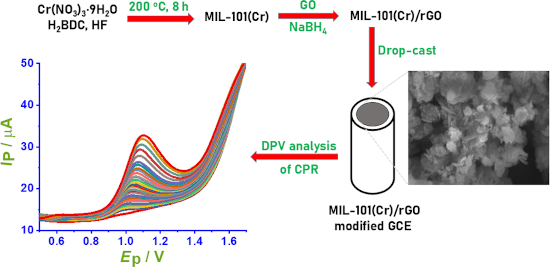
- , complex sample preparation, skilled operators, and lengthy analysis times, which restrict their use for quick or in situ testing. In contrast, electrochemical sensors have become appealing alternatives because of their inherent benefits such as simplicity, low cost, rapid response, high sensitivity, and


Towards 3D crystal orientation reconstruction using automated crystal orientation mapping transmission electron microscopy (ACOM-TEM)
Beilstein J. Nanotechnol. 2018, 9, 602–607, doi:10.3762/bjnano.9.56
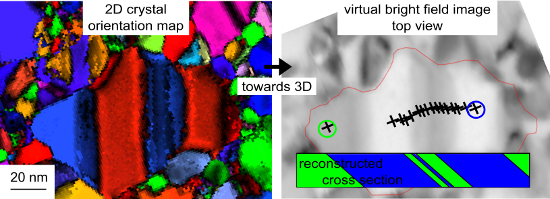
- ), Hermann-von-Helmholtz-Platz 1, 76344 Eggenstein-Leopoldshafen, Germany 10.3762/bjnano.9.56 Abstract To relate the internal structure of a volume (crystallite and phase boundaries) to properties (electrical, magnetic, mechanical, thermal), a full 3D reconstruction in combination with in situ testing is
- desirable. In situ testing allows the crystallographic changes in a material to be followed by tracking and comparing the individual crystals and phases. Standard transmission electron microscopy (TEM) delivers a projection image through the 3D volume of an electron-transparent TEM sample lamella. Only with
- times. The combination of in situ testing with 3D crystal orientation mapping remains a challenge in terms of stability and accuracy. Here, we outline a method to 3D reconstruct the crystal orientation from a superimposed diffraction pattern of overlapping crystals without sample tilt. Avoiding the

Review: Electrostatically actuated nanobeam-based nanoelectromechanical switches – materials solutions and operational conditions
Beilstein J. Nanotechnol. 2018, 9, 271–300, doi:10.3762/bjnano.9.29
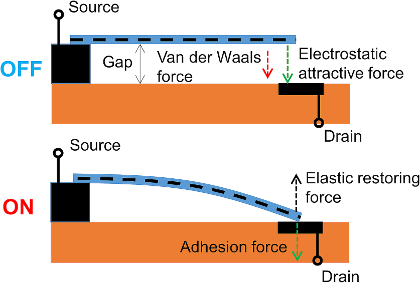
- substrates using a SiO2 layer as a sacrificial material to release free-standing elements [20][21][22][50][132][133]. 3T Si-based NEM switches can operate at jump-in voltages as low as 0.8 V [20]. Both Si and Ge nanowires are used in bottom-up fabricated NEM switches and in in situ testing of devices


Other Beilstein-Institut Open Science Activities



