


Search results
Search for "interferometer signal" in Full Text gives 5 result(s) in Beilstein Journal of Nanotechnology.
Calibration of piezo actuators and systems by dynamic interferometry
Beilstein J. Nanotechnol. 2025, 16, 2086–2091, doi:10.3762/bjnano.16.143
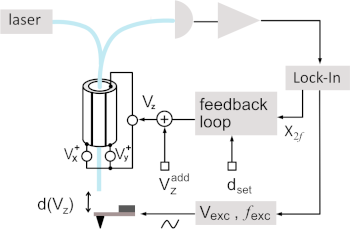
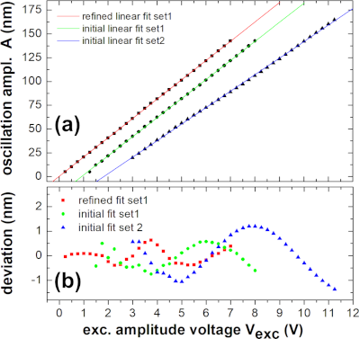
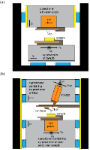
- what extent the cantilever amplitude calibration [13] is affected by the actual extension or extension history of the tube piezo. Experimental Experiments are performed with a NC-AFM interferometric setup, and the methods of interferometer signal analysis are as described in [13]. The schematic setup
- stabilized so that the working point is the inflection point and center of symmetry of the time-dependent interferometer signal [16], implying that the mean cavity length is d0 = , where m is an odd integer and λ is the vacuum wavelength of the light used for interferometer operation in a UHV environment. As
- -step fit method based on Equation 1 as detailed in [13]. Here, VDC represents the DC part of the interferometer signal voltage, V0 is the voltage amplitude of the modulated signal, and φ is the phase shift introduced by the electronics in the signal path, which may be determined from the fit


Advanced atomic force microscopy techniques V
Beilstein J. Nanotechnol. 2025, 16, 54–56, doi:10.3762/bjnano.16.6

- oscillation amplitude yields a signal with a complex temporal structure. This is due to the interferometer signal being limited in amplitude by the spatial periodicity of the cavity light field. By the fit of a model function to the measured time-domain interferometer signal, all displacement signal
Signal generation in dynamic interferometric displacement detection
Beilstein J. Nanotechnol. 2024, 15, 1070–1076, doi:10.3762/bjnano.15.87
- to the harmonic displacement of the cantilever in the time domain. As the interferometer signal is limited in amplitude because of the spatial periodicity of the interferometer light field, an increasing cantilever oscillation amplitude creates an output signal with an increasingly complex temporal
- . Keywords: amplitude calibration; displacement detection; force microscopy; interferometer signal; NC-AFM; Introduction Optical interferometry is a reliable technique utilizing light waves to measure distance and displacement with high precision [1][2]. With the light wavelength as the length standard, a
- variation in d results in a variation of the intensity IM recorded by a detector placed at a fixed distance to the fiber end [11]. In our setup, there is a strong imbalance of reflectivity coefficients between fiber (rf) and cantilever (rc), yielding an interferometer signal with a large average and a


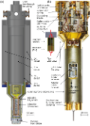
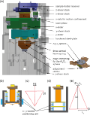
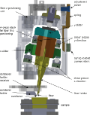
A cantilever-based, ultrahigh-vacuum, low-temperature scanning probe instrument for multidimensional scanning force microscopy
Beilstein J. Nanotechnol. 2022, 13, 1120–1140, doi:10.3762/bjnano.13.95
- fiber needs to be positioned outside the long cantilever axis, close to the boundary of the cantilever [57]. Figure 8e shows the measured interferometer signal as a function of the fiber position across the cantilever. For a cantilever width w of 30 μm, we can estimate the laser spot size to be about 10
- fiber end used here). Note that at such laser powers, the cantilever quality factor is increased or decreased by photothermal effects such that two different quality factors are measured for the interferometer working points on the rising and the falling slopes of the interferometer signal [66][67][68





Understanding interferometry for micro-cantilever displacement detection
Beilstein J. Nanotechnol. 2016, 7, 841–851, doi:10.3762/bjnano.7.76
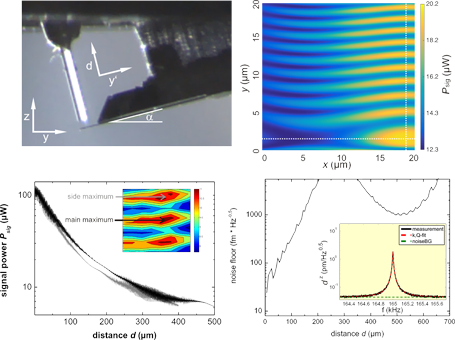
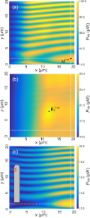
- the reference beam reflected back inside the fiber. To study alignment effects, the interferometer signal is recorded while laterally scanning the fiber over an area of 20 μm × 20 μm for a fixed z. Such patterns are recorded for 512 equidistant slices with z ranging from 0 to 5 μm generating a 3D
- explored, we find that opto-mechanical coupling is apparently the limiting factor for the noise performance of our system. In the distance regime between Fabry–Pérot and Michelson operation (200 to 350 μm) the modulation of the interferometer signal is too small to detect a meaningful cantilever
- the cantilever. Schematic representation of the interferometer signal Psig as a function of the fiber–cantilever distance d. Coarse-approach piezo steps are marked as gray boxes. The inset schematically shows the oscilloscope trace of Vsig for a cantilever excited to an amplitude of larger than λ/8




![[Graphic 27]](/bjnano/content/inline/2190-4286-7-76-i36.png?max-width=637&scale=1.18182) of the noise floor of the interferometer signal as a function of the...
of the noise floor of the interferometer signal as a function of the...
Other Beilstein-Institut Open Science Activities



