Search results
Search for "internalization" in Full Text gives 114 result(s) in Beilstein Journal of Nanotechnology.
A redox-responsive viologen–cavitand nanocarrier for dual-function photodynamic therapy
Beilstein J. Nanotechnol. 2026, 17, 1142–1158, doi:10.3762/bjnano.17.78
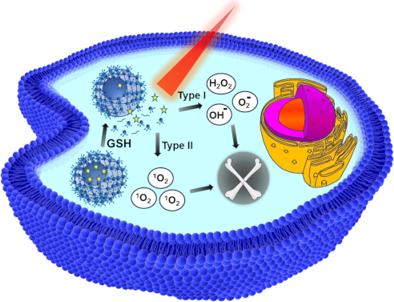
- intracellular internalization further enhances therapeutic efficiency by allowing the simultaneous damage of vital organelles. Ideally, this release is triggered by intrinsic stimuli of the cancer microenvironment, such as low pH, increased enzyme expression, or highly reductive conditions [17][18]. meso
- cytotoxicity confirms the photodynamic efficiency and wide therapeutic window of THPP@p(MVCA-BAC) for tumour ablation. Encapsulation of THPP within p(MVCA-BAC) dramatically enhances its cellular uptake. Free THPP, due to its poor aqueous solubility, shows negligible internalization under physiological
- preserved viability in the dark. In contrast, strong red fluorescence, characteristic of THPP, was observed throughout the cytoplasm, confirming efficient internalization of the nanocarrier. No signal was detected in untreated control cells. These results corroborate flow cytometry data and demonstrate that


Nanocarrier strategies to overcome P-glycoprotein-mediated drug resistance in cancer therapy
Beilstein J. Nanotechnol. 2026, 17, 882–921, doi:10.3762/bjnano.17.64
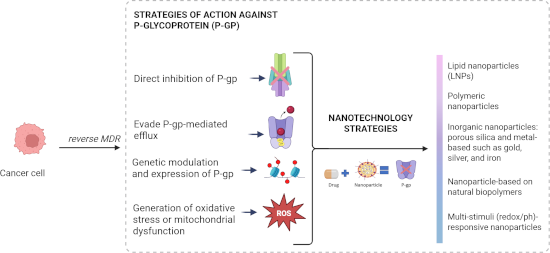
- reduces the cytosolic availability of chemotherapeutics independently of P-gp, but pH-responsive nanocarriers engineered for endosomal escape indirectly address this barrier. EMT-associated phenotypic shifts alter membrane composition and uptake pathways in ways that affect nanoparticle internalization
- (scavenger receptor, class B type 1)-mediated endocytosis as a form of cellular internalization [32]. (ii) To achieve a release in response to the tumor microenvironment, nanoparticles are designed to be sensitive to tumor-specific stimuli, such as acidic pH or ROS so that the nanoparticles remain stable in
- -peptide-functionalized liposomes [36]. Both methodologies affirm that the crux resides in activating internalization routes that circumvent the efflux pump while concurrently depleting its energy source or locally blocking it. Supporting this concept is the incorporation of TPGS into the liposomal bilayer


Restorative potential of laser-synthesized silver nanoparticles with Salvia officinalis for periodontal disease treatment: an in vitro study
Beilstein J. Nanotechnol. 2026, 17, 781–795, doi:10.3762/bjnano.17.55
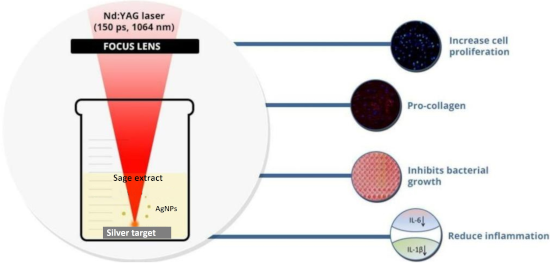
- possesses several biological benefits. While the higher concentration provides greater local therapeutic doses, the smaller particle size allows for greater cellular internalization by endocytosis [34]. The narrow size distribution of SageAgNPs6mJ could also contribute to the consistent biological outcomes



Biomimetic nanoparticles in cancer photodynamic therapy: a review of targeted delivery systems and therapeutic outcomes
Beilstein J. Nanotechnol. 2026, 17, 396–422, doi:10.3762/bjnano.17.27
- hydrophilicity/lipophilicity ensures selective accumulation in target tissues, such as tumors via the EPR effect, and efficient cellular internalization. Low photobleaching sustains activity during treatment, while biocompatibility and biodegradability reduce adverse effects and enhance the therapeutic index
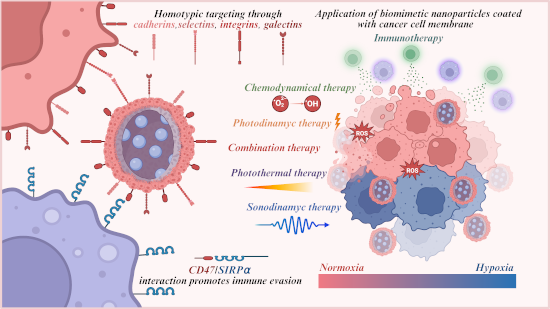
- vasculature, penetration through the interstitial space, and cellular internalization at the target site [47]. Conferring the carriers with a biomimetic shell that mimics the functions of biological cells potentially increases their circulation time and targeting properties, while significantly reducing the
- internalization through receptor-mediated endocytosis and homotypic binding, as well as improve colloidal stability. Strategies such as incorporating pH-sensitive components or lysosomal escape mechanisms further enable controlled drug release within target cells. Despite these advances, optimizing BNP design to


Influence of surface characteristics on the in vitro stability and cell uptake of nanoliposomes for brain delivery
Beilstein J. Nanotechnol. 2026, 17, 139–158, doi:10.3762/bjnano.17.9
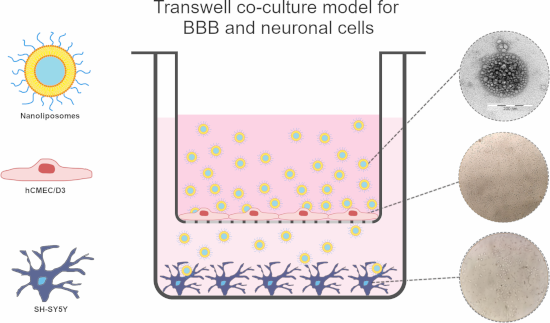
- showed a time- and concentration-dependent internalization pattern, with high impact of the surface characteristics of the different formulations. In addition, transport studies on hCMEC/D3/SH-SY5Y co-cultures confirmed the successful transport of NLs across the BBB cells and their subsequent uptake by
- neurons (ranging from 25.17% to 27.54%). Fluorescence and confocal microscopy micrographs revealed that, once internalized, NLs were concentrated in the perinuclear cell regions. Keywords: blood–brain barrier; cell co-culture; cell uptake; internalization; nanoliposomes; stability; surface
- NLs interact with biomolecules, thus forming a protein corona (PC), altering functional proteins, and engaging in redox reactions with reactive species [6]. These interactions can affect the functionality, biodistribution, targeting, and cell internalization of NLs. Serum components can disrupt the




Development and in vitro evaluation of liposomes and immunoliposomes containing 5-fluorouracil and R-phycoerythrin as a potential phototheranostic system for colorectal cancer
Beilstein J. Nanotechnol. 2026, 17, 97–121, doi:10.3762/bjnano.17.7
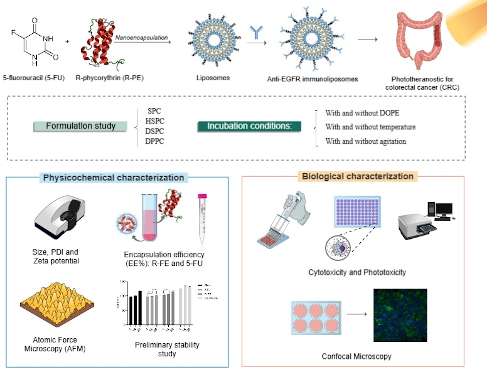
- CCR cell line, the IC50 values for immunoliposomes were higher than those for liposomes. Also, for phototoxicity experiments it was found a reduction in IC50 for all groups tested. The internalization of R-PE was verified, highlighting a greater internalization in the immunoliposome within 24 h. Thus
- intratumor accumulation with higher cellular internalization. In addition, the use of immunoliposomes contributes to reducing systemic toxicity, since their delivery is concentrated in the tumor microenvironment, avoiding exposure of healthy tissues [8]. In colorectal cancer, the epidermal growth factor
- tumor cells, enhancing the internalization of the system and promoting greater cytotoxic activity compared to conventional therapies [10]. By combining selective cytotoxicity with the potential to label cancer tissue using an imaging probe, EGFR-targeted immunoliposomes represent an integrated approach



Internal 3D temperature mapping in biological systems using ratiometric light-sheet imaging and lipid-coated upconversion nanothermometers
Beilstein J. Nanotechnol. 2025, 16, 2306–2316, doi:10.3762/bjnano.16.159
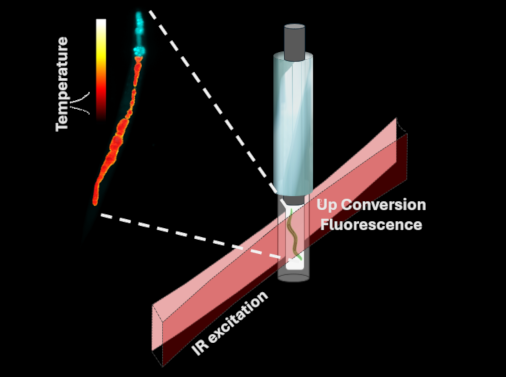
- to electrostatic repulsion with the negatively charged glycocalyx of the intestinal cell membranes, thereby hindering endocytosis [58]. This contrasts with cationic coatings like polyethyleneimine (PEI), which promote endocytosis and lead to UCNP internalization into intestinal cells [59]. This
- observation is consistent with Chen et al. [50], who reported internalization of PEI-capped UCNPs into both the gut cavity and intestinal cells. They attributed UCNP uptake within the gut cavity to the favorable nanoparticle dispersibility and cellular internalization to endocytosis, facilitated by


Optical bio/chemical sensors for vitamin B12 analysis in food and pharmaceuticals: state of the art, challenges, and future outlooks
Beilstein J. Nanotechnol. 2025, 16, 2207–2244, doi:10.3762/bjnano.16.153


Phytol-loaded soybean oil nanoemulsion as a promising alternative against Leishmania amazonensis
Beilstein J. Nanotechnol. 2025, 16, 1826–1836, doi:10.3762/bjnano.16.126

- internalization by the parasite. Importantly, previous studies have demonstrated that nanoemulsions are efficiently internalized by macrophages, which reinforces the potential of our formulation to also target intracellular amastigotes. Taken together, our results pave the way for further in vitro assays on


Exploring the potential of polymers: advancements in oral nanocarrier technology
Beilstein J. Nanotechnol. 2025, 16, 1751–1793, doi:10.3762/bjnano.16.122
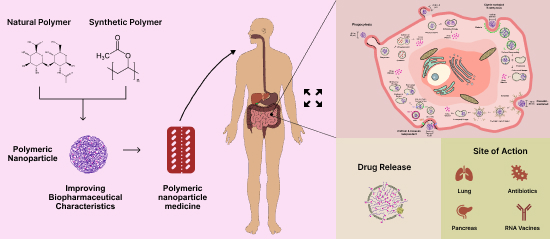
- , along with the mechanisms of active substance internalization and release within the body. Special attention is given to how PNs have been applied to enhance the oral delivery of peptides, nucleic acids, poorly soluble drugs, and small molecules. Additionally, current strategies for administration and
- ]. Endocytosis is the primary pathway through which NPs enter cells. Hydrophobic polymeric NPs often exhibit stronger interactions with the lipid bilayer, which may facilitate their internalization through endocytic mechanisms. In contrast, hydrophilic NPs tend to adsorb onto the cell membrane surface before
- scavenger receptors) on phagocytic cells. These particles are internalized through the plasma membrane, forming a cup-shaped invagination that develops into phagosomes. These phagosomes subsequently fuse with lysosomes, where the contents undergo acidic degradation [78][79]. Internalization of PNs by


Advances of aptamers in esophageal cancer diagnosis, treatment and drug delivery
Beilstein J. Nanotechnol. 2025, 16, 1734–1750, doi:10.3762/bjnano.16.121
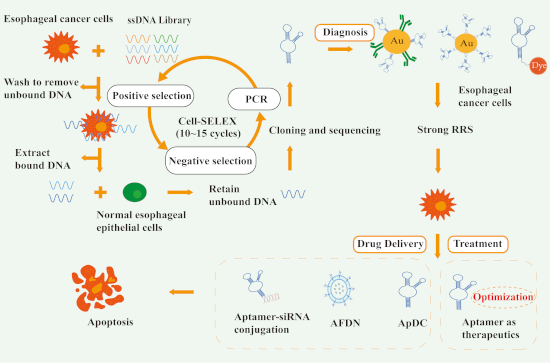
- et al. [107] designed a PEI–aptamer–EPI nanoplatform that relies on high ATP concentrations to release epirubicin (EPI). The polyethyleneimine (PEI) coating makes the whole delivery system positively charged, enables better adsorption to cell membranes, and promotes internalization. In vitro release


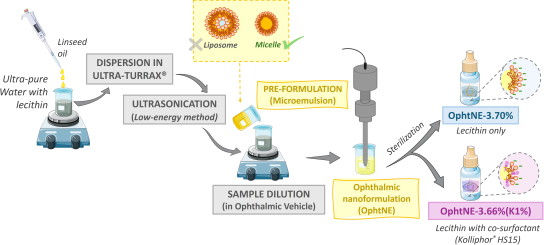
Multifunctional anionic nanoemulsion with linseed oil and lecithin: a preliminary approach for dry eye disease
Beilstein J. Nanotechnol. 2025, 16, 1711–1733, doi:10.3762/bjnano.16.120



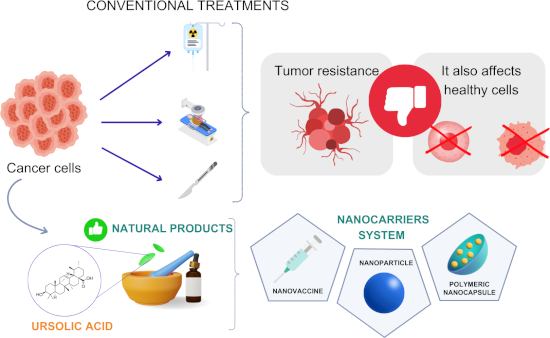
Prospects of nanotechnology and natural products for cancer and immunotherapy
Beilstein J. Nanotechnol. 2025, 16, 1644–1667, doi:10.3762/bjnano.16.116
- editing efficiency, MTT assay, and flow cytometry tests were carried out to observe the therapeutic activity of the technology. The results demonstrated that the nanoparticles increased targeting and internalization, had a knockout rate of 80%, and exhibited better inhibition of HepG2 cell proliferation


Enhancing the therapeutical potential of metalloantibiotics using nano-based delivery systems
Beilstein J. Nanotechnol. 2025, 16, 1350–1366, doi:10.3762/bjnano.16.98
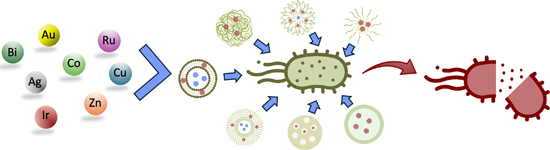
- receptors and ligands, as well as the number of interactions necessary to overcome the energy barrier for cellular uptake. Properly balancing these factors ensures efficient binding and internalization of the nanoparticles by the target cells [50][51]. For example, nanoparticles can be engineered to
- tenfold increase in efficacy against M. smegmatis and M. bovis relative to the free Zn complex. Immunofluorescence analyses confirmed selective uptake of Zn-RIF-Tf-QDs by macrophages and dendritic cells, with minimal internalization by lung epithelial cells and no evidence of cytotoxicity or genotoxicity


Better together: biomimetic nanomedicines for high performance tumor therapy
Beilstein J. Nanotechnol. 2025, 16, 1246–1276, doi:10.3762/bjnano.16.92
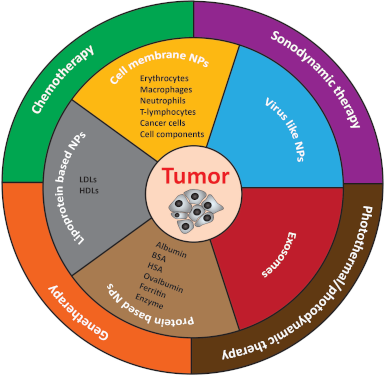
- ]. In that study, a PEGylated-lipid nanoparticle (PEG-liposome) with a mesoporous silica nanoparticle core (LM) was prepared, and then the nanosystem was coated with CCM (CCM@LM). The biomimetic nanomedicine showed high internalization in a way similar to an enveloped virus. The PEGylation of the inner
- cavity provided subcellular localization of payload in the nucleus subsequent to cellular internalization. The whole nanosystem demonstrated a significant anti-tumor activity. Shao et al. established X-ray-responsive CCM-covered mesoporous organosilica nanoparticles for the controlled release of DOX [135
- -HNPs) selectively recognized the source cells and increased the cellular internalization up to nine-fold via homotypic binding. Moreover, the A549/T CM-HNPs sensitized MDR cells to PTX by suppressing the P-gp activity 3.2-fold and induced apoptosis (70%) in homologous A549/T cells [45] (Figure 8). Kong






Piezoelectricity of hexagonal boron nitrides improves bone tissue generation as tested on osteoblasts
Beilstein J. Nanotechnol. 2025, 16, 1068–1081, doi:10.3762/bjnano.16.78
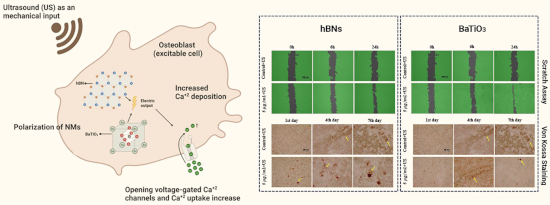
- identical. Despite their different structures, sizes, charges, and shapes, which affect their internalization [65], BaTiO3 was taken up by cells in a concentration-dependent manner, leading to increased cell granulation, as depicted in Figure 4. Furthermore, the SSC% shift in BaTiO3+US treated cells


Serum heat inactivation diminishes ApoE-mediated uptake of D-Lin-MC3-DMA lipid nanoparticles
Beilstein J. Nanotechnol. 2025, 16, 740–748, doi:10.3762/bjnano.16.57
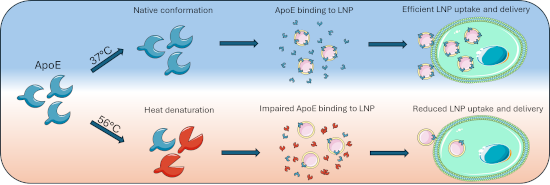
- internalization of RNA molecules by target cells [23]. Several LNP encapsulated RNA-based therapeutics have achieved approval by the United States Food and Drug Administration (FDA) [24], including patisiran/Onpattro for the treatment of hereditary transthyretin amyloidosis. Onpattro LNPs are administered


Nanomaterials in targeting amyloid-β oligomers: current advances and future directions for Alzheimer's disease diagnosis and therapy
Beilstein J. Nanotechnol. 2025, 16, 561–580, doi:10.3762/bjnano.16.44
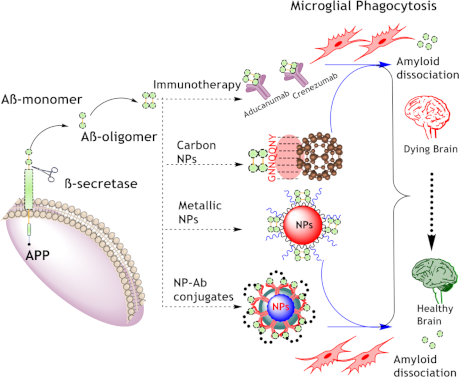
- -fold. These exosomes exhibited rapid internalization in SH-SY5Y cells and co-localized with FITC-conjugated AβOs. Furthermore, CCk-8 assays demonstrated that US-HA-Exos could alleviate AβO toxicity in vitro [85]. Li et al. investigated M2 microglia-derived exosomes (M2-EXOs) and their impact on AD


Development of a mucoadhesive drug delivery system and its interaction with gastric cells
Beilstein J. Nanotechnol. 2025, 16, 371–384, doi:10.3762/bjnano.16.28

- rate. The mucoadhesive characteristic of the system was tested in situ and in vitro. In addition, the in vitro cytotoxicity and internalization of the nanoparticles by mucus-secreting gastric cells were also investigated. We believe that usage of the developed system may increase the retention time of
- concluded that EudAlg nanoparticles do not significantly affect the viability of AGS cell (Figure 4A). Internalization of nanoparticles When nanoparticles are designed for biomedical applications, two important properties to be considered are toxicity and cellular uptake. The cellular uptake of
- nanoparticles is a dynamic process where both endocytosis and exocytosis are involved. The uptake also depends on the concentration of nanoparticles and the duration of the process. Studies conducted with the AGS cell line revealed that nanoparticle internalization generally reaches a plateau within the first 2


Graphene oxide–chloroquine conjugate induces DNA damage in A549 lung cancer cells through autophagy modulation
Beilstein J. Nanotechnol. 2025, 16, 316–332, doi:10.3762/bjnano.16.24
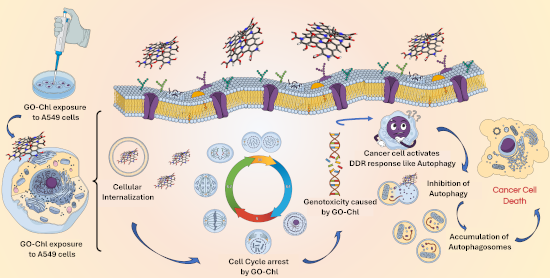
- in 115 mL of solution and the amount of unbound drug left in supernatant, respectively. where mo, msup, and mGO are total amount of drug used initially, unbound drug obtained in the supernatant, and weight of GO, respectively. Cellular internalization of the GO–Chl nanoconjugate and flow-cytometry
- -based propidium iodide uptake analysis The efficacy of nanomedicines mainly depends upon the effective cellular internalization and their transport to the appropriate intercellular effector site [52][53]. Studies have shown that based on its size and surface characteristics (i.e., hydrophilicity or
- of vacuoles were observed in the treated cells (Figure 4a, black arrows). Furthermore, TEM micrographs reveal the presence and effective cellular internalization of the GO–Chl nanoconjugate in A549 cells (Figure 4a; red arrows and Figure 4b), corroborating our previous findings [25]. To investigate



Radiosensitizing properties of dual-functionalized carbon nanostructures loaded with temozolomide
Beilstein J. Nanotechnol. 2025, 16, 229–251, doi:10.3762/bjnano.16.18
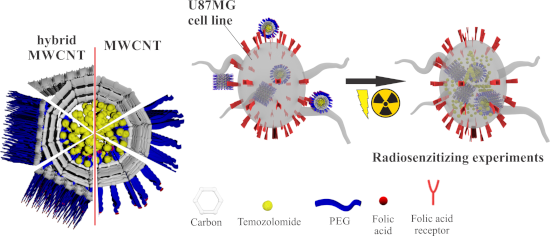
- through the BBTB and uptake into the tumor cells were obtained, as a precondition for higher extent and rate of their internalization and optimal risk/benefit ratio of the treatment with TMZ. This knowledge is based on a lot of publications in which nanoparticulated formulations of different materials
- cell membranes observed after uptake of GO. The mechanisms of MWCNTs-G internalization have not been specifically studied; however, the knowledge from studies of CNTs and graphene/GO can be extrapolated. Some of the previous publications show accumulation of CNTs in phagocytic cells without toxic
- mediate the internalization in addition to the impact of interaction with the biological fluids (i.e., surface adsorption of molecules). In this respect, in the study of Dabrowski et al. [81], the impact of particle size of graphene on the efficacy of internalization was evaluated in normal (LL-24) and




Nanocarriers and macrophage interaction: from a potential hurdle to an alternative therapeutic strategy
Beilstein J. Nanotechnol. 2025, 16, 97–118, doi:10.3762/bjnano.16.10
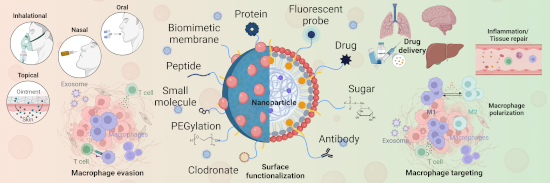
- affect NP internalization. They actively engulf NCs and accelerate their clearance, acting differentially in a time-dependent manner and altering the fate of nanomaterials [26]. In addition to immune-related barriers, the physicochemical properties of the nanomaterial itself can impair the NCs’ ability
- shapes like ellipsoids, discoids, and nanorods with higher aspect ratios are more effectively localized close to blood vessel walls, enhancing their internalization into endothelial cells and potentially improving their therapeutic delivery [1]. After systemic administration, NCs tend to accumulate in
- in KCs, is essential for clearing infections caused by the Gram-positive bacterium Listeria monocytogenes [30]. In nanomedicine, SRs are also responsible for clearing negatively charged NPs such as those composed of silica [31][32]. This interaction leads to the internalization of NCs via endocytosis


Mechanistic insights into endosomal escape by sodium oleate-modified liposomes
Beilstein J. Nanotechnol. 2024, 15, 1667–1685, doi:10.3762/bjnano.15.131
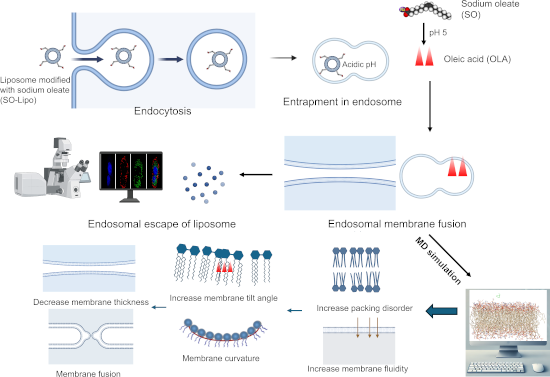
- transforming drug delivery methodologies [1]. Despite their potential, liposomes encounter substantial challenges from the point of administration to achieving therapeutic efficacy. One of the primary obstacles is their propensity for endosomal entrapment. Following internalization via endocytosis, liposomes
- inhibitor of caveolae-mediated endocytosis, also significantly reduced uptake (p < 0.001), suggesting the involvement of caveolae in the internalization of Unmodified-Lipo. Amiloride, which blocks macropinocytosis, had no significant effect (p < 0.99), indicating a negligible role for macropinocytosis in
- findings that fatty acids often use macropinocytosis for internalization [17]. Filipin significantly inhibited uptake (p < 0.001), showing that caveolae-mediated endocytosis also plays an important role in SO-Lipo uptake. These results align with reports that anionic particles undergo caveolae-mediated




Biomimetic nanocarriers: integrating natural functions for advanced therapeutic applications
Beilstein J. Nanotechnol. 2024, 15, 1619–1626, doi:10.3762/bjnano.15.127

- -based nanocarriers is understanding the fundamental building blocks, size, shape, and biological properties to mimic real cells and enable their internalization [31][32]. One efficient strategy for producing biomimetic nanocarriers involves camouflage with biological membranes. The phospholipids


Polymer lipid hybrid nanoparticles for phytochemical delivery: challenges, progress, and future prospects
Beilstein J. Nanotechnol. 2024, 15, 1473–1497, doi:10.3762/bjnano.15.118
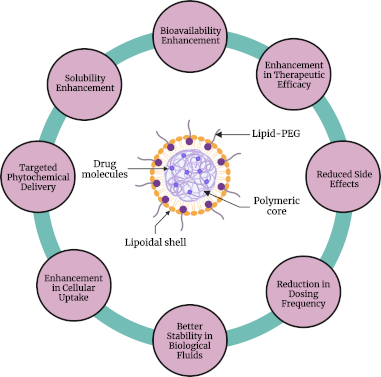
- . Cell cycle analysis and apoptotic studies by flow cytometry revealed much higher apoptotic activity and cellular internalization of CUR-PLHNPs in MCF-7 cells compared to free CUR. Further, the CUR-PLHNPs showed a significantly lower IC50 value (i.e., 7 µg/mL) than free CUR (10.72 µg/mL). Zhao et al
- . fabricated RGD ligand-directed PLHNPs for site-specific delivery of CUR to treat melanoma [83]. The CUR-RGD-PLHNPs showed small PS, low polydispersity index (PDI), high ZP, and high EE. The CUR-RGD-PLHNPs showed 4.3 times higher cellular internalization in HUVECs cells than the native counterpart. Apoptotic
- studies in AsPC-1 and BxPC-3 cells suggested that the fabricated UA-PLHNPs exhibited much higher cellular internalization and cytotoxicity. Further, the developed AU-PLHNPs revealed negligible erythrocyte hemolytic activity. Similarly, Wang et al. fabricated UA-encapsulated chitosan-coated liposomes for