


Search results
Search for "lead-free solder" in Full Text gives 2 result(s) in Beilstein Journal of Nanotechnology.
First-principles study on elastic properties of Cu, (Cu1−x,Nix)3Sn and interfacial mechanical properties of (Cu1−x,Nix)3Sn/Cu in the lead-free solder joint
Beilstein J. Nanotechnol. 2026, 17, 428–439, doi:10.3762/bjnano.17.29
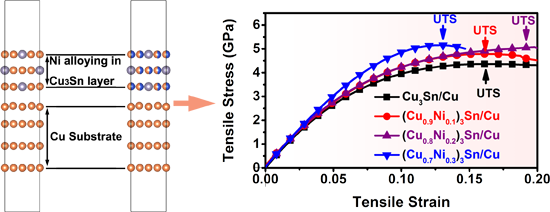
- (CuxNi1−x)3Sn/Cu in lead-free solder joints. The results reveal that, within the thermodynamically stable domain of (CuxNi1−x)3Sn, the increase of Ni content can enhance the interfacial mechanical properties of (CuxNi1−x)3Sn/Cu, and increase the reliability of the lead-free solder joints. The enhancement
- thermodynamic mechanisms and decrease the reliability of the lead-free solder joints. The results presented in this study will not only unveil the effects of Ni alloying on the interfacial properties of lead-free solder joints, but also will provide a guidance for high-performance lead-free solder design by
- alloying strategies to meet the requirements for electronic device miniaturization and harsh environmental applications. Keywords: ductility; elastic modulus; interfacial toughness; lead-free solder; work of adhesion; Introduction Due its toxicity, lead has caused serious problems in human health and


A multi-resistance wide-range calibration sample for conductive probe atomic force microscopy measurements
Beilstein J. Nanotechnol. 2023, 14, 1141–1148, doi:10.3762/bjnano.14.94
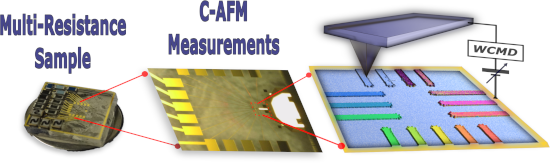
- droplets (F42240, lead-free solder paste – class 5, CIF, France). The fused silica substrate was placed on a heating plate set to 270 °C, which required around 3 min to reach the melting temperature of the solder droplets (217 °C), as observed under an optical microscope. Upon cooling, 16 SMD resistors


Other Beilstein-Institut Open Science Activities



