


Search results
Search for "light-emitting diodes (LEDs)" in Full Text gives 18 result(s) in Beilstein Journal of Nanotechnology.
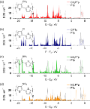
Photochemical synthesis of silver nanoprisms via green LED irradiation and evaluation of SERS activity
Beilstein J. Nanotechnol. 2025, 16, 1417–1427, doi:10.3762/bjnano.16.103
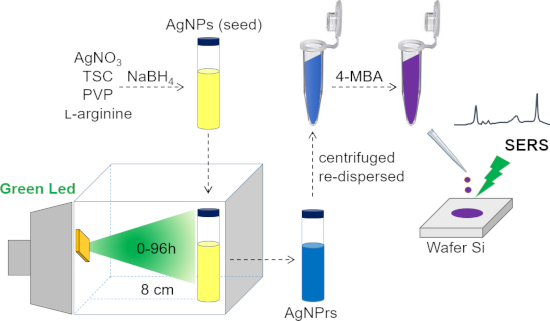
- candidates for surface-enhanced Raman scattering (SERS) due to their strong localized surface plasmon resonance and sharp tip geometry. In this study, AgNPrs were synthesized through a photochemical method by irradiating spherical silver nanoparticle seeds with 10 W green light-emitting diodes (LEDs; 520
- applications. Keywords: light-emitting diodes (LEDs); photochemical synthesis; silver nanoprisms; surface-enhanced Raman scattering (SERS); trisodium citrate; Introduction Anisotropic silver nanoparticles (ASNPs) have attracted increasing attention from research groups worldwide due to their potential


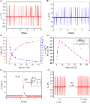
A visible-light photodetector based on heterojunctions between CuO nanoparticles and ZnO nanorods
Beilstein J. Nanotechnol. 2023, 14, 1018–1027, doi:10.3762/bjnano.14.84
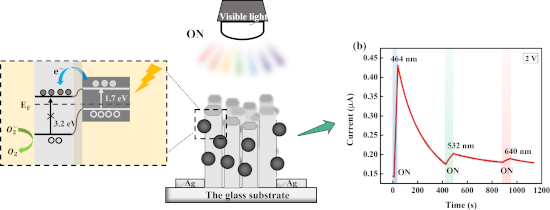
- development of many technologies in the future, such as solar cells [1][2], light-emitting diodes (LEDs) [3][4], laser diodes [5], and optical fibers [6]. Optoelectronics devices contribute to meeting requirements in telecommunications, medical equipment, sensors, and military services. Among those


Triboelectric nanogenerator based on Teflon/vitamin B1 powder for self-powered humidity sensing
Beilstein J. Nanotechnol. 2020, 11, 1394–1401, doi:10.3762/bjnano.11.123
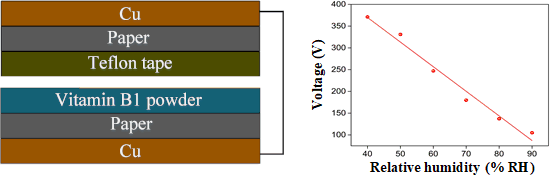
- -emitting diodes (LEDs) integrated in the TVB-TENG system. The TVB-TENG proposed in this study illustrates a cost-effective method for portable power supply and sensing devices. Keywords: humidity sensor; self-powered system; triboelectric nanogenerators (TENGs); triboelectrification; vitamin B1
- -emitting diodes (LEDs) are integrated with the humidity sensor and the luminosity is an indicator of the relative humidity (RH) from the surrounding environment. Experimental The conductive copper foil tape is used as the electrode, while the paper (manufacturer: Miao Ben) at the bottom serves as a
- measured open-circuit voltage was approximately 340 V. The TVB-TENG can be applied as a humidity sensor and exhibits a linear and reversible response to the relative humidity of the environment. Moreover, the change in relative humidity is also indicated by the change in luminosity of a set of light




Influence of the epitaxial composition on N-face GaN KOH etch kinetics determined by ICP-OES
Beilstein J. Nanotechnol. 2020, 11, 41–50, doi:10.3762/bjnano.11.4
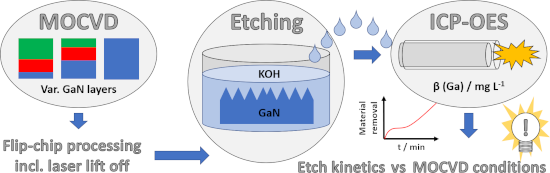
- , Spain 10.3762/bjnano.11.4 Abstract Roughening by anisotropic etching of N-face gallium nitride is the key aspect in today’s production of blue and white light emitting diodes (LEDs). Both surface area and number of surface angles are increased, facilitating light outcoupling from the LED chip. The


Electroluminescence and current–voltage measurements of single-(In,Ga)N/GaN-nanowire light-emitting diodes in a nanowire ensemble
Beilstein J. Nanotechnol. 2019, 10, 1177–1187, doi:10.3762/bjnano.10.117
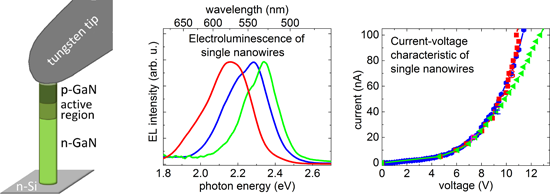
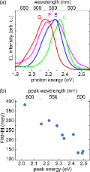
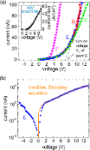
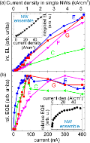
- ) behavior of single, freestanding (In,Ga)N/GaN nanowire (NW) light-emitting diodes (LEDs) in an unprocessed, self-assembled ensemble grown by molecular beam epitaxy. The data were acquired in a scanning electron microscope equipped with a micromanipulator and a luminescence detection system. Single NW
- ]. Regarding the analysis of these devices, most studies focus mainly on the characterization of the NW ensemble properties. However, the properties of single NWs in the ensemble may differ considerably from the mean value measured for the ensemble. For instance, in the particular case of light-emitting diodes
- (LEDs) based on self-assembled NW ensembles, the emission wavelengths of single NWs were found to vary substantially from wire to wire [2][3][4][5]. Hence, in order to better understand the final behavior of NW-ensemble devices, a careful analysis of the individual properties of the single NWs in the


Synthesis and characterization of quaternary La(Sr)S–TaS2 misfit-layered nanotubes
Beilstein J. Nanotechnol. 2019, 10, 1112–1124, doi:10.3762/bjnano.10.111
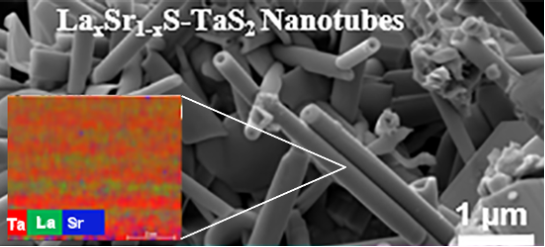
- resonators [11][12][13]. Using ionic liquid gating, ambipolar p–n junctions led to high-performance light-emitting diodes (LEDs) and photovoltaic devices [14]. Most interesting, however, was the demonstration of quasi-1D superconductivity, which reflected the non-centrosymmetric structure of the chiral WS2


Ultrasonication-assisted synthesis of CsPbBr3 and Cs4PbBr6 perovskite nanocrystals and their reversible transformation
Beilstein J. Nanotechnol. 2019, 10, 666–676, doi:10.3762/bjnano.10.66
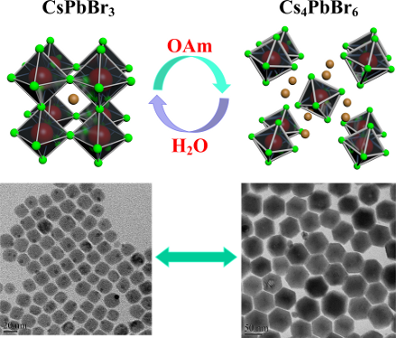
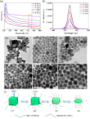
- ; ultrasonication; Introduction Metal halide perovskite nanocrystals (PNCs) are promising candidates for application in the fields of light-emitting diodes (LEDs) [1][2], high-efficiency solar cells [3], low-threshold lasers [4], and photodetectors [5]. Compared to traditional semiconductors, colloidal PNCs



Optimization of the optical coupling in nanowire-based integrated photonic platforms by FDTD simulation
Beilstein J. Nanotechnol. 2018, 9, 2248–2254, doi:10.3762/bjnano.9.209
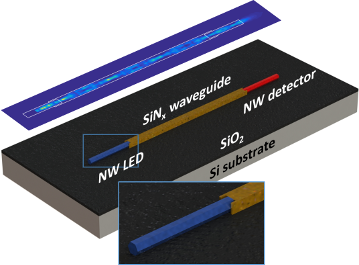
- tunable bandgap [14] and reduced dislocation density [15][16], nitride nanowires (NWs) have become important materials for optical components in the visible to ultraviolet (UV) spectral range [17][18]. Despite their small size, single NW light emitting diodes (LEDs) can produce bright electroluminescence


Light extraction efficiency enhancement of flip-chip blue light-emitting diodes by anodic aluminum oxide
Beilstein J. Nanotechnol. 2018, 9, 1602–1612, doi:10.3762/bjnano.9.152
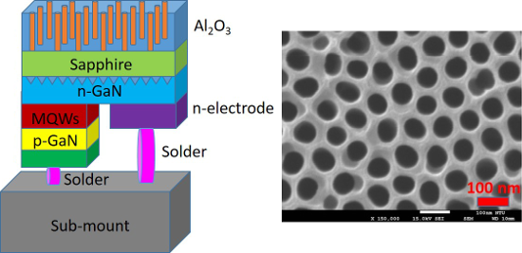
- emitter into a surface plasmon mode produced by AAO. Keywords: anodic aluminum oxide; critical angle of total reflection; efficiency enhancement; flip-chip blue light-emitting diode; Introduction Light-emitting diodes (LEDs) are widely used in various fields, such as optical communication and automobile


Optical orientation of nematic liquid crystal droplets via photoisomerization of an azodendrimer dopant
Beilstein J. Nanotechnol. 2018, 9, 870–879, doi:10.3762/bjnano.9.81
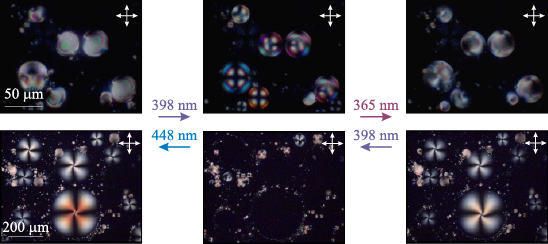
- emitting diodes (LEDs) with maximum emissions at λmax = 365, 384, 398, 406, 422, 448 and 466 nm and FWHM = 10, 13, 19, 16, 16, 25 and 22 nm, respectively. The LED illumination was normal to the cell plane; the average light intensity (measured by a Hioki 3664 power meter) was I = 3–6 mW/cm2, depending on
- were coated with an orienting compound (chromium stearyl chloride), providing a strong homeotropic anchoring of the NLC. The substrate treatment leads to a certain orientation of the NLC droplets which rest on the cell substrate. To induce the photoisomerization processes, we used a set of light


Synthesis of graphene–transition metal oxide hybrid nanoparticles and their application in various fields
Beilstein J. Nanotechnol. 2017, 8, 688–714, doi:10.3762/bjnano.8.74
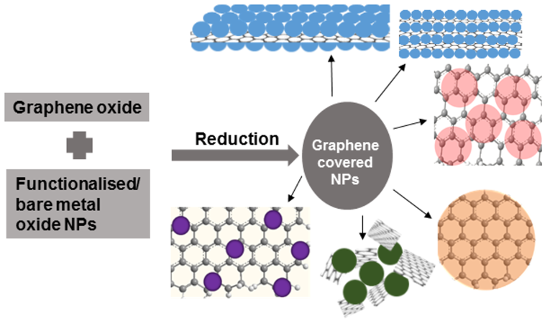
- development of a heterostructure with a direct band gap semiconductor allows this material to be applied in light emitting diodes (LEDs). In most cases, the other counterpart of graphene–NP hybrids are either transition metal or metal oxide NPs. However, in some cases, depending on the scientific requirements






Microwave solvothermal synthesis and characterization of manganese-doped ZnO nanoparticles
Beilstein J. Nanotechnol. 2016, 7, 721–732, doi:10.3762/bjnano.7.64
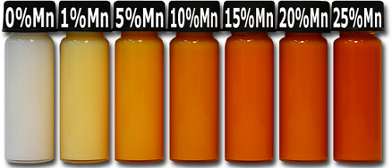
- oxides semiconductors. Zinc oxide (ZnO) is a II–VI semiconductor characterised by a wide band gap of 3.3 eV and a high exciton binding energy of circa 60 meV [4]. ZnO is used in optoelectronic devices, solar cells, data carriers, light emitting diodes (LEDs), gas sensors, thermoelectric devices


Paramagnetism of cobalt-doped ZnO nanoparticles obtained by microwave solvothermal synthesis
Beilstein J. Nanotechnol. 2015, 6, 1957–1969, doi:10.3762/bjnano.6.200
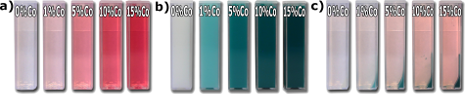
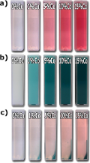
- ][13][14], solar cells [10], catalysts [15], energy storage (battery) materials [16], fast data storage [17], light-emitting diodes (LEDs) [18], gas sensors [10], thermoelectric devices [19], varistors [20][21], window materials for displays [21], laser technology [10], surface acoustic wave devices




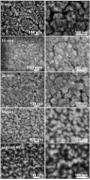
Morphology control of zinc oxide films via polysaccharide-mediated, low temperature, chemical bath deposition
Beilstein J. Nanotechnol. 2015, 6, 799–808, doi:10.3762/bjnano.6.83

- where highly conductive materials are required (e.g., solar cells and light emitting diodes (LEDs)), ZnO must be doped. Several groups have reported the successful doping of ZnO films with dopants such as magnesium [21], iodine [22], boron [23][24], titanium [25], manganese [26], and aluminium [27][28




Encapsulation of nanoparticles into single-crystal ZnO nanorods and microrods
Beilstein J. Nanotechnol. 2014, 5, 485–493, doi:10.3762/bjnano.5.56
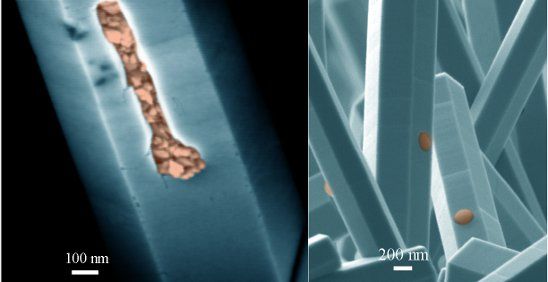
- interesting because they are not only optical cavities but also components for developing UV light-emitting diodes (LEDs). If luminescent quantum dots or dye-doped polymer nanobeads can be encapsulated into a ZnO nano/microrod that is integrated into a LED, the UV emission of ZnO can act as an excitation


Challenges in realizing ultraflat materials surfaces
Beilstein J. Nanotechnol. 2013, 4, 875–885, doi:10.3762/bjnano.4.99
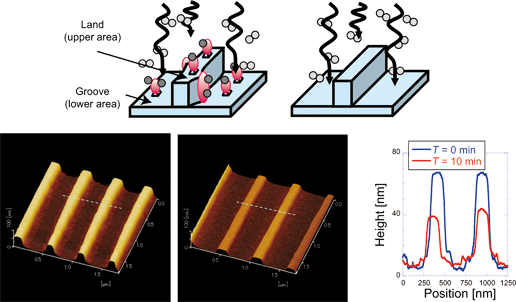
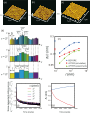
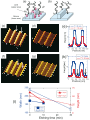
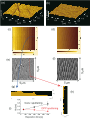
- topic in the field of laser-machining processes, in which a flattened mirror can increase the laser durability [3]. The electron scattering losses must also be reduced for various industrial and scientific applications. To realize high-power light-emitting diodes (LEDs), the surface roughness of the

Structural and electronic properties of oligo- and polythiophenes modified by substituents
Beilstein J. Nanotechnol. 2012, 3, 909–919, doi:10.3762/bjnano.3.101
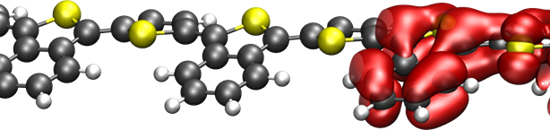
- , e.g., as organic transistors, photoresistances or polymer light-emitting diodes (LEDs) [11]. In particular, thiophene-based organic solar cells have shown remarkable efficiency [5][8]. Nevertheless they are still relatively cheap in production [12]. For all these applications, the particular





Fabrication and spectroscopic studies on highly luminescent CdSe/CdS nanorod polymer composites
Beilstein J. Nanotechnol. 2010, 1, 94–100, doi:10.3762/bjnano.1.11
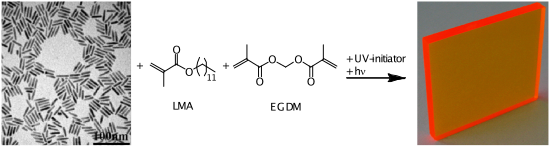
- potential applications in a new generation of light-emitting diodes (LEDs), lasers or luminescent solar concentrators [3][4][5][6]. One of the challenges of these applications is the incorporation of inorganic nanoparticles into organic polymer matrices, since this is usually accompanied by phase separation





