


Search results
Search for "microplastics (MPs)" in Full Text gives 4 result(s) in Beilstein Journal of Nanotechnology.
Microplastic pollution in Himalayan lakes: assessment, risks, and sustainable remediation strategies
Beilstein J. Nanotechnol. 2025, 16, 2144–2167, doi:10.3762/bjnano.16.148
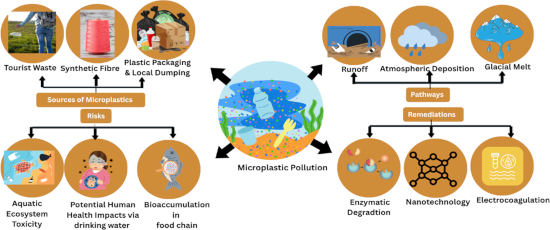
- anthropogenic pressures result in distinct pathways of contamination with microplastics (MPs). MP contamination is currently a problem of global proportions impacting freshwater, oceanic, and terrestrial ecosystems. Although initial studies primarily addressed oceanic ecosystems, current studies show the


Current status of using adsorbent nanomaterials for removing microplastics from water supply systems: a mini review
Beilstein J. Nanotechnol. 2025, 16, 1837–1850, doi:10.3762/bjnano.16.127
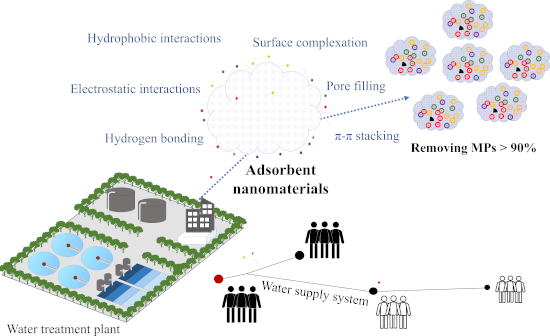
- Nguyen Thi Nhan Tran Le Luu Master Program in Water Technology, Reuse and Management, Vietnamese German University, Ho Chi Minh City, Vietnam 10.3762/bjnano.16.127 Abstract The widespread use of plastic has led to microplastics (MPs) being released in many water sources. MP contamination in water
- materials provide a foundation for developing sustainable, effective solutions to mitigate MPs pollution in the water supply system. Keywords: adsorbent interactions; adsorbent nanomaterials; carbon-based adsorbents; metal-organic frameworks (MOFs); microplastics (MPs); Introduction Plastic materials have
- projected to rise to 33,000 million tonnes by 2050 [1]. However, despite this significant increase in production, the global recycling rate remaines low at approximately 9% since 1950, resulting in the accumulation of plastic waste in ecological and environmental systems [2][3]. The issues of microplastics


Nanotechnology-based approaches for the removal of microplastics from wastewater: a comprehensive review
Beilstein J. Nanotechnol. 2025, 16, 1607–1632, doi:10.3762/bjnano.16.114
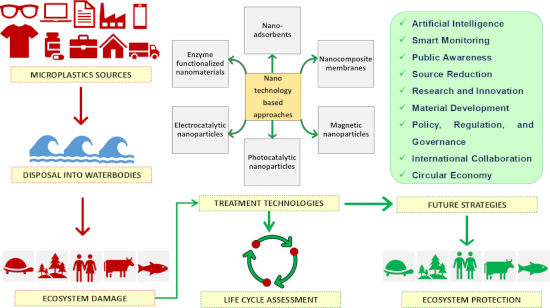
- .16.114 Abstract The increasing prevalence of microplastics (MPs) in aquatic environments has raised significant concerns due to their persistence, potential for bioaccumulation, and adverse effects on human and ecosystem health. Conventional wastewater treatment technologies are largely inadequate for
- estimated that, by 2060, the plastic waste generation could increase annually to 155–265 megatons. In spite of the continuous increase in the production of plastic, the rate of recycling remains low worldwide [1]. Microplastics (MPs) are tiny debris pertaining to plastic of size less than 5 mm. They are


The role of biochar in combating microplastic pollution: a bibliometric analysis in environmental contexts
Beilstein J. Nanotechnol. 2025, 16, 1401–1416, doi:10.3762/bjnano.16.102
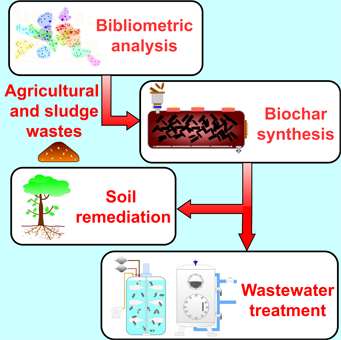
- , Ho Chi Minh City 700000, Vietnam 10.3762/bjnano.16.102 Abstract This study employs a bibliometric analysis using CiteSpace to explore research trends on the impact of biochar on microplastics (MPs) in soil and water environments. In agricultural soils, MPs reduce crop yield, alter soil properties
- , positioning it as a promising solution for nanoplastic remediation. Keywords: aquatic pollution; bibliometric analysis; biochar; microplastics (MPs); soil remediation; Introduction Plastics are widely utilized in various industries and daily life due to their low production cost. The average global per
- recycled in 2015, with 12% incinerated and 79% accumulating in landfills or the natural environment [4]. Microplastics (MPs) have garnered significant attention due to their adverse impacts on human health and the ecological environment. Research primarily focuses on identifying their presence, risks, and



Other Beilstein-Institut Open Science Activities



