


Search results
Search for "nanohelix" in Full Text gives 5 result(s) in Beilstein Journal of Nanotechnology.
He+ FIBID-fabricated 3D AFM tip architectures: an exploratory study of hollow pillars, helices, and spirals
Beilstein J. Nanotechnol. 2026, 17, 863–871, doi:10.3762/bjnano.17.62
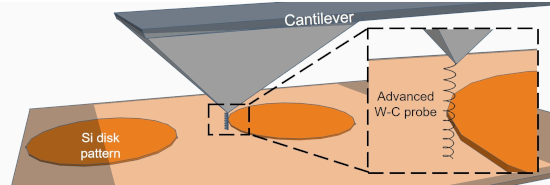
- required. Keywords: 3D-printed tips; AFM tips; beam induced nanomanufacturing; focused ion beam induced deposition (FIBID); helium ion microscope; nanohelix; nanopillar; nanospiral; scanning tip microscopy; surface topography; tungsten carbide; Introduction The atomic force microscope (AFM) is a
- practical: They provide a reference for the nominal step height on the chosen sample. The printed nanoarchitectures display markedly different geometrical features, including variable heights, opening angles, and apex radii, depending on the design. Nanohelix tips exhibit heights ranging from 0.47 to 1.04
- parameters such as wall thickness, pitch, local support features, and final apex termination are likely to be important variables in future optimisation. Conclusion We fabricated eighteen AFM tips with hollow nanopillar, nanohelix, and nanospiral architectures by He+ FIBID and evaluated them under basic


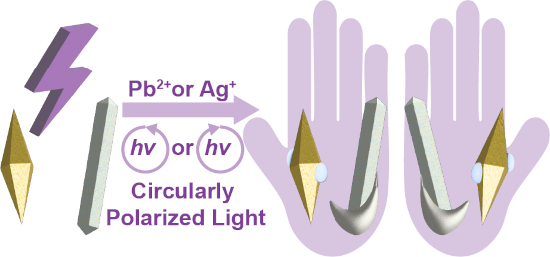
Chiral plasmonic nanostructures fabricated with circularly polarized light
Beilstein J. Nanotechnol. 2025, 16, 2245–2264, doi:10.3762/bjnano.16.154
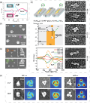
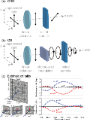
- , whereas EELS and PEEM collect electrons. EELS also provides insight into the energy-dependent LDOS [131]. The energy-filtered EELS probability map of an Au nanohelix is shown in Figure 8c [132]. PEEM analyzes the spatial distribution of electrons ejected by samples under light excitation [133]. Under CPL
- chiral lattices on the nanohelix surface. The authors also suggested that the superchiral near fields may contribute to this study. Applications discussed in this section mainly focus on the local chiral geometric domain rather than the overall geometrical chirality of the nanostructure. This is likely





A review of defect engineering, ion implantation, and nanofabrication using the helium ion microscope
Beilstein J. Nanotechnol. 2021, 12, 633–664, doi:10.3762/bjnano.12.52


3D superconducting hollow nanowires with tailored diameters grown by focused He+ beam direct writing
Beilstein J. Nanotechnol. 2020, 11, 1198–1206, doi:10.3762/bjnano.11.104
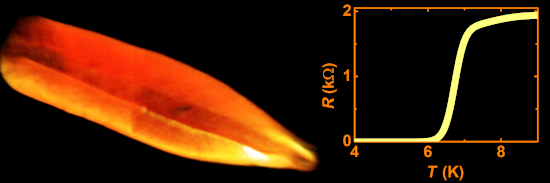
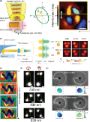
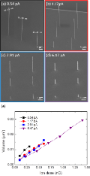
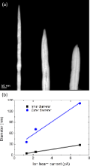
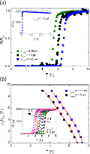
- nanotubes as small as 32 nm in diameter [17] and nanohelices with controllable geometries, including the smallest and most densely packed nanohelix to date with a diameter of 100 nm [19]. In this work, we present the direct writing of 3D WC crystalline superconducting hollow NWs with tailored diameters



Chiral nanostructures self-assembled from nitrocinnamic amide amphiphiles: substituent and solvent effects
Beilstein J. Nanotechnol. 2019, 10, 1608–1617, doi:10.3762/bjnano.10.156
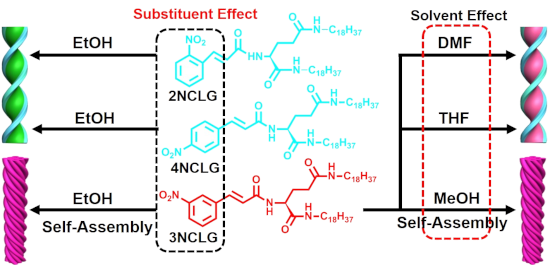
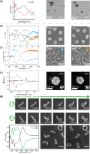
- nm, as shown in Figure 2a. As for 4NCLG assemblies, a similar right-handed helical nanofiber was obtained (Figure 2c). In contrast, a left-handed superhelical structure with a helical pitch of around 500 nm was observed in the 3NCLG system, which was formed by dozens of nanofibers. The nanohelix
- concentration, likely indicating the different self-assembly behaviors of 3NCLG. Firstly, SEM was used to characterize the xerogels and dried precipitate, as shown in Figure 7. As we expected, the left-handed superhelix of 3NCLG precipitated in methanol was observed and the nanohelix (Figure 7a) further
- that of those in ethanol and methanol was also related to the intermolecular hydrogen bonding. Besides, 2NCLG formed right-handed nanohelix both in DMF and THF, which is the same as in ethanol. The 4NCLG gelator formed nanotube structures both in DMF and THF, which is different from the nanohelix that




Other Beilstein-Institut Open Science Activities



