


Search results
Search for "ofloxacin" in Full Text gives 3 result(s) in Beilstein Journal of Nanotechnology.
Photocatalytic degradation of ofloxacin in water assisted by TiO2 nanowires on carbon cloth: contributions of H2O2 addition and substrate absorbability
Beilstein J. Nanotechnol. 2025, 16, 1567–1579, doi:10.3762/bjnano.16.111
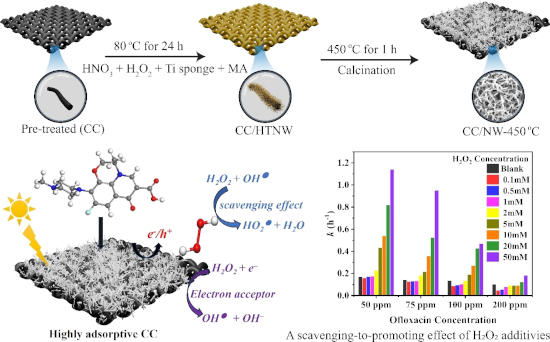
- turn, a superior photoactivity. Compared to TiO2 nanowire arrays grown on metallic Ti substrates, TiO2 nanowires supported on carbon cloth substrates demonstrate markedly superior efficiency in the photocatalytic degradation of ofloxacin (OFL) molecules in water when exposed to UV light. The TiO2
- ; ofloxacin; photocatalytic degradation; TiO2 nanowires; wastewater treatment; Introduction Drug pollution in natural environments has become an increasingly serious issue as a result of the wide applications of drugs in the diagnosis and treatment of human diseases, anti-epidemic disinfection, aquaculture
- additives, and veterinary drugs [1][2]. Ofloxacin (OFL) is a broad-spectrum fluoroquinolone antibiotic widely used in clinical treatments for various bacterial infections [3]. After administration, OFL is not fully metabolized and is primarily excreted through urine, leading to its presence in wastewater


Bismuth-based nanostructured photocatalysts for the remediation of antibiotics and organic dyes
Beilstein J. Nanotechnol. 2023, 14, 291–321, doi:10.3762/bjnano.14.26
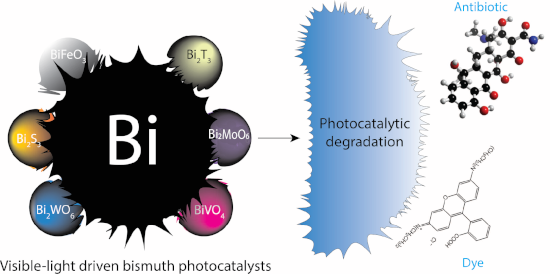
- and fluoroquinolone consumption rates increased 1.8-fold over the course of the study. Different geographical areas have different levels of antibiotics in the environment. For instance, aus der Beek et al. [53] reported ofloxacin and sulfamethoxazole at 17.7 μg/L and 14.3 μg/L, respectively, and
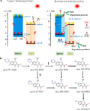
- efficiencies for both ciprofloxacin and ofloxacin were recorded at a highly basic pH [187] using a magnetic Bi2WO6-biochar composite with a pHpzc of 6.75. The best performance was at pH 7. Since both antibiotics and photocatalyst were negatively charged at a basic pH, electrostatic repulsion between them was


pH-driven enhancement of anti-tubercular drug loading on iron oxide nanoparticles for drug delivery in macrophages
Beilstein J. Nanotechnol. 2021, 12, 1127–1139, doi:10.3762/bjnano.12.84
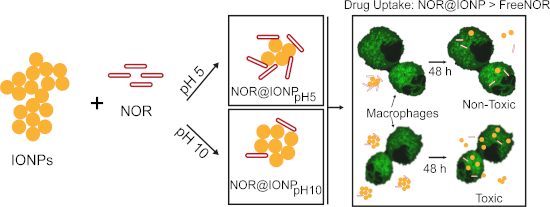
- -TB drugs against mycobacteria, which are found to be resistant to rifampicin and/or isoniazid, the first-line drugs [17]. Although at present, moxifloxacin, ofloxacin and levofloxacin are the major fluoroquinolones used in tuberculosis therapeutics [21], many clinical isolates of M. tuberculosis have



Other Beilstein-Institut Open Science Activities



