


Search results
Search for "phase inversion" in Full Text gives 11 result(s) in Beilstein Journal of Nanotechnology.
Quality by design optimization of microemulsions for topical delivery of Passiflora setacea seed oil
Beilstein J. Nanotechnol. 2025, 16, 2116–2131, doi:10.3762/bjnano.16.146
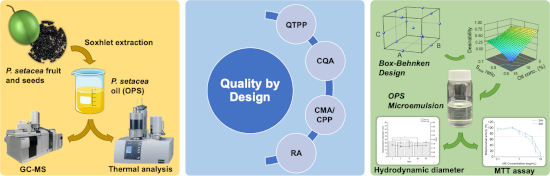
- were conducted using Design-Expert® software (M/s Stat-Ease Inc.). Production method for Passiflora setacea oil-based systems The formulations were prepared using the phase inversion composition method [60]. Component proportions were defined according to the experimental matrix (Table 7). Briefly


Targeting the vector of arboviruses Aedes aegypti with nanoemulsions based on essential oils: a review with focus on larvicidal and repellent properties
Beilstein J. Nanotechnol. 2025, 16, 1894–1913, doi:10.3762/bjnano.16.132
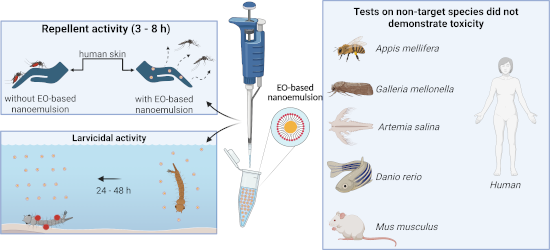
- by phase inversion, using polysorbate 80 and sorbitan monooleate 20 as surfactants. The NE presented an average size of 105.3 nm (±1.36) and a polydispersity index of 0.263 (± 0.004). The larvicidal bioassays against third-stage Aedes aegypti larvae produced an LC50 of 61.4 µg/mL at 48 hours and 26.8


Phytol-loaded soybean oil nanoemulsion as a promising alternative against Leishmania amazonensis
Beilstein J. Nanotechnol. 2025, 16, 1826–1836, doi:10.3762/bjnano.16.126

- phase inversion composition (PIC) method, and then characterized and evaluated. The PHYT-NE had a mean droplet diameter close to 200 nm, a polydispersity index of less than 0.2, spherical shape, and a pH value compatible with cutaneous application. The formulation showed high colloidal stability for at
- cutaneous leishmaniasis [28][29]. To address a promising candidate to this, we developed a stable soybean oil-based nanoemulsion capable of encapsulating PHYT, using the phase inversion composition (PIC) nanoemulsification method. This is a low-shear technique that allows for easy scale-up and helps prevent
- ). Nanoemulsion preparation and composition Nanoemulsions were prepared using the phase inversion composition method, a low-energy technique wherein the aqueous phase (AP) was gradually added dropwise to the oil phase (OP) under continuous magnetic stirring at 1500 rpm, using a magnetically stirrer (IKA® C-MAG


Acrocomia aculeata oil-loaded nanoemulsion: development, anti-inflammatory properties, and cytotoxicity evaluation
Beilstein J. Nanotechnol. 2025, 16, 1277–1288, doi:10.3762/bjnano.16.93
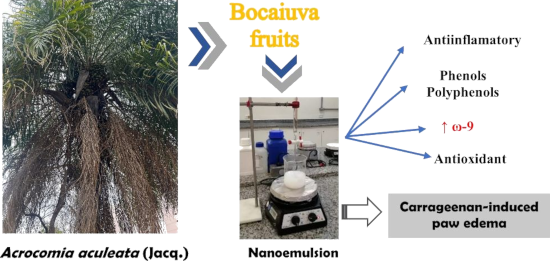
- speed was set at 2,500 mL/min. The composition (in percent) was calculated using the peak normalization method. Preparation of nanoemulsions Acrocomia aculeata oil nanoemulsions were prepared using the phase inversion method [61][62]. The formulations comprised 5% w/w bocaiúva oil, 5% surfactants (Span


Hydrogels and nanogels: effectiveness in dermal applications
Beilstein J. Nanotechnol. 2025, 16, 1216–1233, doi:10.3762/bjnano.16.90
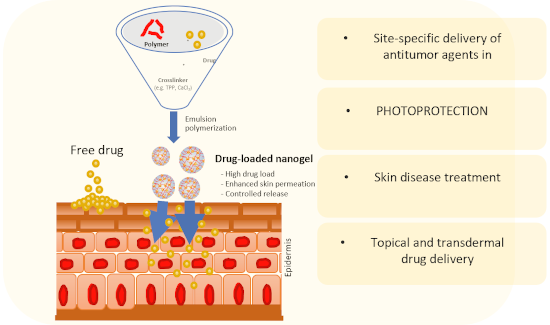
- become attractive due to their high biocompatibility and long circulating time in the blood, as well as low cytotoxicity [73]. They can be prepared by various methods, including phase inversion [73], copolymerization [110][111], and double chemical cross-linking reaction [51]. Cellulose derivatives, such


A review of metal-organic frameworks and polymers in mixed matrix membranes for CO2 capture
Beilstein J. Nanotechnol. 2025, 16, 155–186, doi:10.3762/bjnano.16.14
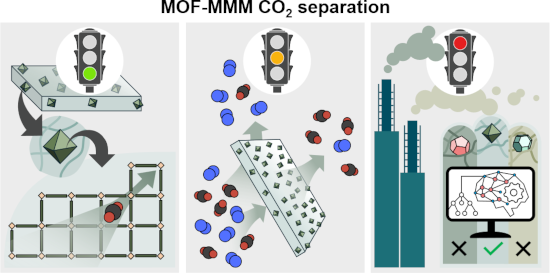
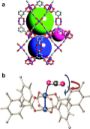
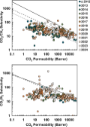
- a thin layer atop a polymer support. Solvent removal following casting yields the finalized MOF-based MMM. This casting method is simple and cost-effective but is primarily relevant in small-scale applications. Asymmetric membranes can alternatively be prepared via phase inversion, where the




Polymer nanoparticles from low-energy nanoemulsions for biomedical applications
Beilstein J. Nanotechnol. 2023, 14, 339–350, doi:10.3762/bjnano.14.29
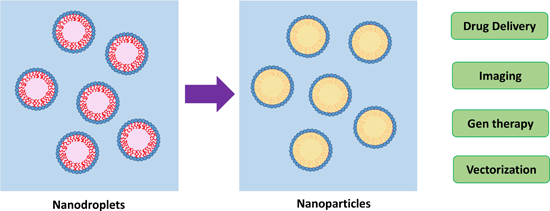
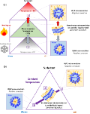
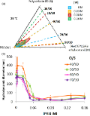
- , particularly by the phase inversion composition method, and the use of these nanoemulsions as templates for the preparation of polymer nanoparticles for biomedical applications are reviewed. The methods of preparation, nature of the components in the formulation, and their impact on the physicochemical
- , nanoparticle concentration, surface functionalization, and the type of polymers that can be processed. Keywords: ethyl cellulose; nanoemulsions; nanomedicine; phase inversion composition (PIC) method; PLGA; polymer nanoparticles; polyuria; polyurethane; surfactants; Review 1 Introduction The field of
- research on the fabrication of polymer nanoparticles from low-energy nanoemulsions, focusing on phase inversion composition. We particularly emphasize their biomedical applications as drug carriers. 2 Nanoemulsions Nanoemulsions are constituted by nanoscale droplets (20–200 nm) dispersed in a continuous




A comprehensive review on electrospun nanohybrid membranes for wastewater treatment
Beilstein J. Nanotechnol. 2022, 13, 137–159, doi:10.3762/bjnano.13.10
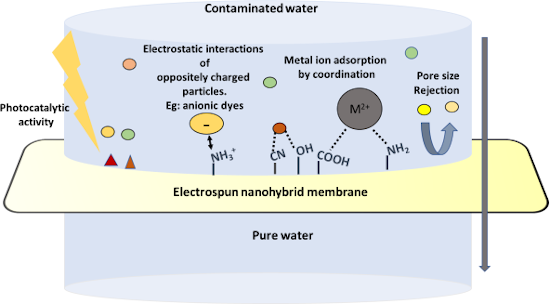
- , and phase inversion [1] to fabricate porous nanomembranes, electrospinning is a straightforward emerging technology that uses electrostatic forces to produce ultrathin fibers with diameters at the nanometer scale. In comparison to the membranes developed via other methodologies, electrospinning
- purification and treatment. The electrospun membranes have shown potential to overcome the bottlenecks of conventional membranes used in water purification, fabricated by techniques such as phase inversion, sintering, stretching, and track-etching. For instance, sintering and stretching, which are commonly




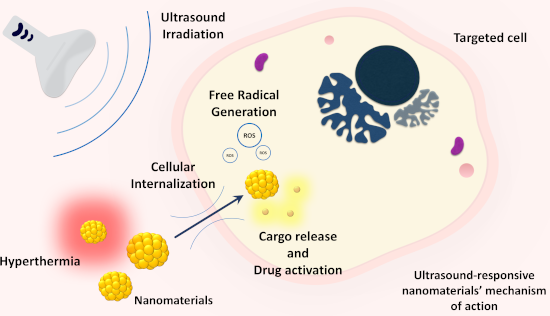
Comprehensive review on ultrasound-responsive theranostic nanomaterials: mechanisms, structures and medical applications
Beilstein J. Nanotechnol. 2021, 12, 808–862, doi:10.3762/bjnano.12.64


Phase inversion-based nanoemulsions of medium chain triglyceride as potential drug delivery system for parenteral applications
Beilstein J. Nanotechnol. 2020, 11, 213–224, doi:10.3762/bjnano.11.16
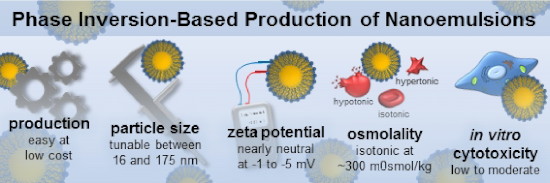
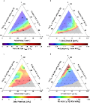
- with droplets of very small diameter (<100 nm), we investigated thermotropic phase transitions as an alternative to the standard procedure of high-pressure homogenization. Employing shock dilution with ice-cold water during the phase inversion gives the opportunity to produce nanoemulsions without any
- Kolliphor HS 15. The experimental results indicate, that nanoemulsions with particles of small and tunable size can be easily formed without homogenization by thermal cycling. Keywords: cellular toxicity; isotonicity; nanoemulsion; phase inversion; solvent free; surface properties; Introduction Nanoscaled
- as the flexibility of the nanoparticles [6][7][8][9]. Shock dilution with ice-cold water during phase inversion of the emulsion gives the opportunity to produce nanocapsules without the use of any potentially toxic organic solvent at low energy cost [10][11]. The choice and the amount of the




Block copolymers for designing nanostructured porous coatings
Beilstein J. Nanotechnol. 2018, 9, 2332–2344, doi:10.3762/bjnano.9.218
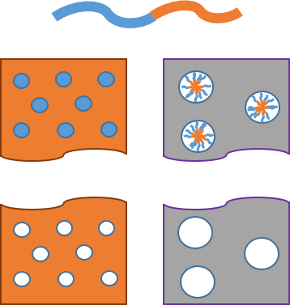
- water at room temperature as coagulant was reported. In this study, the PS-b-PEO BC membranes were obtained by a phase-inversion process starting from a solution of a DMAc/THF/sulfolane solvent mixture and by immersing the casting films in deionized water at room temperature. By comparison with





