


Search results
Search for "phase noise" in Full Text gives 3 result(s) in Beilstein Journal of Nanotechnology.
Terahertz-range on-chip local oscillator based on Josephson junction arrays for superconducting quantum-limited receivers
Beilstein J. Nanotechnol. 2025, 16, 2296–2305, doi:10.3762/bjnano.16.158
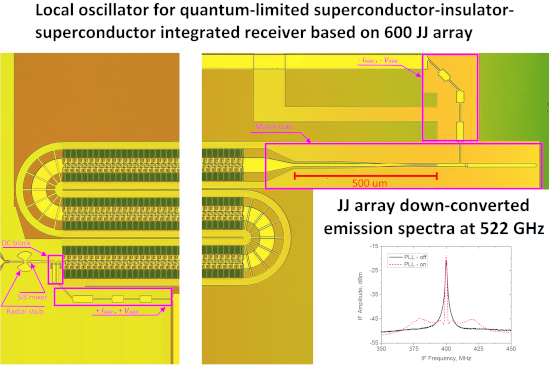
- , the linewidth becomes very small due to the elimination of the influence of both low-frequency and high-frequency noises; its measured value is determined by the resolution bandwidth of the spectrum analyzer. The detailed study of the phase noise in the PLL mode is subject for further research. The


Effective sensor properties and sensitivity considerations of a dynamic co-resonantly coupled cantilever sensor
Beilstein J. Nanotechnol. 2018, 9, 2546–2560, doi:10.3762/bjnano.9.237
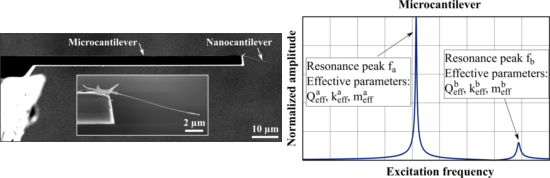
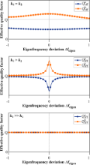
- ratio (SNR) for frequency, amplitude and phase measurements. It mainly depends on the cantilever’s quality factor which directly influences the phase noise and resolution of the resonance peak [19]. With decreasing cantilever dimensions, the quality factor usually decreases, hence, detectability
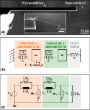

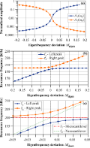

![[Graphic 7]](/bjnano/content/inline/2190-4286-9-237-i43.svg?max-width=637&scale=1.18182) ...
...


Noise performance of frequency modulation Kelvin force microscopy
Beilstein J. Nanotechnol. 2014, 5, 1–18, doi:10.3762/bjnano.5.1
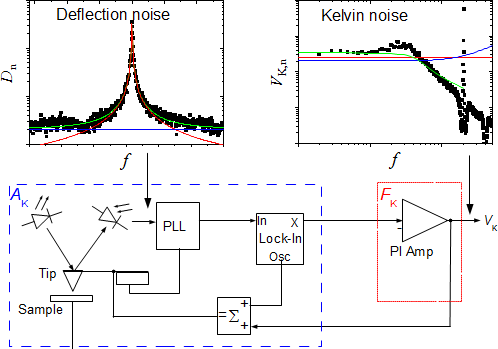
- and optimizing around randomly chosen key values. Keywords: dynamic; frequency noise; Kelvin force microscopy; noise performance; phase noise; thermal excitation; Introduction Surface potential imaging in combination with atomic force microscopy in ultrahigh vacuum is based on the measurement of
- of noise gains as in Figure 1, it is necessary to present it by a noise source inserted between blocks APLL and FPLL. We shall now calculate how the displacement noise at the photodetector output transforms into phase noise at the phase detector output, which is represented by the phase noise
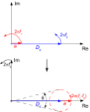
- oscillation at f but with opposite sign, and hence two vectors a at opposite difference frequencies would add arithmetically and cancel. Regarding the phase noise at a frequency fpert, the spurious superimposed oscillations are replaced by the respective noise densities at frequencies Dn(f0 ± fpert)[V





Other Beilstein-Institut Open Science Activities



