


Search results
Search for "polarization microscopy" in Full Text gives 2 result(s) in Beilstein Journal of Nanotechnology.
Deep-learning recognition and tracking of individual nanotubes in low-contrast microscopy videos
Beilstein J. Nanotechnol. 2025, 16, 1316–1324, doi:10.3762/bjnano.16.96
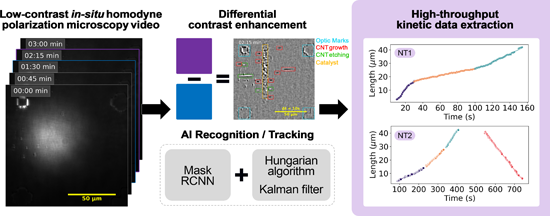
- Vladimir Pimonov Said Tahir Vincent Jourdain Laboratoire Charles Coulomb, Univ Montpellier, CNRS, Montpellier, France 10.3762/bjnano.16.96 Abstract This study addresses the challenge of analyzing the growth kinetics of carbon nanotubes using in situ homodyne polarization microscopy (HPM) by
- ; polarization microscopy; Introduction Carbon nanotubes (CNTs), discovered over three decades ago, continue to present unresolved questions and challenges. Their exceptional properties, both theoretically [1][2] and experimentally demonstrated [3], make them desirable for electronic and optical devices
- selectivity, particularly kinetic selectivity. To address this, we developed a method based on in situ homodyne polarization microscopy (HPM), which is highly sensitive and can detect changes in optical absorption caused by a single carbon nanotube. The technique allows for imaging tens to hundreds of


Dynamic behavior of nematic liquid crystal mixtures with quantum dots in electric fields
Beilstein J. Nanotechnol. 2018, 9, 399–406, doi:10.3762/bjnano.9.39

- was checked by using polarization microscopy. The mass concentration was 0.89%, which led to a volumetric fraction of 1.16% (the QD density is 0.87 g/cm3 and the density of 5CB is 1.02 g/cm3). The mixture was used to fill a 15 μm thick planar aligned cell from Instek, which was mounted in a holder


Other Beilstein-Institut Open Science Activities



