


Search results
Search for "tumour microenvironment" in Full Text gives 6 result(s) in Beilstein Journal of Nanotechnology.
From shield to spear: Charge-reversible nanocarriers in overcoming cancer therapy barriers
Beilstein J. Nanotechnol. 2026, 17, 159–175, doi:10.3762/bjnano.17.10
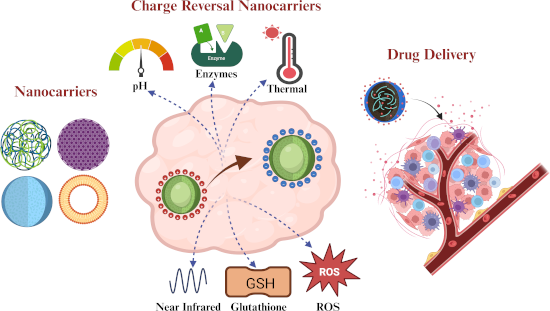
- outcomes over traditional approaches. Among these innovations, charge-reversible nanocarriers have attracted considerable attention due to their ability to overcome physiological and pathological barriers in the tumour microenvironment (TME) by altering their surface charge in response to specific stimuli
- therapies (e.g., immunotherapy) underscore the transformative potential of charge-reversible nanocarriers in revolutionising cancer treatment and improving patient outcomes. Keywords: cancer; charge reversible nanocarriers; nanocarriers; targeted therapy; tumour microenvironment; Review 1 Introduction
- ) [15]. These systems can switch their surface charge in response to tumour microenvironment (TME) triggers such as pH changes, redox states, or enzymatic activity, enhancing drug stability, facilitating cellular uptake, and enabling targeted drug release. This responsive functionality gives CR-NDDSs a


Synthetic-polymer-assisted antisense oligonucleotide delivery: targeted approaches for precision disease treatment
Beilstein J. Nanotechnol. 2025, 16, 435–463, doi:10.3762/bjnano.16.34


Brome mosaic virus-like particles as siRNA nanocarriers for biomedical purposes
Beilstein J. Nanotechnol. 2020, 11, 372–382, doi:10.3762/bjnano.11.28
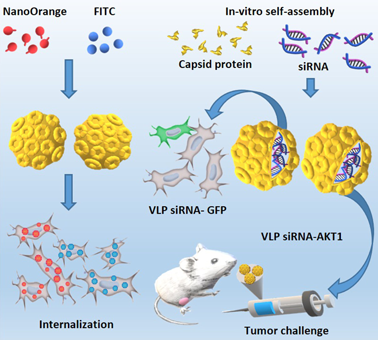
- CPMV-VLPs show greater inhibition of the tumor than using a highly immunogenic agent such as lipopolysaccharide (LPS), poly (I: C), and DMXAA 47. It seems that CCMV regulates the tumour microenvironment similarly to the CPMV virus [57]. The virus could induce the polarization of macrophages by


Enhanced antineoplastic/therapeutic efficacy using 5-fluorouracil-loaded calcium phosphate nanoparticles
Beilstein J. Nanotechnol. 2018, 9, 2499–2515, doi:10.3762/bjnano.9.233
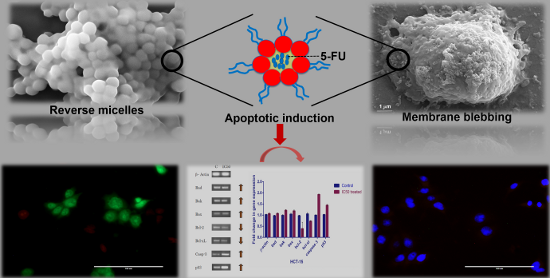
- the rate of 5-FU release from CaP@5-FU NPs, we employed the dialysis bag method. An acidic (in vitro model for the tumour microenvironment) condition correlates with drug release in the acidic tumour regime. On the other hand, physiological conditions at pH 7.4 represent the healthy cell environment
- acidic pH conditions (Figure 1C). At the end of the study (i.e., 60 h), the release was 72% and 52% in acidic and physiological pH, respectively. This experiment demonstrates that the drug 5-FU can be effectively released into a tumour microenvironment from CaP@5-FU NPs, rather than into healthy cells
- . The enhanced accumulation of the drug in acidic pH correlates with the characteristic release profile in the tumour microenvironment [28]. This can be explained by the hydrogen-bonding interaction between the drug and nanoparticles, which might be strong in physiological pH (pH 7.4) and exhibits


Nanoparticle delivery to metastatic breast cancer cells by nanoengineered mesenchymal stem cells
Beilstein J. Nanotechnol. 2018, 9, 321–332, doi:10.3762/bjnano.9.32
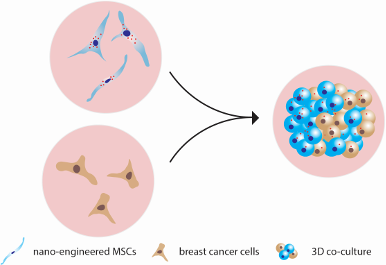
- downstream activation of the MAPK pathway [12]. QD-loaded MSCs have shown to migrate towards tumours and metastases in human breast tumour bearing mice [13]. It is generally accepted that 3D cell cultures are more similar to the composition of tumour microenvironment in vivo compared with 2D cell cultures
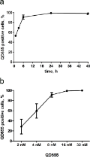
- study simulate tumour microenvironment conditions in vivo and allow the evaluation of nanoparticle transfer between different cell types. The most important finding in the current 3D co-culture model is that intercellular QD delivery occurs between nanoengineered MSCs and breast cancer cells. The



Nano-engineered skin mesenchymal stem cells: potential vehicles for tumour-targeted quantum-dot delivery
Beilstein J. Nanotechnol. 2017, 8, 1218–1230, doi:10.3762/bjnano.8.123
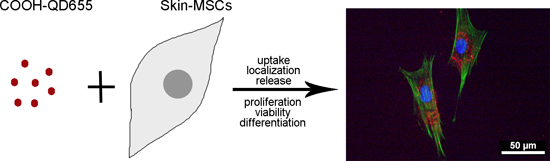
- therapeutic nano-agents [24]. Studies on melanoma [25], prostate cancer [26], breast cancer [6] and lung cancer [27] have shown the ability of MSCs to home to cancer sites in vivo. In the tumour microenvironment, MSCs play a role in the formation of the tumour stroma and support cancer metastasis [28
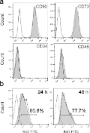
- ]. Therefore, skin-derived MSCs could serve as an appropriate model to study the stem cell (SC) tumour microenvironment and design SC-targeted therapeutics. In the present study, we addressed whether QD-loaded skin MSCs could serve as vectors to deliver NPs to cancer sites. To answer this question, the
- ]. Altogether, we propose several reasons why QD-labelled skin MSCs could serve as a promising NP delivery vector. First, QD labelling would enable MSC tracking and visualization of the tumour microenvironment. Next, the cells in the tumour would take up the released QDs and then the formation of ROS could be





Other Beilstein-Institut Open Science Activities



