


Search results
Search for "vortex dynamics" in Full Text gives 3 result(s) in Beilstein Journal of Nanotechnology.
Superconducting artificial neural networks and quantum circuits
Beilstein J. Nanotechnol. 2026, 17, 744–747, doi:10.3762/bjnano.17.51

- triplet pairing [30], and fast vortex dynamics and relaxation processes in NbRe-based heterostructures, which may serve as a basis for devices requiring ultrafast relaxation times [31]. The concept of this thematic issue emerged during the 10th International Conference on Superconductivity and Magnetism
Fast vortex dynamics and relaxation times in NbRe-based heterostructures
Beilstein J. Nanotechnol. 2026, 17, 292–302, doi:10.3762/bjnano.17.20
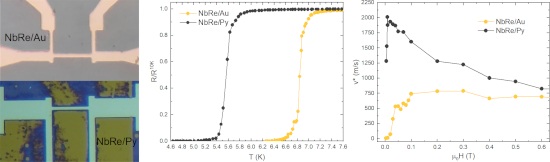
- analysis of Abrikosov vortex dynamics and flux-flow instabilities was performed in NbRe/Au and NbRe/Py bilayers to compare superconducting/normal metal (S/N) and superconducting/ferromagnetic (S/F) heterostructures based on the same superconducting layer. The heterostructures, fabricated by sputtering
- ; superconductivity; vortex dynamics; Introduction Vortex dynamics plays a central role in the electrical transport under magnetic fields in type-II superconductors and is an essential subject of research in superconductivity [1]. In inhomogeneous type-II superconductors, structural defects create pinning centers
- ]. The enhancement of vortex dynamics and the reduction of τE are strongly linked to the optimization of quasiparticle relaxation mechanisms. Excited quasiparticles can relax primarily through two processes, namely thermal electron–phonon (e–ph) interaction and electron–electron (e–e) recombination [1


TEM sample preparation of lithographically patterned permalloy nanostructures on silicon nitride membranes
Beilstein J. Nanotechnol. 2024, 15, 1–12, doi:10.3762/bjnano.15.1
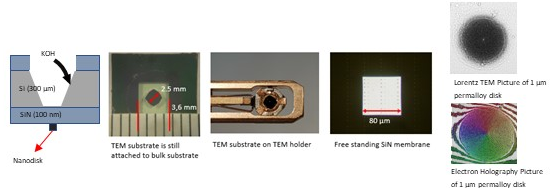
- . Finally, we observed the vortex dynamics of the Py nanodisk under magnetic fields using LTEM and off-axis electron holography. A correlation between preparation methods and the properties of the Py nanostructures was made. Keywords: electron holography; Lorentz transmission electron microscopy; magnetic


Other Beilstein-Institut Open Science Activities



