

The Groebke–Blackburn–Bienaymé reaction in its maturity: innovation and improvements since its 21st birthday (2019–2023)
Cristina Martini, Muhammad Idham Darussalam Mardjan and Andrea Basso
Beilstein J. Org. Chem. 2024, 20, 1839–1879.
https://doi.org/10.3762/bjoc.20.162
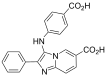

Chemical Information
Calculated using the Chemistry Development Kit 2.12
| Molecular Formula | C21H15N3O4 |
| Molecular Weight | 373.36 g/mol |
| Exact Mass | 373.1063 Da |
| InChI |
InChI=1S/C21H15N3O4/c25-20(26)14-6-9-16(10-7-14)22-19-18(13-4-2-1-3-5-13)23-17-11-8-15(21(27)28)12-24(17)19/h1-12,22H,(H,25,26)(H,27,28)
|
| InChIKey |
LSLAEYBXFZMPQJ-UHFFFAOYSA-N
|
| SMILES |
C1=CC=C(C=C1)C2=C(NC3=CC=C(C=C3)C(=O)O)N4C=C(C=CC4=N2)C(=O)O
|
| Number of Atoms | 43 |
| Number of H-Bond Acceptors | 7 |
| Number of H-Bond Donors | 3 |
| Atoms in the Largest π-System | 28 |
| XLogP | 2.2 |