This search combines search strings from the content search (i.e. "Full Text", "Author", "Title", "Abstract", or "Keywords") with "Article Type" and "Publication Date Range" using the AND operator.
Beilstein J. Org. Chem. 2026, 22, 828–837, doi:10.3762/bjoc.22.65
Graphical Abstract
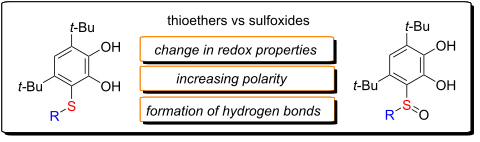
Scheme 1: Synthesis of catechol-contained thioethers 1–7 and sulfoxides 1a–7a.
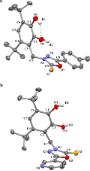
Figure 1: Molecular structures of 1a (a), 4a (b), 5a (c), 6a (d), 7a (e) (solvent molecules and fragment diso...
Figure 2: CV curves of 1 and 1a at the potential ranges: from −0.5 to 1.75 V for 1 (curve 1); from −0.5 to 1....
Scheme 2: Proposed mechanism of electrochemical transformations of catechol sulfoxides (path a – for 1a, 3a, ...
Figure 3: CV curve of 5a at the potential range from −0.50 to 1.40 V (curve 1); from −0.50 to 1.70 V (curve 2...
Figure 4: CV curves of electrolysis products of 7a at the potential ranges from 0.5 to −0.4 V (CH3CN, GC elec...
Scheme 3: Proposed mechanism of the reduction of electrogenerated o-benzoquinone.
Beilstein J. Org. Chem. 2024, 20, 2378–2391, doi:10.3762/bjoc.20.202
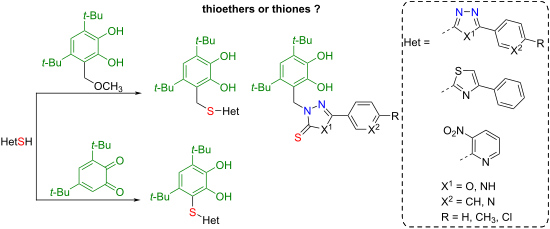
Scheme 1: Synthesis of catechol-containing compounds 1–9.
Figure 1: The X-ray structure of catechol 5 (the thermal ellipsoids of 50% probability). The hydrogen atoms e...
Figure 2: The X-ray structures of catechols 6 (a) and 8 (b) (the thermal ellipsoids of 50% probability). The ...
Figure 3: Fragment of the pack of catechol 5 in crystal (the H-bonds and π–π interactions are shown as dotted...
Figure 4: The interactions in pair of independent molecules A and B of 6 in crystal 6·0.5CH3CN (the H-bonds a...
Figure 5: Fragment of the pack of catechol 8 in crystal (the H-bonds and π–π interactions are shown as dotted...
Scheme 2: Electrochemical transformations of compounds 1–3.
Figure 6: The CV curve of 2 at the potential range from −0.50 to 1.60 V (CH3CN, GC electrode, Ag/AgCl/KCl(sat...
Figure 7: The CV curves of 3 at the potential ranges from –0.5 to 1.2 V (curve 1); from –0.5 to 2.0 V (curve ...
Figure 8: The CV curves of 7 at the potential ranges from –0.5 to 1.3 V (curve 1); from –0.5 to 1.8 V (curve ...
Scheme 3: Proposed mechanism of an electrooxidation of compounds 6–8.
Figure 9: The level of TBARS in rat liver homogenates in vitro, in the presence of compounds 1–9, Trolox, and...
Beilstein J. Org. Chem. 2020, 16, 1863–1868, doi:10.3762/bjoc.16.153
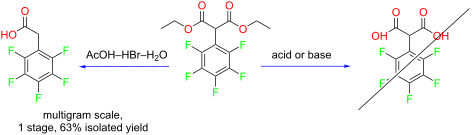
Figure 1: Phenylmalonic acids.
Scheme 1: Synthesis of diethyl 2-phenylmalonate (4).
Scheme 2: Synthesis of diethyl 2-(perfluorophenyl)malonate (3).
Figure 2: Esters of fluorine-substituted 2-phenylmalonic acids.
Scheme 3: Hydrolysis of diethyl 2-(perfluorophenyl)malonate (3).
Figure 3: Molecular structure of 2-(perfluorophenyl)acetic acid (12).
Scheme 4: Formation of 2-(perfluorophenyl)acetic acid (12).